Showing posts with label photographs. Show all posts

Monday, July 17, 2023

ANSEL ADAMS PHOTOS AT THE DE YOUNG MUSEUM, San Francisco, CA

Photo by Ansel Adams, Marin Hills from Lincoln Park, 1952

It is hard to picture the American West without thinking of Ansel Adams and his iconic black and white photos—of New Mexico, Yosemite, the San Francisco Bay area, and other places in the western US. A spectacular exhibit of 100 of Ansel Adam’s photos is currently on display at the De Young Museum in Golden Gate Park in San Francisco, California, along with the work of other photographers and artists who have been inspired by the same landscapes but interpreted them in their own way. 

At the de Young Museum, San Francisco, CA

The exhibit, called Ansel Adams In Our Time, reveals his continued relevance   “Adams’s legacy continues to inspire and provoke, influencing how we envision the landscape and serving as an urgent call to preserve our environment.”

We visited the museum with our granddaughter on a recent Sunday afternoon, reserving our timed entry tickets ahead of time. The rooms were crowded but people patiently waited their turn to get close to the photos. Only at close view can one appreciate the richness of the tones and sharpness of the images—from the range of grays in billowing clouds to the tiny cross on the top of the church in New Mexico.

The Golden Gate Before the Bridge, 1932. Photograph, gelatin silver print. Museum of Fine Arts, Boston.

Ansel Adams’ (1902-1984) grew up in San Francisco. His family home was not far from the cliffs above Seal Rocks. One of my favorite photos in the exhibit is the one he made one clear morning as storm clouds rolled in toward the Golden Gate. This was in 1932, shortly before the Golden Gate Bridge began construction. (The bridge was completed in 1937.)  He later recalled: “One beautiful storm-chasing morning I looked out the window of our San Francisco home and saw magnificent clouds rolling from the north over the Golden Gate. I grabbed the 8-by-10 equipment and drove to the end of 32nd Avenue, at the edge of Sea Cliff. I dashed along the old Cliff House railroad bed for a short distance, then down to the crest of the promontory. From there a grand view of the Golden Gate commanded me to set up the heavy tripod, attach the camera and lens, and focus on the wonderful evolving landscape of clouds.”

The photo memorializes the vastness of the landscape as it was before its intrusion by human-made objects.

The Golden Gate from Telegraph Hill, photo by Carleton E. Watkins, 1868

The exhibit also includes historical photos, including one by Carleton E. Watkins, The Golden Gate  from Telegraph Hill, 1868. In contrast to Adams’ photo, the city dominates in this view of the Golden Gate entrance to San Francisco Bay while the natural landscape fades into the mist.

Canyon de Chelly National Monument Arizona, printed 1967.

Photos like Canyon de Chelly bring the grandeur of nature to the American public,

Ferns near Kiluea Crater National Park, Hawaii, ca 1948.
while  pictures like these ferns, seen close-up, celebrate the patterns and intricacies of the natural world.

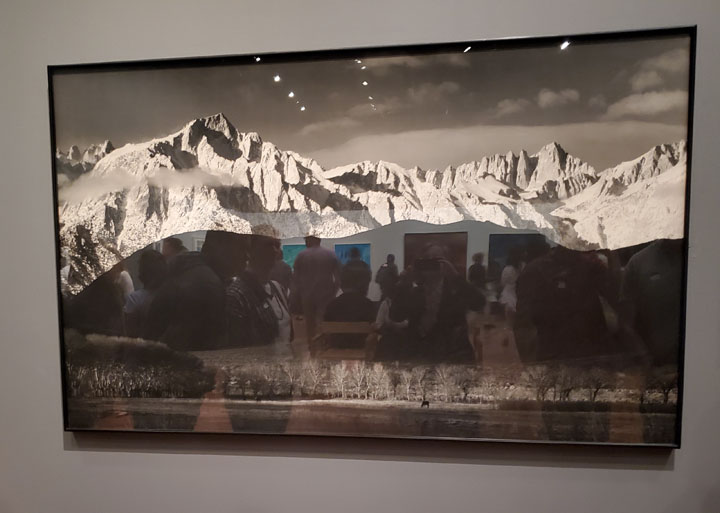
Winter Sunrise, View from Lone Pine.

Most of the photos in the exhibit are relatively small prints requiring close inspection. But in Winter Sunrise, View from Lone Pine, California, printed large and framed in glass, the reflection of the museum gallery on the dark lower slopes creates a collage uniting viewers with the art. It is why people go to museums—to enjoy a personal relationship with the art. At the top of the photo, the snowcapped peaks of the Sierras rise to the skies above the dark hills below ,and at the bottom, frost rimed trees sparkle in the morning light. If you stand to the side to eliminate the reflection, you can see the photo as Ansel Adams intended. It is a brilliant picture.

This is only a small sample of the Ansel Adams photos in the exhibit. The accompanying art work by other artists is also worth a look. The tent camera photos by Abelardo Morell, in which the ground becomes integrated with the view, are unique. I wondered how the images were merged with the photo until I read the description of the method. (See below.)

Tent-Camera photos by Abelardo Morell.

A digital camera captures the reflection of the landscape on the ground in a tent made into a pin-hole camera.

But it is the Ansel Adams photos that are the star of the show. The exhibit will be up at the De Young Museum until August 6, 2023. If you don’t get to see it in person, you can buy the book in the museum shop (which we did) and enjoy it again and again at home.

Monday, January 9, 2023

SONGO NATURE CONSERVANCY, ZIMBABWE, Guest Post by Karen Minkowski

Elephants near Lake Kariba, Zimbabwe

My friend Karen Minkowski, a frequent contributor to The Intrepid Tourist and definitely an intrepid traveler, is currently in Africa, a place that she has visited often. She spent the month of November at the Songo Conservancy site, which is several hundred miles from Victoria Falls, Zimbabwe. She begins her report: 

Woodland Kingfisher (eats lizards and insects, not fish).


I recently spent three weeks in the Songo Conservancy northeast of Victoria Falls, on the shores of Lake Kariba, volunteering for the International Anti-Poaching Foundation (IAPF).

IAPF manages lands where both legal and illegal hunting have severely reduced wildlife populations. Some of these lands border national parks and/or could serve as corridors that would allow wildlife to move between protected areas. The organization recruits and trains young women as rangers who conduct anti-poaching operations within their own communities. (Akashinga is a documentary film about the first set of female rangers trained by IAPF (you can watch it at  https://www.iapf.org/the-film).  IAPF also supports schools, clinics, legal fishing camps and conservation education. The organization was founded by a charismatic, ex-military Australian. His mission is to wipe out poaching in Africa by building communities that coexist with wildlife and have zero tolerance for poaching or other environmental crimes, whether initiated from within or from the outside. The rangers are impressive, and their salaries help support their extended families.

Celebrating after the graduation ceremony for 40 some young women who had successfully completed their training as rangers. 

A full report of Karen's activities with the Songo Conservancy organization, filled with a description of her activities and her wonderful photographs, is HERE as a PDF.  It is filled with incredible close-ups of birds--Karen is a devoted bird-watcher with patience to catch the birds at their best. Karen's text makes you feel as if you are a vicarious visitor too. Enjoy!

Hippos spend their days in the water to keep cool. They feed at night, but on cloudy days, they sometimes leave the water to graze.

I have included just a few samples of her photographs. Be sure to go to the PDF to see all of them.

Monday, June 6, 2022

IMOGEN CUNNINGHAM: A Life of Photography, Getty Museum, Los Angeles, CA

Entrance to Imogen Cunningham Retrospective at the Getty Museum, Los Angeles, California.
Two Callas (detail), photo by Imogen Cunningham

When Imogen Cunningham died June 23, 1976, at the age of 93, she was in the midst of a new project, a book about aging. (It was published after her death.) She took photographs for almost her entire life, leaving behind an incredible body of work.  A retrospective exhibit is currently at the Getty Museum in Los Angeles and, for the first time, photos from her entire career--spanning seventy years–have been mounted together, allowing us to see the development of her thought and work in relation to other photographers and artists of her time and to marvel at the depth and breadth of her work.

Imogen Cunningham, San Francisco, 1966. Photo by Edmund Teske

Art and I viewed the exhibit on a recent Saturday afternoon and were surprised that there was not a long line waiting for the monorail train for a ride from the parking lot to the museum. Then we discovered that we were supposed to have made a reservation online (a Covid rule made to limit crowds.) Luckily for us, it wasn’t very crowded that day and we were allowed to continue. The exhibit, which opened March 8, will only be up until June 12, 2022. So, if you plan to go while it is at the Getty, make sure you have a reservation. (From September 15, 2022 - January 7, 2023, the exhibit will be at the Sonoma Valley Museum of Art, Sonoma, CA.)

The Beach, San Francisco, about 1955.
Each room of the exhibit is devoted to a period in Imogen Cunningham's life–from her early years in Seattle, teaching herself how to make pictures with a camera she ordered by mail, to her marriage and years with small children that forced her to stay close to home, to her later work taking portraits and teaching to earn a living, then traveling and interacting with other photographers in the San Francisco Bay area.
Stan, San Francisco, 1959.
An important part of the exhibit is the 28 minute video interview in which Imogen Cunningham reflects on the course of her life, offering comments on particular pictures on view at the museum.
Angel Island, 1952.

The first thing you notice when you enter each room is that virtually all of the photographs are black and white. The other thing you notice is that they are small. You have to stand up close to each one to appreciate the details and range of values. The earliest photos are dark dream-like images taken with a soft-focus lens, inspired by a trip to Europe after she graduated from the University of Washington.
Mills College, about 1928.

In 1917, Cunningham moved from Washington State to the San Francisco Bay area with her husband, Roi Partridge, who had been hired at Mills College in Oakland, and began to make more sharply delineated pictures.

Amaryillis, 1933.

For the next few years, her main subjects were her children and the flowers in her garden. But Cunningham’s flower photos are not what you’d expect. Rather than beautiful blossoms, she comes in close with her camera to turn the leaves and petals into abstract shapes.
Frida Kahlo, 1931.

One room of the exhibit is devoted to Cunningham’s portrait photography, including many pictures of famous people. After her divorce in 1934, Cunningham supported herself and her family by teaching and studio photography. She also became interested in street photography–unposed pictures of people as they appeared in their daily lives. With other San Francisco area photographers she formed a group call f/64. She also joined the San Francisco Women Artists, a group organized to promote, support, and expand the role of women in the arts.
Looped-Wire Sculpture by Ruth Asawa, 1956.

Among my favorite photos in the exhibit is a close up of a piece by sculptor Ruth Asawa, organic abstract shapes constructed from what looks like wire mesh. I have admired Ruth Asawa's work at the de Young Museum in San Francisco, where the pieces hang like giant bulbous webs in the alcove next to the tower elevator.
Cornish School Trio 2, 1935.

Another photo that particularly intrigues me is a photo of a string quartet, created with double exposures on the same negative to reveal the movement of the players and suggesting the rhythm of the music. Other photos, such as Girl at Point Lobos, look almost like paintings.

Girl at Point Lobos, 1968.

One reason I like to take pictures with my phone when I go to an art exhibit is so I can enjoy and re-examine the pieces again after I go home. The above examples are just a sample of the hundreds of photos on exhibit. I recommend going to the exhibit in person so you can pick out your favorites.


Monday, July 24, 2017

POLKA DOTS: Yayoi Kusama at the Hirshhorn Museum, Washington, D.C. and Four City Tour

Inside the Hirshhorn Museum, Washington, D.C.
“Our earth is only one polka dot among a million stars in the cosmos.” Yayoi Kusama, 1968.
Polka dots were everywhere when I visited the Hirshhorn Museum in Washington, D.C. in April and peeked through the open doors to the crowded galleries exhibiting the amazing artwork by this 87 year old Japanese artist.
Video of Yayoi Kusama is part of the exhibit
Infinity Mirrors at the Hirshhorn was just the first of a five city American tour of Yahoi Kusama’s amazing work. It will be at the Seattle Art Museum (June 30–Sept. 10, 2017), The Broad in Los Angeles (October 2017–January 2018), the Art Gallery of Ontario (March–May 2018) and the Cleveland Museum of Art (July–October 2018). It is a show not to be missed.
Paintings and whimsical sculptures
The Hirshhorn Museum of Contemporary Art is one of the nation's many Smithsonian museums.To quote the Smithsonian news release: “Yayoi Kusama: Infinity Mirrors” provides visitors with the unique opportunity to experience six of Kusama’s most iconic kaleidoscopic environments at once, alongside large-scale, whimsical installations and key paintings, sculptures and works on paper from the early 1950s to the present. It also marks the North American debut of numerous new works by the 87-year-old artist, who is still actively creating in her Tokyo studio.”
Looking into the Obliteration Room, where visitors apply multicolored stickers to walls and furniture
Tickets were so popular that I was not able to get one for my short stay in Washington. Luckily, the design of the Hirshhorn museum (like an oversize donut) is such that open doorways from the outer circular gallery provided a good look into the rooms where her art was displayed.
Polka dot balloons
And there was much more to see. In addition to the Kusama exhibit, there was an amazing display of orchids from the Smithsonian greenhouse on the main floor near the entrance, ranging from sprays of tiny blooms to giant flowers.
Orchids from the Smithsonian greenhouses
On the walls of the inner gallery on the second floor of the museum there were a series of large photographs of public clocks from around the world, one from every one of the world's time zones and each photo taken at exactly 1:55 p.m. It was a trip through time when time has stopped.
World Time Clock by Bettina Pousttchi
And on the third floor of the museum I viewed a varied display of modern paintings and sculptures, ranging from those by self-taught artists to pieces by many of the iconic names of the twentieth century.
Holy Mountain III, by self-taught artist Horace Pippin
So, even though I couldn’t get a Kusama ticket, my visit to the Hirshhorn was more than satisfying. And, I will get a second chance to see Infinity Mirrors when the show comes to Los Angeles in the fall.

Monday, May 16, 2016

MADISON, WISCONSIN: The State Capitol and Monona Terrace

Capital building, Madison, Wisconsin
The last time I used the word “isthmus” was in fourth grade geography. Then I went to Madison, Wisconsin, where the local alternative weekly newspaper is called The Isthmus after the narrow strip of land between Lake Mendota and Lake Monona where the downtown is located. (Two other lakes, Lake Waubesa and Lake Kegonsa, make Madison the “City of Four Lakes.”) The trip was partly for work, but Art and I also had time to visit with relatives, who gave us a tour of the city.
Madison is a city of parks and lakes
We started with a drive around the lakes and to a nature center. It was March, so the leaves had not yet come out on the trees, but it was a beautiful sunny day. We then went to the University of Wisconsin campus for a visit to the Student Union and a brief stop at the Wisconsin Historical Society for a look at its impressive high-ceilinged reading room.
Wisconsin Historical Society
After lunch we went to the Capitol building, with its classic architecture and beautifully decorated dome.
Looking up at the dome of the capital building
On the second floor, we stopped to have our picture taken with the statue of Robert M. La Follette, a former governor of Wisconsin and United States Senator from 1906 to 1925.
On the second floor of the capital building, posing in front of the bust of Robert M. La Follette
Our final stop was at Monona Terrace, Madison’s large community and convention center overlooking Lake Monona.
Inside Monona Terrace
It opened in 1997 but was originally conceived by architect Frank Lloyd Wright nearly sixty years ago. Although it was not constructed until long after his death, it includes elements of his original design. I had forgotten Wright’s connection with Wisconsin. Madison is just 30 miles from Taliesen, in Spring Green, Wisconsin, which was Wright’s home and studio from 1928 to his death in 1959.
Pedro E. Guerrero's photographs documented Wright's public works and private life
When Frank Lloyd Wright was 72 he met a young photographer, Pedro E. Guerrero. Guerrero had a remarkable ability to catch light and space in his pictures, perfectly reflecting Wright’s Prairie style. Pedro, known to Wright as “Pete”, spent the next twenty years photographing both the works and life of the architect. A number of these are displayed inside Monona Terrace in a fascinating permanent exhibit.
Wright's Romeo and Juliet Windmill, Spring Green, Wisconsin, photograph by Pedro Guerrero. The windmill was designed by Wright in 1897 for his aunts Jane and Nell Lloyd James who ran the Hillside Home School. In 1940, Wright installed a speaker connected to a record player to broadcast Bach and Beethoven to the apprentices working outside.
Although our visit to Madison was short, it was particularly meaningful for me because of my Midwest roots. I grew up in Minnesota, but I spent my summers in northern Wisconsin at Camp Bovey near Solon Springs. This is where I learned to love nature and watching wild animals, topics I often write about in my books. As a child I also traveled every year to Kenosha, Wisconsin, on the shore of Lake Michigan, to visit my grandparents and cousins. Wisconsin has many memories for me. Now I have some new ones.

Monday, September 9, 2013

De Young Art Museum, San Francisco: RICHARD DIEBENKORN, the Berkeley Years

Richard Diebenkorn photographed in his studio, at de Young Museum, San Francisco
Richard Diebenkorn, whose painterly landscapes vibrate with the rich colors of California, was a pivotal figure in American art of the mid-twentieth century and one of my favorite painters of all time.  From 1952 to 1966 he painted in his studio in Berkeley, California. The de Young Museum in San Francisco’s Golden Gate Park has mounted an exhibit of the paintings and drawings of that period in a stunning show which I went to see a few weeks ago.  (The show will be up until September 29, 2013.)

Figure on a Porch, 1959
The exhibit, which includes 131 paintings and drawings, is arranged chronologically from his earlier abstract period to his later use of figures, interiors and landscape themes. On the day we visited (a weekday during the first week of school) there were relatively few people in the exhibit which allowed both close-up and distant views.  When close-up the richness of color and three-dimensionality of the application of the paint can be appreciated.  Most of the paintings are large and when seen from across the room the overall composition becomes dominant.  Photography inside the exhibit is not allowed, but you can preview a number of the paintings here.  Among my favorites is Berkeley #44--I bought a poster so I can continue to enjoy it at home.

Photography of Rose Mandel, book by Susan Ehrens
We also went to see the exhibit of Rose Mandel photographs while we were at the museum.  She was a friend of Diebenkorn and photographed him in his studio.  Her photographs, mostly 4 x 5 inch black and white silver gelatin prints, include a series called The Errand of the Eye (from a poem by Emily Dickinson), in which she depicts close-ups of nature. In another series she went around San Francisco photographing reflections and graffiti.  The remarkable thing about her photographs is her ability to keep a sharp focus the part that she wants you to look at and let the rest of the picture be out of focus, or blurry.

A trip to the de Young would not be complete without a visit to the Tower to take in the view of San Francisco from nine stories above the ground.  Even with the fog, it is impressive.  We ate lunch in the museum café and afterward took a stroll around the outdoor sculpture garden which includes a giant safety pin, ceramic apples strewn across the lawn like over-size bowling balls, and pieces by Louise Nevelson, Barbara Hepworth and others.


Safety Pin Sculpture by Claes Oldenburg
For information about planning your visit to the museum, click here.
For more about another recent exhibit at the De Young Museum, see my post on the Girl With a Pearl Earring exhibit, June 17, 2013.

Ceramic Apples by Gustav Kraitz


Monday, August 26, 2013

WATER, FIRE, AND ICE: A Photo Tour of Iceland, Guest Post by Owen Floody


Puffin on the Latrabjarg Cliffs
In May, our friend Owen Floody went on a photo tour of Iceland.  Owen recently retired from a career of teaching and research at Bucknell University in Pennsylvania. He has always been an avid photographer and in his retirement has taken several trips that allow him to pursue his passion. Here is a short reflection on his recent trip to Iceland and a few of his amazing photographs. 


A recent 12-day photo tour (Around Iceland, Iceland Photo Tours, www.phototours.is) convinces me that Iceland fits the bill for a small, not-too-distant place that offers many and varied great sights. It is an attractive destination whether you're concerned with efficiency or not and regardless of your level of commitment to photography. Our tour took us to the far corners of Iceland, including many sites that most tourists wouldn't know of, couldn't reach, or both.  Most of these attractions were natural in some sense, though functioning or derelict buildings added to the variety.

Glacier Lagoon, Iceland
Our tour ran in late May, which probably corresponds to very late winter or early spring in Iceland.  This timing permitted us to catch the puffins and other birds in their finest breeding colors.  On the other hand, it may also have contributed to some challenging weather conditions, with frequent high winds and rain, even some hail and snow.  But we were all trying to become better photographers, so that maybe this weather constituted just another part of the instruction. 

Hraunfossar Waterfalls
What else did we see?  For the most part, think water, fire and ice.  Given the frequent rain, you may not be surprised to learn that much of our time was spent viewing some of Iceland's many impressive waterfalls.  One of my favorites was Hraunfossar, not far from Reykjavik.  This is a series of "lava waterfalls" that are strung out for some distance and incorporate much variety on their own.  Many of the waterfalls were extremely powerful, though I found myself especially attracted to the smaller falls or rapids, usually a bit downstream of the main falls. 

Lake Myvatn Thermal Area
At this point, I'm sure that you're thinking that all of this water might come in handy if the volcanoes and other thermal areas that Iceland is famous for were to spiral out of control.  Until this happens, however, Iceland's thermal areas enrich the landscape with volcanoes, other unusual landforms, steam, and lots of color.  We made three visits to the Lake Myvatn thermal area and continued to find other parts of it hidden away and offering new attractions.

Black Sand Beach
What do water and thermal activity create when combined?  Well, in Iceland, one of the products is the wonderful black-sand beaches that line part of the coast and which are especially impressive when the sea is stormy.  In a more practical vein, the water and thermal activity provide Iceland with much or all of its electricity, permitting it to avoid many or all of the financial and climatic costs of reliance on fossil fuels.

Finally, ice.  Perhaps my favorite of all Iceland's offerings were the glaciers and their offspring, the icebergs that littered the associated glacier lakes or lagoons.  Collectively, these icebergs were the ultimate chameleons: They varied in size, shape and color, and were wonderful to see in any light or weather.  What can be equally attractive when clear, blue or covered in dirt?  I think that you know the answer.

Derelict House
Though our travels in Iceland were extensive, one would have to visit at several times of the year to (a) access all parts of the island, and (b) see its many attractions under all possible weather and lighting conditions.  I plan to chip away at this on future trips.  The only problem will be that of avoiding immobilization by indecision about when and where to go next!

You can read about some of Owen's other photographic journeys in his posts of May 6, 2013 Tanzania: African Wildlife Up Close; and May 20, 2013 Nepal: Shrines, Temples and Breathtaking Scenery.