Showing posts with label India. Show all posts

Monday, April 8, 2019

HOMAGE TO SUNDIALS: Eight Year Anniversary of The Intrepid Tourist

Giant wall Sundial at Redlands University, Redlands, CA
Eight years ago I launched The Intrepid Tourist as an outlet for my travel writing. Since then I have posted a new article once a week, accumulating a whopping total of more than 500 posts--some about far away places, others much closer to home. Most are about my own travel experiences, but others are about the trips made by family and friends. I thank all my guest posters who have contributed reports of their adventures on The Intrepid Tourist and shared their personal views of the world.
Berkeley Botanical Garden, Berkeley, CA
In many of my travels, I have come across sundials and been fascinated by both their beauty and technology. In celebration of the beginning of a new year of The Intrepid Tourist I an sharing a few of my sundial photos. 
Sundial Bridge, Redding, CA
Ranging in size from the giant sundial bridge at Turtle Bay in Redding, California, to a small garden decoration sundial at the Clark Library in Los Angeles, each one has its own special character.
Sundial by Eric Gill, UCLA Clark Library garden, Los Angeles, CA
The oldest known sundial was found in Egypt found in the Valley of the Kings (c. 1500 BC). I have never been to Egypt, but in Rajasthan, India, there is a collection of nineteen architectural astronomical instruments built by the Rajput king Sawai Jai Singh II, and completed in 1734. It features the world's largest stone sundial. I visited this amazing UNESCO world Heritage site when I was in India in 2000.
Stone sun dial at Jantar Mantar, Rajasthan, India
The marker, or gnomen, at the center of the sundial casts its shadow as the sun moves across the sky and indicates the time of day. Importantly, its angle must be equivalent to the Earth's latitude at that point.
Sundial at the Santa Barbara Zoo, California at 4:00 p.m.
A simple way of telling time by the sun is with your own shadow. At the Santa Barbara Zoo, in Santa Barbara, California, is a sundial that is read by standing in the center and casting your own shadow.
Alpha and Omega Sundial in memory of Harriet M. Gale, Grinnell College, Grinnell, Iowa. Paul T. Granlund, Sculptor
At Grinnell College a sundial in the center of campus honors the wife of a retired physics professor. At the University of North Carolina, the Morehead Sundial is on a plaza near the center of campus and has an accompanying plaque that tells us exactly where we are on Earth. I love sundials. They are beautiful and functional and as long as the sun is shining, will always tell the time.
Happy 8th Anniversary to The Intrepid Tourist!
Morehead Sundial Plaque, UNC Campus, Chapel Hill, North Carolina


Monday, May 22, 2017

CYCLING THROUGH SOUTH INDIA, Part 4: Cruising the Backwaters in Kerala, Guest Post by Gretchen Woelfle


A 60km morning ride from Kochi was interrupted by another sumptuous lunch served by the sea, at the home of a chef who owned a restaurant in a nearby town. When we finally arrived at our resort on a lake, we spent the afternoon relaxing by the pool. I really appreciated the  hours we had to relax or explore each afternoon (after daily washing our cycling clothes in the bathroom sink). 
The following morning one friend and I walked to the local village temple where a ten-day festival was in progress. There were just a few people making offerings at temples, and a group of women were chanting non-stop. A man offered to show us around the complex. He was a local, but now lived in Mumbai and worked as a Bollywood cinematographer. Like many of us, he returned home for the holidays. 
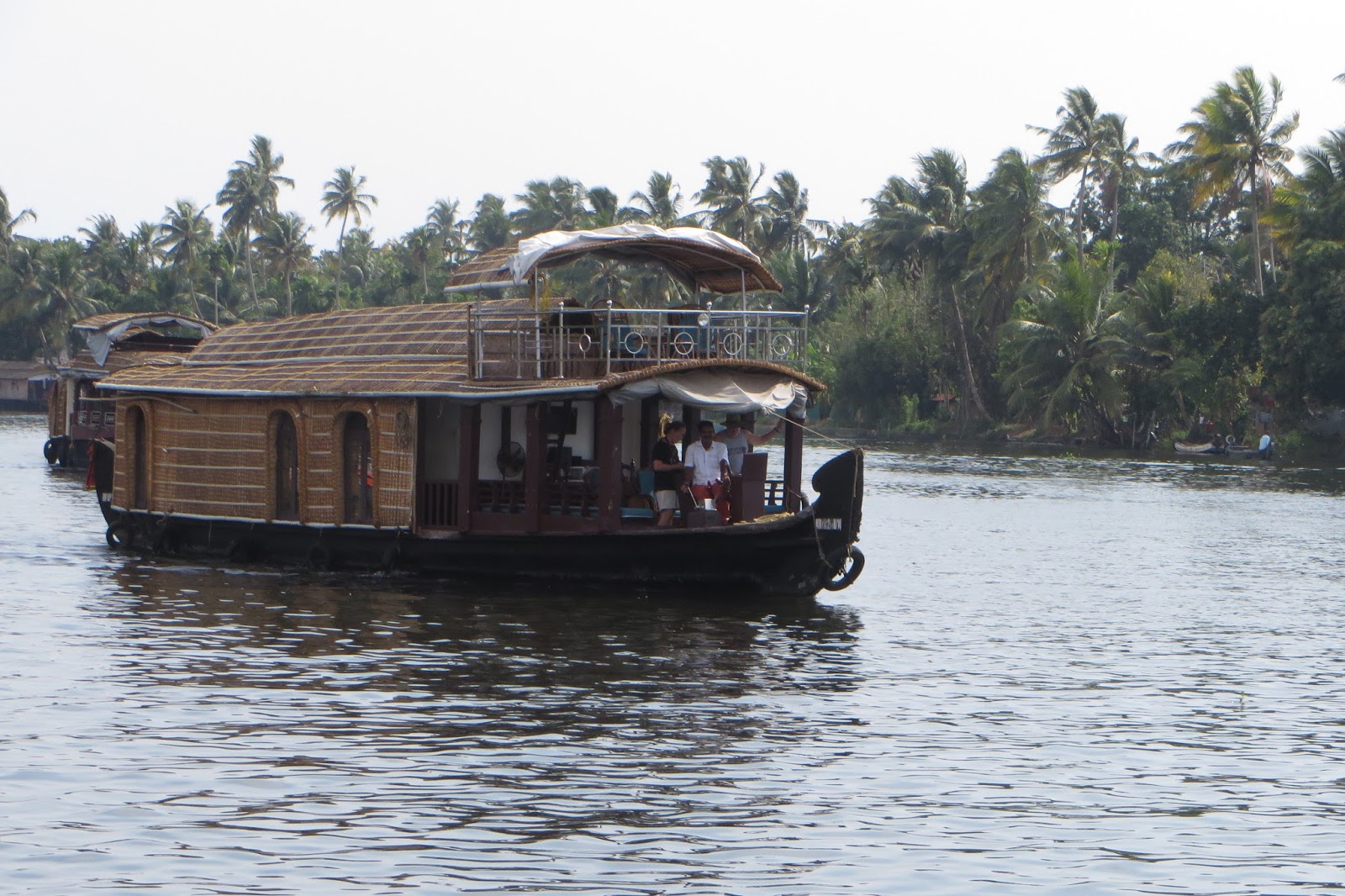
At midday we boarded our three houseboats (converted rice barges). All afternoon we cruised, at first along a wide waterway passing many sorts of boats, then along a narrow canal, passing rice paddies and small homes hugging the shore. 
A brief tropical rainstorm blew over us, then was gone. At sunset we moored the boats together and went for a walk on the canal side path.  We watched a fisherman take off for night fishing, casting his net from a small boat. We chatted with a family living by the water. 
We returned to the boats for happy hour and another sumptuous dinner as night fell on this beautiful tropical landscape.

In the morning we set off on our last and longest cycling day – 90 km (55 miles). It was flat and mostly shady and never far from the ocean breeze. 
Final destination: Varkala a popular tourist destination with a sweeping beach, vast silk emporium, a tailor who made us some tunics overnight, many small shops to spend our last rupees, and cliff-top restaurants to reminisce over the last two weeks. Varkala is full of yoga schools and Ayurveda clinics for the tourists. And so we had an Ayurvedic massage which involved generous amounts of oil and delectable body work. A just reward for all those miles on the bike. 
Cycling distances varied from 12-55 miles/day, averaging about 30 miles/day. Road conditions good, most rides on quiet back roads. Van support was always available for those who chose not to cycle. See www.exodustravels.com for more information on this and other tours.

Selected bibliography:
The God of Small Things by Arundhati Roy. This 1997 Booker-prizewinning novel takes place in Kerala.
The End of Karma: Hope and Fury Among India’s Young by Somini Sengupta. A New York Times reporter, born in India and raised in the U.S., spent several years researching this 2016 book about India today.
Kim by Rudyard Kipling. Story of a street orphan and Tibetan lama in 1890s India: a spy thriller, social commentary, and poignant coming of age story. 

Note: Go to Gretchen's posts on this blog on 4/17/2017 and 4/24/2017 for parts 1 and 2 of her South India cycling trip and 5/15/2017 for part 3.


Monday, May 15, 2017

CYCLING THROUGH SOUTH INDIA, Part 3: KOCHI, KERALA, Guest Post by Gretchen Woelfle


Drying fish, Kerala, India
You’ll find Kerala on the southwestern tip of the Indian sub-continent. Legend has it that St. Thomas came evangelizing in 52 CE, but historical evidence favors the Portuguese who formed an alliance with the local king and built a fort at Cochin (now called Kochi) in 1503. 
 
Our three guides
The spice trade, for which Kerala is still famous, lured the Europeans and today 18% of the population is Christian, 27% Muslim, and 55% Hindu. We had three guides on our cycling trip: Joseph is Christian, Shibu is Muslim, Hari is Hindu. They are the best of friends.
Sunset, Nilgiri Hills
When we descended the Nilgiri hills into Kerala we came to the Arabian Sea which brought cooling breezes to a tropical landscape. That afternoon we went swimming in the sea.  It was windy and choppy, but as warm as a bath. Fishermen still ply their trade in traditional wooden boats, but powered with motors, not sails. 
Fishing Net
We followed Joseph on a winding route of narrow lanes, passing grand homes built by Indians who work in the Gulf States and elsewhere. (Joseph’s wife, a nurse, has worked in Saudi Arabia for three years.) Then into the countryside, stopping for a festival parade of dancers and musicians, and on to the old harbor area of Kochi.
Festival dancers
Cycling down narrow alleyways we reach a private home, climb to a roof terrace and are served a dozen courses of delicious Keralan specialties served on a banana leaf. I eat it all with my right hand, local style. After that we retreat to the shady garden of our British-era guest house to rest and digest! 
Resting at our guest house
A free day in Kochi sends me shopping with friends. We fill my extra duffel bag with carpets, wall hangings, silk tunics, and spices. 
Kathakali actors
We attend a short tourist version of a Kathakali dance, arriving early to watch actors apply their elaborate colorful makeup. Traditional performances last from dusk until dawn, with many actors dramatizing familiar legends. Kathakali plays are accompanied by percussion but no words. Actions and emotions are expressed by stylized movement, hand gestures (mudras) and very expressive faces. We saw a two-person story of a failed seduction which ended badly for the heroine (offstage). 
Sunset over the Arabian Sea in Kerala
Along with the locals, we watch the sun set over the sea. Next day, we’re back on the bikes to meet our next adventure: an overnight cruise on the backwaters of Kerala. 
Tour map
Cycling distances on this trip varied from 12-55 miles/day, averaging about 30 miles/day. Road conditions were good, most rides were on quiet back roads. Van support was always available for those who chose not to cycle. See www.exodustravels.com for more information on this and other tours.

Saris drying in the sun
Selected bibliography:
The God of Small Things by Arundhati Roy. This 1997 Booker-prizewinning novel takes place in Kerala.
The End of Karma: Hope and Fury Among India’s Young by Somini Sengupta. A New York Times reporter, born in India and raised in the U.S., spent several years researching this 2016 book about India today.
Kim by Rudyard Kipling. Story of a street orphan and Tibetan lama in 1890s India: a spy thriller, social commentary, and poignant coming of age story. One of my favorite classics.

Note: Go to Gretchen's posts on this blog on 4/17/2017 and 4/24/2017 for parts 1 and 2 of her South India cycling trip.

Monday, April 24, 2017

CYCLING THROUGH SOUTH INDIA, Part 2: Karnataka and the Nilgiri Hills, Guest Post by Gretchen Woelfle


Gretchen--ready to ride!, Mysore, India
Leaving Mysore by bicycle meant diving headlong into some of the craziest traffic I’ve ever seen. Actually, I loved the thrill of it. But I didn’t mind reaching quiet roads meandering through villages and farmlands. 
Snack stand
We attracted curious attention whenever we stopped for a (frequent) water or tea break. Our guide said that Indians assume only impecunious eccentric foreigners ride bicycles rather than travel by car or motorbike. 
Goat herd traffic jam
Along the way we stopped at a madrasa, a school where Muslim boys study the Koran. We also visited a few ancient Hindu temples. 
Hindu temple sculptures
The Muslim Mughal Empire which spread over most of India in the 17th century destroyed many Hindu temples in the north. But the empire never reached the far south of the country, and so the ancient compounds, covered in beautiful elaborate relief sculpture have been preserved. 
Monkeys in the trees
We cycled to Bandipur National Park where an evening van safari met no tigers, just monkeys and birds. But a walk next morning just across from our lodge took us a mere 100 yards away from a mother and baby elephant foraging for food.  We skirted around them, but I got only fuzzy photos.

A 13km bicycle climb (36 hairpin bends) attracted only five of our group. I joined a few others to walk up the steep slope through villages and woods. A break for tea and coconut cake at the top revived us all and we cycled on to Ooty, a former British hill station. 
Serenade by girls on the bus
In the afternoon we were joined on a steam train (from the British era) by a most entertaining group of student nurses who serenaded us with Bollywood and Indian pop songs. 
Tea pickers, Kerala
Next day we descended through the hills of the Western Ghats through lush tropical forest and tea plantations to the state of Kerala and the southwestern coast of India. More on that next week.

Tour route
Cycling distances on this trip varied from 12-55 miles/day, averaging about 30 miles/day. Road conditions were good, most rides were on quiet back roads. Van support was always available for those who chose not to cycle. See www.exodustravels.com for more information on this and other tours.

Selected bibliography:
The God of Small Things by Arundhati Roy. This 1997 Booker-prizewinning novel takes place in Kerala.
The End of Karma: Hope and Fury Among India’s Young by Somini Sengupta. A New York Times reporter, born in India and raised in the U.S., spent several years researching this 2016 book about India today.
Kim by Rudyard Kipling. Story of a street orphan and Tibetan lama in 1890s India: a spy thriller, social commentary, and poignant coming of age story. One of my favorite classics.