Showing posts with label D.C.. Show all posts

Monday, March 4, 2024

THE NATIONAL MUSEUM FOR WOMEN IN THE ARTS, Washington, D.C.: More Than Just a Museum

Oil painting by Amy Sherald at the National Museum of Women in the Arts, Washington, DC

In early February I went on a short trip to Washington DC with my husband, and while he was at his meetings, I went with a friend to museums, including the newly renovated National Museum of Women in the Arts. The artwork there, all by women, is historical/political/educational/thought provoking/fun. It ranges from pieces produced in the 16th century up to the present day--in all kinds of styles, from traditional to abstract to conceptual. The collection includes paintings, prints, ceramics, sculpture, photographs, and more, some created by recognizable names like Judy Chicago, Faith Ringgold, Berthe Morisot, Frida Kahlo, plus many more by artists I didn't know. The painting above by Amy Sherald, done in 2009, is titled "They Call Me Redbone But I'd Rather Be Strawberry Shortcake." 

Scorch Song by Alison Saar, 2022

Marriage portrait of a Bolognese noblewoman by Lavinia Fontana, 1589.

The National Museum of Women in the Arts, located in the heart of the city not far from the White House, opened in 1987. In 2021, it began major renovations and has recently reopened. As the visitor’s brochure proclaims: “NMWA is more than an art museum. We aim to create gender equity in the arts.”

One of four posters by the Guerrilla Girls on exhibit at the museum.

The museum collections include more than 8000 pieces of art. Galleries on the third and fourth floor, mezzanine, and ground floor display pieces from the permanent collection. 

Entrance to The Sky's the Limit exhibit on the second floor of the museum.

The second floor is for special exhibitions, which at the time of our visit was “The Sky’s the Limit”. (This exhibit closed February 25, 2024, shortly after my visit.) At the suggestion of the woman at the front desk where we got our tickets, we started by taking the elevator to the top, and then worked our way down.

Pregnant Nana by Niki de Saint Phalle, 1995.

The gallery exhibits are organized by theme, although it was a little hard to figure out how the themes related to some of the pieces. As usual, I took my camera and photographed many of the pieces. There's never enough time to see everything at a museum and read every label. This way, when I get home I can look at my pictures and enjoy the museum again. Here are a few of my favorite pieces.

Faience Dog covered in crochet by Joana Vasconcelos, 2005.

Yam Story, painting by Australian artist Emily Kame Kngwarreye 

Suspended Sky by April Gornik, etching and aquatint, 2005.

Young Woman in Mauve by Berthe Morisot, 1880.

Orion, acrylic painting by Alma Woodsey Thomas, 1973.

Woman in white dress seen through screen of black combs. (The Sky's the Limit)

Thirty Pieces of Silver, sculpture by Cornelia Parker (The Sky's the Limit.)

My silhouette reflected in color photo print on metallic paper by Mariah Robertson (The Sky's the Limit).

The Museum of Women in the Arts is housed in a historical building that was originally a Masonic Temple. 
On one wall of the elegant main hall/ballroom are black and white photos of prom couples through the years. When I asked at the information desk if the room had ever been used for a prom, they didn’t know, but they said that it is often rented out for weddings. The National Museum of Women in the Arts is well worth a visit the next time you are in Washington, D.C. It puts a new perspective on the role of women artists and will make you rethink your understanding of art history.

What if women ruled the world? Neon sculpture by Yael Bartana, 2016.

The museum is open Tuesday through Sunday from 10am to 5pm. Admission is $16 for adults, $13 for D.C. residents and seniors. It is free if you are under 21. For more information and directions go to the museum’s website www.nmwa.org .

At the time of our visit, NMWA did not have an onsite café. (They plan to have one in the future.) We walked two blocks down the street to a restaurant called Tatte Bakery and Cafe, and had a delicious lunch. 

Still Life of Fish and Cat by Clara Peeters, after 1620.


Monday, March 9, 2020

THE PHILLIPS COLLECTION, Washington, D.C. Part 2: What Do You Hang Over the Fireplace?

Five Brothers by Alfonso Ossorio at the Phillips Collection, Washington, D.C.
On a visit to Washington, D.C., last spring, I visited the Phillips Collection, the art museum that began as the private collection of the Duncan Phillips family and is now a premier museum of modern art. (Duncan Phillips, who founded the museum, was the grandson of wealthy banker and steel magnate, James H. Laughlin, and son of Pittsburgh window glass millionaire, Duncan Clinch Phillips.) For an overall description of the museum collection and its history, see my earlier post.
As we moved into the part of the museum that was the original Phillips house, I was struck by the way the paintings were integrated into the architecture of each room. Almost every room had a fireplace and I was interested to see how over each one a painting had been selected that fit with its color and style.
Music room, with two paintings by Piet Mondrian
One exception was in the elegant music room, where elaborate wood carvings were part of the massive fireplace design and there was no room for more art. Instead, two Mondrian paintings, set off by the dark wood paneling, had been chosen to flank the fireplace.
Here are some, but not all, of the other fireplaces and their accompanying paintings.
Shells and Fishermen by Milton Avery
Amante Series No. 10 by Manuel Neri
Sunset by Albert Groll
For information about visiting the Phillips Collection, click HERE.

Monday, May 27, 2019

THE PHILLIPS COLLECTION, Washington, D.C., Part 1: America’s First Museum of Modern Art

Detail from Auguste Renoir's Luncheon of the Boating Party at the Phillips Collection, Washington, D.C.
The Phillips Collection in Washington, DC. is not exactly off the beaten path, but many visitors to the capital do not realize the wealth of art that it contains. On our recent trip to Washington we discovered that the museum was just a few blocks from our hotel, so we went for a visit.
Music Room, Phillips Collection, Washington, D.C. Note the ornate gold ceiling.
In 1921, Duncan Phillips, and his wife, Marjorie Acker Phillips, a painter, turned the family art collection into a public museum, the Phillips Memorial Gallery, in their home near Dupont Circle in Washington, D.C. The collection soon expanded and the family moved across the street, turning over the entire house to art.
Henri Matisse, "Interior with Egyptian Curtain." The curtain is based on a Middle Eastern textile owned by the artist.
From the beginning the collection focused on “modern” art, acquiring paintings by French Impressionists such as Monet and Renois and Cubists such as Picasso and Braque. Giving equal focus to American and European artists, Phillips juxtaposed works by Winslow Homer, Thomas Eakins, Maurice Prendergast, James Abbott McNeill Whistler, and Albert Pinkham Ryder with canvases by Pierre Bonnard, Peter Ilsted and Édouard Vuillard.
Luncheon of the Boating Party by Auguste Renoir
But the painting that makes the museum famous and draws the most visitors is Renoir’s Luncheon of the Boating Party. On our recent visit to the Phillips Collection we happened upon a docent talk in which we learned the identities of all the people depicted in the painting and the history of its acquisition. (The man in the lower right corner is painter Gustave Caillobot, a friend and financial supporter of Renoir.) Phillips paid $125,000 for the painting–a sum far beyond anything that had ever been paid for a painting before. It turned out to be a good investment!

As the collection expanded over the years it became necessary to add a new wing to the museum. Every room is filled with remarkable art. One small room is devoted to four paintings by Mark Rothko, each intense canvas taking up most of each wall. Standing in the middle one feels bathed in color on every side. (It is the one room in the museum where photography is not allowed.)
Migration Series by Jacob Lawrence
Another room contains the 60 paintings of the Jacob Lawrence Immigration Series, depicting the migration of African Americans from the rural South to the urban North.. As one circles the room, it is like reading a book. In another room was a remarkable series of photographs, all taken at night and therefore very dark, but with small glimmers of light. The series traces stops on the Underground Railway as they look today.

The Phillips Collection continues to expand and in two years will be celebrating its 100th anniversary. Visiting the permanent collection is free. Special exhibits require paid tickets. We did not have time to see those.
The museum has a nice small café (where we had lunch) and a very nice gift shop. And when I went to the ground floor to the rest room, I passed an exhibit of children’s art created in a joint project of the museum and the Maryland Department of Education. Art education is so often neglected in today’s schools, so I was pleased to see the museum’s involvement in the local community.

Monday, May 20, 2019

VOTES FOR WOMEN: A PORTRAIT OF PERSISTENCE, Exhibit at the National Portrait Gallery, Washington, D.C.

Photo from the 1913 Women's March at the Capital at the entrance to the Votes for Women exhibit at the National Portrait Gallery, Washington, D.C.
In anticipation of the 100th anniversary of the 19th Amendment to the Constitution giving women the right to vote, the National Portrait Gallery in Washington, D.C. has organized a special exhibition tracing the more than 80-year movement for women to obtain the right to vote as part of the larger struggle for equality. It is called Votes for Women: A Portrait of Persistence
Map of states and women's suffrage in 1920. White indicates states with full suffrage, black no suffrage. Some states gave women limited rights to vote. The 14th Amendment gave all women the right to vote in every state.
On my recent trip to Washington, I had a chance to see the exhibit–a wonderful array of photos, videos, paintings, posters, books, pennants and much more. From a 19th century portable ballot box to a Suffragette cookbook, every object in the exhibit has a story. A few of the items that particularly fascinated me are below. But the best way to get a sense of the breadth of the exhibit is at the Google Arts and Culture website with its slide show of selected items. The accompanying book for the exhibit, Votes for Women: A Portrait for Persistence by Kate Clarke Lemay, who also curated the exhibit, is available at the museum shop and online.
Winning poster design by Bertha Margaret Boye for the San Francisco College Equal Suffrage League, 1913. It is on the cover of the exhibition book by Kate Clarke Lemay.
In 1917, women who picketed the White House and refused to pay the fine after being arrested were sent to the Occoquan jail. One of them, Natalie Gray, embroidered her name and those of fellow picketers onto this scrap of fabric as a record of their time there.
Ida B. Wells-Barnett, journalist. In 1913, at the suffrage parade in Washington, D.C., she famously refused to march in the back with the other African American women. Instead, she marched at the front of the Illinois suffrage delegation.
Belva Ann Lockwood. She was the first woman to campaign for the presidency (1884 and 1888). Her platform focused on women's rights issues, particularly suffrage, temperance, and reform for divorce and marriage laws.
In Belva Ann Lockwood's presidential campaign in 1888 she had satin ribbons with a rebus puzzle, picturing her name with images of a bell, the letter "v", a lock, and a log of wood, thereby assisting illiterate voters. Belva, a trained lawyer, testified in Congress helping to achieve the 1872 equal pay bill for government employees. Her efforts also led to legislation enabling married women in the District of Columbia to retain their property rights and the passage of a bill to empower widows to claim full guardianship of their children.
These are just a small sample of the items in this exhibit. Votes for Women: A Portrait of Persistence will be on exhibit until January 5, 2020. If you are in Washington, D.C., it is well worth a visit.

The National Portrait Gallery is part of the Smithsonian. Admission is free.
National Portrait Gallery:
8th and F Streets NW
Washington, D.C. 20001

Monday, August 28, 2017

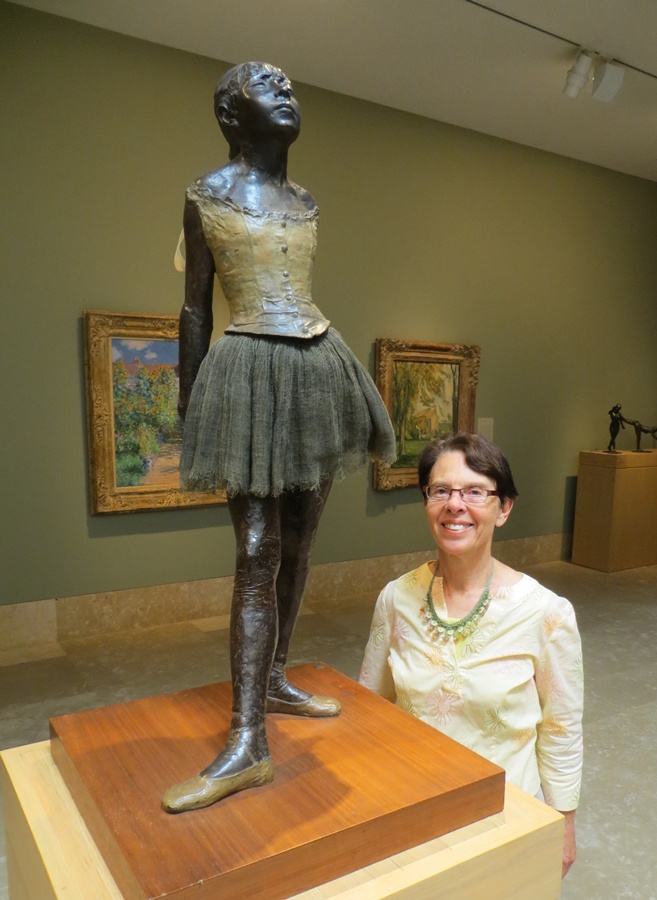
FOUR YOUNG DANCERS by Edgar Degas

Young Dancer by Edgar Degas, Art Institute of Chicago
On a recent visit to the Art Institute of Chicago, I met, once again, the famous sculpture of a young dancer by Edgar Degas. It was like meeting an old friend. In each case, her tutu was a different color, but the figure, paused in thought, was the same.
Little Dancer Age Fourteen, Musee D'Orsay
My first encounter with her was in Paris at the Musee D'Orsay in 1998.
Little Dancer, Norton Simon Museum
I then met her again a few years later in Pasadena, California, at the Norton Simon Museum.
Original Wax Sculpture of the Little Dancer, National Gallery, Washington, D.C.
And then, on a trip to Washington, D.C., three years ago, I saw her again. My previous views–in Paris, at the Norton Simon Museum in Pasadena, and in another exhibit at the National Gallery–were all casts made after his death.  This time I saw Degas’ original wax sculpture of the Little Dancer from which the casts were made, so for the first time I could see how the surface was modeled.  The figure is made of wax over a metal armature to which the artist added wood, rope, and even old paintbrushes in the arms.  Then a wig of human hair was added as well as a cotton-and-silk tutu, a cotton faille bodice, and linen slippers. Her turned out toes, erect posture and raised chin seem to convey an inner determination.The wax model of Little Dancer Aged Fourteen was on view from October 5, 2014 to January 11, 2015.
For a fascinating history of the various versions of the young dancer sculpture, click HERE.

Monday, July 31, 2017

Washington, D.C. MUSEUMS ON THE MALL

Alexander Calder mobile at the entrance to the East Wing of the National Art Museum, Washington, D.C.
Washington, D.C. is a city designed for tourists, especially around the National Mall. On a warm sunny day at the end of April I spent a day walking the Mall, visiting a number of the many museums. I took the Metro from my hotel in Bethesda, and got off at the Smithsonian station, not far from the “castle” that was the first Smithsonian museum, and now the headquarters for what has sometimes been called “our nation’s attic”. Nineteen museums and galleries, as well as the National Zoological Park, make up the Smithsonian museums and eleven are on the National Mall, the park that runs between the Lincoln Memorial and the United States Capitol. Obviously, I did not have time to visit all of them in one day, but I did stop in at several.
Brushstroke, sculpture by Roy Lichtenstein in front of Hirshhorn Museum
 My focus for the day was art museums, the first being the Hirshhorn Museum, which specializes in contemporary art and was featuring a large exhibit by the Japanese artist Yayoi Kusama called Infinity Mirrors. (See my post for last week.) In a futuristic looking building, shaped like a giant donut, the galleries form a circle around a large open courtyard.
Natural History Museum viewed from Hirshhorn Museum window (dots are an extension of the Kusama exhibit)
From the upstairs windows one can look across the mall to the Natural History Museum and the Museum of American History, both favorites of mine but not on my list for the day.
Frederic Bazille was a French painter in the early days of the Impressionist movement
I then crossed the Mall and walked through the National Art Gallery, with its much more formal display of traditional art from various historic periods (including a perennial favorite, Young Dancer by Degas), for lunch at the cafeteria on the ground level. In a small gallery on that level I visited an interesting exhibit of early impressionists, focusing on the French artist Frederic Bazille.  I then rode the level walkway through the long underground corridor to the East Wing where one of the featured exhibits was of the work of sculptor Alexander Calder, with giant mobiles hanging overhead and smaller pieces displayed below.
Arthur M. Sackler Gallery of Asian Art
Then, as I circled back across the mall to the Metro Station, I stopped at two smaller museums in facing symmetrical buildings–the Museum of African Art, where I stopped to view some of the masks and to enjoy the air conditioning, and the Freer/Sackler Museum, which specializes in Asian art. The special exhibit there was of a newly discovered painting by a eighteenth century Japanese artist Kitagawa Utamaro, one of three large panels he had painted of geisha life.
In late April spring flowers were at their height in the Smithsonian gardens
All along the mall, between the museums, are many beautiful gardens, with shady paths, benches for resting, and labels to identify the plants. It was a lovely spring day and in between my museum visits it was a pleasure just to walk outdoors and enjoy the sunshine and spring flowers.

Monday, July 24, 2017

POLKA DOTS: Yayoi Kusama at the Hirshhorn Museum, Washington, D.C. and Four City Tour

Inside the Hirshhorn Museum, Washington, D.C.
“Our earth is only one polka dot among a million stars in the cosmos.” Yayoi Kusama, 1968.
Polka dots were everywhere when I visited the Hirshhorn Museum in Washington, D.C. in April and peeked through the open doors to the crowded galleries exhibiting the amazing artwork by this 87 year old Japanese artist.
Video of Yayoi Kusama is part of the exhibit
Infinity Mirrors at the Hirshhorn was just the first of a five city American tour of Yahoi Kusama’s amazing work. It will be at the Seattle Art Museum (June 30–Sept. 10, 2017), The Broad in Los Angeles (October 2017–January 2018), the Art Gallery of Ontario (March–May 2018) and the Cleveland Museum of Art (July–October 2018). It is a show not to be missed.
Paintings and whimsical sculptures
The Hirshhorn Museum of Contemporary Art is one of the nation's many Smithsonian museums.To quote the Smithsonian news release: “Yayoi Kusama: Infinity Mirrors” provides visitors with the unique opportunity to experience six of Kusama’s most iconic kaleidoscopic environments at once, alongside large-scale, whimsical installations and key paintings, sculptures and works on paper from the early 1950s to the present. It also marks the North American debut of numerous new works by the 87-year-old artist, who is still actively creating in her Tokyo studio.”
Looking into the Obliteration Room, where visitors apply multicolored stickers to walls and furniture
Tickets were so popular that I was not able to get one for my short stay in Washington. Luckily, the design of the Hirshhorn museum (like an oversize donut) is such that open doorways from the outer circular gallery provided a good look into the rooms where her art was displayed.
Polka dot balloons
And there was much more to see. In addition to the Kusama exhibit, there was an amazing display of orchids from the Smithsonian greenhouse on the main floor near the entrance, ranging from sprays of tiny blooms to giant flowers.
Orchids from the Smithsonian greenhouses
On the walls of the inner gallery on the second floor of the museum there were a series of large photographs of public clocks from around the world, one from every one of the world's time zones and each photo taken at exactly 1:55 p.m. It was a trip through time when time has stopped.
World Time Clock by Bettina Pousttchi
And on the third floor of the museum I viewed a varied display of modern paintings and sculptures, ranging from those by self-taught artists to pieces by many of the iconic names of the twentieth century.
Holy Mountain III, by self-taught artist Horace Pippin
So, even though I couldn’t get a Kusama ticket, my visit to the Hirshhorn was more than satisfying. And, I will get a second chance to see Infinity Mirrors when the show comes to Los Angeles in the fall.