Showing posts with label Golden Gate. Show all posts

Monday, July 17, 2023

ANSEL ADAMS PHOTOS AT THE DE YOUNG MUSEUM, San Francisco, CA

Photo by Ansel Adams, Marin Hills from Lincoln Park, 1952

It is hard to picture the American West without thinking of Ansel Adams and his iconic black and white photos—of New Mexico, Yosemite, the San Francisco Bay area, and other places in the western US. A spectacular exhibit of 100 of Ansel Adam’s photos is currently on display at the De Young Museum in Golden Gate Park in San Francisco, California, along with the work of other photographers and artists who have been inspired by the same landscapes but interpreted them in their own way. 

At the de Young Museum, San Francisco, CA

The exhibit, called Ansel Adams In Our Time, reveals his continued relevance   “Adams’s legacy continues to inspire and provoke, influencing how we envision the landscape and serving as an urgent call to preserve our environment.”

We visited the museum with our granddaughter on a recent Sunday afternoon, reserving our timed entry tickets ahead of time. The rooms were crowded but people patiently waited their turn to get close to the photos. Only at close view can one appreciate the richness of the tones and sharpness of the images—from the range of grays in billowing clouds to the tiny cross on the top of the church in New Mexico.

The Golden Gate Before the Bridge, 1932. Photograph, gelatin silver print. Museum of Fine Arts, Boston.

Ansel Adams’ (1902-1984) grew up in San Francisco. His family home was not far from the cliffs above Seal Rocks. One of my favorite photos in the exhibit is the one he made one clear morning as storm clouds rolled in toward the Golden Gate. This was in 1932, shortly before the Golden Gate Bridge began construction. (The bridge was completed in 1937.)  He later recalled: “One beautiful storm-chasing morning I looked out the window of our San Francisco home and saw magnificent clouds rolling from the north over the Golden Gate. I grabbed the 8-by-10 equipment and drove to the end of 32nd Avenue, at the edge of Sea Cliff. I dashed along the old Cliff House railroad bed for a short distance, then down to the crest of the promontory. From there a grand view of the Golden Gate commanded me to set up the heavy tripod, attach the camera and lens, and focus on the wonderful evolving landscape of clouds.”

The photo memorializes the vastness of the landscape as it was before its intrusion by human-made objects.

The Golden Gate from Telegraph Hill, photo by Carleton E. Watkins, 1868

The exhibit also includes historical photos, including one by Carleton E. Watkins, The Golden Gate  from Telegraph Hill, 1868. In contrast to Adams’ photo, the city dominates in this view of the Golden Gate entrance to San Francisco Bay while the natural landscape fades into the mist.

Canyon de Chelly National Monument Arizona, printed 1967.

Photos like Canyon de Chelly bring the grandeur of nature to the American public,

Ferns near Kiluea Crater National Park, Hawaii, ca 1948.
while  pictures like these ferns, seen close-up, celebrate the patterns and intricacies of the natural world.

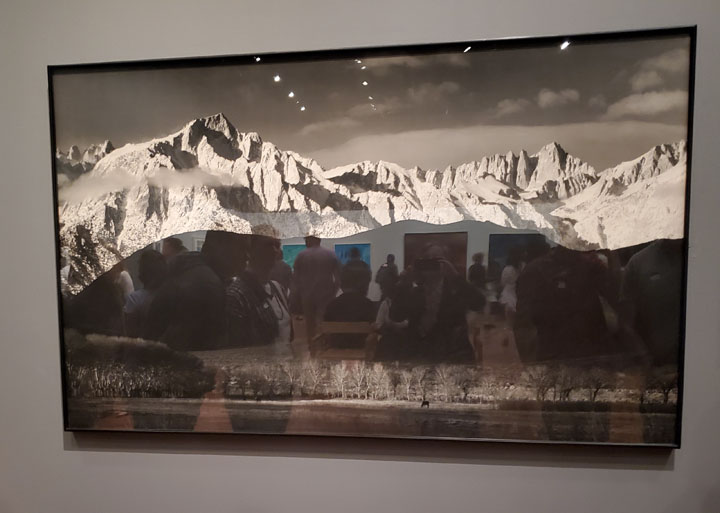
Winter Sunrise, View from Lone Pine.

Most of the photos in the exhibit are relatively small prints requiring close inspection. But in Winter Sunrise, View from Lone Pine, California, printed large and framed in glass, the reflection of the museum gallery on the dark lower slopes creates a collage uniting viewers with the art. It is why people go to museums—to enjoy a personal relationship with the art. At the top of the photo, the snowcapped peaks of the Sierras rise to the skies above the dark hills below ,and at the bottom, frost rimed trees sparkle in the morning light. If you stand to the side to eliminate the reflection, you can see the photo as Ansel Adams intended. It is a brilliant picture.

This is only a small sample of the Ansel Adams photos in the exhibit. The accompanying art work by other artists is also worth a look. The tent camera photos by Abelardo Morell, in which the ground becomes integrated with the view, are unique. I wondered how the images were merged with the photo until I read the description of the method. (See below.)

Tent-Camera photos by Abelardo Morell.

A digital camera captures the reflection of the landscape on the ground in a tent made into a pin-hole camera.

But it is the Ansel Adams photos that are the star of the show. The exhibit will be up at the De Young Museum until August 6, 2023. If you don’t get to see it in person, you can buy the book in the museum shop (which we did) and enjoy it again and again at home.

Monday, January 27, 2014

MARINE MAMMAL CENTER at the Marin Headlands,San Francisco Bay California

View from the Marine Mammal Center entrance on a foggy day.
Every year hundreds of sick and injured seals, sea lions, elephant seals, and sea otters wash up on northern California’s beaches.  If they are lucky, they are found and taken to the Marine Mammal Center on the Marin Headlands where they receive food, medical care, and when they are well enough to be on their own, are returned to the wild. Located on a hillside above the lagoon, the center is open to the public.  On a recent foggy Sunday afternoon I stopped by for a visit.

Life-size Elephant Seal Statue

The entrance to the Marine Mammal Center features life-size statues of a sea lion, elephant seal and sea otter who greet visitors, allowing one to gain an appreciation of how big these animals are and to see them up close--an opportunity one would never have with a live animal.


California sea lion resting next to the pool in its enclosure
Inside the facility a stairway (or elevator) leads to a second floor viewing platform which looks out over the outdoor enclosures where the animals are kept.  Signs caution visitors to be quiet so as not to disturb the animals.  During our visit, in mid-August, not all the enclosures were occupied, but during the pupping season in spring, when young animals get lost and separated from their mothers, the enclosures are full.  A volunteer told us that during the peak period last spring they had hundreds of animals, requiring round the clock feeding.

Whale baleen
The Marine Mammal Center is both a treatment center and an educational center.  Exhibits explain how animals are rescued,what kind of medical treatments they get, the process of reintroducing them to the wild, and the importance of keeping the ocean clean--and the danger to animals of trash, nets, and water pollution.  There are also numerous hands-on exhibits--feeling the softness of sealskin, for instance--as well as displays of animal skeletons, giant whale vertebrae and an example of whale baleen.
The Marin Headlands is located  north of San Francisco, just on the other side of the Golden Gate Bridge.  On the road to the Marine Mammal Center one has a dramatic view of the city and of the bridge. 
The Marine Mammal Center is open to the public daily from 10 a.m. to 5 p.m., except Thanksgiving, Christmas and New Year's Day. Admission is free and no reservation is required unless you have a group of 10 or more people. A well-stocked gift shop, which supports the Center, has books and ocean themed toys, shirts, and decorative objects.  The Center relies on donations for its funding. For more information about the Marine Mammal Center click here.

Monday, January 20, 2014

ALCATRAZ: Rock With a History in San Francisco Bay

Alcatraz. Tunnel and Guard Tower at Entrance to Prison Area.
I’ve been visiting the San Francisco Bay area for more than forty years, and every time I cross the Golden Gate Bridge on my way to Marin County I look to my right and see the tiny island of Alcatraz, with its infamous prison that once housed feared felons such as Al Capone and the "Birdman of Alcatraz”. Finally, a few weeks ago, on an unusually warm and sunny December day,  I went there with my family.  In the early days Alcatraz was a lighthouse and a military base. Then it was a prison. Now it is a national park.  The prison closed in 1963 after twenty-nine years as a federal penitentiary and since 1973 tours have provided the chance to visit and learn some of the island’s history.

Boarding the Ferry in San Francisco
Our tour began at Pier 33 in San Francisco (near Fisherman’s Wharf) where we caught the Alcatraz ferry. After a short ride (about 20 minutes) we landed at the Alcatraz dock where a park ranger introduced us to the island.  After that we were on our own to explore, entering the prison area through the sally port, or secure tunnel.


Building 64, once apartments for families of prison staff. The "Indians Welcome" sign is from the island's occupation by Native Americans 1969-70.
We started with a video and exhibits in Building 64--a good place to spend your time on a day when the weather is not so fine as it was for us. (San Francisco Bay is famous for its wind and fog and it was easy to appreciate how miserable life would have been for prisoners in their drafty unheated cells atop the “rock” on cold winter days.)  We then trudged up the hill to the cell block where we picked up our earphones for the audio tour (included in the price of the tour ticket.)

In preparation for our trip, I and all the kids in the family (ages 8, 10 and 12) read Gennifer Choldenko’s book Al Capone Does My Shirts, a fictional story set in the 1930s during the time that families of the prison staff lived on the island. Prisoners did the laundry for everyone on the island--thus the possibility that Al Capone, who was an inmate from 1934 to 1938, personally washed the family's clothes.  (Al Capone Shines My Shoes and Al Capone Does My Homework by the same author are also set on Alcatraz.) 


View of Alcatraz from Pier 39 in San Francisco
As we walked around the island the story came to life as we passed the apartments where people lived and the dock where children caught the boat each day to go to school on the mainland. At the top of the hill we passed the remains of the warden’s house. Like many of the buildings on the island, it burned after the prison was closed and was never rebuilt.

The audio tour of the cell block was excellent, directing us through the building with stops at critical points to tell about prison life.  The narration is by former prison guards. Several cells were furnished as they would have been–with a narrow bed, toilet and simple table and shelf.  We also visited the dining hall–meals lasted 20 minutes–and what had been the prison library.  Apparently philosophy books were among the most popular.
Prison library.  Books were delivered to inmates.
A few days before our trip to Alcatraz we watched the movie The Birdman of Alcatraz starring Burt Lancaster.  It is the true story of Robert Stroud, whose book on bird diseases, based on his study of birds while in prison in Leavenworth, Kansas, is still the definitive book on the subject.  As it turns out, though, he never had birds at Alcatraz. Stroud came to Alcatraz in 1942 and stayed there until 1952 when he was transferred to a medical facility for federal prisoners in Springfield, Missouri.

Alcatraz lighthouse, built in 1854--the first lighthouse on the West Coast. Ruins of the Warden's house are on left. The city and Bay Bridge are in the distance.

The audio tour ends near the patio outside the administration building in front of the lighthouse, where there is a spectacular view of the city of San Francisco and the Bay Bridge and Golden Gate.  But for prisoners confined to life inside their tiny cells, that view must have seemed a million miles away.

Aerial photo of Alcatraz displayed in the gift shop.
Tour information is available at Alcatraz Cruises, the official government concessioner for visits to the island. Tickets usually sell out days in advance, especially during vacation periods so it is important to plan ahead.  I bought our tickets about a month ahead of time.  Find out more about Alcatraz from the National Park Service website.

The cell house had three tiers of individual cells.
Did anyone escape from Alcatraz?
In its 29 years as a prison, 36 prisoners tried to escape; all but five were recaptured or accounted for.  Three who were unaccounted for participated in the same breakout, the June 1962 escape, immortalized in the movie Escape from Alcatraz with Clint Eastwood.

Golden Gate National Recreation Area
Alcatraz Island is just one part of the breathtaking Golden Gate National Recreation Area, one of the largest and most visited urban National Parks in the United States.

Other "Must See" Spots of the Golden Gate National Recreation Area:
Fort Mason Center
Marin Headlands 
Crissy Field
Presidio
Fort Point
Muir Woods (see my post on this blog for 12/26/11)
Sweeney and Milagra Ridges and Mori Point
Fort Funston
San Francisco National Maritime Historic Park


Support your National Parks
Get involved and preserve their beauty by visiting America’s National Parks http://www.parksconservancy.org


Monday, July 30, 2012

ANGEL ISLAND: History and Nature in the Middle of San Francisco Bay

Angel Island Ferry Landing and view of Visitor Center
Angel Island sits in the middle of San Francisco Bay, a short ferry ride from San Francisco, Oakland, or Tiburon in Marin County.  Or, if you have your own boat, you can sail over and tie up at the dock during the day and moor in the bay overnight.  Once a military base and immigration center (the West Coast equivalent of Ellis Island) Angel Island is now a state park, a natural haven that is home to birds, deer, and other wildlife, and a place where city folks can spend the day hiking and relaxing.  You can also rent kayaks,  bicycles, Segways, and scooters near the ferry landing.

In early July, Art and I met friends at Angel Island for the day.  They came on their boat and we took the ferry from Tiburon, along with a group of day camp children, who delighted in watching the gulls follow the boat and dive after the fish that were stirred up in its wake.  Later, we watched the kids trying to catch their own fish off the dock, but no one had any luck.

Camp Reynolds (West Garrison)
After arriving at the dock and meeting our friends, we followed the path past the picnic area and visitor center to the main road around the island.  We walked for about a third of the way around the island before returning for lunch.  We had a picnic, but you can also buy food at the small café at the ferry landing.

After lunch, we took the tram ride around the island, which takes about an hour and is an opportunity to hear some of the history of Angel Island and see the variety of the landscape on the different sides of the island.  The tram stopped for photos at an overlook where we had a spectacular view of the San Francisco skyline, Alcatraz, the Bay Bridge, the Golden Gate Bridge, and the Marin headlands.  We were told that if we hiked the steep trail to the top of the island on a clear day, we would get a 360 degree view of the whole San Francisco Bay area.
Angel Island Tram
We had a beautifully clear, warm, and sunny day for our visit.  But San Francisco Bay can also be quite foggy.  For ships traveling through the Golden Gate, the rocky coast around Angel Island can be a hazard. One of the stories we heard on our tram ride was about the people who operated the fog bell at the Point Knox Lighthouse on the island in the early days.  The bell was designed with a mechanism that struck it automatically.  But, one foggy day in 1906, the mechanism for the bell failed and the only person home at the time was Juliet Fish Nichols, who had become the lighthouse keeper in 1902.  The bay was full of ships bringing in supplies after the recent San Francisco earthquake and Juliet knew she had to do something to warn them to keep a safe distance from the island.  So she took a sledge hammer to hit the large bell by hand, which she continued to do for twenty hours straight until the fog lifted. Juliet later received commendation for her heroic effort.  Although the lighthouse building at Point Knox is long gone, the large bell remains as a reminder of earlier days.
View of Alcatraz and San Francisco from Angel Island
Angel Island is a great place to spend the day.  For links to ferry schedules and more information about Angel Island's history and facilities, go to the Angel Island State Park site. [Note: some services have changed since this article was written.]

For more about Juliet Nichols, her log, Angel Island, the Point Knox Lighthouse, 1906 San Francisco earthquake, and more go to https://carolinearnoldart.blogspot.com/p/extra-material-for-keeper-of-light.html .