Showing posts with label England. Show all posts

Monday, June 22, 2026

NATURAL HISTORY MUSEUM, LONDON: A Few of Our Favorites

Diplodocus dinosaur skeleton in front of the Natural History Museum, London.

On our recent trip to London, the Natural History Museum was our first stop. The museum is enormous and you can’t possibly see it all in one visit. And even if you do have time, it is best to decide which things to focus on. Our main goal was to see the exhibit of the winners of the yearly photography competition—100 photos selected from more than 4000 entries. We also wanted to revisit some of our favorite parts of the museum.

Blue whale skeleton in Hintze Hall.

We walked to the museum from our hotel near the South Kensington tube stop and entered at the East Gate, where we followed a path through the Evolution Garden to get to the Central Entrance. The museum is free, but we had to line up to go through security. Once inside, the giant skylit space of Hintze Hall loomed before us, with a huge whale skeleton hanging overhead and a grand staircase leading up to a statue of Charles Darwin.

Art with Statue of Charles Darwin.

After paying our respects to Darwin, we stopped at the information booth to pick up a map and get directions to the photo exhibit. The map divides the museum into four color coded zones. We focused on the Green Zone which includes birds, the wildlife photographer of the year gallery, fossil marine reptiles, and treasures of the museum, where we saw the fossil skeleton of Archaeopteryx, the first bird.

Caroline with fossil of giant sea reptile collected by Mary Anning.

On our way to the photo exhibit we passed by the amazing display of fossil skeletons of giant marine reptiles, many of them collected by Mary Anning in the nineteenth century. During the Dinosaur Age the oceans teemed with these huge reptiles.

Wild Photographer of the Year Gallery.

The Wildlife Photographer of the Year photo exhibit requires a ticket, which we purchased at the entrance. Each photo in the exhibit was backlighted so that it glowed in the partially darkened room and was accompanied by a label with the title, photographer’s name and other pertinent information. What surprised me was not only the diversity of the subjects and locations where they were shot, but the variety of cameras—ranging from specially designed equipment to a simple iPhone.

Photo of moth camouflaged against tree bark--taken with an iPhone.
Having worked with photographers on many of my books, I know how hard it is to get just the right shot. I appreciated a quote mounted on one wall of the exhibit: It is vital to be patient and wait for the moment that completes the story you are trying to tell, even if it takes hours or days or weeks, or sometimes even years. (Akansha Sood Singh, natural history filmmaker)

Models of two dodos. Extinct since 1681 due to overhunting, habitat loss and predation by other animals.

The exit from the photo exhibit was through the museum gift shop where it was possible to buy postcards and books of the images in the exhibit. We then visited the bird room in search of the Archaeopteryx fossil but got sidetracked by a case full of birds that have gone extinct, including the dodo, which once lived on a remote island in the Indian Ocean. Although we found a cast of Archaeopteryx in the bird room, we learned that the actual fossil, one of the most valuable items in the museum’s collection, was upstairs in the room of treasures. So we trudged up the stairs to find it.\
Fossil of Archaeopteryx embedded in limestone. You can see impressions of feathers attached to the wings.

After viewing Archaeopteryx and the other museum treasures it was time to sit down and have some refreshments, which we did in the Central Café behind the stairwell on the main floor. We had seen many of our favorites and been inspired by the photo exhibit. We’ll come back another day to see more.

Main entrance to the Natural History Museum, London.


Monday, May 18, 2026

SPRINGTIME IN LONDON: A Walk in Hyde Park

Cherry trees in bloom, Hyde Park, London.

Londoners know that it is spring when the lawns of Hyde Park suddenly turn green, daffodils and lupins emerge from the ground, and cherry trees burst into bloom. On our recent trip to London in late April, the weather was cool and sunny—a perfect time for a walk in the park, a short distance from our hotel in South Kensington.

Viburnum.

Narcissus.

We entered the park at the gate near the Serpentine Gallery and followed the walking path toward the Albert Memorial. The park is huge with separate paths for walkers, bikers, and horses. It was not hard to imagine one of the characters from the Forsyte Saga trotting by on horseback.

Sports lawn.

Large lawns and open spaces provide places for picnics, sports, and for dogs to romp. Benches are frequent and a place to rest and enjoy the view.

Cherry blossoms carpet the ground.

Everywhere we looked there were flowers in bloom. The pink blossoms of the cherry trees were at their peak--on the trees and carpeting the ground. In 2019 Japan sent 125 cherry trees to England as a gift symbolizing friendship and cultural ties.

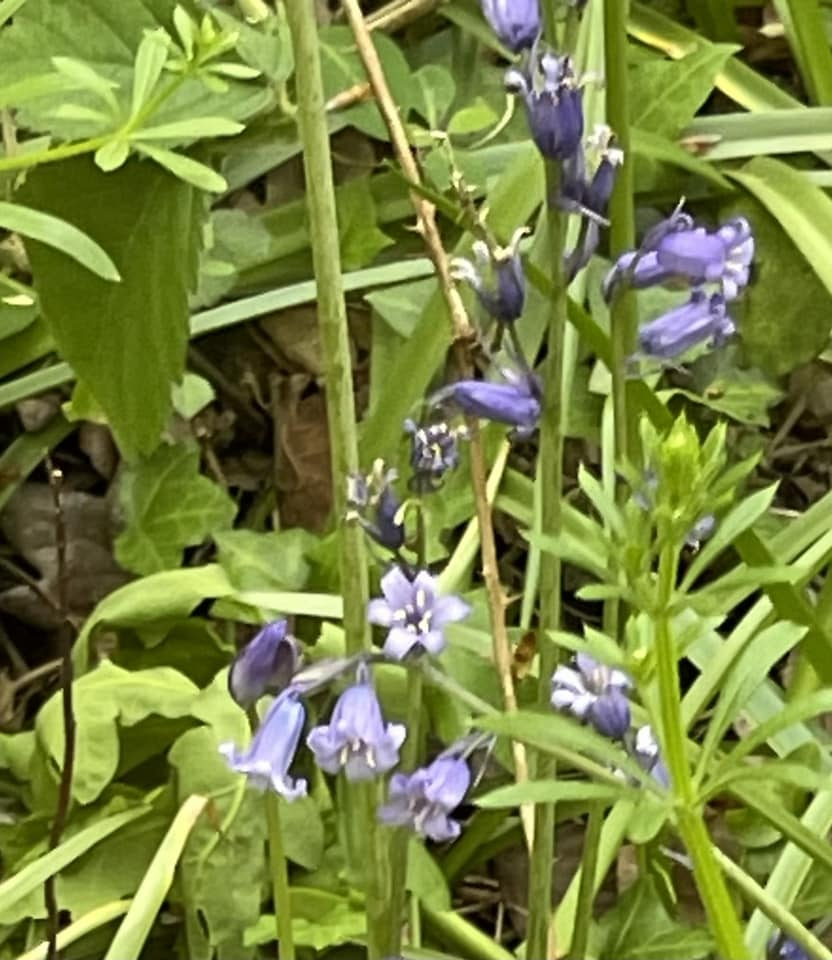
Bluebells with bee.

I spotted a bee collecting nectar from the bluebells next to the path. The next day, on a trip to visit a friend who lives just outside London, we took a walk in the woods and saw hundreds of bluebells in broad patches on the forest floor.
Bluebells on the forest floor in the town of St. Albans.

Albert Memorial.

The Albert Memorial in Hyde Park is hard to miss with its golden spire reaching 176 feet into the sky. A statue of Prince Albert, husband of Queen Victoria, sits inside the pavilion. After Albert died in 1861 at the age of 42, Queen Victoria had the monument erected in his memory. She lived another forty years!

Corner sculpture of the Albert Memorial symbolizing Europe.

Every feature of the structure is significant. At the four corners around the pavilion are large allegorical sculptures representing the arts and sciences and continents.

Albert Hall.

And across the street from the Albert Memorial is Albert Hall, London’s premiere concert hall. It was officially opened by Queen Victoria in 1871.

Mexican Orange Blossom bush.

Our walk gave us just a small taste of what Hyde Park has to offer. We didn’t have the time or energy to do more--it was our first day in London after a very long plane ride from Los Angeles. On a future trip I’d like to see the Peter Pan statue, the Speaker’s Corner, and Serpentine Lake.

Monday, December 8, 2025

ISLE OF WIGHT, A Short Hop Off the English Coast, Guest Post by Susan Kean

iew from Osborne House, Queen Victoria's summer residence.

My friend Susan Kean and her partner George recently did a two day trip to the Isle of Wight off the south coast of England.  It is the largest and second most populous English island. I thank her for sharing her thoughts and beautiful photos with The Intrepid Tourist.

Wightlink ferry.

Tuesday’s adventure included lots of Kings (and Queens)! George booked for us to spend an overnight on the Isle of Wight. 

Victoria valued family life and was very romantic.

Our first stop was Osborne House, Queen Victoria’s summer residence. An amazing place! I now understand the adjective “Victorian” much better! She seemed to love lots of ‘frills’! 

Victoria's bedroom.


Everything was elaborate.

The dining room ceiling was beyond crazy!
Dining room.
And every course had its own piece of silverware.
Place setting.
We toured the house and then the gardens. 

Walled garden with espaliered peach and fig trees.

My favorite was the walled garden. It was a way of having a protected area for growing vegetables and fruit. The walls heated up when the sun shone and meant the area could support fruit such as peaches and figs that would not normally thrive in an open garden.

Planting out garden for next spring.

After lunch in the cafe, we headed to Carisbrooke Castle where Charles 1 was kept prisoner. 

Carisbrooke Castle--a real castle!

We finally ended up in Ventnor where George had booked us into the Palace Hotel, whose claim to fame was that it is where Queen Victoria enjoyed visiting and started the concept of tea parties! 

Royal Hotel Ventnor

It was amazing--like stepping into the set of Bridgerton.

Palace Hotel dining room.

After some walking on Wednesday morning we drove to Freshwater for lunch
. Just about a perfect October day--we were able to eat lunch outside.

Freshwater.


Monday, June 23, 2025

A BEAUTIFUL SPRING DAY IN OXFORD, ENGLAND: Guest Post by Jennifer Arnold

View of Oxford from the top of the tower of St. Mary.

With many thanks to my daughter Jennifer for her excellent report of her recent trip to London with my grandson, who met her there during the spring break from his semester abroad in Madrid. They packed a lot in during the week they were in London! One beautiful spring day they escaped the hustle and bustle of the city did a trip to Oxford for the day.

Street in Oxford with typical Gothic architecture.

Oxford . Oxford is about an hour-and-a-half by train from London and makes a good day trip. We wandered around and enjoyed the beautiful gothic architecture, the famous Blackwell’s book store, St. Mary’s church, and the canal towpath. We went inside the Bodleian library’s divinity school room, which is famous in movies (e.g., it was the infirmary in the Harry Potter movies).

Gothic architecture of one of the colleges.

Printing press.

Connected to the Bodleian was a museum with several free exhibits, including this printing press from the 1800s. They had it set up so that tourists could print a sheet with an excerpt from Chaucer’s The Canterbury Tales.

Jennifer in front of the Radcliffe Camera.

The Radcliffe Camera is a famous building in Radcliffe College. As with most colleges, it was off-limits to tourists to enter. Some colleges were open to the public with advance tickets (but we didn’t arrange this).

View from the top of the tower of St. Mary.

We had to pay 6 pounds each to climb the narrow and steep staircase to the tower top, but it was very worth it. From there you could see Oxford from above in every direction.

Bridge of Sighs, Oxford

Note:
For Jennifer's report of the rest of their week in London, go to her post on June 16, 2025.


Monday, August 14, 2023

NEW FOREST AND HAMPSHIRE COUNTY SHOW, Guest Post by Susan Kean


Winning cow at the New Forest and Hampshire County Show, England

My friend Susan Kean, who has contributed to The Intrepid Tourist before, travels frequently to England to visit friends and family. On her recent trip she spent two days at the New Forest and Hampshire County Agricultural Show in southern England. I thank her for sharing her thoughts and photos.

Heifer on parade.

The first agricultural show was held in 1920 and was a celebration of the traditional agricultural lifestyle of the region. The earliest shows featured judging of cattle, pigs, goats, poultry, rabbits and vegetables. Following this were parades of cattle, horses and ponies and the day always ended with musical stalls and dancing. Today, the New Forest and Hampshire County Show is a three day event, held at the end of July. Show jumping is a major feature, with international classes held throughout the three days.

Lunch and show jumping.

Susan writes, “The highlight was a delicious lunch while watching show jumping."

Winning carrots and beets. 

She adds, "The vegetable and flower displays were also amazing”

Arrangement by the Alverstoke Floral Decoration Society.

All of these are real flowers!

Wild flower display.

The New Forest and Hampshire County Show promotes and encourages the development of agriculture, forestry, equestrianism and horticulture and encourages the improvement in the breeding of stock. It helps raise funds to support the New Forest Agricultural Show Society and other local and national charitable organizations.
 

Monday, May 29, 2023

SPRING WILDFLOWERS AND PONIES IN ENGLAND’S NEW FOREST, Guest Post by Susan Kean

Spring violets, the New Forest, England

My friend Susan Kean, an excellent photographer, recently visited the New Forest in England, when wildflowers were everywhere and new foals were frolicking in the meadows. She has graciously agreed to share some of her photographs with The Intrepid Tourist.

Meadows like this one in the New Forest are places where meadowlarks and other creatures can survive.

My favorite flower, the cowslip. They have an incredible smell.

The New Forest is one of the largest remaining tracts of unenclosed pasture land, heathland and forest in Southern England, covering southwest Hampshire and southeast Wiltshire. It was proclaimed a royal forest by William the Conqueror, featuring in the Domesday Book.

Acres of bluebells.

Susan writes: The bluebell seems to be England’s answer to the California poppy. They grow in surprising places but things have to just right for them to thrive.

Acres of gorse in New Forest.

No visit to the New Forest is complete without pony pictures. Local people (commoners, that is, people who own part of the Common land) are free to graze their animals in the New Forest. This came from the time when King William I, around 1100, established the forest as a royal hunting preserve and the people who lived there were not allowed to fence their properties. They were, however, granted rights to let their animals graze freely. Those rights are still in place today!

New Forest ponies.

Even a wet day in the New Forest was great for pony watching.
There were lots of young foals. 

Mother and foal.

This foal was very curious about me but mom kept an eye on me.
Baby foal would have come right up to me but I decided Mom might not trust me and could give me a hard kick. So I moved away.

Even ponies have to chase after their children sometimes.
For more about sightseeing in Hampshire, see Anita Withrington's guest post about the Alice in Wonderland topiary at the Hampshire Gardens and the National Motor Museum (Feb 26, 2023).

Bluebells, New Forest.