Showing posts with label museums. Show all posts

Monday, July 22, 2024

INDIGENOUS HISTORIES at the KODE MUSEUM OF ART, Bergen, Norway

Big Party (detail) by Patricia Rengifo. Indigenous Histories at the Kode Museum of Art, Bergen, Norway

On our recent trip to Norway I visited a fascinating exhibition at the Kode Museum of Art in Bergen called Indigenous Histories. With more than 285 items on display, the exhibition presents different accounts of indigenous experience from South America, North America, Oceania, and the Nordic region, through art and visual culture, curated by artists and researchers who are indigenous or of indigenous descent. It will be on view until August 25, 2024. Here are just a few examples illustrating the wide variety of items in the exhibit and where they are from.

SOUTH AMERICA

Peru

Brazil. Big Party by Patricia Rengifo


Brazil

Brazil

Peru

Brazil

Brazil

OCEANIA

Australia

Australia

Australia

Australia

New Zealand

NORTH AMERICA

Mexico

Mexico

Canada

Canada

NORDIC REGION

Norway

Norway

The Kode Museums include four art museums and three composers' homes. For more about the Kode Museums in Bergen check their website.
[Note: this post appeared at my Art and Books blog on June 22, 2024.]


Monday, July 17, 2023

ANSEL ADAMS PHOTOS AT THE DE YOUNG MUSEUM, San Francisco, CA

Photo by Ansel Adams, Marin Hills from Lincoln Park, 1952

It is hard to picture the American West without thinking of Ansel Adams and his iconic black and white photos—of New Mexico, Yosemite, the San Francisco Bay area, and other places in the western US. A spectacular exhibit of 100 of Ansel Adam’s photos is currently on display at the De Young Museum in Golden Gate Park in San Francisco, California, along with the work of other photographers and artists who have been inspired by the same landscapes but interpreted them in their own way. 

At the de Young Museum, San Francisco, CA

The exhibit, called Ansel Adams In Our Time, reveals his continued relevance   “Adams’s legacy continues to inspire and provoke, influencing how we envision the landscape and serving as an urgent call to preserve our environment.”

We visited the museum with our granddaughter on a recent Sunday afternoon, reserving our timed entry tickets ahead of time. The rooms were crowded but people patiently waited their turn to get close to the photos. Only at close view can one appreciate the richness of the tones and sharpness of the images—from the range of grays in billowing clouds to the tiny cross on the top of the church in New Mexico.

The Golden Gate Before the Bridge, 1932. Photograph, gelatin silver print. Museum of Fine Arts, Boston.

Ansel Adams’ (1902-1984) grew up in San Francisco. His family home was not far from the cliffs above Seal Rocks. One of my favorite photos in the exhibit is the one he made one clear morning as storm clouds rolled in toward the Golden Gate. This was in 1932, shortly before the Golden Gate Bridge began construction. (The bridge was completed in 1937.)  He later recalled: “One beautiful storm-chasing morning I looked out the window of our San Francisco home and saw magnificent clouds rolling from the north over the Golden Gate. I grabbed the 8-by-10 equipment and drove to the end of 32nd Avenue, at the edge of Sea Cliff. I dashed along the old Cliff House railroad bed for a short distance, then down to the crest of the promontory. From there a grand view of the Golden Gate commanded me to set up the heavy tripod, attach the camera and lens, and focus on the wonderful evolving landscape of clouds.”

The photo memorializes the vastness of the landscape as it was before its intrusion by human-made objects.

The Golden Gate from Telegraph Hill, photo by Carleton E. Watkins, 1868

The exhibit also includes historical photos, including one by Carleton E. Watkins, The Golden Gate  from Telegraph Hill, 1868. In contrast to Adams’ photo, the city dominates in this view of the Golden Gate entrance to San Francisco Bay while the natural landscape fades into the mist.

Canyon de Chelly National Monument Arizona, printed 1967.

Photos like Canyon de Chelly bring the grandeur of nature to the American public,

Ferns near Kiluea Crater National Park, Hawaii, ca 1948.
while  pictures like these ferns, seen close-up, celebrate the patterns and intricacies of the natural world.

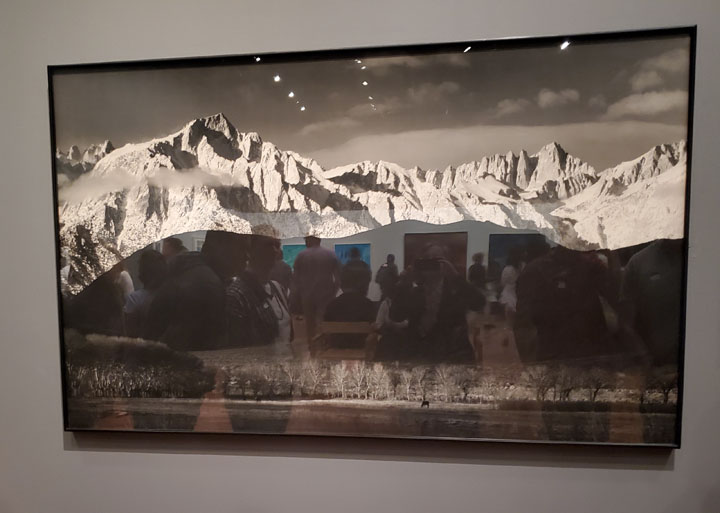
Winter Sunrise, View from Lone Pine.

Most of the photos in the exhibit are relatively small prints requiring close inspection. But in Winter Sunrise, View from Lone Pine, California, printed large and framed in glass, the reflection of the museum gallery on the dark lower slopes creates a collage uniting viewers with the art. It is why people go to museums—to enjoy a personal relationship with the art. At the top of the photo, the snowcapped peaks of the Sierras rise to the skies above the dark hills below ,and at the bottom, frost rimed trees sparkle in the morning light. If you stand to the side to eliminate the reflection, you can see the photo as Ansel Adams intended. It is a brilliant picture.

This is only a small sample of the Ansel Adams photos in the exhibit. The accompanying art work by other artists is also worth a look. The tent camera photos by Abelardo Morell, in which the ground becomes integrated with the view, are unique. I wondered how the images were merged with the photo until I read the description of the method. (See below.)

Tent-Camera photos by Abelardo Morell.

A digital camera captures the reflection of the landscape on the ground in a tent made into a pin-hole camera.

But it is the Ansel Adams photos that are the star of the show. The exhibit will be up at the De Young Museum until August 6, 2023. If you don’t get to see it in person, you can buy the book in the museum shop (which we did) and enjoy it again and again at home.

Monday, October 24, 2022

FOUR DAYS IN COPENHAGEN, DENMARK: Old and New Along the Canals

Copenhagen in Danish is Kobenhavn ("Koben Harbor")

Why Copenhagen? 1. We had never been there before. 2. We are big fans of Danish TV—Borgen, The Bridge, Seaside Hotel, The New Nurses—and 3. Copenhagen is an easy train ride to northern Germany where Art was scheduled to attend a conference in Hanover. With a nine-hour time difference between Los Angeles and Denmark, we needed a place to spend a few days to recover from jet lag before the conference started. So in early October, my husband Art and I spent four days in Copenhagen, Denmark--visiting museums, eating delicious food, immersing ourselves in Danish culture.

Drawbridge tower on the Knippel Bridge and
our hotel, the NH Collection, a modern glass structure at the side of the canal.

On our first morning, after a lavish breakfast at our hotel--eggs, meat, cheese, fruit and, of course, Danish pastries--we set out, crossing the Knippel Bridge into the center of the city. I had not previously realized that Copenhagen is a city of canals, much like Amsterdam, crisscrossed by bridges and waterways. 

Glass topped canal tour boat, Copenhagen

Tour boats circle through the canals and this seemed like a good way to get an overview of the city; so we bought tickets and joined the crowd waiting to board the next boat. The tour was narrated in English, which turns out to be the universal language in Denmark, since few people outside of Denmark speak Danish.

Colorful Nyhavn

The boat made two stops during the one-hour tour, one of them in Nyhavn, with its colorful houses, once filled with rowdy sailors, now with tourists and canal-side restaurants. 

National Library, its windows reflecting the water and  a passing ferry.

Among the other sites we saw in the course of our boat tour were: the Queen’s residence; the Opera House (where we were told a diving competition is held once a year from its roof overhanging the canal); the Little Mermaid (less impressive than in pictures); rows of old warehouses, now turned into expensive apartments; the National Library (known as the Black Diamond because of the way light from the water sparkles off the dark glass). Later that day we visited the library, taking an elevator to the top to view the canal from the inside.

Display of the Royal Copenhagen Christmas plates.

In the center of the city, two long streets lined with shops are dedicated to pedestrians. While shopping was not our goal, we were drawn into the Royal Copenhagen Porcelain shop, where we discovered a display of the classic Danish Christmas plates. We have three (from 1967, 1970 and 1972)—they hang in our kitchen at home—given to us by Art’s aunt, Carolyn T. Arnold, who collected them on her trips around the world. (Portions of Aunt Carolyn's travel memoir have appeared on this blog.)

View from the top of the Round Tower, with the bridge connecting Denmark to Sweden in the distance.

Also in the city center is the Round Tower, where from the top one gets a 360 view of the city--a sea of tile-topped roofs punctuated by skinny, church steeples. Tourists walk to the top of the tower, but King Frederick famously rode his horse up the ramp.

Danish Design Museum. Model of collapseable housing for use in emergency centers. Exhibits at the museum include both state-of-the-art products made with new materials as well as historic examples of fabrics, furniture, and so on.

Over the next three days we visited several museums, including the Danish Design Museum; the old Natural History Museum, which was featuring an exhibit of Neanderthal discoveries; the Palm House and Butterfly House at the Botanical Garden; and the National Historical Museum, with exhibits beginning with prehistory and progressing to Vikings and beyond. 

Meteorite in courtyard of Natural History Museum. Inside was a Neanderthal Exhibit

At all of the museums, helpful explanatory labels were in both Danish and English.
At the Butterfly House in the Botanical Garden.

We devoted a whole day to the Louisiana Modern Art museum, a forty-minute train ride north of Copenhagen—worth its own blogpost.  It, like all of the museums, has a nice cafe—the perfect stop for lunch or afternoon coffee.

Walkway along the canal. Copenhagen is a mix of old and new.

Copenhagen is a very walkable city. By law, all the canals must have pedestrian walkways along the side and streets through the neighborhoods generally have little traffic. However, as a pedestrian, one has to watch out for both bicycles and cars. Bicycles are a preferred mode of transport and get a separate lane on main roadways.

As a major port in the North Sea, boats and shipping are at the center of Copenhagen's history.

We dressed in layers for the cool fall weather and always carried an umbrella for the occasional shower. But overall, the weather was perfect for exploring the city. 

King Frederick on his horse.

We didn't see everything on our visit to Copenhagen (for instance, Tivoli, the famous amusement park, was closed for the season) but we got a good taste of Danish culture. At the end of our four days we knew a lot more about Denmark than before and had significantly reduced our jet lag. 

Inside the dome of the Marble Church.


Monday, August 2, 2021

Kitty Hawk, North Carolina: The Birthplace of Aviation


52 Places to Go: Week 31

Wilbur Wright, Kitty Hawk, NC
On December 17, 1903, in Kitty Hawk, North Carolina, Wilbur and Orville Wright made the first powered flight in a heavier-than-air machine. In the summer of 2008, as part of a family vacation on the Outer Banks of North Carolina, I visited Wright Brothers National Memorial at Kitty Hawk and  saw the museum that displays their airplanes, their workshop, and climbed to the top of the small hill where their historic flights were launched.
Orville Wright, Kitty Hawk, NC

Before building airplanes, the Wright brothers made and sold bicycles in Dayton, Ohio.  Their experience making bicycles helped them develop the skills they needed to build and fly airplanes.


In 1899, Wilbur and Orville began making airplanes in their bicycle shop.  Other people were also working the invention of flying machines, but no one had successfully flown one. Wilbur and Orville realized that flying a plane was similar in some ways to riding a bicycle.  It required constant small adjustments to keep it in balance.  This idea, combined with the Wright brothers skill at assembling machines, contributed to their success at creating the first airplane.

Museum at Wright Brothers National Memorial

During our visit to the museum, we listened to a presentation by one of the park service volunteers, who demonstrated how the various parts of the plane could be controlled by the pilot and keep the plane airborne.  Everyone–including all four generations of our family-- enjoyed the visit and learned things we didn’t know before.

Did you know?  On October 24, 1911, at Kitty Hawk, NC, Orville Wright established a new world soaring record in a 50 mile-per-hour wind of nine minutes and forty-five seconds.  This remained a world’s record for 10 years.

View of the Wright brothers' flight path from top of hill


Details: You can get directions and plan your trip to Kitty Hawk and the Wright Brothers National Memorial at http://www.nps.gov/wrbr/forkids/index.htm
The Wright Brothers National Memorial is operated by the U.S. National Park Service. My National Parks Pass provided free entry for everyone in our car. Check the website for current fees.

History of the Outer Banks:  click here for some nice images, history of the Kitty Hawk area and links to more information.

During the rest of our week on the Outer Banks we enjoyed swimming at the beach and in the pool of our rented house, bike riding, eating fresh local crabs, watching fiery summer thunderstorms from the safety of our porch, and basically, just relaxing.  It was the perfect place for a summer vacation!

 This article first appeared 6/18/2012.

All Text and Photos Copyright by Caroline Arnold