Showing posts with label paintings. Show all posts

Monday, July 28, 2025

BRIAN CZAJA’S MINIATURE DREAM HOUSES Guest Post by Caroline Hatton

Mini-house by Brian Czaja (31" long, 10 1/2" high)


My friend Caroline Hatton, a children’s writer and frequent contributor to this blog, met architect Brian Czaja at the 2025 Seattle Miniature Show, where she kept coming back to his display to see the mini houses he had made. All the photos in this post are courtesy of Brian Czaja.

As a lifelong fan of miniatures, I was in heaven last March at the 2025 Seattle Miniature Show. Dozens of exhibitors displayed and sold minis: finished houses, kits, building materials, tools... real-life tools (such as scissors) and mini tools (such as scissors only half an inch or 1.5 cm long), mini furniture, appliances, pots and pans, potted plants, pies and pudding, mini grab-and-go sushi deli boxes with a plastic-wrapped fortune cookie smaller than my smallest fingernail clipping...

House 1 living room.

House 1 bedroom.

My absolute favorites were the miniature contemporary homes designed, built, and furnished by Brian Czaja. Alas, visitors were not allowed to take photos in the exhibitors hall. Fortunately, Brian agreed to help me put together this blog post, so that you too can enjoy seeing his works of art.  

The three photos above show his House number 1. it is 31" (roughly 79 cm) long and 10 1/2 (roughtly 27 cm) high. The size of House 1 is 1:24 scale (one twenty-fourth of real-life size, which minieatureists also call 1/2" scale because 1 foot in real life becomes 1/2" in miniature.)  

At the show, my guess that he is a retired architect was correct! He went to Syracuse University School of Architecture in New York state, then studied and taught at the University of Bristol in England. He had his own practice in Buffalo, New York, for almost 30 years, worked for other firms in Phoenix, Arizona, for almost 20 years, then in northern California, and now lives in Salem, Oregon.

I asked him why he makes mini houses. “To keep active thinking and doing what I’ve done for a very long time,” he said. “It’s fun to design and build.” His mini houses reflect the way he has always designed, especially as a believer in simplicity.

House 2 design.

Brian begins the process with an idea and imaginary site—on a hill, by the ocean, in a meadow. He develops the idea in his sketch books until he is satisfied with what he has designed. His requirements are simple for all his designs—a house for two artists. Once the idea and design are set, he starts developing “construction drawings.” These can be quite detailed depending on the design. “Just like in the real world, you have to know how it’s going to be built.”

House 2 construction.

Once the construction drawings are finished, Brian orders materials and begins building, using his preferred woods: basswood, cherry, and red oak—only three kinds, to keep the inventory under control in his mini lumber yard. He makes all his houses from scratch, using no laser cutters or purchased windows and doors.

House 2.

When the house is done, he starts on the interior. He designs it (furniture, planters, etc.) at the same time as the house, but doesn’t make it until the last step.

House 3.

The above photo is a view of House 3 from across the pond, with the living and dining areas on the right end. The size of Houses 2-5 is 1:48 scale (one forty-eighth of real-life size, which miniaturists also call 1/4" scale because 1 foot in real life is represented by 1/4" in miniature.) 

House 3 living and dining areas.

The height of a real chair is 18" (or roughly 46 cm) to the top of the cushion. The chair height in Houses 2-5 is 3/8" (or 9.5 mm) on the 1:48 scale.

The mini paintings are scale reproductions of real-life paintings… by Brian! The man needs more than one outlet for his endless creativity.

House 4 living, dining and bedroom levels.

House 4 living room.

For House 4, Brian didn’t have to imagine on what plot of land he would build it. In his travels, he happened to spot a hillside home with ocean view and couldn’t help but dream up what house he would build there instead.

House 5 main entry.

House 5 back deck.

A big difference between Brian’s mini work and his past, real-life work is that now, he is both the architect and the client, so if he has any complaints, all he has to do is talk to himself! Seriously, this dual role allows him to take liberties, such as adding or deleting rooms as he wishes. Other pleasing differences are that things like site and weather are no problem. He can make the imaginary site fit the house and he can build in his workshop even if it’s raining or snowing outside.

I decided to write about this because many of the miniatures I have seen, including some of the finest museum pieces with plenty of character, don’t feel unique or even distinctive, so I don’t tend to remember them specifically. In contrast, Brian’s houses struck me as memorable.

To see Brian’s houses with your own eyes, consider visiting him at the upcoming Seattle Miniature Show on March 5-9, 2026.

I can’t wait to see his new creations!

Monday, June 10, 2024

EXPERIENCE AMERICA at the Smithsonian American Art Museum, Washington, D.C.

Baseball at Night, by Morris Kantor 1934, at the Smithsonian American Art Museum, Washington, DC.

In Washington, D.C., the Smithsonian American Art Museum(SAAM) shares a building with the National Portrait Gallery (to be discussed in another post). For museum goers, it’s a two-fer. And it’s free, just like other Smithsonian museums! As in many places elsewhere in Washington, this is a repurposed federal building, originally the national patent office. 

Third Floor Gallery

The four floors are packed with art, displayed in what were once offices and meeting rooms. On the third floor is a long gallery, in all its Victorian splendor, where patent applicants once displayed models of their inventions. Today, portraits of famous sports figures line the upper walls. 

Vaquero by Luis Jimenez. Modeled 1980, cast 1990.

Outside, at the G Street entrance, one is greeted by a large blue horse sculpture. Both entrances to the building lead from the street to a large covered atrium, where there are benches to sit, tables where you can sit and eat snacks from the Courtyard Café, and colorful displays of orchids from the Smithsonian plant collections. 

Orchids in the Atrium of the Museum.

I chose to start in the SAAM gallery at the west end of the first floor, which, is devoted to art from the years of the Great Depression, a time when artists enjoyed public support unlike any time before or since. The title of the exhibit: Experience America.

Entrance to the six rooms of Experience America. Valley Farms by Floss Dickinson, 1934, on left; Baseball at Night by Morris Kantor, 1934 on right.

“Many of the paintings in Experience America were created in 1934 for a pilot program designed to put artists to work; others were produced under the auspices of the WPA, which followed. The thousands of paintings, sculptures, and murals placed in schools, post offices, and other public buildings stand as a testimony to the resilience of Americans during one of the most difficult periods in our history.”

Scenes from American Life: Beach by Gertrude Goodrich, 1941-1947. Mural for Cafeteria of the old Social Security Building.

Although there are a few sculptures in the exhibit, most of the pieces are representational paintings revealing a picture of life in America at that time—from hometown baseball games and barber shop scenes, to farms, city life, and cotton pickers in the South. Here is a sample of paintings in the exhibit.

Ryder's House, by Edward Hopper, 1933.

Orilla Verde at the Rio Grande by Kay Walkingstick, 1935.

Skating in Central Park by Agnes Tait, 1934.

Grandma Moses Goes to the Big City (detail) by Grandma Moses 1946. She lived to be 101 and was 86 when she painted this..
 
In His Barbershop by Ilya Bululowsky 1934.

Sunlight and Shadow by Alan Rohan Crite, 1941.

The Experience America exhibit at SAAM is ongoing. The permanent exhibitions of SAAM feature American art from the time of the Early Republic to Modernism. I did a quick walk through the Folk and Self-Taught Art section, and the Modern and Contemporary Art on the third floor, but ran out of time and energy to see everything. I’ll have to go back to see the rest.

Suburban Post in Winter by William Gropper, 1936-37. Mural study for Freeport, New York, Post Office.


Monday, April 1, 2024

ART SHOW--PAINTINGS BY TOM SCHEAFFER, at the Maya Moon Collective, San Diego, CA

Painting by Tom Scheaffer

My brother Tom Scheaffer is currently exhibiting his beautiful paintings at the Maya Moon Collective in San Diego, California, 3349 Adams Avenue, San Diego, CA 92116. 

Tom Scheaffer dressed up as a French artist.

The opening reception, Saturday, March 23rd, 6 to 8 pm, was attended by many of Tom's friends and well wishers. Tom dressed up as a French artist, adding to the festivity of the occasion. 


Tom works in a colorful, expressionist/realistic style, depicting scenes in nature, especially of places in Southern California. His paintings are also inspired by his roots in the upper Midwest and summers in the North Woods at Camp Bovey in northern Wisconsin. Here are some samples of the paintings in the exhibit at the Maya Moon Collective.


If you are in the San Diego area, be sure to stop by to see the exhibit and have a bite to eat at the Maya Moon Cafe. The paintings will be up until the end of April.
Tom gives special thanks to George McKeever for helping him hang the show. For a few more pictures of Tom's paintings, click HERE.


Monday, September 27, 2021

LEGION OF HONOR ART MUSEUM, San Francisco, CA: Pompeii and Wangechi Mutu Exhibits

52 Places to Go: Week 39

Legion of Honor Art Museum, San Francisco, CA, modeled after the Palais de Legion de Honneur, Paris, France

The classical elegance of the Legion of Honor art museum in San Francisco sits high above the Pacific, offering a spectacular view of the Golden Gate headlands. (On the day we visited the coast was shrouded in fog, but the setting was still inspiring.) The huge permanent collection inside the museum focuses on ancient and European art, works on paper, and more, displayed in large, airy, elegant rooms.

Entrance to Last Supper in Pompeii exhibit.

In early May, my daughter and I and a friend did an excursion to the Legion of Honor to view two special exhibits--The Last Supper in Pompeii, focusing on food and drink as seen in frescoes, mosaics, artifacts and even a carbonized loaf of bread from the ruins of Pompeii; and I am Speaking, Are You Listening?, the sculptures and paintings of artist Wangechi Mutu, intriguingly placed in conjunction with Rodin sculptures and other traditional art of the museum’s permanent collection.

Rodin sculpture; sculpture and paintings by Wangechi Mutu.

The Pompeii exhibit is now closed but the Wangechi Mutu exhibit will be up until November 7, 2021. For an interview with Wangechi Mutu, click HERE. We also did a quick tour of the permanent collection, including a room full of Impressionist art. It was a great choice for my first public outing since the beginning of the pandemic. Timed entry tickets, masks and social distancing made us feel safe and allowed plenty of room to see the art both up close and at a distance. Tables in the museum cafe, where we had a delicious lunch, are also spaced apart.

A loaf of carbonized bread found in the ruins of Herculaneum. Another display showed carbonized dates, figs, pomegranates, wheat, olives, shellfish and other foodstuffs-- evidence of the wide variety of foods people at Pompeii ate.

We began our visit with the Pompeii exhibit on the ground floor of the museum. Each item was accompanied by a label with sometimes surprising explanatory information. A fresco depicting what looked like a baker at his bread stall in the market was revealed to be a Roman politician handing out free loaves of bread as he appealed for votes. 

Mosaic of sea creatures

Among my favorite items was a depiction of edible fish in a panel made of tiny mosaic tiles, “drawn” in such detail that they almost looked painted. I especially liked the octopus, having just seen the movie “My Octopus Teacher” an ode to the intelligence of this adaptable cephalopod.

Sculpture by Wangechi Mutu

Our first encounter with the Wangechi Mutu exhibit was in the museum's outer courtyard where we found large half-human/half-reptile figures flanking Rodin's Thinker. Inside the museum we found more of Wangechi Mutu's art installed side-by-side with the permanent exhibits in several of the galleries. (I had not previously appreciated the extent of the museum's Rodin collection that filled several rooms.) Using natural materials (mud, sticks, shells, stones) Wangechi Mutu's pieces seem to grow out of the earth. 

At the back of the room, behind Wangechi Mutu's figure, we see Rodin's Shades from the Gates of Hell.

Wangechi Mutu: An artist who calls both Nairobi and New York home, she moves voraciously between cultural traditions to challenge colonialist, racist, and sexist worldviews with her visionary projection of an alternate universe informed by Afrofuturism, post-humanism, and feminism. Mutu’s sprawling exhibition at the Legion of Honor, a museum built for the showcase of European art from antiquity through Impressionism presided over by Auguste Rodin's The Thinker, aims to spur “a purposeful examination of art histories, mythologies, and the techniques of archiving and remembering.” (from the museum website)

I am speaking. Are you listening?

The signature piece of the exhibit is a pair of figures facing one another, as if in conversation, I am speaking. Are you listening?  At the same time, the artist is in conversation with us, the viewers.

In this exhibit, while the contrast between old and new, traditional and experimental, is sometimes disconcerting, it makes us look at both with refreshed eyes. I didn't plan on seeing the Wangechi Mutu exhibit when i bought my Pompeii tickets, but I'm glad I did.


Monday, January 13, 2020

ART IN VENICE: Part 1, The Peggy Guggenheim Collection

Venice, Italy. In the courtyard of the Peggy Guggenheim Museum
Note: Our visit to Venice was in September 2019, before the devastating high tides that inundated many of the historic sites of the city. Although the Peggy Guggenheim museum was closed temporarily, the director posted the following statement on Instagram: “Fortunately, the museum staff is well and safe, the museum and collections are safe and have not been damaged." The following report is an overview of our visit before the floods.

Venice is an art lover's paradise. Art is everywhere you look, from the magnificent mosaics on the walls of St. Mark’s Basilica to the interiors of churches and museums, to the galleries lining the streets along the canals.
"White Cross" by Vasily Kandinsky, 1922
On our recent visit to Venice, we visited two of Venice’s most outstanding art museums, the Peggy Guggenheim Collection, with its fabulous examples of 20th century paintings and sculpture, and the Accademia Gallery, with room after room of Venetian masterpieces and more.
Entrance to the Peggy Guggenheim Collection from the Grand Canal
The paintings and sculptures in the Peggy Guggenheim museum, housed in a palace on the banks of the Grand Canal, brought back memories of my modern art courses in college--from the cubist paintings of Picasso and Braque to the surrealist art of Dali, Magritte and Miro, to the abstract expressionist art of the 1950s.
Ticket stub with map of museum.
Peggy Guggenheim, niece of Solomon Guggenheim (whose collection is in the the famous Frank Lloyd Wright designed museum in New York), began collecting art in 1938 and in 1942 opened a gallery in New York. In 1949 she bought the Palazzo Venier dei Leoni in Venice and began filling it with art. She opened it to the public in 1951.
View across the Grand Canal from the Peggy Guggenheim Museum
A temporary exhibit in the museum shows Peggy Guggenheim when she was actually living in the house. Last year was the 70th anniversary. After Peggy Guggenheim's death in 1979 her house and collection of art became part of the Solomon R. Guggenheim Foundation, established by her uncle.
Here are just a few of my favorite pieces of art in the museum.
Man Ray, "Silhouette" 1916
Joan Miro "Dutch Interior" 1928

Corneille, "The Great Solar Symphony" 1964
The chair in the corner is a piece of art--not for sitting.
I especially liked that the pictures were hung with plenty of "breathing space" so each could be enjoyed without competing with a neighbor.
Alexander Calder "Silver Bed Head" 1945-46, detail
Several pieces by sculptor Alexander Calder were on display, both mobiles and some of his smaller pieces, like "Silver Bed Head" in which the wires and their shadows function like a playful lined drawing.
This large painting by Jackson Pollack, framed in the museum doorways, can be seen three rooms away.

Jackson Pollack, "Alchemy" 1947. A close-up view reveals the complexity of colors and textures.
Peggy Guggenheim was an enthusiastic supporter of Jackson Pollack and has eleven of his paintings in her collection, including several of his "drip" paintings. She supported him financially and in November 1943 gave him his first one-man show at her gallery in New York.
Grace Hartigan, "Ireland", 1959
The only painting by a woman in the Peggy Guggenheim collection is Grace Hartigan's "Ireland." As a woman artist in a male-dominated era, she got less recognition than abstract expressionists like Jackson Pollack and Robert Motherwell, but she is one of the few female painters to receive a level of comparable exposure. In 1957, Life magazine caller her "the most celebrated of the young American women painters."

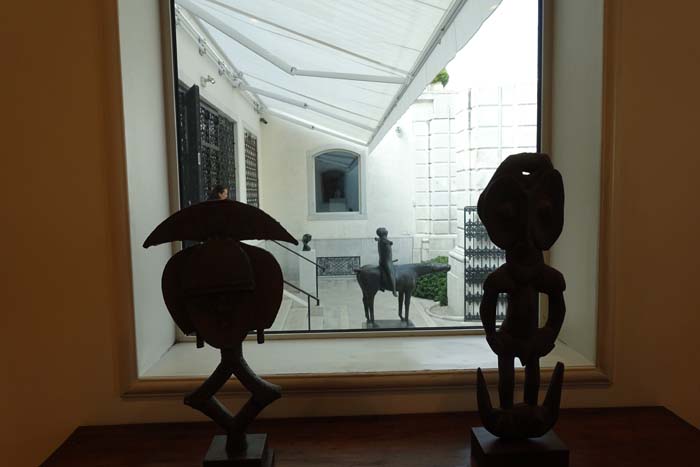
Marino Marini, "The Angel of the City" 1948, bronze sculpture of a boy on a horse, greets visitors on the patio of the museum.
Peggy Guggenheim lived in Venice for thirty-three years. She died at age 81 in December 1979. Her ashes are placed in a corner of the garden of Palazzo Venier dei Leoni, next to the place where she customarily buried her beloved dogs.

After visiting the Peggy Guggenheim collection and browsing the gift shop, we had a nice lunch in the adjacent garden cafe. A wide variety of art galleries line the streets of Venice, especially in the area between the Peggy Guggenheim Collection and the Gallery Accademia. Here are a couple of gallery exhibits that struck my fancy as we walked by:
This portrait of Marilyn Monroe was created with tiny images of butterfly wings.
"Dog" by Fernando Bottero, 2008
These whimsical cats reflect the theatrical personality of Venice
I like to take pictures in museums and galleries to remind me of what I saw and so I can enjoy seeing the art again. My visit to the Accademia Gallery will be in Part 2 of my report on Venice art.