Showing posts with label London. Show all posts

Monday, June 22, 2026

NATURAL HISTORY MUSEUM, LONDON: A Few of Our Favorites

Diplodocus dinosaur skeleton in front of the Natural History Museum, London.

On our recent trip to London, the Natural History Museum was our first stop. The museum is enormous and you can’t possibly see it all in one visit. And even if you do have time, it is best to decide which things to focus on. Our main goal was to see the exhibit of the winners of the yearly photography competition—100 photos selected from more than 4000 entries. We also wanted to revisit some of our favorite parts of the museum.

Blue whale skeleton in Hintze Hall.

We walked to the museum from our hotel near the South Kensington tube stop and entered at the East Gate, where we followed a path through the Evolution Garden to get to the Central Entrance. The museum is free, but we had to line up to go through security. Once inside, the giant skylit space of Hintze Hall loomed before us, with a huge whale skeleton hanging overhead and a grand staircase leading up to a statue of Charles Darwin.

Art with Statue of Charles Darwin.

After paying our respects to Darwin, we stopped at the information booth to pick up a map and get directions to the photo exhibit. The map divides the museum into four color coded zones. We focused on the Green Zone which includes birds, the wildlife photographer of the year gallery, fossil marine reptiles, and treasures of the museum, where we saw the fossil skeleton of Archaeopteryx, the first bird.

Caroline with fossil of giant sea reptile collected by Mary Anning.

On our way to the photo exhibit we passed by the amazing display of fossil skeletons of giant marine reptiles, many of them collected by Mary Anning in the nineteenth century. During the Dinosaur Age the oceans teemed with these huge reptiles.

Wild Photographer of the Year Gallery.

The Wildlife Photographer of the Year photo exhibit requires a ticket, which we purchased at the entrance. Each photo in the exhibit was backlighted so that it glowed in the partially darkened room and was accompanied by a label with the title, photographer’s name and other pertinent information. What surprised me was not only the diversity of the subjects and locations where they were shot, but the variety of cameras—ranging from specially designed equipment to a simple iPhone.

Photo of moth camouflaged against tree bark--taken with an iPhone.
Having worked with photographers on many of my books, I know how hard it is to get just the right shot. I appreciated a quote mounted on one wall of the exhibit: It is vital to be patient and wait for the moment that completes the story you are trying to tell, even if it takes hours or days or weeks, or sometimes even years. (Akansha Sood Singh, natural history filmmaker)

Models of two dodos. Extinct since 1681 due to overhunting, habitat loss and predation by other animals.

The exit from the photo exhibit was through the museum gift shop where it was possible to buy postcards and books of the images in the exhibit. We then visited the bird room in search of the Archaeopteryx fossil but got sidetracked by a case full of birds that have gone extinct, including the dodo, which once lived on a remote island in the Indian Ocean. Although we found a cast of Archaeopteryx in the bird room, we learned that the actual fossil, one of the most valuable items in the museum’s collection, was upstairs in the room of treasures. So we trudged up the stairs to find it.\
Fossil of Archaeopteryx embedded in limestone. You can see impressions of feathers attached to the wings.

After viewing Archaeopteryx and the other museum treasures it was time to sit down and have some refreshments, which we did in the Central Café behind the stairwell on the main floor. We had seen many of our favorites and been inspired by the photo exhibit. We’ll come back another day to see more.

Main entrance to the Natural History Museum, London.


Monday, May 18, 2026

SPRINGTIME IN LONDON: A Walk in Hyde Park

Cherry trees in bloom, Hyde Park, London.

Londoners know that it is spring when the lawns of Hyde Park suddenly turn green, daffodils and lupins emerge from the ground, and cherry trees burst into bloom. On our recent trip to London in late April, the weather was cool and sunny—a perfect time for a walk in the park, a short distance from our hotel in South Kensington.

Viburnum.

Narcissus.

We entered the park at the gate near the Serpentine Gallery and followed the walking path toward the Albert Memorial. The park is huge with separate paths for walkers, bikers, and horses. It was not hard to imagine one of the characters from the Forsyte Saga trotting by on horseback.

Sports lawn.

Large lawns and open spaces provide places for picnics, sports, and for dogs to romp. Benches are frequent and a place to rest and enjoy the view.

Cherry blossoms carpet the ground.

Everywhere we looked there were flowers in bloom. The pink blossoms of the cherry trees were at their peak--on the trees and carpeting the ground. In 2019 Japan sent 125 cherry trees to England as a gift symbolizing friendship and cultural ties.

Bluebells with bee.

I spotted a bee collecting nectar from the bluebells next to the path. The next day, on a trip to visit a friend who lives just outside London, we took a walk in the woods and saw hundreds of bluebells in broad patches on the forest floor.
Bluebells on the forest floor in the town of St. Albans.

Albert Memorial.

The Albert Memorial in Hyde Park is hard to miss with its golden spire reaching 176 feet into the sky. A statue of Prince Albert, husband of Queen Victoria, sits inside the pavilion. After Albert died in 1861 at the age of 42, Queen Victoria had the monument erected in his memory. She lived another forty years!

Corner sculpture of the Albert Memorial symbolizing Europe.

Every feature of the structure is significant. At the four corners around the pavilion are large allegorical sculptures representing the arts and sciences and continents.

Albert Hall.

And across the street from the Albert Memorial is Albert Hall, London’s premiere concert hall. It was officially opened by Queen Victoria in 1871.

Mexican Orange Blossom bush.

Our walk gave us just a small taste of what Hyde Park has to offer. We didn’t have the time or energy to do more--it was our first day in London after a very long plane ride from Los Angeles. On a future trip I’d like to see the Peter Pan statue, the Speaker’s Corner, and Serpentine Lake.

Monday, June 16, 2025

A WEEK IN LONDON: Tower of London, Houses of Parliament, Charles Dickens and More, Guest Post by Jennifer Arnold

Houses of Parliament, London.

With many thanks to my daughter Jennifer for her report of her recent trip to London with my grandson, who met her there during the spring break from his semester abroad in Madrid. They packed a lot in during the week they were in London!

My son and I recently spent a week being tourists in London (Easter week 2025), visiting some of the major sites and learning about British history and contemporary life. One theme that seemed to connect the different sites we saw is the long history of England and the British empire, and the continued class conflict and power struggles.

The "tower", which is now a gift shop.

Tower of London.
The Tower of London is really a castle, although it does have one building called “the tower”. This used to be where the kings and queens lived, and it represents both a long and fraught political history as well as the proud history of the royal family. 

Guards marching as a part of the ceremony of the password, which is solemnly shared with the guards.

There are informative and entertaining tours given by the “beef-eaters” (no one knows where that name came from), who live on site with their families and take care of the Tower. The charming man who gave our tour told us that he had been in the British military for 30+ years, serving as the principal violinist in their orchestra! As part of the tour, he told us about the many political prisoners and beheadings that took place nearby. This castle was the primary seat of English political and military power for hundreds of years. 

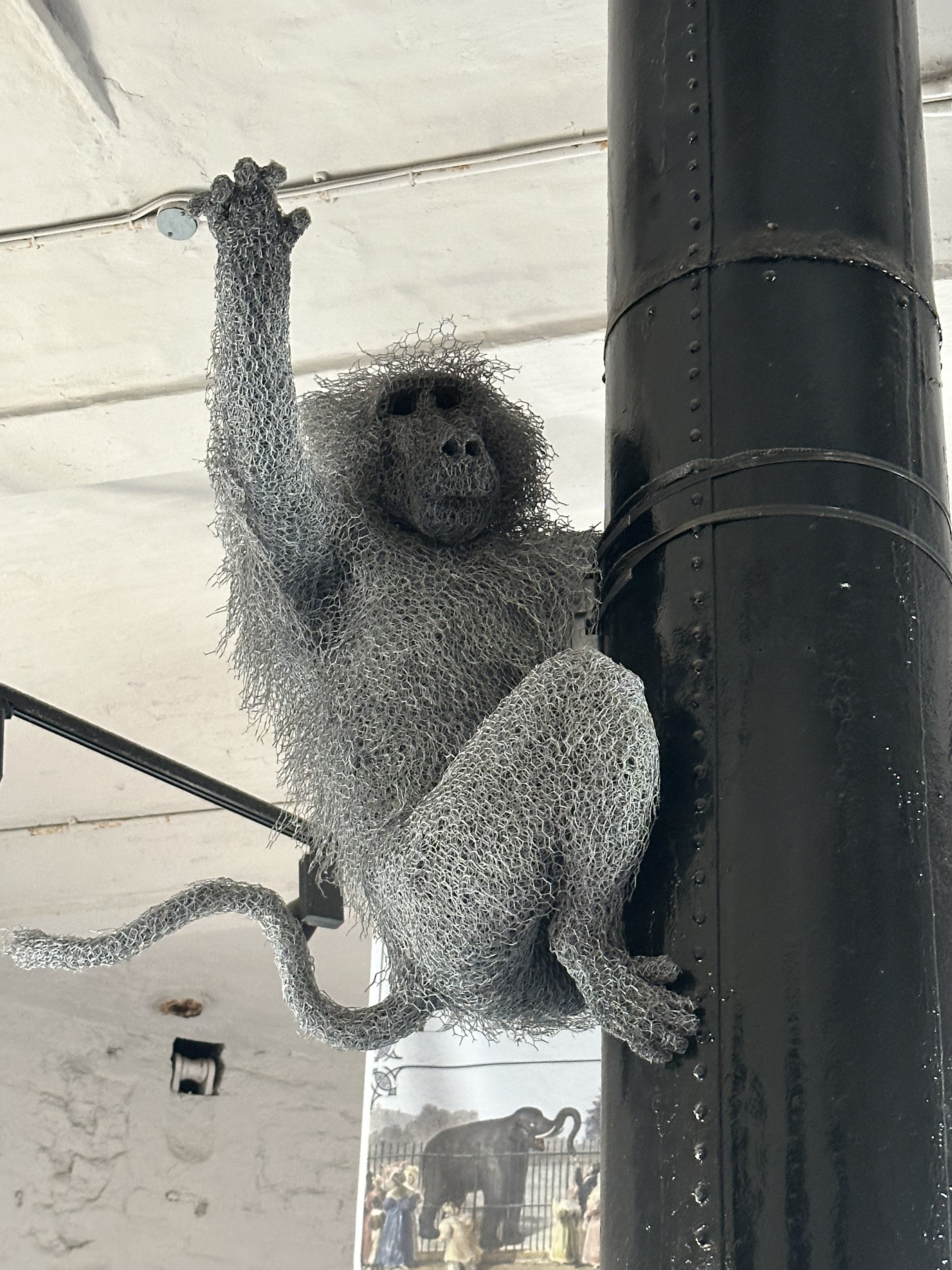
Metal monkey sculpture.

Artistic metal sculptures depict some of the animals that used to be kept at the tower of London; these animals from far-off places were given as gifts and kept in the tower, which was not always the best habitat.


Observatory ball.  Every day at exactly 1:00 pm Greenwich Mean Time, this red ball on the top of the observatory drops. It is visible from the Thames and allows ships to synchronize their clocks with the official time.

The Greenwich Royal Observatory   A little south of London is the Greenwich Royal Observatory. This observatory marks the location of the Prime Meridian, which is the line that is used across the world to count as the start of a “day”. The museum teaches about the astronomers and mathematicians who worked there, and the long endeavor to develop a method of calculating longitude accurately from a ship. This project took decades, spurred on by a monetary award offered by the British government.  There were many attempts along the way that weren’t successful but nevertheless made scientific and engineering contributions. Ultimately the solution was to develop a clock that would be accurate within seconds when aboard a ship. You can read more about this in Dava Sobel’s book Longitude.

Royal Observatory.. This line marks the prime meridian.

It’s striking how the financial support of the English government was critical to both the scientific advancements as well as the social infrastructure of marking time consistently across the globe.  This is an early example of a federally funded grant, and it accrued power to England.

Houses of Parliament. This photo was taken in one of the only places we were allowed to take pictures.

The Houses of Parliament . Unfortunately, we were visiting during Easter week, which is a holiday in England, so we couldn’t see the houses of parliament in action. But we still could enter the space and take an audio tour. British Parliament includes both the House of Lords and the House of Commons. Originally these parliamentary roles were only open to men of wealth, but later they opened up to “commoners”, and today the only real political power lies in the House of Commons. But we also learned that the House of Lords plays an important negotiating role, precisely because they do not have the same level of power as the House of Commons. The rooms dedicated to the House of Lords are also a lot more ornate than the rooms for the House of Commons!


The 80’s: Photographing Britain at the Tate Britain.  This powerful exhibit depicted several major class struggles in the 70’s and 80s, including union strikes, the coal miner’s strike, and the struggle for recognition of the LGBTQ+ community.


Dickens Museum

Charles Dickens Museum . This museum is built in one of the houses where Dickens lived in the 1800’s, in a beautiful and somewhat secluded neighborhood of London. We learned that Dickens himself came from a financially insecure background, which was blamed on his father’s inability to manage his debts. At age 12 Dickens was sent to work in a factory doing grueling and uninspiring work. This undoubtedly motivated the themes in his novels, which portrayed the poor in a positive light and championed their cause. We also learned that Dickens’ had a flamboyant and entertaining personality. He enjoyed financial success during his lifetime due to the popularity of his writings, and he frequently entertained at his house and performed his books.


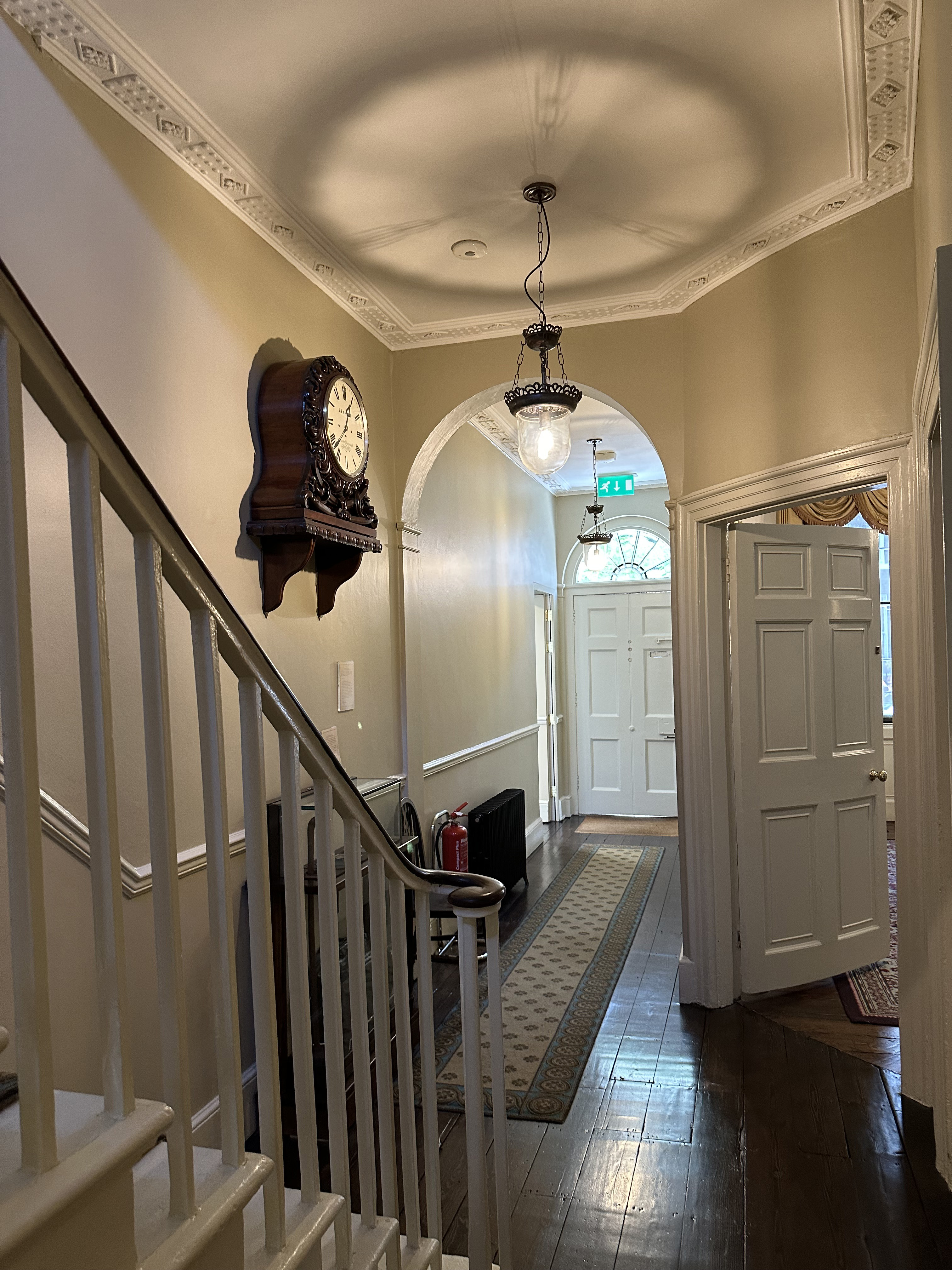
Handel House. The room where Handel entertained visitors and musicians, next door to the room where he did most of his composing.

Handel and Hendrix House .  In an unusual twist of fate, two major musicians lived in neighboring houses in London at very different times. The composer George Frederic Handel rented a house in the early 1700s, where he composed his famous Handel’s Messiah and many other works, and from where he developed his career in London. 
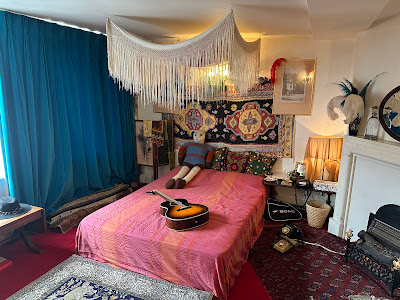
The bedroom of Jimi Hendrix’s flat.

Two centuries later, Jimi Hendrix rented a flat next door where his career took off in the 1960’s.

 Note: Next week look for Jennifer's post about their day trip from London to Oxford.


Monday, September 26, 2022

A TRIP TO ENGLAND: YORK AND LONDON, Guest Post by Jennifer Arnold

York Minster Cathedral, York, England

My daughter Jennifer, a professor at the University of North Carolina, recently went to England for a conference, but also had time to do a little sightseeing. I thank her for sharing a few of her thoughts and photos of her trip with the Intrepid Tourist.

I visited England September 5-11, 2022, for the Amlap ( Architectures and Mechanisms of Language Processing) conference in the city of York. My graduate student and I landed in London the morning of September 5 and took a train to York. After three days of the conference we came back to London on Saturday September 10, spent the afternoon sightseeing in London, and flew out on September 11.  While we were in England, Queen Elizabeth passed away on Thursday September 8. Below are pictures from both York and London.

YORK

York is a walled city in northeast England that was founded by the ancient Romans. Its huge 13th-century Gothic cathedral, York Minster, has medieval stained glass and 2 functioning bell towers. The City Walls form a walkway on both sides of the River Ouse. The Monk Bar gate houses an exhibition tracing the life of 15th-century Plantagenet King Richard III. ― Google


York is a delightful and scenic town, surrounded by walls. The river Ouse cuts through the city. 


The weather was generally beautiful while we were there (just a little standard English rain), and I enjoyed walking and running on the paths by the river.


Here is one of the entrances to the center part of the city, which is surrounded by walls. 
Among the highlights of York is York Minster, a medieval cathedral. 


On September 10, after the passing of Queen Elizabeth, flags were at half-mast.

LONDON


View of Big Ben and Westminster Abbey across the Thames. Unfortunately, Westminster Abbey was closed in honor of the queen, so we couldn’t visit.


Across London there were numerous tributes to the queen. Her picture was projected on the Tube doors for the Elizabeth line.


On our visit to the British Museum the Rosetta stone was a highlight (especially given that I and my student are language scientists).


Around London there were numerous individual spontaneous tributes to the queen like this one outside a shop.


We walked past Buckingham palace on the afternoon of Saturday September 10, two days after the queen’s passing. The place was mobbed with thousands of visitors. 


For those who were willing to wait in a long line, the guards were letting people through, a few at a time, to walk past the palace and pay respects. Everyone was being very calm and respectful. There were piles of flowers, home-made cards and stuffed animals filling the grass and decorating the outer gate.

Jennifer Arnold (R) and her graduate student Elaine Ye (L) as they arrive in York.


Monday, August 15, 2022

ENGLAND, A CHILDREN’S LITERATURE TOUR, Part 2, Mary Poppins and More, Guest Post by Cathy Bonnell

Mary Poppins Sculpture, Leicester Square, London

My friend Cathy Bonnell, a retired school librarian who lives in Phoenix, Arizona, loves to travel and recently spent two weeks in England with her daughter Courtney, a journalist. Cathy has contributed previously to The Intrepid Tourist. I thank her for sharing her photos and report of her trip in July to London and the Lake District, with an eye to special connections to children’s literature.

Clifford the Big Red Dog and Cathy

After three days in The Lake District we were
back in London and a visit to Leicester Square to see these literary statues—very whimsical. 

Gene Kelly

Paddington Bear

Harry Potter

Lots of school groups out viewing them also.

Covent Garden Market

Covent Garden neighborhood

Covent Garden neighborhood

Spent some time wandering through Covent Garden before the theater to see Tina, which was excellent!

The London Eye Giant Ferris Wheel

Since we have seen the usual tourist attractions before, we didn’t take in many on this trip, except during a rest by the Thames, where we had an excellent view of the giant Ferris wheel, the London Eye, built for the Millenium.

Historical marker on house where Monty Python film maker lived 1976-1987.

Unfortunately my second week in London was spent in quarantine when Covid struck.  Still, it was a memorable trip and time with my daughter!

Part 1 of Cathy's trip to England posted on August 8, 2022.