Showing posts with label Los Angeles. Show all posts

Monday, February 3, 2025

REMEMBERING WILL ROGERS’ STABLES – Lost in the Palisades Fire, Los Angeles, CA, Guest Post by Caroline Hatton

Will Rogers' Stables and Horses, circa 1930s, Los Angeles, CA.

My friend Caroline Hatton, a children’s writer and frequent contributor to this blog, took these photos in the 2010s, during the many years when she spent time at the park with horses, for joy and fitness.

“A man that don’t love a horse, there is something the matter with him.”—Will Rogers, cowboy, humorist, movie star and commentator of the 1920s and 1930s. He had a ranch near Los Angeles. After he died, his widow Betty donated it to the State of California to be enjoyed as a public park and as a memorial to him. It became Will Rogers State Historic Park.

In a recent post  on this blog Caroline Arnold described how the devastating 2025 Palisades Fire in Los Angeles, California, destroyed buildings in the park, including the house and stables. As she wrote, “They remain only in pictures and in our memories.”

Will Rogers' Stables, 2013, lost in 2025.

Here are some pictures and memories of Will Rogers’ stables. They looked to me mostly like in the historic photo (at the top of this blog post), which was displayed inside the stables’ central rotunda.

When I first came to the park in the late 1900s, horses lived in the stables, so those were not open to visitors. Later on, the use of the stables ended in order to preserve the building and it was opened to the general public.

For years, I went to the park to read, write, hike, carry a full pack up the trails to train for summer backpack trips in the Sierra Nevada, and best of all, to spend happy times horseback riding in lessons or on trails, and volunteering to help children with special needs benefit from Therapeutic Horseback Riding under the guidance of specially-certified instructor Tami Leevan. I often walked through the stables and paused the passage of time to listen for echoes from the past.

Just outside the stables.

The above sign, in front of the stables, survived the fire. It marks the graves of two of Will Rogers’ favorite horses, Bootlegger and Soapsuds.

Posted in the stables.

Corridor inside the stables.

View of rotunda in the stables.

Will Rogers.

Four large doors (on the rotunda front and back, and at the ends of the left and right wings) gave access to 24 stalls and two restrooms, each with a flush toilet and a bathroom-type sink.

View from inside the rotunda, 2014.

Arena, stables, pasture, 2014.

Visitors on a guided trail ride, 2018.

Far from being a lifeless place haunted by the ghosts of horses and the humans who loved them, the equestrian facility was kept vibrant by passionate users. Westside Riding School, the concessionaire operating the business inside the state park from 2006 to 2021, offered riding lessons and trail rides. In the above photos, a young student rides a well-loved lesson horse, bareback; a teen student competes at the annual school show; and one-time visitors enjoy a guided trail ride to Inspiration Point and back. A different concessionaire was in business until the 2025 fire. Equestrian visitors were welcome to bring their own horses to the park for day-use of the riding and roping arenas, and trail to Inspiration Point.

Westside Riding School. 10th Anniversary photo (by B. Hatton), posed like the historic photo.

On the 10th anniversary of Westside Riding School, owner Dorte Lindegaard Wolf (7th from the right in the above color photo) led students (including me, the author of this post, 5th from the left) and friends to pose with school horses, like in the historic photo.

Polo practice.

Events at the park included polo matches, with practice sessions in the few days before.

This was my happy place for many years. Some of my absolute best horse memories are from there. The time a kind horse named Doc carried me bareback at a gentle gallop, up the trail to Inspiration Point. How years of helping children with special needs gave me an idea for a children’s story, which got published in a magazine. The friendships and connections with humans and horses. No wildfire can erase the memories of the countless people who found happiness at the park.

FOR MORE INFO

 Read Caroline Arnold’s 2020 post about Will Rogers State Historic Park

Monday, January 20, 2025

REMEMBERING WILL ROGERS’ HOUSE-- Lost in the Palisades Fire, Los Angeles, CA

Will Rogers' House, Will Rogers State Historic Park, Los Angeles, CA.

“I never met a man I didn’t like.”—Will Rogers, cowboy, humorist, film star and commentator of the 1920s and 1930s.  He was a quintessential American.

Will Rogers’ house in Will Rogers State Park in Los Angeles, California, was one of the many victims of the recent catastrophic Palisades wildfire, which burned more than 23,000 acres and destroyed more than 1000 homes. It is gone forever. The park, with its historic house, horse stables, polo field, picnic area and hiking trails has been a favorite place to visit during the almost fifty years I have lived in Southern California. I loved the exhibits in the Visitor Center and the black and white films of Will Rogers doing rope tricks for the movies and telling jokes as a popular public speaker and commentator. I loved the guided tours of his home, filled with artifacts of his life—his saddle, colorful blankets, sculptures, and comfortable furniture. Every volunteer docent had their own stories to tell of Will Rogers and his family as they led the tour through the rooms of the house. I loved watching polo players on the field in front of the house. I loved hiking on the trails past the horse barns and corrals up to Inspiration Point, with its spectacular 360 degree view—from the Pacific Ocean to downtown Los Angeles. The wildflowers and native shrubs in the park will grow back in time, but the house and mementos of Will Rogers’ life can never be replaced. They remain only in pictures and our memories.

I have written about Will Rogers’ State Park twice on this blog, in March 2014 and June 2020. I am reposting here my report from 2014. 

Will Rogers House, Will Rogers State Park
When I have visitors in Los Angeles, one of my favorite places to take them is Will Rogers State Historic Park, the former home of the famous cowboy, humorist, film star and commentator of the 1920s and 1930s.  Tucked into the foothills of the Santa Monica Mountains just north of Sunset Boulevard, the ranch style home looks out over a broad lawn (once used by Will’s friends to practice golf) and a large field where Will and his friends played polo. The field is still used for weekend matches and occasionally we take a picnic and sit on the sidelines and watch. A short walk from the house leads to the stables where Will once kept his horses.  According to Will, “A man that don’t love a horse, there is something the matter with him.” Today one can go for horse riding lessons and trail rides in the park.

Horses in one of the corrals
On a recent Sunday when my brothers were in town, we spent an afternoon at the park.  We began at the small museum adjacent to the house.  People of our parents' generation have fond memories of listening to Will Rogers on the radio, seeing him in movies, and reading his newspaper columns, but for most of us today Will Rogers is a historical figure. Will was born in 1879 of Cherokee and European descent. He was raised on a ranch in Oklahoma where he learned to ride and rope, skills that led him to perform in Wild West shows, and eventually brought him to Hollywood. He died in an airplane crash in Alaska in 1935. In the museum are photographs and exhibits and a wonderful video showing his amazing rope tricks and clips from some of his speeches. 
At Christmas time the house is decorated by volunteers
Thursday through Sunday, volunteers lead free tours of Will Rogers’ house, providing an opportunity to see his collection of Western art, hear some of the many stories about his life, and get a sense of the casual and comfortable style of life he preferred.  Despite his fame and wealth, Will did not live the glamorous life of other movie stars of the time. Instead, he entertained with casual barbecues and sing-a-longs and decorated his house in a homey, ranch style. 
View of Los Angeles from Inspiration Point, Will Rogers State Park
After our tour we set out for a walk on the loop trail up to Inspiration Point.  Following the dirt path past the stables, we wound our way uphill.  As we passed the corrals, a few friendly horses came over for a pat on the nose. Although the trail is not strenuous, I chose to loop the other way and met the rest of the group on their way back down.  I have been to the top many times and the view of the city and Pacific Ocean is impressive.
Will Rogers lived on the ranch from 1926 to 1935
Perhaps Will Rogers’ most famous quip was: “I never met a man I didn’t like.” His house and ranch reflect his generous spirit and love of the outdoors. After Will Rogers died, his daughter donated the house and ranch to the state of California so that it would be preserved as a state park. We are lucky she did.
For directions and information about visiting the park go to www.parks.ca.gov/willrogers .

Monday, June 3, 2024

MAGNIFICENT CACTI AND SUCCULENTS: The Desert Garden at the Huntington, San Marino, CA

Desert Garden at the Huntington Botanical Garden, San Marino, CA.

When “June Gloom” blankets the Pacific coast on the west side of Los Angeles where we live, we go inland to get a little sunshine. We don’t have to go far—one of our favorite places is the Huntington  (located in San Marino just a 40 minute drive way) with its Library, Art Museums and huge Botanical Garden. We enjoy all the themed gardens—the rose garden, herb garden, Japanese garden, Chinese garden and more—but our favorite is the desert garden with its plethora of cactus, succulents and other drought resistant plants. It is always our first stop as we make our way around the 207-acre grounds of the Huntington estate. Here are a few photos of the desert garden from a recent visit.


In one section of the garden, dozens of barrel cacti seem scattered like spiny bowling balls across the sandy soil. It is hard to resist taking photographs in the desert garden--close-ups that reveal the complex shapes of each species and broader views showing the wide range of colors and shapes of the plants.


In other parts of the garden the plants are tucked among chunks of volcanic rock that become hiding places for small lizards. After pausing for a few seconds for its picture to be taken, this lizard scampered away.


The range of colors in succulents is amazing--from yellow, orange and red, to multiple shades of green, blue and grey.


Some of the plants have delicate blooms. This past winter Southern California had record setting rains, which may explain some of the lushness of the desert garden on our visit.


These herbaceous plants known as "towers of jewels", have an other-worldly appearance, resembling spiny multi-colored spaceships. They are endemic to the Canary Islands.


Little cacti next to big cacti illustrate the range of sizes in the cactus world.


While cacti are armed with sharp spines, this succulent has a leaf-like covering and "arms" that end in delicate clusters of blooms. Alluaudia procera comes from Madagascar.


The branches of this white flowering floss silk tree is covered with white flowers. The bulging trunk is armed with sharp thorns.


Gravel paths wind through the desert garden providing visitors with close-up views..


Everywhere you look, there is something to marvel at--the variety of shapes and colors, the wonderful symmetry of nature, the repetition of patterns, the remarkable way that desert plants have adapted to the stresses of extreme heat and lack of water.. 


The Huntington Library, Art Museums, and Botanical Garden is a collections-based research and educational institution founded in 1919 by Henry E. and Arabella Huntington. Henry Huntington was a businessman who built a financial empire in Southern California. The former residence of the Huntingtons is now the Art Gallery. You can see their portraits displayed near the entrance.

Visiting the Huntington

Tickets for visiting the Huntington can be purchased online, where you are asked to choose an entry time. Reservations are required for most days.  For prices and details check the Huntington website. The website also has a map and directions. Parking is free.

There are several places to eat at the Huntington ranging from cafes and a coffee shop to the Rose Garden Tea Room (for which you need reservations weeks in advance.) On our recent visit we ate lunch at the Jade Court Café where we enjoyed delicious Chinese food, sitting outdoors at a shaded table.

The Huntington also has an excellent gift shop, located near the entrance.


There is much to see at the Huntington. For an earlier post at The Intrepid Tourist about a visit to the Chinese Garden, click HERE.


Monday, May 13, 2024

KOREAN TREASURES AT LACMA (the Los Angeles County Museum of Art) Guest Post by Caroline Hatton

 Korean Quadruple Gourd Vase, LACMA

My friend Caroline Hatton, a children’s writer and frequent contributor to this blog, took these photos
in March 2024. She writes:

While in L.A. for only two days, I was lucky to spend an hour at LACMA (the Los Angeles County Museum of Art). Viewing “Korean Treasures,” a temporary exhibition until June 30, 2024, filled my short visit with a rich experience.

The 35 items on display were selected from the vast collection of Chester and Cameron Chang, donated to LACMA. The selection offers a broad glimpse at artworks from past millennia to the present, including calligraphies, paintings, scrolls, screens, ceramics and sculptures.

The Poet Lee Baek (LI Bai) Watching a Waterfall by Yi Immun
An ink painting on silk from around 1800, traditionally attributed to Yi Inmun, shows the celebrated Chinese poet Li Bai “Gazing at a Waterfall on Mount Lu” and composing his most famous poem, the one by that title. The image includes a mountain waterfall, a timeless, universal source of awe, and two culturally distinctive and significant products of the creativity sparked by this emotion—a Chinese poem and a Korean painting.

A pair of cranes represents Trust, a Confucian virtue.

On a screen illustrating The Eight Confucian Virtues, which are Filial piety, Brotherly love, Loyalty, Trust, Propriety, Righteousness, Integrity and Sensibility, animals adorn the top of each panel. A pair of cranes represents Trust.

Stone in the shape of the Korean Peninsula.

One of my favorite forms of artistic creativity is what we see at any age in a cloud, a chunk of driftwood, or a rock. This is why I liked the sculpture by Mother Nature, titled “Stone in the Shape of the Korean Peninsula.” I especially liked how the vision inspired the artist who sculpted a wooden base for it, to carve water ripples around the stone.

Ceramics.

I liked the variety represented by seven ceramics in one display, every one of a distinctive shape and color. Vases, a jar, a vessel, a bottle and a seal are faceted in different ways, glazed in different colors, and designed for different functions. My favorite was the “Quadruple gourd vase” (photo at the top of this blog post), in part because it inspired me to make a miniature version of it some day.

Two dozen more diverse art works await viewers with differing sensibilities!

All text and photos, copyright Caroline Arnold. www.theintrepidtourist.blogspot.com


Monday, September 25, 2023

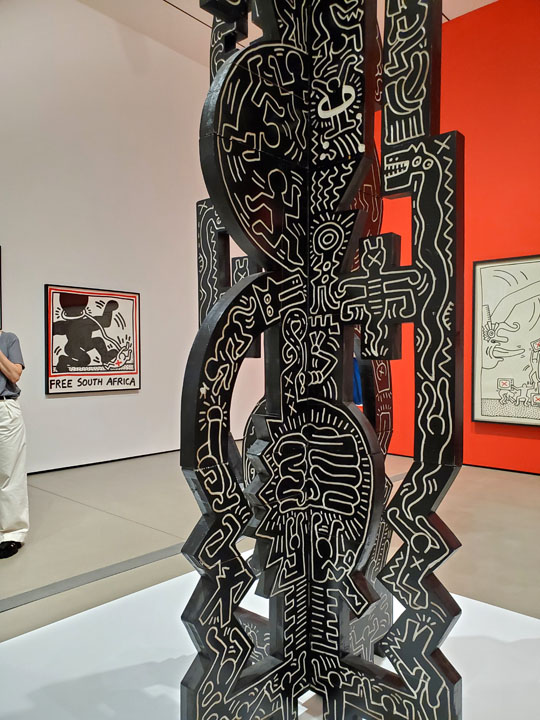
KEITH HARING, ARTIST AND ACTIVIST: The Broad Art Museum, Los Angeles, CA

Keith Haring, Art is for Everyone at The Broad Museum in Los Angeles

For months I had seen light pole banners along the streets of Los Angeles promoting the Keith Haring exhibit at The Broad museum of modern art in downtown LA. Playful polka-dotted creatures danced across each banner. I wanted to see more. 

T-shirts, posters, books, are among the many ways Keith Haring's expressed his creativity.

Keith Haring, Art for Everyone, is an amazing collection of paintings, drawings, sculptures, pottery, t-shirts, and art on just about any surface he could draw on. A rotating slide show of his public art on buildings in NYC, subway stations, and elsewhere is projected on the wall outside the entrance to the exhibit. Inside the exhibit his paintings are so numerous they are double-hung to fit them all in.

As a child, Haring learned to draw using Disney characters and Dr. Seuss books a models.

Strong black lines, bright colors, animals (especially snakes) and other imaginative creatures, characterize Haring’s work. 

I couldn't resist having my photo taken through this decorated window.

His art reflects the influence of other artists of the time such as Andy Warhol, Jean-Michel Basquiat and Roy Lichtenstein. (You can see examples of their work upstairs at The Broad in the permanent collection.)

Haring designed posters and flyers to promote AIDS awareness.

Keith Haring, born in 1958, worked in New York City in the 1970s and 1980s, producing an enormous quantity of work before dying of AIDS in 1990. In 1988 he created the Keith Haring Foundation to 
continue his artistic legacy and to provide funding to AIDS organizations for education, research, and care, as well as to groups that work with children and marginalized communities.

Haring protested apartheid in South Africa through his art.

His commitment to speaking out about issues he believed in grew stronger throughout his career. “Haring’s activism was central to his practice. He used his imagery and celebrity to protest apartheid in South Africa, raise awareness of the crack cocaine epidemic, and the AIDS crisis, and support causes from nuclear disarmament to UNICEF.”

In the last room of the exhibit are some of Keith Haring's final works, including a painting with an unfinished corner, providing a clue to his method.

The Keith Haring exhibit at The Broad is the first exhibit of his work in Los Angeles. The exhibit requires a timed paid ticket, available online. (The rest of the art museum is free.) The Keith Haring exhibit closes on October 8, 2023. See it while you can. 

Moses and the Burning Bush, 1985


Monday, August 21, 2023

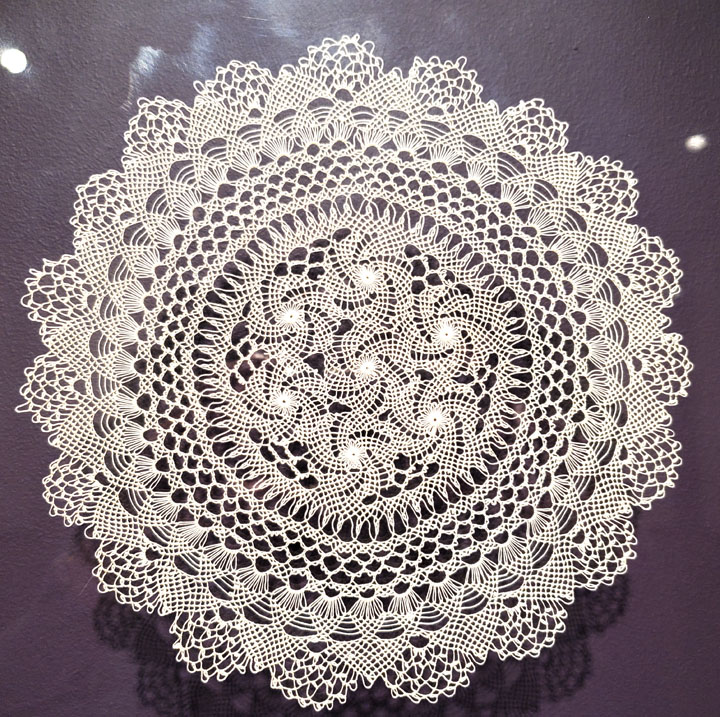
THE LANGUAGE OF LACE: Armenian Lace Doilies at the Fowler Museum, Los Angeles, CA

Armenian lace doily made by Marie Pilibossian. At the Fowler Museum, UCLA.

Until my recent visit to the Fowler Museum at UCLA in Los Angeles, California, to see Janyak: Armenian Art of Knots and Loops, I never appreciated the artistry of lacemaking and its cultural significance. A fascinating exhibit in a small inner gallery displays a variety of beautiful lace doilies made by Marie Pilibossian (1898-1986) an Armenian genocide survivor who emigrated to America, with explanations of the various designs and what they represent.

Fine thread tied in knots and loops is used to make the doilies.

The craft of lacemaking is called Janyak in Armenian, and each region has its own embroidery styles.

Symbolic meanings of various motifs.

 “Among the shapes identified by scholars is a triangle that alludes to Mount Ararat, symbolizing the Armenian homeland. Other elements represent eternity, the tree of life, Zangezur (a region in Armenia), and Armenian folk dancers. In this way, janyak carried within its knots and loops an understanding and affirmation of familial and cultural roots—a shared and treasured history.”


Designs and techniques are passed down from mother to daughter.


If you go to the Fowler museum to see the permanent exhibits or one of the other special exhibits (see my earlier post about the amazing beaded art of Haitian artist Myrlande Constant) be sure to stop in to see Janyak: Armenian Art of Knots and Loops. The exhibit will be up until February 2023. You will be amazed at the intricacies of the designs.

The center swirl design is symbol of eternity.

For information about the exhibit:

https://fowler.ucla.edu/wp-content/uploads/2023/07/Fowler_PR_Janyak-Armenian-Needle-Lace.pdf

Fowler Museum of Cultural History, UCLA, Los Angeles, CA.