|
| Capital building, Madison, Wisconsin |
The last time I used the word “isthmus” was in fourth grade geography. Then I went to Madison, Wisconsin, where the local alternative weekly newspaper is called
The Isthmus after the narrow strip of land between Lake Mendota and Lake Monona where the downtown is located. (Two other lakes, Lake Waubesa and Lake Kegonsa, make Madison the “City of Four Lakes.”) The trip was partly for work, but Art and I also had time to visit with relatives, who gave us a tour of the city.
 |
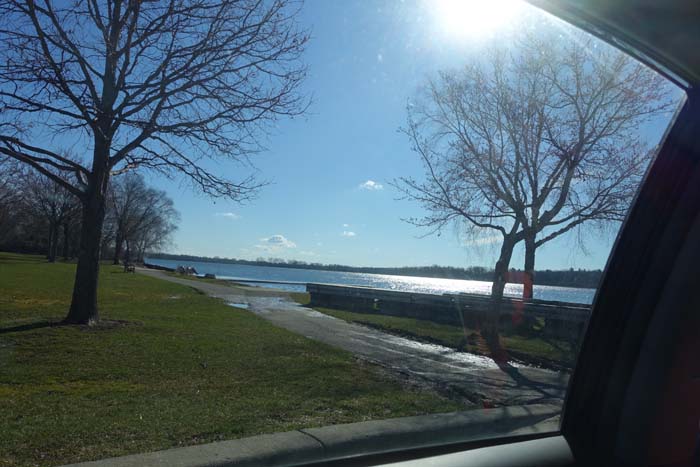
| Madison is a city of parks and lakes |
We started with a drive around the lakes and to a nature center. It was March, so the leaves had not yet come out on the trees, but it was a beautiful sunny day. We then went to the University of Wisconsin campus for a visit to the Student Union and a brief stop at the Wisconsin Historical Society for a look at its impressive high-ceilinged reading room.
 |
| Wisconsin Historical Society |
After lunch we went to the Capitol building, with its classic architecture and beautifully decorated dome.
 |
| Looking up at the dome of the capital building |
On the second floor, we stopped to have our picture taken with the statue of Robert M. La Follette, a former governor of Wisconsin and United States Senator from 1906 to 1925.
 |
| On the second floor of the capital building, posing in front of the bust of Robert M. La Follette |
Our final stop was at Monona Terrace, Madison’s large community and convention center overlooking Lake Monona.
 |
| Inside Monona Terrace |
It opened in 1997 but was originally conceived by architect Frank Lloyd Wright nearly sixty years ago. Although it was not constructed until long after his death, it includes elements of his original design. I had forgotten Wright’s connection with Wisconsin. Madison is just 30 miles from Taliesen, in Spring Green, Wisconsin, which was Wright’s home and studio from 1928 to his death in 1959.
 |
| Pedro E. Guerrero's photographs documented Wright's public works and private life |
When Frank Lloyd Wright was 72 he met a young photographer, Pedro E. Guerrero. Guerrero had a remarkable ability to catch light and space in his pictures, perfectly reflecting Wright’s Prairie style. Pedro, known to Wright as “Pete”, spent the next twenty years photographing both the works and life of the architect. A number of these are displayed inside Monona Terrace in a fascinating permanent exhibit.
 |
| Wright's Romeo and Juliet Windmill, Spring Green, Wisconsin, photograph by Pedro Guerrero. The windmill was designed by Wright in 1897 for his aunts Jane and Nell Lloyd James who ran the Hillside Home School. In 1940, Wright installed a speaker connected to a record player to broadcast Bach and Beethoven to the apprentices working outside. |
Although our visit to Madison was short, it was particularly meaningful for me because of my Midwest roots. I grew up in Minnesota, but I spent my summers in northern Wisconsin at Camp Bovey near Solon Springs. This is where I learned to love nature and watching wild animals, topics I often write about in my books. As a child I also traveled every year to Kenosha, Wisconsin, on the shore of Lake Michigan, to visit my grandparents and cousins. Wisconsin has many memories for me. Now I have some new ones.