Showing posts with label Minnesota. Show all posts

Monday, April 14, 2025

CALIFORNIA OR BUST: Celebrating the 14th Anniversary of The Intrepid Tourist

The Scheaffer family at the Continental Divide, Colorado, August 1958.

It was fourteen years ago, in April 2011, that I launched The Intrepid Tourist as a platform for my travel writing. Since then I have put up a new post once a week, usually on a Monday. At first, the posts were articles based on my own travel. Over the years the blog has expanded to include posts from family and friends and currently totals more than 700 posts, seen by more than a half a million readers. In honor of this fourteenth anniversary I am posting a chapter from my memoir,
Settlement House Girl, about my family’s cross-country trip in 1958 from Minneapolis to California and back. It was the most exciting trip we had ever taken and whetted my appetite to see more of the world.

California or Bust

T

he summer that I am fourteen (1958), our family embarks on an ambitious five week camping trip, packing the six of us into our 1954 Chevrolet Belair sedan for the journey from Minneapolis to California and back.  While my father has a long summer vacation, we don’t have the money to afford expensive trips--staying in hotels and eating in restaurants. The solution is car camping--staying at public campgrounds and cooking our own food.  Prior to that summer my mother had resisted going camping, insisting that it is too much work and not a vacation. But in 1958, my brother Tom is eight and Peter nine and old enough to help out. Steve and I have learned camping skills at overnights and cookouts as campers at Camp Bovey.

We buy two tents, sleeping bags, a camp stove, kerosene lantern, and set of nesting kettles. To prepare for the trip, we practice setting up camp in the backyard, much to our neighbors’ amusement as they watch from the other side of the fence. We each have a role. Keeping time with a stopwatch, my father directs the action: unfolding and spreading out the tent, pounding the stakes, erecting the umbrella support poles, propping up the rain flap. By the end of July we have the routine down pat and are ready to go.

Never before have any of us seen mountains, deserts, or the ocean. We feel like ancient explorers ready to discover a new land. Leaving Minneapolis and the rolling farmland of southern Minnesota behind, we cross the South Dakota prairie (with an obligatory stop at Wall Drug for photos and souvenirs), to our first campsite in the Black Hills, where we marvel at the giant heads on Mount Rushmore and the herds of shaggy bison roaming the plains.

Our next stop is Rocky Mountain National Park in Colorado, pitching our tents in the thin Alpine air. We hike along the mountain trails and get caught in a sudden snowstorm, amazed to encounter snow in summer.  We spot plump pikas harvesting grass to sun dry before they store it in underground burrows for winter. We watch water ouzels forage at the bottom of icy streams fed by melting mountain snow. I sit on a rock and stick my bare toes in the rushing water, but they quickly turn numb--which makes me wonder how the birds stay warm.

Caroline and her brothers at Mesa Verde.

From Rocky Mountain National Park we drive across the Continental Divide to the town of Montrose in western Colorado for a family reunion with my cousins.  From there we go to Mesa Verde National Park, pitching our tent at the edge of the mesa and, like the ancient cliff dwellers, cook our food over an open fire. It is easy to imagine our campsite as a place where the Anasazi might have tilled the ground to plant corn and beans or hunted deer and wild turkeys with bows and arrows. As we gaze into the canyon below we see a complex of square buildings built into the cliff wall a thousand years ago. My brothers and I delight in scrambling up and down the ladders of the cliff dwellings and investigating the open rooms. Protected from wind and weather by the overhanging rocks, the basic structure has changed little over time.

Inside the museum I peer at fine baskets, intricately decorated pots, carved stone and bone tools and other artifacts, and wonder about the ancient Americans who made them and why around 1300 AD they abandoned their homes. In the museum shop, I buy a small painting of a dancing figure by Navajo artist Harrison Begay. Outside, on the patio, a Native American man is constructing an elaborate sand painting, pouring colored grains to make tiny figures and geometric designs. We leave before the “painting” is complete, knowing that it is temporary, meant for tourists to see the artist at work. I learn that according to Navajo tradition, such paintings are part of healing ceremonies, destroyed after the ceremony is over.  

From Mesa Verde we head to Southern California to visit our cousins in a Los Angeles suburb. Our car has no air conditioning, so we cross the desert at night. Stars sparkle overhead in the clear, dry air as we speed down the highway. I can't imagine that anything could possibly live in such a barren, alien land. We arrive at my cousins’ house long past midnight and pitch our tents in their backyard. 

In Southern California I have my first view of the ocean and of waves taller than I am. Although I have been to Lake Michigan, a body of water so big that one can’t see to the other side, the Pacific is almost incomprehensible in its vastness. In tide pools along the shore I discover sea urchins, tiny crabs, and bright red sea stars. When I venture into the water to swim, a wave catches me by surprise and knocks me over. I can taste the salt on my tongue.

At the Minnesota state line.

On our return trip to Minneapolis we take a more northern route, stopping at the Grand Canyon; Salt Lake City; and Yellowstone National Park. It is one thing to read about ancient rock formations, the Mormon Temple, boiling rock pools and giant geysers, and another to see them in real life. This trip gives us all a taste of the infinite variety of our world and whets my appetite to see more of it.

Arriving home in Minneapolis.

SETTLEMENT HOUSE GIRL: Growing Up in the 1950s at North East Neighborhood House, Minnepolis, Minnesota is available at Amazon (paperback or ebook) or to order at your favorite bookstore. ISBN 9798864903285

Wednesday, January 1, 2025

HAPPY NEW YEAR 2025 from THE INTREPID TOURIST

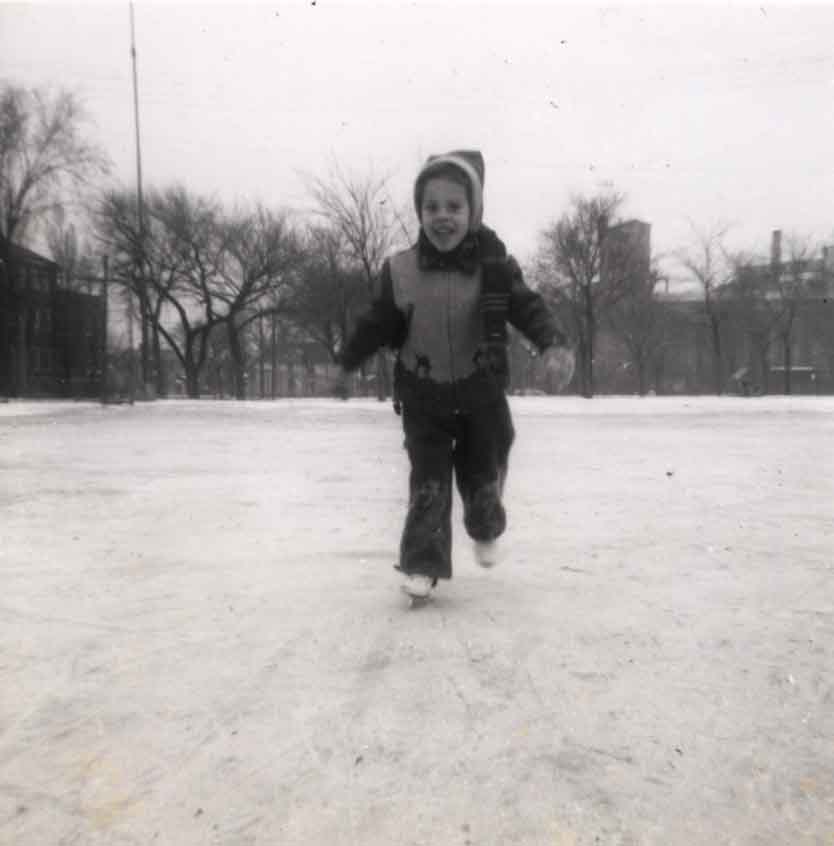
Caroline, ice skating at Bottineau Park in Northeast Minneapolis, 1950.

"By New Year’s Day, the pine needles of the Christmas tree are dry and brittle. It is time to take the tree down. After the lights and ornaments are removed and boxed for next year, we take the tree outside to the roof deck, propping it up in the snow. Decorated with strings of bread cubes and cranberries, it is ready for the birds to enjoy. With the excitement of Christmas over, it is now time to write thank-you notes and to enjoy skating at Bottineau Park, sledding at the Columbia Park golf course, and other winter activities."

From Chapter 7: Family Christmas at NENH, SETTLEMENT HOUSE GIRL: Growing Up in the 1950s at North East Neighborhood House, Minneapolis, Minnesota.

I have fond memories of celebrating the holidays when I was a child in Minneapolis. Now, many years later, from my home in California, I send best wishes to you and all my faithful readers.

HAPPY NEW YEAR 2025


Monday, December 23, 2024

HAPPY HOLIDAYS from THE INTREPID TOURIST

Scheaffer family in apartment at NENH, 1950.

"On Christmas Eve, after my brothers and I are asleep, my parents arrange “Santa’s” gifts under the tree. On Christmas morning, after everyone is awake, my father turns on the tree lights and gives the signal to enter. We rush in, each going straight to our own pile. Santa’s gifts are unwrapped and it is obvious who they are for—a doll for me, a train for Steve, stacking blocks for Peter, a stuffed toy for Tom."  

From Chapter 7: Family Christmas at NENH, SETTLEMENT HOUSE GIRL: Growing Up in the 1950s at North East Neighborhood House, Minneapolis, Minnesota.

 I have fond memories of celebrating Christmas when I was a child. Now, many years later, from my home in California, I send best wishes to you and all my faithful readers.

HAPPY HOLIDAYS

2024


Monday, December 2, 2024

TRAVELING THE WORLD WITH STAMPS: The Joy of Stamp Collecting

Stamps from Chile.

From the time I was small I loved collecting postage stamps, following in the steps of my father who often spent his evenings sorting, choosing, and mounting stamps in his album. The foreign names, currencies and images introduced me to a wider world and made me want to travel to those far-off places. It wasn’t until I grew up that I had the chance to travel abroad, but as I sorted my stamps and put them into albums I dreamed of going to those countries one day. I write about my childhood stamp collecting in my memoir, SETTLEMENT HOUSEGIRL: Growing Up in the 1950s at North East Neighborhood House, Minneapolis,Minnesota. Here are some excerpts from the book:

Snowy Egret, by John James Audubon.

The decorations in my father’s office at North East Neighborhood House reflect two of his favorite hobbies—bird watching and stamp collecting.
  On one wall, in a framed Audubon print, a snowy egret displays elegant white plumes. On another wall of my father’s office hangs a framed map of the United States filled with stamps commemorating notable historic events. On one stamp, tiny engraved images of men on horseback mark the arrival of the Kearny Expedition in New Mexico in 1846. On another, miniature boats brave a stormy sea to honor the Coast Guard. A stamp with the Iowa state flag flanked by two elegant stalks of corn honors the state’s 100th birthday.

Iowa Statehood commemorative stamp in my father's album.

I share my father’s love of stamps and have my own album. I love the exotic country names printed on each stamp—Magyar, Sverig, Republique Ivoire—and locating them on the maps in our atlas.  I learn more about geography and history from those colorful paper rectangles than from my books at school.

Christmas always yields a bumper crop of stamps for my collection–from the envelopes of cards and letters to blocks of stamps cut from the brown paper wrapped packages from out-of-town. Staff and foreign students who are residents at NENH save the stamps from their mail and give them to me as well.  I tear off the stamped corners of the envelopes and put them into bowls of warm water to soak.  As the water dissolves the glue, the stamps float off their backing. I fish them out and put them between paper towels, pressing with a heavy book to keep them flat. 

How to apply hinges to your stamps.

Once the stamps are dry, I sort them into glassine envelopes.
  I keep the stamps in cigar boxes and catalogue them alphabetically by country for foreign stamps, and numerically by denomination for US stamps, with a separate section for commemoratives. I select the best for my album, attaching each stamp with a folded paper hinge.

At the back of my album I have special pages for blocks—groups of four stamps torn from the 100 stamp sheets printed by the Post Office. Some of my blocks are in mint condition. These I slip into protective acetate holders. Unlike the used stamps, sullied by postmark ink and without glue on the back, these stamps can still be used for postage. The best mint blocks include the serial number for the sheet. Even more prized is a whole sheet of 100 stamps.

From the time I was born, my father routinely bought a sheet of each new commemorative at the time it was issued—three dollars a sheet—with the plan that they would grow in value over time. It was meant to be an investment to help fund my college education. Thirty years later, after I am grown, my father gives me his collection of mint sheets. They come with this note:


THE STAMP FANTASY

Buy one sheet of every new commemorative stamp for 18 years, 1944-1962.

Sell stamps in 1962 at their increased value, some at fantastic profit.

Result: Big Money  Equals: College education for Caroline

Reality: Missed many issues after 1948. Plus, couldn’t afford to keep it up, as cost of stamps increased from 3 cents to 4 cents to 10 cents, etc.

Value of stamps in collectors market in 1979:  3 cent stamp  =  3 cents cash

Therefore: Merry Christmas, 1979. Enjoy the stamps and use them for postage. Five 3 cent stamps = today’s postage.

Hope your envelopes are large enough!


By 1979, the cost of a first class stamp was 15 cents.

My father passed on his enthusiasm for stamp collecting to his grandson, my son Matt. When Matt was growing up, they spent hours together choosing stamps to put in his album.


Matt and my father, Les Scheaffer. 1984

"The postage stamps of a nation are a picture gallery of its glories. They depict in miniature its famous men and women, the great events of its history, its organizations, its industries, its natural wonders...No one can pursue this hobby without developing a greater knowledge of their national heritage." Arthur E. Summerfield, Postmaster General 1953-1961


SETTLEMENT HOUSE GIRL is available at Amazon in both a paperback and ebook edition. 


Monday, April 15, 2024

THE ROAD TO CAMP BOVEY: From Minneapolis to Northern Wisconsin, Recollections from Childhood

Camp Bovey sign, 1961.

Seventy-five years ago, under the direction of my father, Les Scheaffer, North East Neighborhood House, a settlement house in Minneapolis, founded Camp Bovey near Solon Springs, Wisconsin. It was a place where children and families of Northeast Minneapolis could enjoy nature and the outdoors, learn camping skills, and have fun together. My first trip to Camp Bovey (then called Camp Hodag) was when I was four years old. Over the next seventeen years I went there many times--with my family, as a camper, and as a staff member for the summer sessions when I was in college. No matter how many times I made the trip, I always felt the excitement of going to Camp.

The four Scheaffer children at Camp Bovey, 1951.

I write about Camp Bovey in four chapters of my new memoir, SETTLEMENT HOUSE GIRL: GrowingUp in the 1950s at North East Neighborhood House, Minneapolis, Minnesota. Here is an excerpt, describing the trip to Camp as I knew it as a child.

Camp Bovey. View of the lodge from across the lake, 2022.

The trip to Camp Bovey from northeast Minneapolis is 150 miles. I know all the stops and landmarks by heart, and no matter how many times I take the trip, the excitement of going to Camp never fades. If you don’t stop, you can make it in about three hours. But for our family the trip always takes longer, with stops along the way for gas, groceries, toilets, a picnic lunch, and if we are lucky, wildlife viewing--perhaps a deer, bald eagle, or in spring, a patch of trilliums.

We always aim to get an early start, but never do, and by the time we reach Taylor’s Falls on the Minnesota side of the St. Croix River, everyone is hungry. St. Croix State Park, across the bridge on the Wisconsin side of the river, is a favorite lunch spot with its scenic view, rocks to climb, and space for my brothers and me to use up some energy before getting back into the car.

After lunch we head east to Turtle Lake, where we turn north on Highway 63 toward Cumberland, home of the Tower House Restaurant, named for the turret on the Victorian house in which it is located. When I am thirteen I taste an exotic foreign food for the first time at the Tower House—pizza! It is delicious.

Cumberland is on an isthmus between two lakes. In winter, the Chamber of Commerce drives an old car onto the frozen lake and raises money by taking bets on when the ice will melt and the car will sink. In 1960, we pass through town in early April and the car is still sitting on the ice. We are on the way to Camp to celebrate my brother Tom’s tenth birthday. By the time we go by again, on our way to Camp for a Memorial Day work weekend, the car is gone. We never find out how long it took for the ice to melt that year.

After Cumberland, the next major town is Spooner. We sometimes stop for a light meal at the Buckhorn Inn on Spooner’s main street. My brothers and I love sitting on the high bar stools. We are allowed to order anything under a dollar. As we wait for our food we ponder the heads of deer and other animals mounted on the wall and wonder if the bizarre two-headed calf is real. It is. Outside Spooner, Highways 53 and 63 merge, and we continue north, going through the tiny towns of Minong and Wascott before arriving at our turnoff at Gordon. To the left is the fire tower on top of the hill above Lake St. Croix. We turn right onto County Road Y.

At Gordon, we are ten miles from Camp and almost there. The first five miles out of town are on a two-lane blacktop. When we reach Flamang Road, we turn left onto a graded sand road. We drive for another five miles, crossing Ox Creek and passing a few cabins. A sign for Camp Bovey, across from a cluster of tumble-down log buildings that we call the haunted farm, marks the last leg of the trip, a narrow rutted road winding through jack pine forest. It isn’t long before we get the first glimpse of Lake Metzger glimmering through the trees, and then, after passing the three “boys” cabins, pull into a parking place at the back of the lodge. We have arrived at Camp.

Flagpole. Dedication to Lester Scheaffer, founder of Camp Bovey, 1949.

Today’s trip to Camp Bovey bypasses Taylor’s Falls and follows the Interstate toward Duluth, cutting over to Highway 53 at Spooner. But the thrill of going to Camp never fades.


Camp Bovey is celebrating its 75th Anniversary this year, 2024. It is still a place for children and families to enjoy the out-of-doors. For more about Camp Bovey and anniversary events, go to the Camp Bovey Facebook page or the ESNS website. (North East Neighborhood House became East Side Neighborhood Services (ESNS) in 1963.)


Monday, April 10, 2023

MY TRAIN TRIP: Celebrating the 12th Anniversary of The Intrepid Tourist


In January 1951, when I was six, I went with my family on a short train ride from Minneapolis where we lived, to St. Paul on the other side of the Mississippi River. When we got home I wrote a report of the trip, in neatly printed letters on lined paper. It is my first travel writing--the beginning of a long life of writing down my travel experiences. On this twelfth anniversary of The Intrepid Tourist I’d like to share that report, along with a chapter from my memoir telling about the trip from today’s perspective.


The windows of our third floor apartment at the Northeast Neighborhood House faced Bottineau Park, where, beyond the chain link fence on the far side of the park, the tall brick building of Gluek’s Brewery rose above a web of train tracks.  All day long, big black engines chugged along the tracks blowing their whistles and belching smoke as they shifted cars from one siding to the other and pulled boxcars and flatcars from the mills, factories, and breweries of Northeast Minneapolis out of the city.  [Gluek’s Brewery, at Marshall Street and 22nd Avenue, was torn down in 1966.]

Les and Kay Scheaffer, Caroline and Steve, 1948, in front of NENH 

My brother Steve, barely tall enough to see over the windowsill, loved watching the trains.  He wanted to be an engineer when he grew up. For Christmas in 1950, when he was three, he got a wooden Skaneateles train set with tracks, cars, and switches.  His favorite book was the story of Tootle, about the baby train who goes to train school to learn skills such as how to pull the dining car without spilling the soup, and most importantly, to always stay on the tracks—even when playing in the meadow might be more fun. [Tootle, written by Gertrude Crampton and illustrated by Tibor Gergely in 1945, is part of Simon and Schuster's Little Golden Books series. As of 2001, it was the all-time third best-selling hardcover children's book in English. (Publisher’s Weekly, Dec 17, 2001)]

Milwaukee Road Train Depot, Minneapolis

On January 4, 1951, Steve and I and our parents took a long anticipated train trip to St. Paul—a short but thrilling ride across the Mississippi River to Minneapolis’ Twin City. Our brothers, Tom and Pete, ages one and two, were too young to appreciate the trip and stayed home with Gladys, our live-in babysitter. The weather outside was cold but clear as we drove from Northeast Minneapolis to the Milwaukee Station downtown. At the ticket window we purchased our tickets, which, according to my account, cost 14 cents each, presumably the pro-rated portion of the Minneapolis to Chicago fare. Our train was the Hiawatha, a sleek streamliner with bright orange and maroon cars, named after Henry Wadsworth Longfellow’s famous poem.

Hiawatha Train Engine

The train was waiting outside under the roof of the iron train shed. We boarded at the club car in the rear and walked the length of the train, passing through the parlor cars, private rooms, dining cars, until finally we reached our coach. We settled into our seats after pushing the buttons to tilt them just right and got ready for the noon departure. Then with a bump and shudder and clang along the tracks the train began to move out of the station. The tracks hugged the banks of the Mississippi underneath tall bluffs before crossing over a bridge to the St. Paul station. The total ride: 30 minutes.

By the time we got to St. Paul we were hungry so we hailed a taxi for a ride to a large department store for lunch in the dining room. Afterward, we shopped for souvenirs and gifts for Tom, Pete and Gladys before walking back to the station. In the station lobby, Steve and I were fascinated by a huge model train display where tiny engines circled on tracks through a miniature town.

Our trip back to Minneapolis was in one of the new Vista-Dome Zephyr cars of the Burlington train line. Its glass-topped seating area provided panoramic views of the passing scenery. We climbed the stairs and crowded into one of the double seats. The rest of the Vista-Dome was filled with a Scout troop--kids and their parents--also on a day excursion. I should have been excited about riding in the Vista-Dome, but according to my mother’s account of the trip, I asked to leave and go downstairs to the less crowded seats so I could work on my new embroidery set—my souvenir for the trip.

Steve’s souvenir was a miniature village set, complete with tiny train and tracks. In my mother’s account of the trip she says:  He came home and asked for a piece of string. I wondered what for–and it was to hitch the wagon onto the bike–to be a station baggage truck. He filled the wagon high with baggage and was very happy reliving what he had seen.” Clearly Steve had absorbed every detail of our trip to St. Paul. He didn’t grow up to be a train engineer, although for a time he had a job as a bus driver. He has always been interested in vehicles and mechanical things and how they work.

Milwaukee Road Train Shed

The Milwaukee Road Railroad Depot has not had train service since 1971. While many of the surrounding neighborhood buildings have been torn down for urban redevelopment, including the Great Northern Station of the Burlington Line, the Depot has been preserved as a historic building and been converted to a hotel and restaurant; in winter it houses an ice skating rink. When I was growing up, the train stations in downtown Minneapolis were a transportation hub. Now, on my visits to Minneapolis, when I drive by the old Milwaukee Road Depot and look at the iron fretwork supporting the roof of the Train Shed, it brings back memories of my long ago train trip with my family to St. Paul. Someday I’ll have to go back in the winter and skate under the shed.

*****

From my mother’s account of the train trip:

            We returned to Minneapolis in the Vista-Dome Zephyr–which was really exciting for Stevie–Caroline enjoyed the outing in her own way. We happened to come back with a Scout Troop–about thirty kids and ten parents doing the same jaunt. I thought Caroline would be interested in them, but she wanted to leave the crowded Vista-Dome--where we were all in one seat–to a seat below where she could embroider. Her souvenir was an embroidery set–so much to Les’ disgust I showed her the backward outline stitch and she’s been busy at it every waking minute since. She does nice work too. (Kay’s letter to her mother, Jan 5, 1951)


Monday, October 11, 2021

MILL CITY MUSEUM: Minneapolis, Minnesota

 52 Places to Go: Week 41

View from deck on top floor of the Mill City Museum, Minnespolis, MN
Even though I grew up in Minneapolis, I never appreciated how much the flour milling industry contributed to the growth of the city until my visit to the Mill City Museum. Built into the ruins of what was once the world’s largest flour mill, the Mill City Museum is located on the historic Mississippi Riverfront. When I visited with my family in July 2015, my grandson proclaimed it to be the best museum he’d ever been to. Why? I asked. Because of all the interactive exhibits.
A series of graduated screens demonstrates how the finest flour sifts to the bottom
At the entrance to the museum, you are invited to turn the crank of a small rolling machine that crushes the wheat into flour. Then you shake a set of sifting screens to see how the finest flour comes out at the end. Other hands-on exhibits include a room with models where visitors (mostly kids) can experiment with dam building and water flow, a kitchen where we sampled some delicious bread made with Gold Medal flour, and videos of historic TV and radio ads for General Mills products such as Bisquick and Malt-O-Meal. In other exhibits, we learned about the invention of Wheaties and Bisquick, the history of Betty Crocker, and the early years of the Minneapolis milling industry.
Betty Crocker was invented in 1921 to personalize answers to customer letters
For the Flour Tower tour, we sat on bleachers in a room-size elevator that stopped at floors of the former mill. We saw milling equipment, videos of the mill in action, heard comments by former mill workers, and learned about the mill from the guide. At the top, we exited to a balcony with a panoramic view of St. Anthony Falls, the iconic Stone Arch bridge, and the east bank of the Mississippi. We returned to ground level in an outside glass elevator. We finished our visit (after lunch in the museum café) with the movie Minneapolis in 19 Minutes Flat, a humorous and informative look at the growth and development of the city, narrated and acted by Minneapolis radio personality Kevin Kling.
Stone Arch bridge over the Mississippi and St. Anthony Falls, power source for the mills
The Mill City Museum, operated by the Minnesota Historical Society, is inside what was once the "A" Mill of the Washburn Crosby Milling Company, which, after merging with 26 other milling companies, became General Mills in 1928. When I was growing up, I attended Washburn High School in South Minneapolis. Our sports teams were the Millers. I listened to the WCCO radio and television (owned and named after the Washburn Crosby Company); I watched the Lone Ranger and Rocky and Bullwinkle on television (sponsored by General Mills); I ate Wheaties and Cheerios for breakfast; and I learned to cook with the Betty Crocker Picture Cookbook. In more ways than I previously realized, my life was impacted by the flour milling industry in Minneapolis.
Growing up, my family always had a (much smaller!) box of Bisquick handy for making biscuits, pancakes and waffles.

Currently, the Mill City Museum is closed. Mill City Museum reopens November 4, 2021! 

This article was first published 7/27/15

All text and photographs copyright Caroline Arnold


Monday, July 27, 2015

MILL CITY MUSEUM: Minneapolis, Minnesota

View from deck on top floor of the Mill City Museum
Even though I grew up in Minneapolis, I never appreciated how much the flour milling industry contributed to the growth of the city until my recent visit to the Mill City Museum. Built into the ruins of what was once the world’s largest flour mill, the Mill City Museum is located on the historic Mississippi Riverfront. When I visited a few weeks ago with my family, my grandson proclaimed it to be the best museum he’d ever been to, and when I asked him why, he said it was because of all the interactive exhibits.
A series of graduated screens demonstrates how the finest flour sifts to the bottom
At the entrance to the museum visitors are invited to turn the crank of a small rolling machine that crushes the wheat into flour and then shake a set of sifting screens to see how the finest flour comes out at the end. Other hands-on exhibits include a room with models where visitors (mostly kids) can experiment with dam building and water flow, a kitchen where we sampled some delicious bread made with Gold Medal flour, and exhibits with buttons to push that play videos of historic TV and radio ads for General Mills products such as Bisquick and Malt-O-Meal. In other exhibits we learned about the invention of Wheaties and Bisquick, the history of Betty Crocker, and the early years of the Minneapolis milling industry.
Betty Crocker was invented in 1921 to personalize answers to customer letters
For the Flour Tower tour we sat on bleachers in a room-size elevator which stopped at various floors of the former mill where we saw milling equipment, videos of the mill in action, heard comments by former mill workers, and learned about the mill from the guide. At the top we went out to a balcony with a panoramic view of St. Anthony Falls, the Stone Arch bridge, and the east bank of the Mississippi. We then returned to ground level in an outside glass elevator. We finished our visit (after lunch in the museum café) with the movie Minneapolis in 19 Minutes Flat, a humorous and informative look at the growth and development of the city narrated and acted by Minneapolis radio personality Kevin Kling.
Stone Arch bridge over the Mississippi and St. Anthony Falls, power source for the mills
The Mill City Museum is operated by the Minnesota Historical Society inside what was once the A Mill of the Washburn Crosby Milling Company, which, after merging with 26 other milling companies, became General Mills in 1928. When I was growing up I attended Washburn High School in south Minneapolis. Our sports teams were the Millers. I listened to the WCCO radio and television (owned and named after the Washburn Crosby Company); I watched the Lone Ranger and Rocky and Bullwinkle on television (sponsored by General Mills); I ate Wheaties and Cheerios for breakfast; and I learned to cook with the Betty Crocker cookbook. In more ways than I previously realized, my life was impacted by the flour milling industry in Minneapolis.
Growing up, we always had a (much smaller!) box of Bisquick handy for making biscuits, pancakes and waffles.

Monday, April 6, 2015

50 States: Celebrating the Fourth Anniversary of The Intrepid Tourist

When I was in fifth grade we had to memorize all the states of the United States and their capitals. (In 1955, there were only 48 states.) To prove we knew them, we had to stand up in front of the class and recite them as we pointed to the correct place on the map. At the time, I lived in Minnesota and was most familiar with the nearby states of the Midwest, where we traveled in summer on vacation. Gradually, my horizons widened, first on a family trip to California in 1958, which added many of the western states, and then the next summer on a family trip to visit relatives in Connecticut. (We traveled by car–six of us crammed into our 1954 Chevy, with a carrier on top filled with our camping equipment.)  Now I have managed to visit all but one of the fifty states. The missing state is Louisiana. I was once on an airplane headed for Dallas that couldn’t land because of a thunderstorm and we were redirected to Baton Rouge for refueling. But I don’t count that as being in Louisiana because my feet didn’t actually touch the ground. So it's still on the list.

My goal in traveling is not how many places I’ve visited but discovering what is unique and interesting about the places I go. Four years ago I launched The Intrepid Tourist blog as a place where I could share some of my travel experiences both near and far. I am grateful to my friends and family who have allowed me to share some of theirs too. Now, as I celebrate the fourth anniversary of the blog, I look forward to more travel and more posts. Whether my excursions are close to home or on the other side of the globe, I always find something new and interesting to see. Perhaps this year I will make a trip to Louisiana and then I will be able to say I have been in all 50 states!

Monday, June 2, 2014

WEISMAN ART MUSEUM, Minneapolis, Minnesota

Weisman Art Museum, Designed by Frank Gehry, Minneapolis, MN
Perched on a bluff above the Mississippi River, the gleaming exterior of the Weisman Art Museum on the campus of the University of Minnesota seems to hover like an earthbound space station.  Designed by Frank Gehry and first opened in 1993 (it was recently remodeled and expanded) the museum houses more than 20,000 artworks, many of them on view in the large, airy spaces inside.  On a recent visit to the Twin Cities I visited the museum.  It brought back memories of my trip to Bilbao, Spain, a few years ago and visiting the Guggenheim Museum there, also designed by Frank Gehry.  While not exactly a twin, the two buildings are close relatives.
Sculpture: Executive in a Red Chair by Duane Hanson
The Weisman Museum’s permanent exhibits feature twentieth century American art, a rich collection of ceramics, traditional Korean furniture, and works on paper.  As I walked into the large central gallery I saw what appeared to be a seated man reading a newspaper in one corner.  At first I thought he was a museum employee (the guards don’t wear uniforms), but as I got closer realized that it was a life size sculpture depicting Weisman, the businessman who donated much of the money to build the museum.  The sculpture, by Duane Hanson is called “Executive in a Red Chair.”
Special Exhibit:  Siberia, Imagined and Reimagined
An exhibit of photographs of Siberia filled the two rooms for temporary exhibits.  The pictures, which span both the history of photography and of Russian involvement in Siberia, range from the mid-nineteenth century to the present day and reflect cultural, historical and political aspects of Siberia as well as its vast landscape.  Some of the pictures depict the indigenous people who have inhabited the region for centuries, hunting, fishing, and herding reindeer and show how their lives and the landscape have changed, in most cases not for the better.  A last section of the exhibit compares Siberia with the American West, pairing photographs such as the Ansel Adams photos of a meandering river with mountains in the background with a very similar scene shot in Siberia.
Painting, Flowers by Georgia O'Keefe
The galleries with American art had works by many familiar artists–Louise Nevelson, Georgia O’Keefe, Andy Warhol, Marsden Hartley, and many more.  David Smith’s sculpture, Star Cage, 1950 was displayed in one corner.  During the year I took classes at Hunter College in New York (1967), David Smith was my sculpture teacher.  By then his works had become much more minimalist.
Sculpture: Star Cage by David Smith
Just outside the entrance to the museum is the beginning of a walking bridge across the river to the West Bank campus.  It was a beautiful day, so I walked across to enjoy the sunshine and the view.  Behind me was the museum and university campus.  In front I saw the skyline of downtown Minneapolis, which has been totally transformed since the time I was a child and grew up in the city.  While some things have stayed the same, I always enjoy coming back and seeing my home town as a tourist.
Detail, Clasp on Korean chest


Monday, April 14, 2014

WHERE IN THE WORLD? Celebrating the Third Anniversary of The Intrepid Tourist

Greenwich, England, Prime Meridian
From the time I was young and followed the progress of our family road trips on the map as I sat in the back seat of the car, I have always been fascinated with geography–both the actual places that we drove through and the lines on the map marking arbitrary divisions between towns, states and countries. I love reading atlases and finding geographic markers on the globe. In celebration of the third anniversary of The Intrepid Tourist I would like to share a few photos that mark some of the geographic points I have personally visited.

My parents and three brothers at the Continental Divide, 1958
The oldest is a family photo at the Continental Divide I took with my Brownie camera on our trip in 1958 from Minneapolis to California.  That trip was the first time any of us had seen mountains–Minnesota, by comparison, being a relatively flat state. We were all suitably impressed.  At Monarch pass, elevation 11,312 feet, we read that water flowing to the east ended up in the Gulf of Mexico and water flowing to the west, in the Pacific.

Standing on Four States at once at the Four Corners, 1990
On that same trip our family camped for several days at Mesa Verde in Colorado. As we headed south we drove through the four corners area where Colorado, New Mexico, Arizona and Utah meet.  Many years later I was in southwestern Colorado again researching my book, The Ancient Cliff Dwellers of Mesa Verde, with Richard Hewett, the photographer of the book.  On our way back to Los Angeles, we stopped at the Four Corners marker and took pictures.

Caroline in the Northern Hemisphere, Jennifer in the Southern Hemisphere
Another historic photo is the picture of me and my daughter Jennifer taken on the Equator in Uganda in 1971.  Two things impressed me about being on the Equator. I had expected it to be hot, but, in fact, due to the elevation, the climate in Uganda was quite comfortable even in summer. As expected, the sun was almost directly overhead at noon. What surprised me was how quickly it became dark when the sun set.  Conversely, at dawn the sun just seemed to pop over the horizon, and suddenly it was day.

When I was in Turkey two years ago, I crossed the bridge that links Asia and Europe in Istanbul. On our return, we passed a similar sign welcoming us to Europe.

Welcome sign on the Asian side of the Bosporus
In 1999, while spending three months in Australia when Art was on sabbatical, we traveled to Alice Springs where we made a point to visit the marker for the Tropic of Capricorn.  Visiting the Tropic of Cancer is still on my bucket list.  We were relatively close last summer while vacationing in the Yucatan, but not close enough to make it a destination.
At the Tropic of Capricorn, near Alice Springs, Australia 1999
I still have many geographic points I would like to visit. Who knows, perhaps they will become subjects for The Intrepid Tourist someday.  As I begin this fourth year of the blog, I thank all of my friends and family who have contributed to The Intrepid Tourist and all of you who have been my faithful readers.
To another year of Happy Traveling!