Showing posts with label Paris. Show all posts

Monday, January 20, 2025

MARY CASSATT AT WORK, Legion of Honor Art Museum, San Francisco, CA

A Kiss for Baby Ann, No. 3, 1897, pastel by Mary Cassatt. Legion of Honor Art Museum, San Francisco, CA.

Mary Cassatt, known for her sensitive paintings of women and children, was both the only American artist and only woman artist to exhibit with the Impressionists. In a stunning exhibit at the Legion of Honor Art Museum in San Francisco, the breadth of her work is displayed—drawings, prints, oil paintings and lustrous pastels. 

Woman in a Black Hat and Raspberry Pink Costume (detail), pastel, ca. 1905.

In December, when I was in the Bay Area, I went to the exhibit with my family. Although I was familiar with some of the paintings from my art history classes in college and from visits to other museums, I had never had the opportunity to see so many pieces up close and to appreciate Mary Cassatt’s work over the span of her lifetime (1844-1926).
Under the Lamp, aquatint and soft ground etching, 1883.

Before entering the galleries, we prepared ourselves by watching an excellent video playing in a room just inside the ticket area. (Timed tickets are required to see the exhibit.) In the video we learned about Mary Cassatt’s background as the daughter of a wealthy Philadelphia family. Like many young women of the time, she attended to art school. But unlike other young women who went on to become matrons of society, Mary Cassatt was determined to become a successful professional artist. She moved to Paris and pursued her career there. She never married.

At the Loge, 1878.

In the video, selected pieces of art were discussed by experts. We learned, for instance, to look carefully at the painting of the woman at the opera to see the gentlemen in the opposite box just as intently looking at her!

Portrait of Mrs. Robert S. Cassatt, the Artist's Mother, ca 1885. 

We also learned about Mary Cassatt’s relationships with her family, who initially disapproved of her art career. Later they joined her in France. Her mother and sister appear in some of her paintings.  Mary Cassatt also used paid models for her work.

Clarissa, Turned Right with her Hand to her Ear, 1890-1893, Pastel.

Detail.

While much of Mary Cassatt’s work is in oil paint, many of her most vibrant portraits are drawn with pastels. The advantage of pastels is that the color is pure pigment, not diluted with oil or another medium. A close-up look at her pastels reveals the freedom and looseness of the strokes and shimmer of the overlapping color. In contrast, the faces of her figures are more carefully modeled.

Prints, dry point and color aquatint.

I had not previously appreciated Mary Cassatt’s skill as a printmaker. In the exhibit we see examples of dry point engravings as well as aquatint prints. Cassatt believed that printmaking was the ultimate instructor in drawing. She said, "That is what teaches one to draw."

Family Group Reading (detail), 1898.

Many of the Impressionists focused on outdoor scenes in their paintings and worked in "plein air". While most of Mary Cassatt's art depicts of interior scenes, in some cases, as in Family Group Reading, she places her figures in an outdoor setting.

On a Balcony, 1878-79.

The most impressive thing about Mary Cassatt’s depictions of people is the expressions on the faces. She manages to capture their inner feelings and interpersonal connections. In Mother About to Wash a Sleepy Child, we sense the tenderness between mother and baby.

Mother About to Wash her Sleepy Child, 1880.

On the day of our visit, after viewing Mary Cassatt at Work, we ate a tasty lunch in the museum cafe, and then explored the permanent collection in the main floor galleries, ending in the room with paintings by Mary Cassatt's comrades in art--Monet, Manet, Renoir, Cezanne, Pissarro, Degas. Mary Cassatt at Work is an enlightening exhibit.  I gained a new appreciation of her as an innovator. I saw a talented woman who was determined to forge a career at a time when women were not encouraged to do so. If you don't get to see the Mary Cassatt exhibit at the Legion of Honor before it closes January 26, 2025, there are many other museums where you can see her work.

The Long Gloves, 1886. Pastel.


Monday, January 15, 2024

THREE HOURS IN OREGON CITY, OREGON: Guest Post by Caroline Hatton at The Intrepid Tourist

The Willamette Falls in Oregon City, Oregon.

My friend Caroline Hatton, a children’s writer and frequent contributor to this blog, took these photos in Oregon City, Oregon,
in November 2023.

Oregon City (red dot) and Portland (black dot), Oregon.

My husband’s French horn sounded stuffy and one of four valves clacked. So we took it to a respected French horn doctor, Kevin Blodget at Wally’s Music Shop in Oregon City. 

As a spot on the land, Oregon City is where the Willamette and Clackamas Rivers merge. As a spot in history, it was the end of the Oregon Trail, along which emigrants came in covered wagons from the Missouri River during the second half of the 1800s. On a map, Oregon City looks like an integral part of the urban amoeba stretching out from Portland.

Once the French horn was in Kevin’s expert hands for diagnosis, we went for a stroll along the nearby, paved, McLoughlin Promenade, on top of the volcanic basalt cliff that parallels the Willamette River. Soon we started seeing the horseshoe-shaped Willamette Falls (photo at the top of this post). They have long been a culturally important place for many Native American tribes. Today, both river banks downstream of the falls are crowded with huge, ugly, decrepit industrial buildings like I had only seen before in post-apocalyptic movies. This results from a history of hydroelectric power and paper production.

Back at the shop, Kevin reassured us that the horn’s rotors were aligned correctly and demonstrated how to use two different types of oil to lubricate the instrument’s plumbing. The horn sounded sufficiently decongested.

Mike's Drive-In, Oregon City, Oregon.

Before the afternoon drive home, I voted in favor of a quick, local-color lunch at Mike’s Drive-In, a couple of blocks away. Waiters no longer come to parked cars to take orders or serve food. Instead, scanning a QR code leads to ordering online and customers must go inside to pick up their food.

Mike's Drive-In, Oregon City, Oregon.

It was early for lunch and the restaurant was almost empty, so we decided to eat inside. No crowd meant no waiting for a table or food, no noise to interfere with quiet conversation, and a lower risk of assorted seasonal contagions. The menu included hamburgers and fried seafoods served in red plastic baskets, ice-cream, and 23 shake flavors. We asked what the most popular item was—fried pickles!—but couldn’t psych ourselves up to taste them. We had perfectly acceptable hamburgers and onion rings.

The Kaegi Pharmacy display at the Museum of the Oregon Territory.

After lunch, I wanted to see one more thing. It had to be the Museum of the OregonTerritory because it contains a historic pharmacy exhibit, something I can’t seem to pass up, due to some inexplicable fondness for old pharmacies. The display presents antiques from the Kaegi Pharmacy, founded in 1927 in nearby Wilsonville.

In the pharmacy display.


Of the hundreds of pharmaceutical jars, bottles, and vials, I took pictures of those that made me chuckle.

In the pharmacy display at the Museum of the Oregon Territory.


One bottle label identified the Kaegi Pharmacies, and a drawer was full of antique labels, similar to those in my parents’ 1960s pharmacy in Paris. Long before I was twelve, my mother had taught me how to apply the right amount of glue on the back of a label, how to center it between the two side seams of the glass bottles containing ethyl ether, or 70% ethyl alcohol, or glycerine, and how to make sure it was straight… if I didn’t want to have to soak it off and start over. She reluctantly approved my first batch despite the fact that no two labels were at the exact same height—but only after I argued that no customer would buy more than one bottle at a time, so why waste glue and labels? Later on, she showed me the preceding step: how to fill bottles, up to the (exact same) level (in all the bottles in every batch or else…).

In the pharmacy display at the Museum of the Oregon Territory.


My mother did know that nobody’s perfect and that it’s O.K. After all, when she was in Pharmacy School in 1940s French Indochina (now Vietnam), she famously could not detect the distinctive stench of Asafetida (also known as Devil’s Dung), the stinky gum from a plant’s roots and an herbal medicine used to treat asthma, cough, and, um… flatulence (farting). Yet my father fell in love with her anyway.

All text and photos, copyright Caroline Arnold. www.theintrepidtourist.blogspot.com

Monday, March 30, 2020

THE NEW ORLEANS PHARMACY MUSEUM Guest post by Caroline Hatton

The New Orleans Pharmacy Museum

My friend and fellow children’s book author Caroline Hatton visited New Orleans, Louisiana, in December 2017. She took all the photos in this post. For more information about her, visit www.carolinehattonauthor.com.

After I was born in 1950s Normandy and before I could walk, I caught my earliest glimpses of the outside world when I crawled to the floor-to-ceiling window of my parents’ countryside village pharmacy. Wicker shopping baskets came and went, heavier on the way back. Muddy rubber boots splashed by on rainy days. Across the Route Nationale and village plaza, the church bell clanged the hours away. I grew up playing and doing homework in the back room at the pharmacy, hearing pharmaceutical tales at the dinner table. Later, as a pharmacy school student, I worked as an intern at my parents’ pharmacy in Paris until I graduated in 1979. No wonder I simply have to see old pharmacies and collect photos of antique potion vials when I travel.
By 1979, such sights had disappeared from pharmacies in France.

The New Orleans Pharmacy Museum was no exception, especially since the pharmacist who first set up shop there in 1823, Louis J. Dufilho, Jr., was born in France—just like me! As a teen, he moved to New Orleans with his family and grew up in the family pharmacy. He went back to France and attended pharmacy school in Paris—just like me! He made history when he became America’s first licensed pharmacist.
There were none of these in 1979 France.

Today, the museum exhibits fill two floors. Guided tours are available. The courtyard can be rented for special events. In the 19th century, additional buildings housed the family home, slave quarters, stables, and carriage house.
As a pharmacy intern in 1979 Paris, I once carried a doctor’s prescription to a leech shop to bring back “2 medium leeches” for a patient!
I used an identical item to compound prescription pills in 1979 Paris.

Upstairs at the museum.
A vintage poster for Vin Mariani (Mariani Wine), claimed that it fortified body and brain, and restored vitality. That’s not hard to believe, considering that it contained cocaine from brewed coca leaves. 

VIN MARIANI
POPULAR FRENCH TONIC WINE
Fortifies and Refreshes Body & brain
Restores Health and Vitality

What the museum info failed to disclose, though, is that Mariani Wine is the French ancestor of Coca-Cola. The story goes like this: after the French inventor of Mariani Wine (a chemist born to a pharmacist family) started marketing it in 1863 and achieved international success, in 1885, an American pharmacist by the name of J.S. Pemberton concocted a mere imitation, a “French wine of coca, ideal tonic.” Soon, Pemberton altered the formula, replacing the alcohol with cola extract and the plain water with fizzy water. A few years later, another American pharmacist, A.G. Candler, bought the formula and founded the Coca-Cola company. In 1903, cocaine was removed from the ingredients. And today, the French for Diet Coke is “Coca Light.”

Monday, August 28, 2017

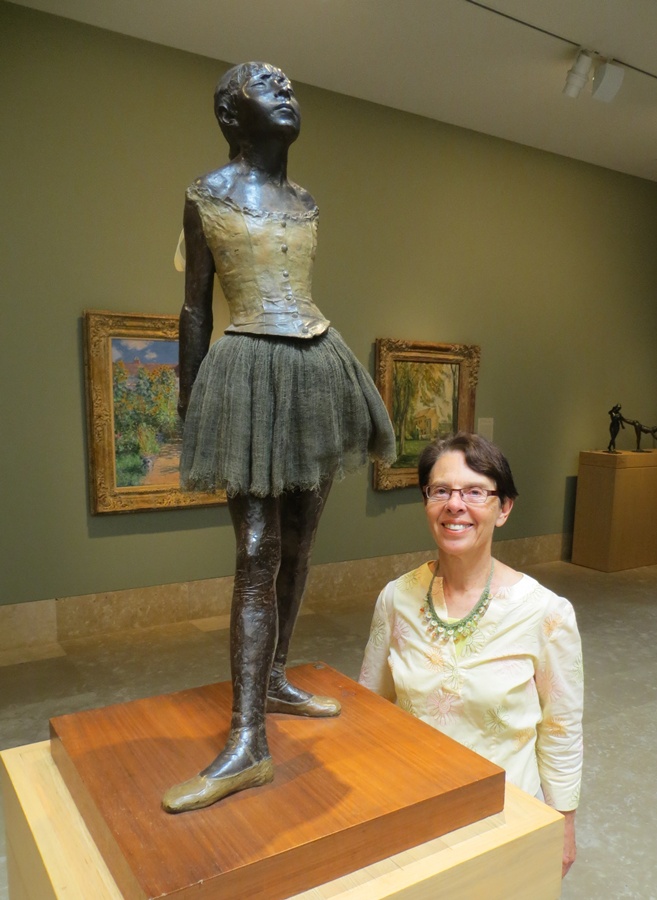
FOUR YOUNG DANCERS by Edgar Degas

Young Dancer by Edgar Degas, Art Institute of Chicago
On a recent visit to the Art Institute of Chicago, I met, once again, the famous sculpture of a young dancer by Edgar Degas. It was like meeting an old friend. In each case, her tutu was a different color, but the figure, paused in thought, was the same.
Little Dancer Age Fourteen, Musee D'Orsay
My first encounter with her was in Paris at the Musee D'Orsay in 1998.
Little Dancer, Norton Simon Museum
I then met her again a few years later in Pasadena, California, at the Norton Simon Museum.
Original Wax Sculpture of the Little Dancer, National Gallery, Washington, D.C.
And then, on a trip to Washington, D.C., three years ago, I saw her again. My previous views–in Paris, at the Norton Simon Museum in Pasadena, and in another exhibit at the National Gallery–were all casts made after his death.  This time I saw Degas’ original wax sculpture of the Little Dancer from which the casts were made, so for the first time I could see how the surface was modeled.  The figure is made of wax over a metal armature to which the artist added wood, rope, and even old paintbrushes in the arms.  Then a wig of human hair was added as well as a cotton-and-silk tutu, a cotton faille bodice, and linen slippers. Her turned out toes, erect posture and raised chin seem to convey an inner determination.The wax model of Little Dancer Aged Fourteen was on view from October 5, 2014 to January 11, 2015.
For a fascinating history of the various versions of the young dancer sculpture, click HERE.

Monday, February 22, 2016

BIKING THROUGH FRANCE: from the Memoir of Carolyn T. Arnold

Old Roman Bridge, Along the Riviera, France
My husband’s Aunt Carolyn bicycled in France in the summer of 1951. The following is an excerpt from her memoir about the trip.

Following my pleasant experiences bicycling in Ireland (see post for 7/29/13), I decided to try France, Italy, and Switzerland in the same way the following summer. The hostel group landed at Cherbourg, and after preliminaries at Customs, we began our journey through Normandy and quaint Brittany.
American Memorial Cemetery, Normandy, France
From the city of Avranches, we saw Mont St. Michel, perched high on a granite rock, an island at high tide. We crossed the causeway at low tide to the village at sea level. Then we began the climb up the rocky trail to the church at the top, rising 500 feet above the village. Later, back at the village, we paused for the famous omelettes at Madam Poulard’s, cooked over an open fireplace.
Two French boys in grain field
Along the beautiful Loire Valley, we saw many famous old chateaux: Amboise, Chenonceaux, and Chaumont. I lost the group in Amboise and found my college French was not adequate to communicate. I did get the attention of a gendarme directing traffic, mainly, as he pointed out, because I was riding the wrong way on a one-way street! I soon overtook my friends.
Amboise Cathedral
From Tours, we took a train to the Riviera. Riding along the beautiful coast road was very warm, so occasionally we stopped for a quick change and a dip in the sea.
Beach at Cannes
We continued on from Cannes to Nice to Monte Carlo, where again I got lost, but my French had improved by this time. Finally, together again, we crossed the French-Italian border–all downhill riding. We checked our bicycles to Venice for storage and continued by train to Rome.
Boarding the train
After touring Rome, Florence, Venice and Switzerland, we returned to Paris. Joan, my roommate, and I bought a paperback, “Paris on Foot.” That was a lucky purchase as it divided the city into areas which could be seen by foot in one day. We covered every area of the city during the week and also learned to ride the Metro.
Boulevard St. Michele, Paris
We met another hosteler one evening, and he escorted us to a bistro where we joined in the singing with the locals. We were wide-eyed at one middle-aged gentleman (probably an American) who had too much wine. Two French girls, who had been playing up to him, helped him stagger from the room. The girls came back a short time later, and we felt sure they had his bank roll.
Flower seller, Paris
Can you imagine riding a bicycle across the Place de la Concorde? Traffic was with an “I don’t care attitude,” whizzing around the great circle. The traffic gave me pause for a minute, but we were on our way to the boat train and home. We made it.

Perhaps the original intrepid tourist was Carolyn Arnold, my husband’s aunt.  A single school teacher in Des Moines, she began traveling abroad when she was in her forties, beginning with a bicycling trip through Ireland in 1950.  She went on from there to spend a year as a Fulbright Exchange Teacher in Wales, to more trips to Europe and beyond, and eventually became a tour leader, taking all her nieces and nephews (including Art) on her travels.  When she retired from teaching, she wrote of her experiences in a memoir called Up and Down and Around the World with Carrie.  Today, as I read of her travels, I marvel at her spirit of adventure at a time when women did not have the independence they do today. 

All photos by Carolyn T. Arnold.

Monday, January 2, 2012

Paris Weekend, August 1998

Paris:  Rodin Museum with the Thinker
Woody Allen’s recent movie Midnight in Paris brought back memories of my one and only visit to Paris in August, 1998, when Art and I spent a long weekend there during our three month stay in London.  Here is the entry from my diary at the time:

    It was the August Bank Holiday Monday in England and rather than fight the crowds at London’s traditional West Indian Carnival (the equivalent of Mardi Gras and touted as Europe’s biggest street festival) we decided to spend the weekend in Paris.  We traveled via Eurostar, the high speed train that goes through the Chunnel. (The Chunnel part lasts about 20 minutes.)  It is a remarkably easy way to get from the heart of London to the heart of Paris in just under three hours.  Because we booked late we ended up going first class which cost more but meant that we were wined and dined both ways.
Toy boats for rent in the Tuileries Garden
We arrived midday on Saturday and after checking into our hotel (near the Place d’Italie on the Left Bank) we set out on foot to explore the city.  Half the fun is just wandering through the narrower streets past sidewalk cafés, open air markets, art galleries, etc.  Whenever we travel to Europe (which isn’t that often) we are on a perpetual search for a certain kind of leather key case Art likes and this gives us an excuse to go into shops.  Much to my surprise, I remembered more of my high school and college French than I would have thought, and we managed to communicate quite well.  (We never did find a key case.) 

Notre Dame Cathedral, Rose Window
Our stroll eventually brought us to the Seine and to Notre Dame Cathedral, a must-see despite the crowds.  We arrived as an afternoon service was just ending.  The combination of the organ music reverberating through the lofty  spaces, the waxy smell of hundreds of votive candles, and the brilliant stained glass rose windows makes one appreciate the power of the church.  We had dinner at a tiny family run restaurant where the food was delicious even though we weren’t completely sure of what we were eating.  (Menu items were not a staple of my high school French training.)  Paris is a relatively small city and one can walk or take the Metro almost anywhere. 

Eiffel Tower at Night
After dinner we walked to the Eiffel Tower which is brilliantly lit up at night.  Art doesn't like heights so we didn’t go to the very top, but compromised on the middle level—which is still hundreds of feet off the ground.  Needless to say, the view was impressive with the city and the river sparkling below.  One historical tidbit explained at the tower is that after it was finished in 1889, it was used to test the physical principles of falling objects.  Basically, they tossed things over the side and watched them fall!

Sacre Coeur
 Sunday in Paris was devoted to museums and a visit to Montmartre and Sacre Coeur, a church on top of a hill in one of the more arty, and quaint parts of Paris.  One climbs the steps to the church mainly for the view.  Stationed around the base were a number of street performers dressed like clowns, mummies, etc.  Each one stood motionless, like a statue, until a coin dropped into the hat; then the figure would change to a new position, a performance that especially entranced children.  The mummies, which looked like King Tut wrapped in gold stretch fabric, were particularly bizarre.

Viewing a Degas Dancer in the Musee D'Orsay
 Paris has too many museums to see anything but a sampling on a weekend visit.  On Sunday we decided to go to the Musee D’Orsay, a former railway station that has been remodeled  to display a large portion of the wonderful 19th Century and Impressionist paintings in the Louvre collection.  We also went to the Rodin museum which displays his works in a lovely 18th century house and garden.

Louvre with I.M. Pei designed Pyramid in front.
We saved our trip to the Louvre until Monday and spent most of the day there.  When we got tired of looking at art we walked in the Tuileries Gardens which stretch out in front of the museum and look toward the Arc de Triomphe.  At the end of the afternoon we returned to the train station, got onto the train, and zipped through the French countryside as the sun was casting golden shadows over the fields.  Altogether, it was a lovely weekend. 
Au Revoir!