Showing posts with label Chicago. Show all posts

Monday, October 28, 2019

ANDY WARHOL: From A to B and Back Again, Exhibit at SFMOMA, San Francisco, CA

Andy Warhol, Self Portrait, at SFMOMA exhibit Andy Warhol: From A to B and Back Again
At the end of August, when I was in Oakland, I took the BART to San Francisco to see the fabulous Andy Warhol retrospective at the San Francisco Museum of Modern Art, Andy Warhol: From A to B and Back Again. (The title of the exhibit is taken from Andy Warhol's book, The Philosophy of Andy Warhol, 1975.) The show ended September 2nd but is  now at the Art Institute of Chicago where it opened on October 20th. (Previously, the show was at the Whitney Museum in New York.) 
Portraits of Elizabeth Taylor and Marilyn Monroe
The exhibit encompasses Andy Warhol’s career from his growing up years in Pittsburgh and early career in New York in the fashion industry, to his ground breaking conversion of soup cans and Brillo boxes to pop art, to portraits of Marilyn Monroe, Elizabeth Taylor, Jackie Kennedy, and much, much more.
Painting of S and H Green Stamps, created by making a stamp from a rubber eraser.
His painting of S and H green stamps (apparently inspired by helping his mother paste them into books) brought back similar memories of mine, filling books with stamps my family got at grocery stores and gas stations and then turning them in to redeem prizes. In the same room at the museum a pile of Brillo boxes and a diagram of dance steps to do the Lindy were displayed.
A pair of diagrams showing the pattern of foot-steps (one for the man, one for the woman) doing the Lindy, a popular dance originating in the 1920s
The exhibit was so big that at MOMA in San Francisco it took up space on three floors (plus one more if you count the examples of his black and white photographs displayed on the third floor of the museum.)
Mylar silver cloud pillows. Recreation of 1966 exhibit of helium filled Mylar balloons at the Castelli Gallery.
In one room, giant silver balloons formed a popular interactive exhibit. Visitors, especially children, enjoyed batting the cloud-like pillows into the air, creating a constantly changing 3-D art piece.
Flower paintings and cow wallpaper
The variety of Andy Warhol's creativity is astounding, ranging from painting and pop-art, to video, television, interactive and performance pieces, to magazines (Interview) and advertising.
The large Rorschah painting was inspired by the "ink blot test" created by Swiss psychiatrist Hermann Rorschach.  Warhol folded the canvas in half vertically to make a mirror image of the design.
Although I had long been aware of Andy Warhol’s soup cans and extravagant life style during the 1970s in New York, I never appreciated the breadth and brilliance of his creativity until I saw the exhibit of his work at SFMOMA.
A few of Andy Warhol's commissioned portraits.
Among my favorites were his portraits, displaying both his painterly style as well his impeccable sense of design and ability to capture the essence of his subject. From 1967 to 1987, Warhol made hundreds of commissioned portraits, typically using a combination of Polaroid photography, screen prints, and paint. One room at SFMOMA is dedicated to these portraits.
The giant image of Mao was created by Andy Warhol in 1972. (Acrylic paint, silkscreen ink, pencil on linen.)
To appreciate the giant painting of Mao Tse Tung one has to stand on the other side of the room. It is mounted on a recreation of the Mao wallpaper that was on the walls of Andy Warhol's studio.
Wilhelmina Ross
Andy Warhol often painted the same subject over and over, as in the case of Wilhelmina Ross. He painted her 73 times, originally as part of a commission by an Italian art dealer in 1974 for a series of 105 portraits of drag queens.
A matchbook with "Drink Coca-Cola" on its cover, has been blown up to giant size in this painting.
But what most people will remember about Andy Warhol is his elevation of ordinary objects, such as a bottle or glass of Coca-Cola, to the status of art, making us think twice about the role these objects play in our lives and our culture.

Monday, August 28, 2017

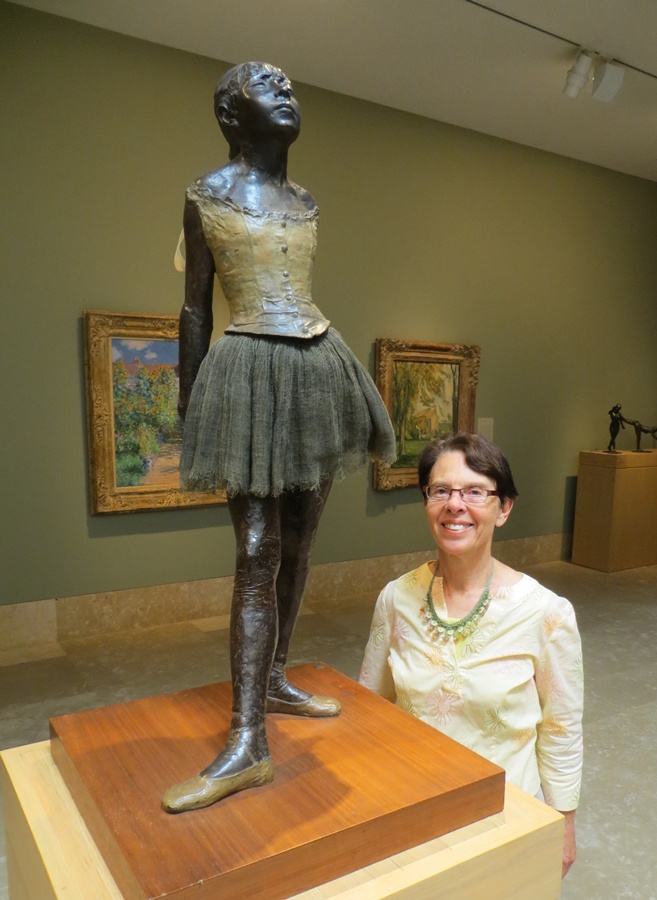
FOUR YOUNG DANCERS by Edgar Degas

Young Dancer by Edgar Degas, Art Institute of Chicago
On a recent visit to the Art Institute of Chicago, I met, once again, the famous sculpture of a young dancer by Edgar Degas. It was like meeting an old friend. In each case, her tutu was a different color, but the figure, paused in thought, was the same.
Little Dancer Age Fourteen, Musee D'Orsay
My first encounter with her was in Paris at the Musee D'Orsay in 1998.
Little Dancer, Norton Simon Museum
I then met her again a few years later in Pasadena, California, at the Norton Simon Museum.
Original Wax Sculpture of the Little Dancer, National Gallery, Washington, D.C.
And then, on a trip to Washington, D.C., three years ago, I saw her again. My previous views–in Paris, at the Norton Simon Museum in Pasadena, and in another exhibit at the National Gallery–were all casts made after his death.  This time I saw Degas’ original wax sculpture of the Little Dancer from which the casts were made, so for the first time I could see how the surface was modeled.  The figure is made of wax over a metal armature to which the artist added wood, rope, and even old paintbrushes in the arms.  Then a wig of human hair was added as well as a cotton-and-silk tutu, a cotton faille bodice, and linen slippers. Her turned out toes, erect posture and raised chin seem to convey an inner determination.The wax model of Little Dancer Aged Fourteen was on view from October 5, 2014 to January 11, 2015.
For a fascinating history of the various versions of the young dancer sculpture, click HERE.

Monday, August 21, 2017

Chicago River Cruise: MAGNIFICENT ARCHITECTURE

Chicago Skyscrapers
No one who visits Chicago can fail to be impressed by the soaring skyscrapers and other large historic buildings that crowd the downtown. One of the best ways to appreciate their beauty, origin, and role in Chicago’s history is to take a river cruise sponsored by the Chicago Architecture Foundation, which I did on a recent visit. The cruises are narrated by knowledgeable volunteers who point out key features of the buildings, tell about who designed them and when, and about their significance.
We are directed to the dock at the top of the stairs to the river walk
It was a beautiful sunny day, not too warm or windy. To board the boat we went to the dock, located on the river walk just east of the stairs descending from Michigan Avenue.
Chicago River and River Walk
We sat in long rows of chairs on the top deck of the ship, affording us with a 360 degree view of our surroundings. The trip began by sailing westward up the river to the north branch, passing under numerous bridges. Although built as drawbridges, we were told that they are now raised only twice a year, in spring and fall, to let large boats into or out of  their winter docks. After the cruise was finished, we walked along the river and visited one of the bridge houses, now turned into a museum.
View of the bridge from inside the bridge house
Most of the buildings in Chicago today were constructed after the great Chicago Fire of 1871 that had destroyed much of the city. As we made our way up the river, it was a trip through history, although jumbled together. Side by side are old and new, lavishly decorated and starkly plain, utilitarian and almost whimsical.
Going under the Dearborn Street Bridge

Reflections
I was particularly fascinated by the reflective glass of some buildings that echoed and altered their neighbors across the river. Or, in some cases, the river itself.
River Point marks the confluence of the river's main stem with its two branches. The arches at the top and the bottom are designed to reflect  the shape of the building and the curves of the surrounding banks--both literally and figuratively .
River Point, built 2017. Designed by Pickard Chilton Architects
 Marina City, built in 1967, are two giant towers that are part of a multi-use complex. The curved balconies remind people of giant corncobs.
Marina City towers
At the end of the cruise we headed toward Lake Michigan, turning around at the Marina. To our left was the amusement park on Navy Pier.
Giant Ferris Wheel, Navy Pier
 As we turned around we were treated to the full panorama of the Chicago skyline. It was spectacular.
After docking, we ate lunch at one of the many riverside restaurants, and then took a walk along the river to enjoy the sights and sounds of life along the water's edge. I thank Jim Akerman and Luann Hamilton and their daughter Claire, for treating me to this wonderful view of their city and for being most generous hosts during my visit.
To learn more about Chicago architecture, visit www.architecture.org
View of skyline from the cruise
 

Monday, August 14, 2017

THE CHICAGO ART INSTITUTE: From Paperweights to Impressionists and More

Two stately lions guard the entrance to the Art Institute of Chicago, one of the oldest and largest art museums in the United States, and one of my favorites. As I walked up the steps from Michigan Avenue and opened the door, stickers proclaimed it to be Chicago's number one museum choice on TripAdvisor. 
Rainy Day, Paris, Gustave Caillabotte, 1877
My visit to the museum on a recent trip to Chicago was an opportunity to become reacquainted with some of the museum's most famous paintings, including George Seurat's Sunday Afternoon on La Grande Jatte, Vincent Van Gogh's Bedroom at Arles and a number of Claude Monet's haystack paintings. 
Detail, Sunday Afternoon on La Grande Jatte by George Seurat
I have fond memories of visiting the Art Institute as a child and when I was in college and art school in Iowa (we rode to Chicago on the train.) I haven't been back since, so it was a delight to visit again. The museum has grown enormously with several additional modern wings.
Sculptures in the Modern Wing
Like most large museums, it is impossible to see everything in one visit so I decided to focus on the modern European and American wings. But on my way, I saw a sign pointing downstairs to an exhibit of paperweights and a special photography exhibit.
Paperweights from the collection of philanthropist Arthur Rubloff
My parents had their own small collection of paperweights so I was intrigued to see that exhibit–hundreds of glass paperweights arranged in artful designs.It is one of three premier collections of paperweights in the world. Other well-known paperweight collectors include Truman Capote, who wrote that the paperweight was like "some fragment of a dream."
Juvisy, France, photograph by Henri Cartier-Bresson
I am always interested in photography, so I went to see that exhibit too. It was a selection of photographs acquired by Hugh Edwards, curator of photography from 1959 to 1970. Edwards wrote about a photo by Cartier-Bresson of children playing by the Seine, "There are many great photographs by Cartier-Bresson, but this always remains my favorite."
Haystacks by Claude Monet
My visit to the museum was short and I was able to see only a fraction of the pieces on exhibit. I hope it won't be so long before I go back again.
A special exhibit of Gauguin paintings opened June 25th and will be open until September 10th.
Paul Gauguin: Artist as Alchemist, exhibit

Monday, April 8, 2013

ROOM WITH A VIEW: Two Year Anniversary of The Intrepid Tourist

Isle of Mull (Inner Hebrides, Scotland)--view from the front door of our country hotel, Tiroran House.
Two years ago, I launched The Intrepid Tourist as an outlet for my accumulated writing and ongoing thoughts from a lifetime of travel.  I didn't know if anyone else would be interested in my posts, but, somewhat to my surprise, the blog has logged more than 28,000 views since it began in April 2011.  Thanks to all of you have been reading my posts!  For this second anniversary I would like to share a few views from my hotel rooms as I have traveled to various places.  I almost always take a photo of the view from my room, both as a document of where I've been, and a reminder that the travel experience is not just the official sights, but also the more personal view.
View of the Dubai skyline with the Burj Khalifa, the tallest building in the world, seen from our hotel near the airport.
In the old days of film cameras, the room views were a way of starting off or finishing a roll of film.  Now, with a digital camera, the view from the room just becomes part of the overall photo album.  Sometimes the view is a spectacular vista, in other cases it may be a glimpse of local life, an unusual perspective, or a momentary event.

On my recent trip to Turkey, my hotel was on a narrow residential street. Each morning as light began to dawn, I was awakened by the call to prayer at the nearby mosque. Later, as I leaned over the small balcony on my third floor street-side room I could see my neighbors, the ubiquitous cats, and the view of the harbor beyond the end of the street. 

View toward the water down Kumbaraci Street, in the Beyglu neighborhood of Istanbul
Occasionally the most interesting view is aerial, sometimes looking down onto an interior courtyard.  On a trip to Barcelona several years ago we stayed in a large, high-rise hotel.  As we looked down into the atrium the umbrellas in the bar area loomed like giant mushrooms.

Looking down onto the bar area of Hotel Rey Juan Carlos in Barcelona.
Sometimes the most interesting view is at night. When I visited Chicago a year ago and looked out of my room one evening, I was struck by the geometric shapes of the buildings framed against the misty night sky.

Night view of Chicago skyscrapers from my room at Hotel 71.
I look forward to more travel in the future and to adding to my photo collection of rooms with a view.  I will continue posting reports and hope that you will continue reading them.  My list of places to go and things to see keeps growing!

Monday, June 25, 2012

Commentary by Marie Akerman on the poem "Map" by Julie Cadwallader-Staub


We recently attended a family reunion and Art's aunt proudly shared the essay that her granddaughter, Marie Akerman, had written for the History of Cartography Project, No. 20, a commentary on "Map" by Julie Cadwallader-Staub. It is a delightful essay and brought back memories of the many maps in my life. The poem that inspired the essay was written by Julie Cadwallader-Straub, who lives in Burlington, Vermont. She included “Map” in her first published collection of poetry, Face to Face (DreamSeeker Books, 2010); it is also featured on her website, www.juliecspoetry.com and Garrison Keillor read it on National Public Radio, in The Writer’s Almanac for 23 March 2011 (writersalmanac.publicradio.org).

Here is the beginning of Marie's commentary:

Like Julie Cadwallader-Staub I, too, have grown up surrounded by maps. When I was a kid my family crowded into our car each summer, my sister and I buried in the backseat with luggage and several unwieldy road maps. My dad led us on exhausting trips across the web of highways that link Chicago, my hometown, to every other place on the continent. Although my dad was the one who toiled lovingly over the itineraries, my mom was no passive bystander on the road. She was the navigator, pointing out when my dad had strayed from the bold line of red marker that highlighted our route—“Jim! That was the exit!” At the time I didn’t realize the significance of these well-worn pieces of paper, but as I have gotten older I have come to appreciate my dad’s collection of personalized road maps. They record a childhood’s worth of family trips; they are memories of summers and days that I can no longer remember on my own. ..... Read the rest of this wonderful essay written by Marie Akerman at the History of Cartography Project.

Like Marie, I have many memories of maps, and like Julie-Cadwallader-Staub, I grew up in Minneapolis. (Her poem recalls childhood trips with her family in Minnesota as she visits her aging father.)  When I was a child, my family made annual summer trips from our home in Minneapolis to visit our relatives in Wisconsin, Illinois, Ohio, and once, all the way to California. This was before the days of freeways and I remember poring over the maps as we drove, calculating the total distance by adding up the distances between towns, dividing it by our speed (which was difficult because it constantly varied) and trying to estimate our time of arrival.  After I grew up and got married, some of our trips took us to Chicago where we visited my husband's relatives, which included  Marie and her family.  On one of those trips I remember using a Triptych from AAA, a kind of map flip-book that broke down each section of the trip into a page size segment.  Today, as we travel, my husband likes to use his GPS to get us to our destination, but I still prefer a paper map. Like Julie, I like to imagine us as a tiny dot following those black lines across the paper.  At any moment in time, I want to "see" where we are on the map. 

I hope you will follow the links to read Julie Cadwallader-Staub's poem and Marie's full essay.  
 
No. 20. “Map,” by Julie Cadwallader-Staub,Commentary by Marie Akerman was first published 2012 as a limited edition broadsheet by the History of Cartography Project, Department of Geography, University of Wisconsin–Madison, 550 North Park Street, Madison, WI 53706-1404, U.S.A.  http://www.geography.wisc.edu/histcart
Marie Akerman is daughter of geographer Luann Hamilton and map historian James Akerman, of Chicago. She recently graduated from Grinnell College, Grinnell, Iowa, where she majored English.

Monday, May 7, 2012

CHICAGO: Marilyn, Millennium Park, and the Art Institute—A Stroll Down Michigan Avenue

One tower of the Crown Fountain, Millennium Park
Recently, I was in Chicago for a conference and had an hour or so on the last afternoon to stroll down Michigan Avenue from my hotel on Wacker Drive to Millennium Park and the Chicago Art Institute about a half-mile away.


25-foot Marilyn Monroe Statue
My first stop was across the bridge over Chicago River.  I wanted to take a closer look at the giant Marilyn Monroe statue mounted in the plaza near the Chicago Tribune building on Chicago’s Magnificent mile.  Sculpted in her iconic pose with skirts flying, she dwarfed the people below.  I didn’t realize that this was a last chance to see the statue in Chicago.  The 25-foot-tall statue of the actress is slated to leave its spot along Michigan Avenue on May 7th and go to Palms Springs, California. The bronze and stainless steel sculpture, created by artist Seward Johnson, depicts Monroe in her famous pose from the film “The Seven Year Itch.” In the film, a draft catches Monroe’s dress as she passes over a subway grate.  Apparently, as soon as the sculpture was unveiled last July, people began positioning themselves under the movie star’s dress to catch a subway-level view and snap pictures.

Every Tree Counts!
I then turned back across the river and headed south past several blocks of shops and restaurants before arriving at Millennium Park.  It was spring, and rows of blooming tulips lined planters along the way.  It also sprinkled off and on so I was glad I had my raincoat. The first thing I noticed when I got to the park, besides the fact that it was an island of green amidst neighboring skyscrapers, was that the trees all had large green tags tied around their trunks, informing us of their monetary value to the community. In celebration of Arbor Day in 2011, the Morton Arboretum tagged hundreds of trees in Illinois with the dollar amount each tree will give back to the community in environmental and socio-economic benefits over the next 15 years. Trees absorb air pollutants, including ozone, nitrogen dioxide and sulfur dioxide, through the leaves and intercept particulate matter like dust, ash and smoke. They also lower air temperature, reducing the production of ozone. 

Jay Pritzker Pavilion, Millennium Park

Peeking through the trees at the back of the park I could see what looked like large metallic sails silhouetted against the sky.  As I walked closer I saw that they formed the roof of an outdoor amphitheater. Designed by Frank Gehry, the Jay Pritzker Pavilion is said to be the most sophisticated outdoor concert venue of its kind in the United States.  It was empty on a weekday afternoon, but I could imagine it filled with people.


Reflected in the Cloud Sculpture
Walking back toward the street I came upon an elevated plaza in the center of the park on which a shiny giant amoeba shaped structure sat, reflecting the surrounding skyline and all the passersby, including me.  The curved surface made it function like a huge fun-house mirror.  The cloud sculpture was designed by artist Anish Kapoor as an interactive piece and it was impossible to not be drawn to it and try to take a picture of myself reflected on its surface.

Caroline in Millennium Park

Every turn revealed a new sculptural surprise.  In a small garden plaza stood three open ball shaped structures in blue, yellow, and white created by Mexican artist Yvonne Domenge. Below the garden was the Crown Fountain, two 50-foot glass block towers of flowing water that project video images of 1,000 different Chicagians onto their surfaces.  Created by artist Jaume Plensa the facing images appear to look at one another and interact as their expressions subtly change and then disappear, or abruptly squirt water out of their mouths, before morphing into a new face. Children were having fun splashing in the water that collected at the base of the towers.

Art Institute of Chicago
Finally, I arrived at the Art Institute with its familiar lions flanking the entrance. I have fond memories of visits to the Art Institute when I came to Chicago as child with my family on visits to my grandmother and later when I was in college in Iowa and rode to Chicago on the train.  I didn’t have time to see any of the current exhibits on this trip, but browsed in the wonderful museum gift shop.  I’ll have to return to Chicago on a longer trip and do all the things that I missed this time.


Monday, February 6, 2012

London's Toynbee Hall: The First Settlement House

Toynbee Hall is in London's East End
In the summer and fall of 1998, during our three month stay in London, I paid a visit to Toynbee Hall, founded in 1884.  I wanted to get  more insight into the beginnings of the settlement house movement in England and also how it evolved--or in fact, didn't evolve--in the same way as it did in the United States.  The visit was inspired by the research I did for my book, Children of the Settlement Houses, and my own background growing up in a settlement house in Minneapolis.  (Until I was ten, my family lived at the Northeast Neighborhood House, now East Side Neighborhood Services, which my father directed.  Go to at my website  and to my Dec 14 Art and Books blog for more about my life growing up at Northeast Neighborhood House.)

Social reformers Samuel and Henrietta Barnett founded Toynbee Hall
Much of Toynbee Hall was bombed during WWII, but the main building that has the dining room and main meeting room remains almost unchanged.  I was surprised to find out that the main focus, even into the 1980's, was still residential--that college and post college students from Oxford and Cambridge would live in Toynbee Hall and the idea was that somehow this meeting of the classes in the neighborhood would result in the enlightening of the poor.  I somewhat overstate the case, because there are some ongoing programs for children and the elderly at Toynbee Hall, but it doesn't seem to have the vibrancy of U.S. settlements, which as far as I can tell have changed a lot in the last hundred years to meet the needs of the time.  Part of the stodginess of Toynbee Hall, I'm told, is because of the huge cutbacks in funding for social programs during the Thatcher years.  Many social service agencies in Britain have still not recovered.  In any case, it was fascinating for me to see the roots of the settlement house movement.  You might say that if it hadn't been for Toynbee Hall my parents might never have met and I wouldn't be here today.  (My parents were social workers and met in Chicago in the 1930's.  They lived and worked at Association House as they were training for their careers in settlement house work.)

Settlement houses still exist today, mostly in large cities, and are community centers offering a wide range of social services ranging from day care and food banks to sports and recreational programs, services for seniors, and more.  A famous early settlement house in the United States is Hull House, founded by Jane Addams in Chicago.  I visited Hull House, now a museum, earlier in the same summer that I visited Toynbee Hall.  The neighborhood that Hull House originally served was torn down for urban renewal, but the original building is maintained by the University of Illinois.  Settlements have evolved as the needs of the people in the neighborhoods around them have changed.  Some have closed their doors but many continue to serve the people in their surrounding communities. Sadly, the Jane Addams Hull Association, which had served people in Chicago for 122 years, closed its doors on January 27, 2012, a victim of the economic downturn and inability to fund its programs.

In 1884 when Toynbee Hall was founded, the neighborhood around the settlement, which is in London’s East End, was largely Jewish and eastern European , but now it is almost totally Bengali.  As you walk down the main shopping street you see shops filled with strange vegetables, exotic spices and beautiful saris.   The neighborhood is also famous for its restaurants and on the day of my visit I had a delicious and inexpensive curry lunch at one of them.