Showing posts with label photographer. Show all posts

Monday, July 17, 2023

ANSEL ADAMS PHOTOS AT THE DE YOUNG MUSEUM, San Francisco, CA

Photo by Ansel Adams, Marin Hills from Lincoln Park, 1952

It is hard to picture the American West without thinking of Ansel Adams and his iconic black and white photos—of New Mexico, Yosemite, the San Francisco Bay area, and other places in the western US. A spectacular exhibit of 100 of Ansel Adam’s photos is currently on display at the De Young Museum in Golden Gate Park in San Francisco, California, along with the work of other photographers and artists who have been inspired by the same landscapes but interpreted them in their own way. 

At the de Young Museum, San Francisco, CA

The exhibit, called Ansel Adams In Our Time, reveals his continued relevance   “Adams’s legacy continues to inspire and provoke, influencing how we envision the landscape and serving as an urgent call to preserve our environment.”

We visited the museum with our granddaughter on a recent Sunday afternoon, reserving our timed entry tickets ahead of time. The rooms were crowded but people patiently waited their turn to get close to the photos. Only at close view can one appreciate the richness of the tones and sharpness of the images—from the range of grays in billowing clouds to the tiny cross on the top of the church in New Mexico.

The Golden Gate Before the Bridge, 1932. Photograph, gelatin silver print. Museum of Fine Arts, Boston.

Ansel Adams’ (1902-1984) grew up in San Francisco. His family home was not far from the cliffs above Seal Rocks. One of my favorite photos in the exhibit is the one he made one clear morning as storm clouds rolled in toward the Golden Gate. This was in 1932, shortly before the Golden Gate Bridge began construction. (The bridge was completed in 1937.)  He later recalled: “One beautiful storm-chasing morning I looked out the window of our San Francisco home and saw magnificent clouds rolling from the north over the Golden Gate. I grabbed the 8-by-10 equipment and drove to the end of 32nd Avenue, at the edge of Sea Cliff. I dashed along the old Cliff House railroad bed for a short distance, then down to the crest of the promontory. From there a grand view of the Golden Gate commanded me to set up the heavy tripod, attach the camera and lens, and focus on the wonderful evolving landscape of clouds.”

The photo memorializes the vastness of the landscape as it was before its intrusion by human-made objects.

The Golden Gate from Telegraph Hill, photo by Carleton E. Watkins, 1868

The exhibit also includes historical photos, including one by Carleton E. Watkins, The Golden Gate  from Telegraph Hill, 1868. In contrast to Adams’ photo, the city dominates in this view of the Golden Gate entrance to San Francisco Bay while the natural landscape fades into the mist.

Canyon de Chelly National Monument Arizona, printed 1967.

Photos like Canyon de Chelly bring the grandeur of nature to the American public,

Ferns near Kiluea Crater National Park, Hawaii, ca 1948.
while  pictures like these ferns, seen close-up, celebrate the patterns and intricacies of the natural world.

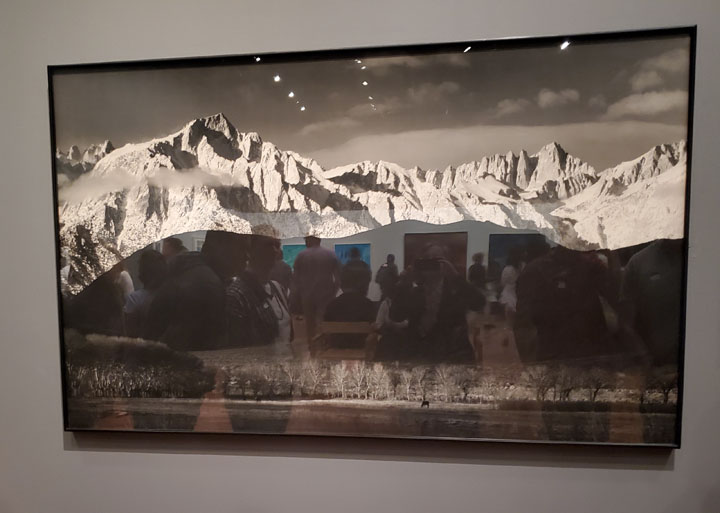
Winter Sunrise, View from Lone Pine.

Most of the photos in the exhibit are relatively small prints requiring close inspection. But in Winter Sunrise, View from Lone Pine, California, printed large and framed in glass, the reflection of the museum gallery on the dark lower slopes creates a collage uniting viewers with the art. It is why people go to museums—to enjoy a personal relationship with the art. At the top of the photo, the snowcapped peaks of the Sierras rise to the skies above the dark hills below ,and at the bottom, frost rimed trees sparkle in the morning light. If you stand to the side to eliminate the reflection, you can see the photo as Ansel Adams intended. It is a brilliant picture.

This is only a small sample of the Ansel Adams photos in the exhibit. The accompanying art work by other artists is also worth a look. The tent camera photos by Abelardo Morell, in which the ground becomes integrated with the view, are unique. I wondered how the images were merged with the photo until I read the description of the method. (See below.)

Tent-Camera photos by Abelardo Morell.

A digital camera captures the reflection of the landscape on the ground in a tent made into a pin-hole camera.

But it is the Ansel Adams photos that are the star of the show. The exhibit will be up at the De Young Museum until August 6, 2023. If you don’t get to see it in person, you can buy the book in the museum shop (which we did) and enjoy it again and again at home.

Monday, October 23, 2017

BOWERS MUSEUM, Santa Ana, CA: 100 Years Ago, Ernest Shackleton's Antarctic Expedition and Frank Hurley's Amazing Photos

Bowers Museum of Cultural Art, Santa Ana, California
One hundred years ago, Sir Ernest Shackleton’s Antarctic expedition came to an end when he and his crew were rescued after a harrowing two year ordeal trapped in ice and out of touch with the world. Newspapers around the world ran headlines to celebrate, publishing amazing photos by Australian photographer Frank Hurley, who had been hired to document the expedition. Endurance: The Antarctic Legacy of Sir Ernest Shackleton and Frank Hurley is a  fascinating exhibit of Frank Hurley’s photos and other artifacts from the expedition at the Bowers Museum of Cultural Art in Santa Ana, California from September 30, 2017 to January 28, 2018.
Lecture series poster for the exhibit Endurance, the Antarctic Legacy
Two weeks ago we went to see the exhibit and to hear a lecture by Melissa Roth, Pulitzer Prize winning documentary photographer, who is currently working on a book about Frank Hurley. (A number of lectures will be given during the exhibit.) She shared passages from his diary along with critiques of some of his photos, which not only document the journey, but are also stunning works of art. In many, the ship, which was painted black, stands in stark contrast to the surrounding ice and sky. For one of his most famous photos, known as the “ghost ship” or “the long, long night,” he did the opposite. He photographed the ship at night, lighting it with flares to create an eerie contrast with the black sky. Other photos portray the day to day life of the crew, including meals, card games, taking scientific measurements, and even portraits of the dog teams that helped carry equipment on sledges.
Some of the exhibit related items available in the museum gift shop
For the museum exhibit, Hurley’s original glass plates and celluloid negatives, now at the Royal Geographical Society in London, have been scanned at high resolution and printed in large format. The pictures are arranged chronologically. Hurley also had a movie camera and those films are projected on large screens along the wall. One harrowing sequence shows the final collapse of the ship in a storm as it is crushed by the shifting pack ice. Background noises of seals and penguins and the ever present wind enhance the feeling of being there as one follows the sequence of photos around the room. The exhibit prohibits photography. You can see a sample of his photos HERE and read more about Hurley's life of adventure.
One of nine thangka paintings by Shashi Dhoj Tulachan
Before we left, we took a quick look at one of the other current exhibits at the Bowers Museum, Sacred Realms: Temple Murals by Shashi Dhoj Tulachan from the Gayle and Edward P. Roski Collection. These incredibly detailed paintings are huge, unlike typical temple art. They are the work of a 69-year-old Buddhist monk named Shashi Dhoj Tulachan, a second generation thangka artist living in Tuksche, a remote village located in Mustang, Nepal's northernmost district adjacent to Tibet. The practice of thangka painting is centuries old and is an art carried out by highly trained monks to teach about Buddha and the Buddhist religion. The overwhelming amount of detailed imagery in each painting includes deities, mythologies, and the use of repeated and abstracted design. For those seeking enlightenment, thangka paintings exist as objects of meditation.
Video of monks creating a thangka painting
The Bowers Museum also has a number of other exhibits and a variety of permanent collections which we didn't have time to see before the museum closed. We did stop at the gift shop on our way out and purchased a book about the Shackleton expedition and Frank Hurley's incredible photos. The more we look at them, the more we appreciate Hurley's artistic skill and his technical mastery in unbelievably daunting conditions.