Showing posts with label exhibit. Show all posts

Monday, April 1, 2024

ART SHOW--PAINTINGS BY TOM SCHEAFFER, at the Maya Moon Collective, San Diego, CA

Painting by Tom Scheaffer

My brother Tom Scheaffer is currently exhibiting his beautiful paintings at the Maya Moon Collective in San Diego, California, 3349 Adams Avenue, San Diego, CA 92116. 

Tom Scheaffer dressed up as a French artist.

The opening reception, Saturday, March 23rd, 6 to 8 pm, was attended by many of Tom's friends and well wishers. Tom dressed up as a French artist, adding to the festivity of the occasion. 


Tom works in a colorful, expressionist/realistic style, depicting scenes in nature, especially of places in Southern California. His paintings are also inspired by his roots in the upper Midwest and summers in the North Woods at Camp Bovey in northern Wisconsin. Here are some samples of the paintings in the exhibit at the Maya Moon Collective.


If you are in the San Diego area, be sure to stop by to see the exhibit and have a bite to eat at the Maya Moon Cafe. The paintings will be up until the end of April.
Tom gives special thanks to George McKeever for helping him hang the show. For a few more pictures of Tom's paintings, click HERE.


Monday, July 17, 2023

ANSEL ADAMS PHOTOS AT THE DE YOUNG MUSEUM, San Francisco, CA

Photo by Ansel Adams, Marin Hills from Lincoln Park, 1952

It is hard to picture the American West without thinking of Ansel Adams and his iconic black and white photos—of New Mexico, Yosemite, the San Francisco Bay area, and other places in the western US. A spectacular exhibit of 100 of Ansel Adam’s photos is currently on display at the De Young Museum in Golden Gate Park in San Francisco, California, along with the work of other photographers and artists who have been inspired by the same landscapes but interpreted them in their own way. 

At the de Young Museum, San Francisco, CA

The exhibit, called Ansel Adams In Our Time, reveals his continued relevance   “Adams’s legacy continues to inspire and provoke, influencing how we envision the landscape and serving as an urgent call to preserve our environment.”

We visited the museum with our granddaughter on a recent Sunday afternoon, reserving our timed entry tickets ahead of time. The rooms were crowded but people patiently waited their turn to get close to the photos. Only at close view can one appreciate the richness of the tones and sharpness of the images—from the range of grays in billowing clouds to the tiny cross on the top of the church in New Mexico.

The Golden Gate Before the Bridge, 1932. Photograph, gelatin silver print. Museum of Fine Arts, Boston.

Ansel Adams’ (1902-1984) grew up in San Francisco. His family home was not far from the cliffs above Seal Rocks. One of my favorite photos in the exhibit is the one he made one clear morning as storm clouds rolled in toward the Golden Gate. This was in 1932, shortly before the Golden Gate Bridge began construction. (The bridge was completed in 1937.)  He later recalled: “One beautiful storm-chasing morning I looked out the window of our San Francisco home and saw magnificent clouds rolling from the north over the Golden Gate. I grabbed the 8-by-10 equipment and drove to the end of 32nd Avenue, at the edge of Sea Cliff. I dashed along the old Cliff House railroad bed for a short distance, then down to the crest of the promontory. From there a grand view of the Golden Gate commanded me to set up the heavy tripod, attach the camera and lens, and focus on the wonderful evolving landscape of clouds.”

The photo memorializes the vastness of the landscape as it was before its intrusion by human-made objects.

The Golden Gate from Telegraph Hill, photo by Carleton E. Watkins, 1868

The exhibit also includes historical photos, including one by Carleton E. Watkins, The Golden Gate  from Telegraph Hill, 1868. In contrast to Adams’ photo, the city dominates in this view of the Golden Gate entrance to San Francisco Bay while the natural landscape fades into the mist.

Canyon de Chelly National Monument Arizona, printed 1967.

Photos like Canyon de Chelly bring the grandeur of nature to the American public,

Ferns near Kiluea Crater National Park, Hawaii, ca 1948.
while  pictures like these ferns, seen close-up, celebrate the patterns and intricacies of the natural world.

Winter Sunrise, View from Lone Pine.

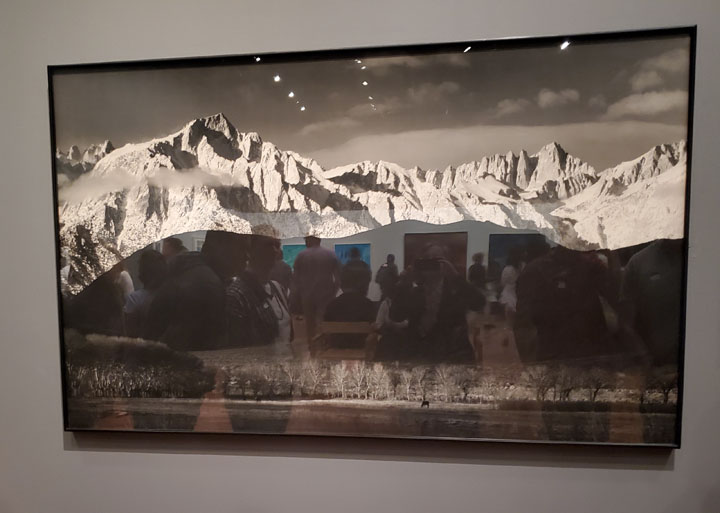
Most of the photos in the exhibit are relatively small prints requiring close inspection. But in Winter Sunrise, View from Lone Pine, California, printed large and framed in glass, the reflection of the museum gallery on the dark lower slopes creates a collage uniting viewers with the art. It is why people go to museums—to enjoy a personal relationship with the art. At the top of the photo, the snowcapped peaks of the Sierras rise to the skies above the dark hills below ,and at the bottom, frost rimed trees sparkle in the morning light. If you stand to the side to eliminate the reflection, you can see the photo as Ansel Adams intended. It is a brilliant picture.

This is only a small sample of the Ansel Adams photos in the exhibit. The accompanying art work by other artists is also worth a look. The tent camera photos by Abelardo Morell, in which the ground becomes integrated with the view, are unique. I wondered how the images were merged with the photo until I read the description of the method. (See below.)

Tent-Camera photos by Abelardo Morell.

A digital camera captures the reflection of the landscape on the ground in a tent made into a pin-hole camera.

But it is the Ansel Adams photos that are the star of the show. The exhibit will be up at the De Young Museum until August 6, 2023. If you don’t get to see it in person, you can buy the book in the museum shop (which we did) and enjoy it again and again at home.

Monday, June 6, 2022

IMOGEN CUNNINGHAM: A Life of Photography, Getty Museum, Los Angeles, CA

Entrance to Imogen Cunningham Retrospective at the Getty Museum, Los Angeles, California.
Two Callas (detail), photo by Imogen Cunningham

When Imogen Cunningham died June 23, 1976, at the age of 93, she was in the midst of a new project, a book about aging. (It was published after her death.) She took photographs for almost her entire life, leaving behind an incredible body of work.  A retrospective exhibit is currently at the Getty Museum in Los Angeles and, for the first time, photos from her entire career--spanning seventy years–have been mounted together, allowing us to see the development of her thought and work in relation to other photographers and artists of her time and to marvel at the depth and breadth of her work.

Imogen Cunningham, San Francisco, 1966. Photo by Edmund Teske

Art and I viewed the exhibit on a recent Saturday afternoon and were surprised that there was not a long line waiting for the monorail train for a ride from the parking lot to the museum. Then we discovered that we were supposed to have made a reservation online (a Covid rule made to limit crowds.) Luckily for us, it wasn’t very crowded that day and we were allowed to continue. The exhibit, which opened March 8, will only be up until June 12, 2022. So, if you plan to go while it is at the Getty, make sure you have a reservation. (From September 15, 2022 - January 7, 2023, the exhibit will be at the Sonoma Valley Museum of Art, Sonoma, CA.)

The Beach, San Francisco, about 1955.
Each room of the exhibit is devoted to a period in Imogen Cunningham's life–from her early years in Seattle, teaching herself how to make pictures with a camera she ordered by mail, to her marriage and years with small children that forced her to stay close to home, to her later work taking portraits and teaching to earn a living, then traveling and interacting with other photographers in the San Francisco Bay area.
Stan, San Francisco, 1959.
An important part of the exhibit is the 28 minute video interview in which Imogen Cunningham reflects on the course of her life, offering comments on particular pictures on view at the museum.
Angel Island, 1952.

The first thing you notice when you enter each room is that virtually all of the photographs are black and white. The other thing you notice is that they are small. You have to stand up close to each one to appreciate the details and range of values. The earliest photos are dark dream-like images taken with a soft-focus lens, inspired by a trip to Europe after she graduated from the University of Washington.
Mills College, about 1928.

In 1917, Cunningham moved from Washington State to the San Francisco Bay area with her husband, Roi Partridge, who had been hired at Mills College in Oakland, and began to make more sharply delineated pictures.

Amaryillis, 1933.

For the next few years, her main subjects were her children and the flowers in her garden. But Cunningham’s flower photos are not what you’d expect. Rather than beautiful blossoms, she comes in close with her camera to turn the leaves and petals into abstract shapes.
Frida Kahlo, 1931.

One room of the exhibit is devoted to Cunningham’s portrait photography, including many pictures of famous people. After her divorce in 1934, Cunningham supported herself and her family by teaching and studio photography. She also became interested in street photography–unposed pictures of people as they appeared in their daily lives. With other San Francisco area photographers she formed a group call f/64. She also joined the San Francisco Women Artists, a group organized to promote, support, and expand the role of women in the arts.
Looped-Wire Sculpture by Ruth Asawa, 1956.

Among my favorite photos in the exhibit is a close up of a piece by sculptor Ruth Asawa, organic abstract shapes constructed from what looks like wire mesh. I have admired Ruth Asawa's work at the de Young Museum in San Francisco, where the pieces hang like giant bulbous webs in the alcove next to the tower elevator.
Cornish School Trio 2, 1935.

Another photo that particularly intrigues me is a photo of a string quartet, created with double exposures on the same negative to reveal the movement of the players and suggesting the rhythm of the music. Other photos, such as Girl at Point Lobos, look almost like paintings.

Girl at Point Lobos, 1968.

One reason I like to take pictures with my phone when I go to an art exhibit is so I can enjoy and re-examine the pieces again after I go home. The above examples are just a sample of the hundreds of photos on exhibit. I recommend going to the exhibit in person so you can pick out your favorites.


Monday, October 18, 2021

IMMERSIVE VAN GOGH: LOS ANGELES

52 Places to Go: Week 42


Last week, Art and I went to the Los Angeles installation of the Immersive Van Gogh show--a distinctly Hollywood experience, dazzling, fascinating, and nothing like viewing Van Gogh’s art in a museum, where the art stays firmly in place on the walls. At the theater/gallery for the Immersive Van Gogh exhibit on Sunset Boulevard, light projections of Van Gogh’s art swirled around us–on the four walls of the room, reflected in mirrors, on the floor, and on us, all to the beat of surround sound music–while we sat inside our designated socially distanced circles, masks on. It was like being inside a giant kaleidoscope.

The show, which repeats about every 45 minutes, roughly follows the course of Van Gogh’s life, from his early paintings like The Potato Eaters, to his final super productive phase, including Starry Night. We sat through the show twice–the first time just in awe and absorbing the experience, the second time admiring again, taking more pictures, and changing our position in the room to see the art from a different angle.

The show invites viewers to step into Van Gogh’s paintings and become part of the scene–to sit at the table with the potato eaters, to join a street scene in Arles, to look the artist in the eye in his self-portraits, to fly with crows over a wheat field in Southern France.
In one sequence, we join the artist’s process as the pieces of furniture in his bedroom are drawn, colored, and placed in the room. And because the paintings are magnified on such a huge scale, one can see and appreciate every brush stroke.


Everyone who is familiar with Van Gogh’s art will recognize the images on the walls–irises, sunflowers, windmills, an absinthe drinker, stars in the sky–as they morph seamlessly from one scene to the next. It was hard to stop taking photos. And yet, the photos capture mere transient moments in the exhibit because the images are constantly moving. (We also took some short videos, but even those are only an approximation of the actual experience.)

Immersive Van Gogh is an elaborate production. It was designed and conceived by Massimiliano Siccardi, with soundtrack by Luca Longobardi, who both pioneered immersive digital art experiences in France. The show has been seen in Paris, Toronto, and has been or will be shown in twenty American cities. (Click on the Choose Your City button on the website to find out when it will be near you.)


In the room just outside the exhibit, a short summary of Van Gogh’s life is presented–The Seasons of Vincent Van Gogh: Winter, Spring, Summer, Fall–with critical facts and dates (born 1853, died 1890.) There is also a sculpture created from the hundreds of letters that Van Gogh wrote. When you leave the show, you exit through the gift shop, where you can purchase all sorts of Van Gogh themed items including books about his life. But the main draw is the exhibit itself, unlike any other art show I’ve ever attended.


Immersive Van Gogh is a good Covid outing--everyone wears masks and keeps their social distance. Tickets are for timed entry, limiting the number of people inside at one time. Our tickets were for 10:00 on a Sunday morning. We did not have to stand in line to get in, but when we came out, there was a long line of people waiting. There are different levels of tickets. Ours included seat cushions (especially useful for sitting on the floor) and when we exited, we exchanged our cushions for a free poster of Van Gogh to take home. 

Before you enter the exhibit, you can take a selfie in front of this enlarged portrait of Vincent Van Gogh.


Monday, December 16, 2019

MANET AND MODERN BEAUTY at the Getty Museum, Los Angeles, CA

Photo of French painter Edouard Manet (Frontispiece design by Eugene Grasset)
The late works of French painter, Edouard Manet (1832 - 1883), are currently on exhibit at the J. Paul Getty Museum in Los Angeles, California. Manet and Modern Beauty includes more than ninety works of art–paintings, drawings, pastels–providing a glimpse into the Manet’s incredible skill as a painter and to his life in his final years. I recently visited the exhibit. Some paintings were familiar, but many I had never seen before. In all, I was awed by his fluid brushstrokes, use of color, and ability to bring his subjects to life.
J. Paul Getty Museum, stairs to Manet Exhibit
As I climbed the stairs to the second floor of the exhibition building, I realized that the vertical portion of each step had been painted to create a giant image of Jeanne, the featured work of the exhibit and a recent acquisition by the Getty.
Jeanne (Spring) was exhibited at the 1882 Salon in Paris, along with Manet’s famous painting A Bar at the Folies-Bergere.
When Manet created the painting, also known as Spring, it was intended to be the first in a series depicting the seasons.The painting shows a beautiful young woman with a flowered bonnet and parasol surrounded by lush greenery. It is the essence of spring rather than a conventional depiction. The series was never completed. Autumn was the only other season Manet painted, and this painting was also in the exhibit--a figure against background inspired by a Japanese silk scarf decorated with a chrysanthemum motif--flowers that bloom in the fall.
Boating, 1881. This painting was begun after Manet began working with the Impressionists
The exhibit is divided into five sections. The first, La Vie Moderne, includes paintings that were first shown at a solo show in 1880 at a Parisian gallery that was connected to a new fashion and culture magazine called La Vie Moderne.
Plum Brandy, 1877
Many of those paintings depict portraits of women in bars and cabarets. Others were of friends and relations or members of Paris society, such as opera singer Emilie Ambre, who was Manet's neighbor in the summer and fall of 1880.
Portrait of Emilie Ambre as Carmen, 1990
The second section, Portraits of an Era includes various portraits, including an example of one he did in pastels. Between about 1878 and his death in 1883, the artist created nearly one hundred pastels, finding the process--which uses sticks of pure color--less demanding than painting.
Portrait of Madame Jules Guillemet, 1880, pastel on canvas
The third section of the exhibit, The Four Seasons, includes the picture of Jeanne, Autumn and others.
In Manet’s final years his health was failing. In 1880 he spent the summer at a spa in Bellevue getting treatments for the pain in his left leg.  The fourth section of the Getty exhibit, Manet at Bellevue, displays illustrated letters written to friends and colleagues from the spa.
Peaches, about 1880
The final section, Flowers, Fruit and Gardens, was one of my favorite parts of the exhibit. The paintings are small, but brilliantly executed, with the peaches in one seeming so real that you want to reach out and grab one to eat. Manet had many friends, and they often visited him, bringing flowers, which he then painted. His paintings of roses, lilacs and other flowers appear as fresh as the day they were picked. And the glass vases holding the flowers sparkle in the light.
Moss Roses in a Vase, about 1882
Manet has been called a “titan of modern art” by the director of the J. Paul Getty Museum. This exhibit is a showcase of his brilliance and mastery of the medium.
Plaza at J. Paul Getty Museum
Manet and Modern Beauty was co-organized by the J. Paul Getty Museum and the Art Institute of Chicago, and is supported by an indemnity from the Federal Council on the Arts and the Humanities. For more information about the exhibit and visiting the museum, click HERE.

Monday, September 9, 2019

BEYOND CURIE: Celebrating Women in Science at the Museum of Natural Sciences, Raleigh, NC

Beyond Curie: A Celebration of Women in Science, Exhibit at the North Carolina Museum of Natural Sciences; photo of Marie Curie, Polish/French Scientist, 1903
Chances are that you know about Marie Curie, the scientist who did pioneering work on radioactivity, and Rachel Carson, whose book Silent Spring alerted the world to the dangers of DDT, but what about Mae Jemison, the first black woman to travel in space or Grace Hopper, the computer scientist whose many accomplishments include coining the word “computer bug” after finding a moth in an early computer machine.
Mae Jemison. On September 12, 1992 she flew into space on the Shuttle Endeavour
These women and 36 more are featured in the exhibit, Beyond Curie at the Museum of Natural Sciences in Raleigh, North Carolina, a celebration of women scientists, all of whom surmounted incredible odds in the pursuit of knowledge, understanding, and impact.
Rachel Carson's book Silent Spring was published in 1962
On a recent trip to North Carolina, I spent a day at the Museum of Natural Sciences and had a chance to visit the Beyond Curie exhibit. Each of the women scientists is profiled on a large poster, which includes her photograph and highlights of her achievements. If you download an app to your phone, you can also discover 3-D images associated with the displays.
Here is a selection of a few of the remarkable women you featured in the exhibit.
Rose Frisch's research led to the discovery of the hormone that regulates hunger, fat and puberty.

Kalpana Chawla, an American astronaut, was the first woman of Indian origin to fly in space

Diane Figueroa, a noted marine biologist, is also an ambassador for science education.
Grace Hopper, a computer scientist, was also a Rear Admiral in the US Navy.
Lisa Ng and her team helped contain and treat the epidemic infections from the SARS and avian "bird" flu viruses.
Mildred Dresselhaus, an outstanding carbon physicist, was the first female president of the American Association of the Advancement of Science
Margaret Ann Bulkley had a brilliant career, posing as a man named James Barry. It was not discovered that she was female until after her death.