Showing posts with label UCLA. Show all posts

Monday, April 20, 2026

MURALS AT THE FOWLER MUSEUM, UCLA, Los Angeles, California

Close-up of mural created by UCLA students for Fowler Museum, Los Angeles, CA.

On a recent visit to the Fowler Museum on the UCLA campus, I was struck by the murals lining the walls surrounding the center atrium. Printed with colorful, overlapping images that repeated across the surface, they invited me to look closer. There are six of them—two with enlarged versions of the individual images, and four with the images much smaller, printed in rows and covering the entire surface of the canvas. Standing far away, each mural looks like a giant vertical carpet, filling the available space. Close-up the effect is almost three-dimensional, like an optical illusion, the designs shimmering in the air.


According to the information panel about the murals, they were created by UCLA students working with Brazilian artists and activists Monica Nador and Bruno Oliviera of the Jardim Miriam Arte Clube (JAMAC) in Sao Paolo.  (JAMAC fosters collaboration between artists, local residents, and activists to create murals, prints, and public interventions that reflect community narratives and struggles.) Through a series of workshops, conversations led to a design process, followed by stencil making, and finally a discussion-based construction of patterns that reflected the complex interactions between the community and the artist.


In the following photographs you can appreciate the complexity of the designs and the richness of the patterns and colors.  But to get the full impact you have to see them in person.


To find out about the meaning of the images and the source of their inspiration you can listen to interviews with the students HERE.. 

The Fowler Museum is open Wednesday 12-8 pm, and Thursday through Sunday 12-5 pm. Admission is always free.


Monday, June 26, 2023

EXTRAORDINARY BEADED TAPESTRIES by HAITIAN ARTIST CONSTANT MYRLANDE: Fowler Museum, Los Angeles, CA

Art of Myrlande Constant (detail), Fowler Museum, Los Angeles, CA

Myrlande Constant is a Haitian textile artist whose works reflect the vibrancy of life in Haiti--from family celebrations to religious traditions. As you enter the gallery at the Fowler Museum atUCLA in Los Angeles where her works are currently exhibited, you are struck by the explosion of color. The tapestries literally shimmer on the walls. 

Myrlande Constant: The Work of Radiance, gallery at the Fowler Museum

Created with thousands of tiny beads that capture and reflect the light, it is almost impossible to convey their beauty and complexity in a still photo. Even a short video barely does them justice.


The exhibit, on view from March 26, 2023 to August 27, 2023, is a retrospective, showcasing examples of Myrlande Constant’s work from the time she was a young woman working in the factories of Haiti, to today when her work is collected in museums around the world. Early works are smaller with simpler designs, but her recent creations are complex scenes with dozens of images woven together on large pieces of fabric, resembling, at times, the scale of medieval tapestries.

"Elaborate narratives and compositions characterize her work and distinguish it from that of earlier drapo artists who focused more on pieces used in Vodou ceremonies. … In her drapo, Constant illustrates stories of healing, justice and celebration. She depicts her reality, in which everyday life coexists with the sacred and transcendent, and the intimate and monumental mingle fluidly."

Constant's textile designs originate in the Haitian tradition of beaded flags, or drapo, and include images from Haitian daily life and from Constant’s ancestral religion, Vodou. But the beading technique introduced by Constant allows for greater detail and scale than traditional drapo Vodou, which typically use sequins. Constant's tiny beads, sewed on one by one, create a rich three-dimensional surface..

Detail from Grande Alouba. Grande Alouba is a revered female elder Iwa, regal and accompanied by her attendants. The Iwa are deities who are deeply enmeshed in the lives of individuals and families--in their dreams, struggles, fate, temperament, as well as their power to heal and defend themselves.

The fighting cock is a symbol of Ogou, the warrior Iwa.


In all Constant's works, her name becomes part of the design--with the "n's" sometimes inverted.  Many are "framed" with elaborate borders.

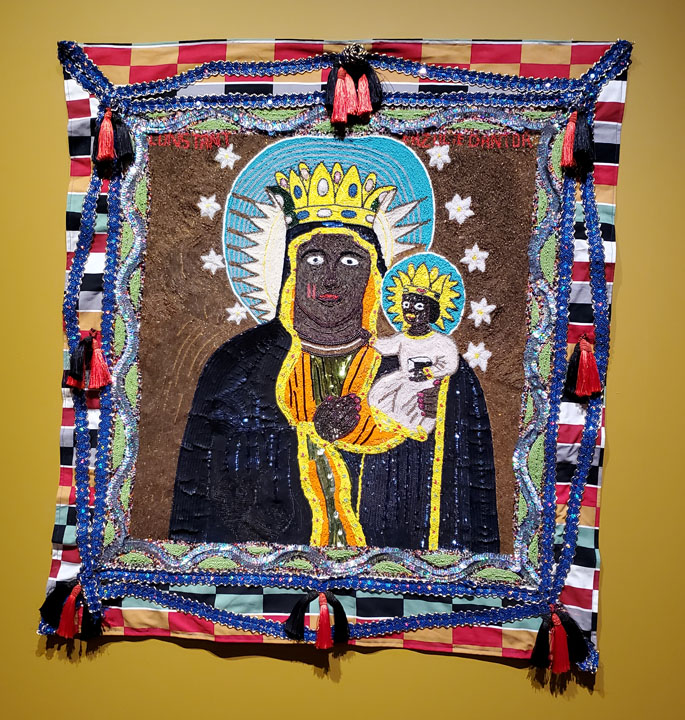
Erzulie Dantor, 1995-2020. 

Constant spent 25 years working on her portrait of Erzulie Dantor. 
Erzulie Dantor is credited with launching the Haitian Revolution, which overthrew colonialism and abolished slavery, creating the first independent Black republic. She is revered as a symbol of Black working class motherhood.

Detail of Haiti, Tuesday, January 12, 2010.

Political and current events are also the subject of some of Constant's pieces. 
In the year after the catastrophic 2010 earthquake, Constant created this tapestry, filled with scenes she had witnessed in her own community.

The above photos are just samples of the dozens of works on display in the Fowler Museum exhibit. In addition to the textiles on the walls, a video interview of Constant Myrlande in her studio plays in an adjacent room, providing insight on her method and purpose. The exhibit at the Fowler ends August 27, 2023. If you cannot see it in person, you can read about it in the book Myrlande Constant: The Work of Radiance, Katherine Smith and Jerry Philogene, editors (Fowler Museum UCLA, 2023). She is a remarkable woman. This is the first U.S. museum exhibition devoted to the work of a Haitian femaile contemporary artist. 

Baron Vulgaire, Baron Ravage.


Monday, May 9, 2022

JACARANDA TIME AT THE UCLA SCULPTURE GARDEN, Los Angeles, CA

Maja by Gerhard Marcks, Franklin Murphy Sculpture Garden, UCLA

My favorite time of year to visit the Franklin Murphy Sculpture Garden at UCLA in Los Angeles is in May, when the jacaranda trees are blooming. Clouds of blossoms hang from the branches, and at the height of the bloom, the petals begin to drop, carpeting the lawn and walkways with a layer of purple.
Jacaranda trees in bloom at the UCLA Sculpture Garden

During the week the campus is busy with students, but on the weekend, the garden is a quiet place for walking, pushing baby strollers, bird watching, or having an impromptu picnic on the grass. When my children were small, they loved to ride their bikes along the interconnected sidewalks--kid-sized freeways. On the morning of my recent visit, just a few people were there.

Oval Form (Trezion) by Barbara Hepworth

The sculpture garden is located at the north end of the UCLA campus, adjacent to the Young Research Library and the Broad Art Center Plaza. Scattered across more than five acres are over seventy sculptures by artists such as Hans Arp, Deborah Butterfield and Auguste Rodin. Small panels in front of each piece identify the title, artist and source of the gift to UCLA. Founded in 1967, the sculpture garden is managed by the Hammer Museum.

The Walking Man by Auguste Rodin, Broad Art Plaza

Signature of Auguste Rodin on the base of The Walking Man
During the forty plus years that I have lived in Los Angeles, I’ve been to the sculpture garden many times. You can read a report of a visit in 2020, UCLA SCULPTURE GARDEN: A Fresh Air Museum in the Middle of Los Angeles, on this blog HERE. Each time I go to the sculpture garden it is like visiting old friends. Here are a few of my favorite pieces from my most recent visit.

Automne, 1948 by Henri Laurens

  
Detail from Queen of Sheba by Alexander Archipenko

     
Cubi XX, 1964 by David Smith 
 

For more information about the Franklin D. Murphy Sculpture garden and a map of the area, click HERE.

Jacaranda trees (Jacaranda mimosifolia) are native to northwestern Argentina and southern Bolivia, but have been cultivated in almost every part of the world where there is no risk of frost. Jacarandas can be found throughout most of Southern California--including my front yard--where they were imported by the horticulturalist Kate Sessions. (A wonderful children’s book The Tree Lady by H. Joseph Hopkins, tells the story of Kate Sessions (1857-1940), the first female graduate of the University of California with a degree in science, and creator of parks and gardens in San Diego where she is known as the "Mother of Balboa Park".)

Jacaranda petals


Monday, May 2, 2022

ABORIGINAL FABRICS FROM AUSTRALIA a Feast for the Eyes at the Fowler Museum, Los Angeles, CA

Australian aboriginal fabrics and Lorrkkon (hollow log coffin)at Fowler Museum, UCLA.

If you like textiles and fabric art as much as I do, you will love the exhibit of Aboriginal Screen-Printed Textiles from Australia’s Top End now on view at the Fowler Museum on the UCLA campus in Los Angeles. 

Goose egg design (close-up). The interplay of overlapping colors is similar to that in an op-art painting.

Yards and yards of colorful fabrics are displayed, richly colored and featuring images from the natural world and from the lives of the people who made them. The designs are created by contemporary artists at five Aboriginal-owned art centers. As the introduction to the exhibit states, “The exhibition pays tribute to the resilience and beauty of Aboriginal Australia and reminds us of the enduring connections between peoples and their lands.“

Fabrics used in furniture design. Goose egg design in background.

Art and I went to see the exhibit on a Sunday afternoon, and although we had to show our vaccination card and wear a mask, few other people were there. We were particularly interested in this exhibit because of our trip to northern Australia in 2001 when we visited the Injalak Arts and Crafts Center, one of the centers with work on display. The other cooperatives represented in the exhibit are Tiwi Design, Jilamara Arts and Crafts Association,  Bábbarra Women’s Centre, and Merrepen Arts, Culture and Language Aboriginal Corporation
A kangaroo, snake, goose, fish and water lily design greets visitors at the entrance to the exhibit.

From the moment we entered the gallery we were struck by the rich colors and designs of the fabrics. Animals including fish, birds, crocodiles, bats, snakes, frogs and other creatures of the northern Australian landscape are depicted along with fish nets, baskets and other objects traditionally used in everyday life. Elements of the natural world–plants, water, landscape–also play a part in the designs.
Snakes and flying foxes (fruit bats).

In addition to the cloth, there are numerous videos demonstrating how the fabrics are made and explaining some of the cultural connections to the designs. You can view some of these videos online on the Fowler Museum website.

Video explaining the role of rock art images at Injalak.
Many of the screen printed fabrics are purchased by collectors. The fabric is also used for home furnishings and for creating high-end fashionable clothing. 

Prize winning outfit designed by Chloe Moa at the Melbourne Cup Carnival, 2013, using Marita Sambono’s Dagum (Fog dreaming) fabric.

Dressmaker dummies model dresses in another display of the exhibit. Lengths of fabric are available for sale in the Fowler Museum gift store--but are quite expensive.

Designs depicting fish nets, an emergency response to a hurricane, and water lilies.

Admission to the Fowler Museum is free. This exhibit is on view from December 5, 2021 to July 10, 2022. Other exhibits currently on view are Gosette Lubondo: Imaginary Trip; “How Do You See This World?” The Art of Almighty God; and Fowler in Focus: Communication Systems in a Global Context.The museum is open Wed-Sun from 12:00 to 5:00pm.  

Fowler Museum of Cultural History, UCLA, Los Angeles, CA


Monday, June 8, 2020

UCLA BOTANICAL GARDEN: From Cacti to a Subtropical Woodland in the Heart of Los Angeles

At the Mildred E. Mathias Botanical Garden, UCLA, Los Angeles, CA
Tucked in a corner of the UCLA campus in Los Angeles, California, is the Mildred E. Mathias Botanical Garden, a surprising escape from the surrounding urban and academic activity. This urban oasis is a wealth of trees, flowers, bushes, ferns and other plants from all over the world, in places that share a similar climate to that of Southern California. Shaded paths wind through the garden, moving from the desert garden at street level up a hill past palms and ferns to a subtropical woodland.
Palm tree.
On a recent Sunday, Art and I went for a walk through the garden, occasionally passing other people at a proper social distance, although in general it was possible to enjoy the garden without much contact with others. Like us, other garden visitors were getting out of their houses and enjoying some fresh air during the Covid-19 quarantine.
Lush bloom in the subtropical woodland.
Although UCLA is not far from where I live and I have driven past the entrance to the Botanical Garden hundreds of times, it has been more than thirty years since I actually walked in the garden. I had forgotten how pleasant it is and how impressive is its collection of plants, all clearly labeled. 
The Mindanao Gum tree has a characteristic colorful bark.
The 7.5 acre garden is an outdoor classroom, research facility and community resource. Visiting the garden is free to the public. (Bathrooms are closed during the Covid-19 pandemic.)
Approaching the La Kretz entrance.
There are three entrances to the garden, one along Hilgard Avenue, and two on Tiverton, across from the Dental School and Medical Center. We came in through the La Kretz entrance on Tiverton, and followed the path, first to the Garden Pavilion and patio with picnic tables, then up toward the lilies and subtropical forest. Birds were singing and spring flowers were blooming all along the way.
Bamboo planting at the Tiverton entrance to the garden.
We returned to the gate on a lower path above the stream. We could have stayed longer than we did, but this was just the beginning of a longer walk around the UCLA campus. (See my post about the UCLA Sculpture Garden.)
Spring flowers.
Now that I’ve returned to the Botanical Garden after my long absence, I’m eager to come back and explore more, especially as the seasons change.
Dirt paths meander through the garden beds.
For a map and information about visiting the Milded E. Mathias Botanical Garden, click HERE.
To learn more about botanist Dr. Mildred E. Mathias and her long and distinguished career at UCLA, click HERE.

Monday, June 1, 2020

UCLA SCULPTURE GARDEN: A Fresh Air Art Museum in the Middle of Los Angeles

Sculpture Garden, UCLA, Los Angeles, California
On a recent Sunday afternoon, our excursion to get out of the house was a walk on the UCLA campus in Los Angeles, California, visiting the botanical garden at one end and the Franklin D. Murphy Sculpture Garden at the other. It was the perfect place to get some exercise and fresh air.
The Sculpture Garden is dedicated to Franklin D. Murphy, UCLA's Third Chancellor
There were a few other people, but not many, and lots of flowers and birds. (We wore our masks and kept our social distance when necessary.) The jacaranda trees were just beginning to bloom. Soon, the lawn will be a carpet of purple petals. It was a beautiful day and the grand vista brought to mind the famous pointillist painting by Georges Seurat, Sunday Afternoon at La Grande Jatte--without the ladies in their long skirts and parasols.
Architectural Sculpture, Oliver Andrews
The sculpture garden is nestled on five acres between campus buildings and consists of a network of walkways around large stretches of lawn.
Desnudo Reclinado, Francisco Zunicka
More than seventy sculptures, by artists ranging from Auguste Rodin and Henri Matisse to Barbara Hepworth and Alexander Calder dot the landscape.
Cubi XX by David Smith; the horse sculpture in the background is Pensive by Deborah Butterfield
A large metal piece called Cubi XX by David Smith brought back memories of the sculpture class I took at Hunter College many years ago when he was my teacher. He encouraged us to work with contemporary materials. I spent the semester creating small abstract constructions with Plexiglas.
The Bird Goddess, Vladis Vildziunas
As Art and I rested in one of the seating areas, we watched a beautiful pair of western bluebirds, as well as flycatchers and juncos with young, foraging among the surrounding plants. It seemed appropriate that one of nearby sculptures was called Bird Goddess!
A pair of dancers by Robert Graham are mounted on pedestals near a pool at the edge of the garden.
Both the Sculpture Garden and the Botanical Garden are free and open to the public. When school is in session they are popular places for students to gather and enjoy the fresh air. But now, with classes online and the school year nearly over, relatively few people are on campus and there is plenty of room to move about and keep one's social distance.
For more information about the Franklin D. Murphy Sculpture garden and a map of the area, click HERE.
Looking through Ptolemy III by Jean Arp