Showing posts with label textiles. Show all posts

Monday, January 6, 2025

SANGRE DE NOPAL/BLOOD OF THE NOPAL: Exhibit at the Fowler Museum, UCLA, Los Angeles, CA

Sangre de Nopal exhibit at the Fowler Museum, UCLA.

One of my favorite museums in Los Angles is the Fowler Museum on the campus of UCLA, with its focus on art and material culture, primarily from Asia, Africa, and the Pacific, as well as the Americas. In mid-December I made an excursion to the Fowler to do some holiday shopping in its excellent gift shop, and while I was there made a quick visit to the exhibit Sangre de Nopal/Blood of the Nopal: Tanya Aquiniga and PorfirioGutierrez en Conversacion/in Conversation, which is on view in one of the four museum galleries. While we were there we saw two groups of school children who had come to see the exhibit and participate in the hands-on displays.

Somos una tela continue (We are a continuous cloth), 2023 by Tanya Aquiniga, 2023. Found objects and stones from the Los Angeles River, low-fired terra cotta, cotton dyed with terracotta, and cotton rope.

The exhibit features fiber artists Tanya Aquiniga and Porfirio Gutierrez as well as Oaxacan textiles from the Fowler Museum collection. 

Oaxacan textiles from the Fowler collection. Installation inspired by the temporary devotional structures called Lis Dxan erected during Holy Week in Zapotecan communities.

Here are some of the items on display.

Somos Mujeres (We Are Women) by Tanya Aquiniga, 2024. Terra cotta, nickel, epoxy, cochineal dye, cochineal insects, cotton rope. 

Nopal by Tanya Aquiniga, 2017. Abaca pulp, clay, alpaca, flax, succulents, iron, horsehair, cochineal, copper, gold, human hair.

Emotional Body by Tanya Aquiliga, 2023. Cotton rope and low-fire terra cotta. Video.

Detail of Emotional Body.


Sangre de Nopal/Blood of the Nopal: Tanya Aguiñiga & Porfirio Gutiérrez en Conversación/in Conversation 
is organized by the Museum of Contemporary Art Santa Barbara and developed in collaboration with the Fowler Museum at UCLA. It is a multi-site project offering an expanded understanding of the scientific and Indigenous origins of cochineal, a red dye developed by the Zapotec peoples.

What is cochineal?

First cultivated by the Zapotec peoples around 500 B.C., cochineal is derived from an insect that lives on the opuntia (prickly pear) cactus. Its chemical ingenuity, stability, and chromatic intensity changed the course of art around the world. Despite the global scale and impact of cochineal, its spiritual, medicinal, and technical origins within Indigenous Mexican communities remain little understood. Sangre de Nopal offers a case study in multi-generational innovation, acknowledging the scientific knowledge and cultural heritage embedded in the cultivation of cochineal. (From the Fowler Museum website.)


The exhibit will be on view at the Fowler until January 12, 2025. I am glad I got to see it before it closes.

Entrance to Fowler Museum of Cultural History, UCLA


Monday, June 26, 2023

EXTRAORDINARY BEADED TAPESTRIES by HAITIAN ARTIST CONSTANT MYRLANDE: Fowler Museum, Los Angeles, CA

Art of Myrlande Constant (detail), Fowler Museum, Los Angeles, CA

Myrlande Constant is a Haitian textile artist whose works reflect the vibrancy of life in Haiti--from family celebrations to religious traditions. As you enter the gallery at the Fowler Museum atUCLA in Los Angeles where her works are currently exhibited, you are struck by the explosion of color. The tapestries literally shimmer on the walls. 

Myrlande Constant: The Work of Radiance, gallery at the Fowler Museum

Created with thousands of tiny beads that capture and reflect the light, it is almost impossible to convey their beauty and complexity in a still photo. Even a short video barely does them justice.


The exhibit, on view from March 26, 2023 to August 27, 2023, is a retrospective, showcasing examples of Myrlande Constant’s work from the time she was a young woman working in the factories of Haiti, to today when her work is collected in museums around the world. Early works are smaller with simpler designs, but her recent creations are complex scenes with dozens of images woven together on large pieces of fabric, resembling, at times, the scale of medieval tapestries.

"Elaborate narratives and compositions characterize her work and distinguish it from that of earlier drapo artists who focused more on pieces used in Vodou ceremonies. … In her drapo, Constant illustrates stories of healing, justice and celebration. She depicts her reality, in which everyday life coexists with the sacred and transcendent, and the intimate and monumental mingle fluidly."

Constant's textile designs originate in the Haitian tradition of beaded flags, or drapo, and include images from Haitian daily life and from Constant’s ancestral religion, Vodou. But the beading technique introduced by Constant allows for greater detail and scale than traditional drapo Vodou, which typically use sequins. Constant's tiny beads, sewed on one by one, create a rich three-dimensional surface..

Detail from Grande Alouba. Grande Alouba is a revered female elder Iwa, regal and accompanied by her attendants. The Iwa are deities who are deeply enmeshed in the lives of individuals and families--in their dreams, struggles, fate, temperament, as well as their power to heal and defend themselves.

The fighting cock is a symbol of Ogou, the warrior Iwa.


In all Constant's works, her name becomes part of the design--with the "n's" sometimes inverted.  Many are "framed" with elaborate borders.

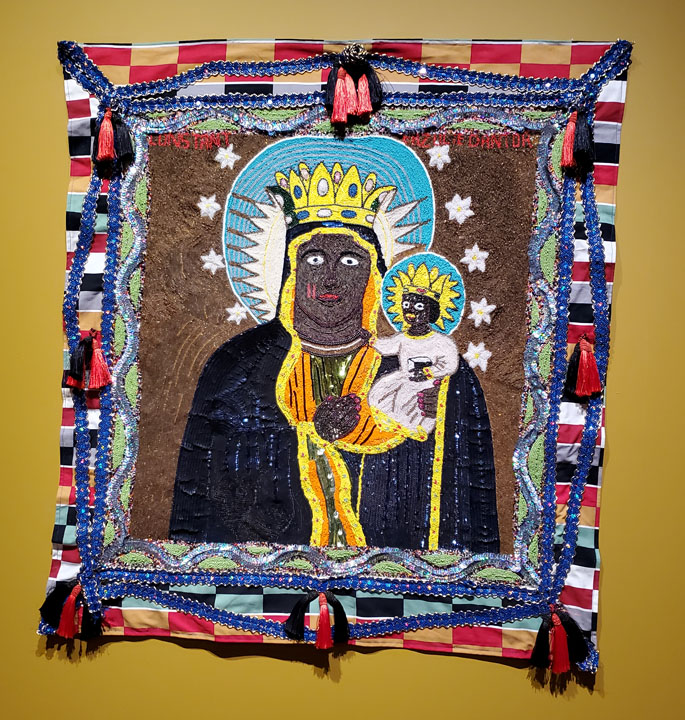
Erzulie Dantor, 1995-2020. 

Constant spent 25 years working on her portrait of Erzulie Dantor. 
Erzulie Dantor is credited with launching the Haitian Revolution, which overthrew colonialism and abolished slavery, creating the first independent Black republic. She is revered as a symbol of Black working class motherhood.

Detail of Haiti, Tuesday, January 12, 2010.

Political and current events are also the subject of some of Constant's pieces. 
In the year after the catastrophic 2010 earthquake, Constant created this tapestry, filled with scenes she had witnessed in her own community.

The above photos are just samples of the dozens of works on display in the Fowler Museum exhibit. In addition to the textiles on the walls, a video interview of Constant Myrlande in her studio plays in an adjacent room, providing insight on her method and purpose. The exhibit at the Fowler ends August 27, 2023. If you cannot see it in person, you can read about it in the book Myrlande Constant: The Work of Radiance, Katherine Smith and Jerry Philogene, editors (Fowler Museum UCLA, 2023). She is a remarkable woman. This is the first U.S. museum exhibition devoted to the work of a Haitian femaile contemporary artist. 

Baron Vulgaire, Baron Ravage.


Monday, May 2, 2022

ABORIGINAL FABRICS FROM AUSTRALIA a Feast for the Eyes at the Fowler Museum, Los Angeles, CA

Australian aboriginal fabrics and Lorrkkon (hollow log coffin)at Fowler Museum, UCLA.

If you like textiles and fabric art as much as I do, you will love the exhibit of Aboriginal Screen-Printed Textiles from Australia’s Top End now on view at the Fowler Museum on the UCLA campus in Los Angeles. 

Goose egg design (close-up). The interplay of overlapping colors is similar to that in an op-art painting.

Yards and yards of colorful fabrics are displayed, richly colored and featuring images from the natural world and from the lives of the people who made them. The designs are created by contemporary artists at five Aboriginal-owned art centers. As the introduction to the exhibit states, “The exhibition pays tribute to the resilience and beauty of Aboriginal Australia and reminds us of the enduring connections between peoples and their lands.“

Fabrics used in furniture design. Goose egg design in background.

Art and I went to see the exhibit on a Sunday afternoon, and although we had to show our vaccination card and wear a mask, few other people were there. We were particularly interested in this exhibit because of our trip to northern Australia in 2001 when we visited the Injalak Arts and Crafts Center, one of the centers with work on display. The other cooperatives represented in the exhibit are Tiwi Design, Jilamara Arts and Crafts Association,  Bábbarra Women’s Centre, and Merrepen Arts, Culture and Language Aboriginal Corporation
A kangaroo, snake, goose, fish and water lily design greets visitors at the entrance to the exhibit.

From the moment we entered the gallery we were struck by the rich colors and designs of the fabrics. Animals including fish, birds, crocodiles, bats, snakes, frogs and other creatures of the northern Australian landscape are depicted along with fish nets, baskets and other objects traditionally used in everyday life. Elements of the natural world–plants, water, landscape–also play a part in the designs.
Snakes and flying foxes (fruit bats).

In addition to the cloth, there are numerous videos demonstrating how the fabrics are made and explaining some of the cultural connections to the designs. You can view some of these videos online on the Fowler Museum website.

Video explaining the role of rock art images at Injalak.
Many of the screen printed fabrics are purchased by collectors. The fabric is also used for home furnishings and for creating high-end fashionable clothing. 

Prize winning outfit designed by Chloe Moa at the Melbourne Cup Carnival, 2013, using Marita Sambono’s Dagum (Fog dreaming) fabric.

Dressmaker dummies model dresses in another display of the exhibit. Lengths of fabric are available for sale in the Fowler Museum gift store--but are quite expensive.

Designs depicting fish nets, an emergency response to a hurricane, and water lilies.

Admission to the Fowler Museum is free. This exhibit is on view from December 5, 2021 to July 10, 2022. Other exhibits currently on view are Gosette Lubondo: Imaginary Trip; “How Do You See This World?” The Art of Almighty God; and Fowler in Focus: Communication Systems in a Global Context.The museum is open Wed-Sun from 12:00 to 5:00pm.  

Fowler Museum of Cultural History, UCLA, Los Angeles, CA