Showing posts with label FOWLER MUSEUM. Show all posts

Monday, April 20, 2026

MURALS AT THE FOWLER MUSEUM, UCLA, Los Angeles, California

Close-up of mural created by UCLA students for Fowler Museum, Los Angeles, CA.

On a recent visit to the Fowler Museum on the UCLA campus, I was struck by the murals lining the walls surrounding the center atrium. Printed with colorful, overlapping images that repeated across the surface, they invited me to look closer. There are six of them—two with enlarged versions of the individual images, and four with the images much smaller, printed in rows and covering the entire surface of the canvas. Standing far away, each mural looks like a giant vertical carpet, filling the available space. Close-up the effect is almost three-dimensional, like an optical illusion, the designs shimmering in the air.


According to the information panel about the murals, they were created by UCLA students working with Brazilian artists and activists Monica Nador and Bruno Oliviera of the Jardim Miriam Arte Clube (JAMAC) in Sao Paolo.  (JAMAC fosters collaboration between artists, local residents, and activists to create murals, prints, and public interventions that reflect community narratives and struggles.) Through a series of workshops, conversations led to a design process, followed by stencil making, and finally a discussion-based construction of patterns that reflected the complex interactions between the community and the artist.


In the following photographs you can appreciate the complexity of the designs and the richness of the patterns and colors.  But to get the full impact you have to see them in person.


To find out about the meaning of the images and the source of their inspiration you can listen to interviews with the students HERE.. 

The Fowler Museum is open Wednesday 12-8 pm, and Thursday through Sunday 12-5 pm. Admission is always free.


Monday, January 6, 2025

SANGRE DE NOPAL/BLOOD OF THE NOPAL: Exhibit at the Fowler Museum, UCLA, Los Angeles, CA

Sangre de Nopal exhibit at the Fowler Museum, UCLA.

One of my favorite museums in Los Angles is the Fowler Museum on the campus of UCLA, with its focus on art and material culture, primarily from Asia, Africa, and the Pacific, as well as the Americas. In mid-December I made an excursion to the Fowler to do some holiday shopping in its excellent gift shop, and while I was there made a quick visit to the exhibit Sangre de Nopal/Blood of the Nopal: Tanya Aquiniga and PorfirioGutierrez en Conversacion/in Conversation, which is on view in one of the four museum galleries. While we were there we saw two groups of school children who had come to see the exhibit and participate in the hands-on displays.

Somos una tela continue (We are a continuous cloth), 2023 by Tanya Aquiniga, 2023. Found objects and stones from the Los Angeles River, low-fired terra cotta, cotton dyed with terracotta, and cotton rope.

The exhibit features fiber artists Tanya Aquiniga and Porfirio Gutierrez as well as Oaxacan textiles from the Fowler Museum collection. 

Oaxacan textiles from the Fowler collection. Installation inspired by the temporary devotional structures called Lis Dxan erected during Holy Week in Zapotecan communities.

Here are some of the items on display.

Somos Mujeres (We Are Women) by Tanya Aquiniga, 2024. Terra cotta, nickel, epoxy, cochineal dye, cochineal insects, cotton rope. 

Nopal by Tanya Aquiniga, 2017. Abaca pulp, clay, alpaca, flax, succulents, iron, horsehair, cochineal, copper, gold, human hair.

Emotional Body by Tanya Aquiliga, 2023. Cotton rope and low-fire terra cotta. Video.

Detail of Emotional Body.


Sangre de Nopal/Blood of the Nopal: Tanya Aguiñiga & Porfirio Gutiérrez en Conversación/in Conversation 
is organized by the Museum of Contemporary Art Santa Barbara and developed in collaboration with the Fowler Museum at UCLA. It is a multi-site project offering an expanded understanding of the scientific and Indigenous origins of cochineal, a red dye developed by the Zapotec peoples.

What is cochineal?

First cultivated by the Zapotec peoples around 500 B.C., cochineal is derived from an insect that lives on the opuntia (prickly pear) cactus. Its chemical ingenuity, stability, and chromatic intensity changed the course of art around the world. Despite the global scale and impact of cochineal, its spiritual, medicinal, and technical origins within Indigenous Mexican communities remain little understood. Sangre de Nopal offers a case study in multi-generational innovation, acknowledging the scientific knowledge and cultural heritage embedded in the cultivation of cochineal. (From the Fowler Museum website.)


The exhibit will be on view at the Fowler until January 12, 2025. I am glad I got to see it before it closes.

Entrance to Fowler Museum of Cultural History, UCLA


Monday, December 18, 2023

FOWLER MUSEUM, UCLA: Intersections

Intersections: World Arts/Local Lives. Fowler Museum of Cultural Arts.

One of my favorite museums in Los Angeles is the Fowler Museum of Cultural Arts, located on the UCLA campus just north of the Janss Steps. Housing more then 120,000 art and ethnographic objects and 600,000 archaeological objects it is a treasure house of ancient, traditional, and contemporary cultures of Africa, Native and Latin America, and Asia and the Pacific. It is also a space for a wide variety of wonderful temporary exhibits.

Cloth constructed from recycled metal tabs, from Africa. Intersections exhibit.

Inside the museum, surrounding a garden/atrium, are four galleries. Two are for temporary exhibits. In one of the other galleries is the permanent installation of the silver collection of the Fowler Family (after whom the museum is named.) Among my favorites in this room is the set of Apostle spoons and a painting depicting a royal banquet at which silver dishes like those in the collection were used. This blog post is devoted to a brief overview of some of the exhibits in the main gallery, Intersections, a sampling of objects from the Fowler collection..

Masks.

Intersections: World Arts/Local Lives, first opened to the public in 2006 and since then has showcased objects that inspire conversation and reflection. 

Wooden carvings.

The exhibits in the gallery explore how arts from Africa, Asia and the Pacific and the Americas conceptually intersect with each other. Major sections of the exhibition consider how these arts served as vehicles of action, knowledge, power and transformation.                                                      

Memories and Transcendence: Tree of Life and other objects.

An exceptional collection of more than 900 Mexican works was donated in 1997 by the Daniel Family and includes a magnificent ceramic Trees of Life, Day of the Dead figurines, and masks from Metepec, Oaxaca, Michoacan, Jalisco, Puebla, and Guanajuato.

Spirit's Walk, painting on bark from East Arnhem Land, Australia

Mexican Day of the Dead figures.

A small room within Intersections is for temporary exhibits. (See my earlier post on Armenian Lace.)

In addition to the two galleries for temporary exhibits, an exhibition space for photographs is on the walls of the hallway surrounding the atrium of the museum. (The most recent exhibit there was Remain in Light: Visions of Home and the Diaspora , striking black and white photos, often with dramatic skies, depicting contemporary life in Armenia.) I make regular trips to the Fowler as new exhibits are mounted, but I always return to the Intersections gallery. It is the heart of the museum.


PS And the Fowler Museum gift shop is a perfect place to find gifts for the holidays--or any other time of year!

Monday, June 26, 2023

EXTRAORDINARY BEADED TAPESTRIES by HAITIAN ARTIST CONSTANT MYRLANDE: Fowler Museum, Los Angeles, CA

Art of Myrlande Constant (detail), Fowler Museum, Los Angeles, CA

Myrlande Constant is a Haitian textile artist whose works reflect the vibrancy of life in Haiti--from family celebrations to religious traditions. As you enter the gallery at the Fowler Museum atUCLA in Los Angeles where her works are currently exhibited, you are struck by the explosion of color. The tapestries literally shimmer on the walls. 

Myrlande Constant: The Work of Radiance, gallery at the Fowler Museum

Created with thousands of tiny beads that capture and reflect the light, it is almost impossible to convey their beauty and complexity in a still photo. Even a short video barely does them justice.


The exhibit, on view from March 26, 2023 to August 27, 2023, is a retrospective, showcasing examples of Myrlande Constant’s work from the time she was a young woman working in the factories of Haiti, to today when her work is collected in museums around the world. Early works are smaller with simpler designs, but her recent creations are complex scenes with dozens of images woven together on large pieces of fabric, resembling, at times, the scale of medieval tapestries.

"Elaborate narratives and compositions characterize her work and distinguish it from that of earlier drapo artists who focused more on pieces used in Vodou ceremonies. … In her drapo, Constant illustrates stories of healing, justice and celebration. She depicts her reality, in which everyday life coexists with the sacred and transcendent, and the intimate and monumental mingle fluidly."

Constant's textile designs originate in the Haitian tradition of beaded flags, or drapo, and include images from Haitian daily life and from Constant’s ancestral religion, Vodou. But the beading technique introduced by Constant allows for greater detail and scale than traditional drapo Vodou, which typically use sequins. Constant's tiny beads, sewed on one by one, create a rich three-dimensional surface..

Detail from Grande Alouba. Grande Alouba is a revered female elder Iwa, regal and accompanied by her attendants. The Iwa are deities who are deeply enmeshed in the lives of individuals and families--in their dreams, struggles, fate, temperament, as well as their power to heal and defend themselves.

The fighting cock is a symbol of Ogou, the warrior Iwa.


In all Constant's works, her name becomes part of the design--with the "n's" sometimes inverted.  Many are "framed" with elaborate borders.

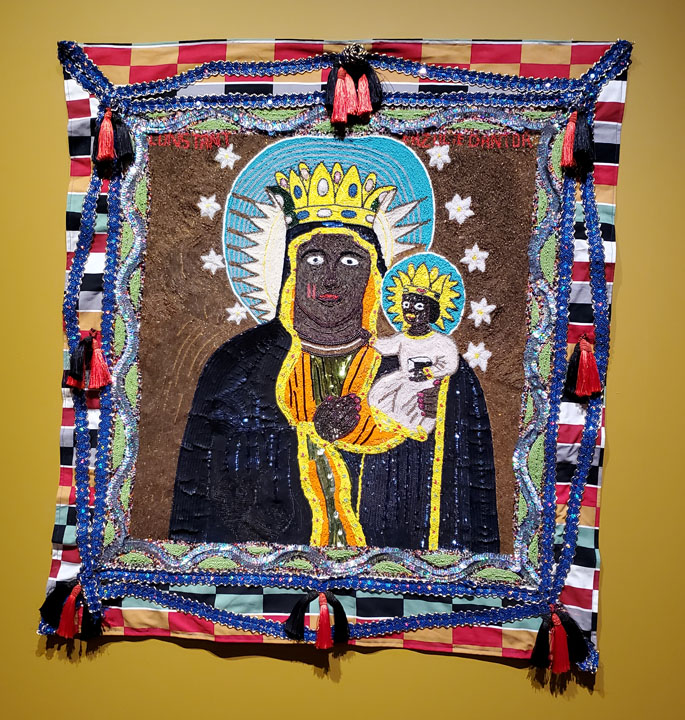
Erzulie Dantor, 1995-2020. 

Constant spent 25 years working on her portrait of Erzulie Dantor. 
Erzulie Dantor is credited with launching the Haitian Revolution, which overthrew colonialism and abolished slavery, creating the first independent Black republic. She is revered as a symbol of Black working class motherhood.

Detail of Haiti, Tuesday, January 12, 2010.

Political and current events are also the subject of some of Constant's pieces. 
In the year after the catastrophic 2010 earthquake, Constant created this tapestry, filled with scenes she had witnessed in her own community.

The above photos are just samples of the dozens of works on display in the Fowler Museum exhibit. In addition to the textiles on the walls, a video interview of Constant Myrlande in her studio plays in an adjacent room, providing insight on her method and purpose. The exhibit at the Fowler ends August 27, 2023. If you cannot see it in person, you can read about it in the book Myrlande Constant: The Work of Radiance, Katherine Smith and Jerry Philogene, editors (Fowler Museum UCLA, 2023). She is a remarkable woman. This is the first U.S. museum exhibition devoted to the work of a Haitian femaile contemporary artist. 

Baron Vulgaire, Baron Ravage.


Monday, May 2, 2022

ABORIGINAL FABRICS FROM AUSTRALIA a Feast for the Eyes at the Fowler Museum, Los Angeles, CA

Australian aboriginal fabrics and Lorrkkon (hollow log coffin)at Fowler Museum, UCLA.

If you like textiles and fabric art as much as I do, you will love the exhibit of Aboriginal Screen-Printed Textiles from Australia’s Top End now on view at the Fowler Museum on the UCLA campus in Los Angeles. 

Goose egg design (close-up). The interplay of overlapping colors is similar to that in an op-art painting.

Yards and yards of colorful fabrics are displayed, richly colored and featuring images from the natural world and from the lives of the people who made them. The designs are created by contemporary artists at five Aboriginal-owned art centers. As the introduction to the exhibit states, “The exhibition pays tribute to the resilience and beauty of Aboriginal Australia and reminds us of the enduring connections between peoples and their lands.“

Fabrics used in furniture design. Goose egg design in background.

Art and I went to see the exhibit on a Sunday afternoon, and although we had to show our vaccination card and wear a mask, few other people were there. We were particularly interested in this exhibit because of our trip to northern Australia in 2001 when we visited the Injalak Arts and Crafts Center, one of the centers with work on display. The other cooperatives represented in the exhibit are Tiwi Design, Jilamara Arts and Crafts Association,  Bábbarra Women’s Centre, and Merrepen Arts, Culture and Language Aboriginal Corporation
A kangaroo, snake, goose, fish and water lily design greets visitors at the entrance to the exhibit.

From the moment we entered the gallery we were struck by the rich colors and designs of the fabrics. Animals including fish, birds, crocodiles, bats, snakes, frogs and other creatures of the northern Australian landscape are depicted along with fish nets, baskets and other objects traditionally used in everyday life. Elements of the natural world–plants, water, landscape–also play a part in the designs.
Snakes and flying foxes (fruit bats).

In addition to the cloth, there are numerous videos demonstrating how the fabrics are made and explaining some of the cultural connections to the designs. You can view some of these videos online on the Fowler Museum website.

Video explaining the role of rock art images at Injalak.
Many of the screen printed fabrics are purchased by collectors. The fabric is also used for home furnishings and for creating high-end fashionable clothing. 

Prize winning outfit designed by Chloe Moa at the Melbourne Cup Carnival, 2013, using Marita Sambono’s Dagum (Fog dreaming) fabric.

Dressmaker dummies model dresses in another display of the exhibit. Lengths of fabric are available for sale in the Fowler Museum gift store--but are quite expensive.

Designs depicting fish nets, an emergency response to a hurricane, and water lilies.

Admission to the Fowler Museum is free. This exhibit is on view from December 5, 2021 to July 10, 2022. Other exhibits currently on view are Gosette Lubondo: Imaginary Trip; “How Do You See This World?” The Art of Almighty God; and Fowler in Focus: Communication Systems in a Global Context.The museum is open Wed-Sun from 12:00 to 5:00pm.  

Fowler Museum of Cultural History, UCLA, Los Angeles, CA


Monday, October 10, 2016

FOWLER MUSEUM, UCLA, Three Exciting New Exhibits: Prints, Fiber Art, and Yarn Paintings; Los Angeles, CA

Huichol Yarn Painting, on exhibit at the Fowler Museum, Los Angeles, CA
One of my favorite places to take visitors to Los Angeles is the Fowler Museum, located at UCLA near the bottom of the Janss Steps, not far from central campus. It is dedicated to exploring world arts and cultures, especially Africa, Asia and the Pacific. Last weekend I visited to see three recently opened shows: Nkame: A Retrospective of Cuban Printmaker Belkis Ayon; Uncommon Threads: The Box Project; and The Spun Universe: Huichol Yarn Paintings from Mexico. All were amazing.

Prints by Cuban artist Belkis Ayon
The prints of Belkis Ayon are huge–actually assemblages of multiple plates to make mural size pieces. Most are black and white, which increases the dramatic effect and emphasizes the many textures that make up the design. The subjects of many of the prints are from stories connected to the Afro-Cuban fraternal society Abakua. Belkis Ayon (1967-1999) used a technique called collography, which fastens a variety of materials onto cardboard to make a printing plate which is then put through a press. You can see her at work in a video that is part of the exhibition. Nkame (a word synonymous with “greeting” and “praise” in the language of Abakuá) is on exhibit October 2, 2016 to February 12, 2017.


The Uncommon Threads Box Project
For the Uncommon Threads Box Project a number of international fiber artists were invited to create works that could be fit in a standard size box. The results are displayed along with larger works by the artists. The amazing part of this exhibit is both the variety of materials and the range of interpretation of what it means to fit into a box.

Fabric covered blocks by James Bassler
In some cases, the finished fabric was folded or rolled into a box while other artists turned the fabric into a box or, in one case, blocks. The exhibit will be on view September 11, 2016 to January 15, 2017.


Detail of Huichol Yarn Painting
The Huichol Yarn paintings in The Spun Universe exhibit can by seen in a small gallery within the larger Intersections gallery. Colored yarn is the “paint” used to produce the radiant colors and intricate designs in these traditional works created by the Wixarika people of Western Mexico. The yarn is turned and twisted and affixed to a wooden board with beeswax. The designs, inspired by mythology and shamanic visions, feature animals, human figures, plants and other ritual objects. The “paintings” are stunning viewed both close-up to see the intricate details, and at a distance where they have a poster-like boldness. The exhibit will be on view August 14, 2016 to December 4, 2016.
Large Huichol Yarn Painting--our favorite in the exhibit
Selected items from the Fowler’s huge collection are in an ongoing exhibit called  Intersections: World Arts, Local Lives. Another gallery has a permanent display of the Francis E. Fowler, Jr. Collection of Silver. So there is always much to see at the museum.
And, a must when you visit the Fowler, is a stop at the excellent gift shop with its changing selection of merchandise that is coordinated with current exhibitions.
Six paneled print by Belkis Ayon

The Fowler Museum is open Wednesday through Sunday noon to 5 pm and 8 pm on Wednesday.
Admission is FREE.
For directions and parking, click HERE.