Showing posts with label jacaranda. Show all posts

Monday, May 9, 2022

JACARANDA TIME AT THE UCLA SCULPTURE GARDEN, Los Angeles, CA

Maja by Gerhard Marcks, Franklin Murphy Sculpture Garden, UCLA

My favorite time of year to visit the Franklin Murphy Sculpture Garden at UCLA in Los Angeles is in May, when the jacaranda trees are blooming. Clouds of blossoms hang from the branches, and at the height of the bloom, the petals begin to drop, carpeting the lawn and walkways with a layer of purple.
Jacaranda trees in bloom at the UCLA Sculpture Garden

During the week the campus is busy with students, but on the weekend, the garden is a quiet place for walking, pushing baby strollers, bird watching, or having an impromptu picnic on the grass. When my children were small, they loved to ride their bikes along the interconnected sidewalks--kid-sized freeways. On the morning of my recent visit, just a few people were there.

Oval Form (Trezion) by Barbara Hepworth

The sculpture garden is located at the north end of the UCLA campus, adjacent to the Young Research Library and the Broad Art Center Plaza. Scattered across more than five acres are over seventy sculptures by artists such as Hans Arp, Deborah Butterfield and Auguste Rodin. Small panels in front of each piece identify the title, artist and source of the gift to UCLA. Founded in 1967, the sculpture garden is managed by the Hammer Museum.

The Walking Man by Auguste Rodin, Broad Art Plaza

Signature of Auguste Rodin on the base of The Walking Man
During the forty plus years that I have lived in Los Angeles, I’ve been to the sculpture garden many times. You can read a report of a visit in 2020, UCLA SCULPTURE GARDEN: A Fresh Air Museum in the Middle of Los Angeles, on this blog HERE. Each time I go to the sculpture garden it is like visiting old friends. Here are a few of my favorite pieces from my most recent visit.

Automne, 1948 by Henri Laurens

  
Detail from Queen of Sheba by Alexander Archipenko

     
Cubi XX, 1964 by David Smith 
 

For more information about the Franklin D. Murphy Sculpture garden and a map of the area, click HERE.

Jacaranda trees (Jacaranda mimosifolia) are native to northwestern Argentina and southern Bolivia, but have been cultivated in almost every part of the world where there is no risk of frost. Jacarandas can be found throughout most of Southern California--including my front yard--where they were imported by the horticulturalist Kate Sessions. (A wonderful children’s book The Tree Lady by H. Joseph Hopkins, tells the story of Kate Sessions (1857-1940), the first female graduate of the University of California with a degree in science, and creator of parks and gardens in San Diego where she is known as the "Mother of Balboa Park".)

Jacaranda petals


Monday, March 29, 2021

BACK YARD WILDLIFE, Guest Post by Karen Minkowski at The Intrepid Tourist

52 Places to Go: Week 13

Hooded oriole (male)

My friend Karen Minkowski, a dedicated wildlife watcher and keen photographer, has made the most of her Covid confinement by discovering the wealth of wildlife in her Southern California back yard. I thank her for sharing her observations and wonderful photographs with The Intrepid Tourist.

2020 was the year my hiking shoes didn’t get much use…

I stopped walking in LA’s Santa Monica Mountains shortly before the March lockdown was imposed and after that didn’t leave my rented home much at all. Soon, I turned my attention to our suburban backyard, a patch of boring grass partly surrounded by tall mature trees with dense foliage and low maintenance non-native plants. Like millions of other people in their homes, I discovered that my backyard was a safe place to try to connect with a tiny bit of the natural world. And over the next year I saw more wildlife in the yard than I ever expected.

Black phoebe

The diversity of bird species that pass
through the yard is impressive. Some, like this Black Phoebe, visit almost daily. They perch out in the open to ensure a straight flight path to air-borne insects or those hiding in the lawn. Many birds forage in the trees, obscured by the foliage and moving too rapidly for me to capture a clear image, either in my mind or with the camera.

Crows

Crows are common, noisy and highly visible. Here’s one about to feed a begging
youngster.

Eastern fox Squirrel

The ubiquitous Eastern Fox Squirrels are
an introduced (non-native) species in southern California. Their ability to thrive in fragmented habitat has led to the displacement of the Western Gray squirrel, which requires mostly undisturbed wooded or forested areas and now occupies the foothills and mountainous areas. Nonetheless, Fox Squirrels are fun to watch as they dig up edibles buried who knows when from caches they’ve dug in the ground; tumble as they chase each other across the lawn; gnaw on a fallen clothespin; or stretch along a tree limb to soak up the morning sun.

Opossum

Early in the pandemic’s
first spring we spotted an opossum. As I photographed it over the next half hour, it seemed more curious than wary as it watched me. I never saw it again.

Hooded oriole (female)

In April the very vocal Hooded Orioles were likely breeding in the neighbors’ palm
trees. I would see them mostly when they were foraging. They remained in the area for several weeks before migrating south.

A Jacaranda tree dominates the backyard. 

Allen's hummingbird and jacaranda blossoms

Bee feeding on jacaranda blossom

Squirrel eating jacaranda flower

It bloomed in early spring, and by May its purple
blossoms were falling, providing food for at least three different families of animals: Allen’s hummingbird and honeybees drink the nectar, while squirrels ingest the whole flower.

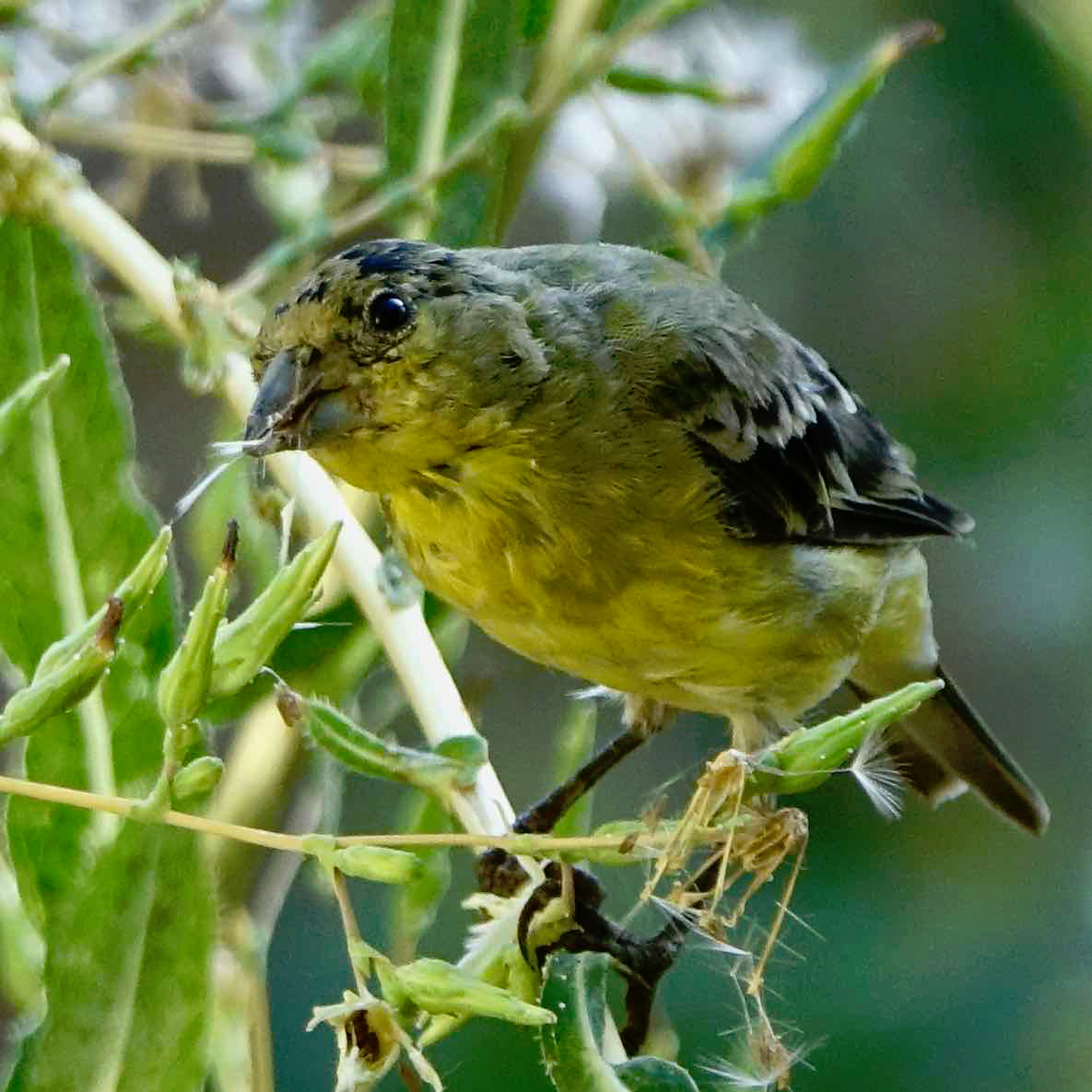
Lesser goldfinch

During late spring and summer I often stood on
a ladder to watch birds in the neglected backyard of the house next door. Filled with flowering weeds, it attracted seed-eaters like this young Lesser Goldfinch (above) and the House Finch (below). 

House finch

One summer morning a bulldozer destroyed this productive patch of
suburbia gone wild, which is now almost completely covered by a construction project to extend and enlarge the existing house.

Cooper’s hawk. This common raptor in the San Fernando Valley nests here beginning in late-March.

For a few days in July a beautiful juvenile
Cooper’s hawk hung out in the backyard.

Allen's hummingbird.

In July I hung a hummingbird feeder and have enjoyed seeing Allen’s hummingbirds many times a day since then.


One early morning in autumn the crows were cawing relentlessly. I went outside to see what was disturbing them and glimpsed the silhouette of what resembled a large house cat high up in a tree. 


Great-horned owl

But something about the shape didn’t seem quite cat-like, and soon the increasing light revealed that we had a spectacular Great-horned Owl in our backyard. The owl rested here for a good twelve hours, rarely moving from its perch and seemingly unperturbed by the incessant vocal harassment of the crows, perched as close as six feet away. Next morning the owl was gone. Months later I still check the tree, awaiting its return.

Yellow-rumped warbler

Winter arrived… Occasionally I spot “new” bird species, like this lovely Yellow-rumped warbler.
It paused just long enough for me to snap its portrait as it darted quickly in search of insects, the winter diet for many omnivorous birds.

Bushtit, another insect eater.

Cedar waxwing

As winter began to wane and vaccines arrived my feet were
itching to walk through forests and woods. 


One day I put on my hiking shoes and drove to Franklin Canyon. Below are a few images of my first 2021 forays.

Red-shouldered hawk

Ruby-crowned kinglet. (The crown is seen only when a male becomes excited during the breeding season.)


California thrasher, singing his lovely song after the rain had stopped.

I still check my backyard, but
enjoying much more my return to LA’s more natural environments.