Showing posts with label Sculpture. Show all posts

Monday, May 11, 2026

MIRO AND THE UNITED STATES: Exhibit at the Phillips Collection, Washington, D.C.

Woman and Birds at Sunrise, by Joan Miro. Exhibit at the Phillips Collection, Washington, D.C.

Dream-like figures floating in space, sinuous lines, and all over patterns are a hallmark of the art of the Catalan artist Joan Miro (1893-1983). On my recent visit to the Phillips Collection art museum in Washington, D.C. I saw a fascinating exhibit of Miro’s work—mostly paintings, but also some sculptures—showing how he was influenced by American artists like Alexander Calder and Jackson Pollock, and how they in turn were influenced by him.

Left, The First Spark of Day II by Joan Miro. Right, August, Rue Daguerre by Joan Mitchell.

Miro and the United States
is co-organized by the Phillips Collection and the Fundacio Joan Miro in Barcelona, Spain. It will be on view at the Phillips from March 21 to July 5, 2026.

Detail of Somersault, an early Miro work exhibited in the US in 1926 at the Brooklyn Museum of Art.

The American public first became aware of Miro’s art beginning in the 1920s when it was shown at galleries and in Museum exhibitions in the US. 

Copy of Miro's mural in the Terrace Plaza Hotel, Cincinnati, Ohio.

But Miro’s first visit to the United States was not until 1947 when he came to paint a mural at the Terrace Plaza Hotel in Cincinnati, Ohio, a modern new hotel designed by the Chicago firm Skidmore, Owings and Merrill. A reproduction of the mural fills one large wall of the exhibit at the Phillips.

Passage of the Divine Bird by Joan Miro.

Another room of the exhibit is devoted to a series of 22 works called Constellations. In every piece we see groups of black dots joined by lines to form shapes similar to those of the Zodiac. Miro began the series when he was living and working in France in 1940. But when the Germans invaded France during WWII he escaped to Spain where he finished the series. The Constellation paintings were exhibited at his gallery in New York in 1945 to great acclaim.

Constellation series by Joan Miro.

Miro’s original Constellation paintings were done in gouache. 
Then in 1959, the Constellation series was reproduced as limited-edition prints using a stencil technique called couchoir. The works on exhibit are couchoir prints.

Person Throwing a Stone at a Bird, by Joan Miro.

On the day of my visit to the Phillips a class of middle school students was at the exhibit. In each room the teacher gave them an assignment. I overheard her telling the students to choose a painting without looking at the title and create their own title. I wonder what they came up with—it would be hard to beat some of the expressive titles Miro chose for his own work.

The Beautiful Bird Revealing the Unknown to a Pair of Lovers by Joan Miro.

During Miro’s visits to the United States he met many artists and also saw their work in various exhibits. In the show at the Phillips we see numerous examples of Miro’s paintings hung side by side with those of other artists, showing similarities in their choice of images and techniques. Information panels explain the connections. Alexander Calder and Miro became friends after meeting in Paris in 1928, and continued to exchange letters and ideas through the rest of their lives. You can see similarities between Miro's thin black lines and the wires that support Calder's sculptures. One critic said, “Calder’s mobiles are like living Miro abstractions.” 

Red Polygons by Alexander Calder is one of two his mobiles in the exhibit.

Jackson Pollack, the American painter famous for his "drip" paintings, also influenced Miro and has several paintings in the exhibit. In 1952, when Miro first saw Jackson Pollock’s paintings in Paris, he said “It freed me.” Some of the other artists influenced by Miro and represented in the exhibit include Joan Mitchell, Adolph Gottlieb, Barnett Newman, Norman Lewis,  Grace Hartigan, Willem de Kooning.

Left, Vigil by Adolph Gottlieb. Right, detail, Eyes in the Heat by Jackson Pollock.


Head by Joan Miro.

A few examples of Miro’s sculptures are included in the exhibit as well as those of several American sculptors—all displaying an imaginative approach to the world and the human figure.

Red Sun by Joan Miro.

In January 2015 I wrote about a visit to another Miro exhibit which was held at the Nasher Museum of Art at Duke University in North Carolina. At the time, the museum also had an exhibit of the art of Robert Rauschenberg. I wrote: “In both exhibits the viewer is asked to consider similar questions—What is art? What is the meaning of art? How do we see? What is my relationship to this piece of art.? In the current exhibit at the Phillips museum, I think one can ask the same questions as one considers Miro’s art and that of the American artists impacted by his work and who influenced him.

After viewing the Miro exhibit, my friend and I enjoyed a tasty lunch in the museum café on the first floor. It is adjacent to the excellent gift shop. Both the café and gift shop are open to the public, although one needs to buy a ticket to visit the galleries. I always enjoy visiting the Phillips Collection when I am in Washington, DC. Here are links to posts about previous visits.

May 19, 2019  THE PHILLIPS COLLECTION, Washington, D.C., Part 1: America's First Museum of Modern Art

March 9, 2020  THE PHILLIPS COLLECTION, Washington, D.C., Part 2:  What Do You Hang Over the Fireplace?

October 21, 2024   A TREASURE HOUSE OF MODERN ART, The Phillips Collection, Washington, D.C. 

October 28, 2024   WHAT TO HANG OVER THE FIREPLACE, A Visit to the Phillips Collection, Washington, D.C.

Monday, October 6, 2025

ART WALK: Western Washington University Sculpture Collection

Stone Enclosure: Rock Rings by Nancy Holt. Western Washington University sculpture collection, Bellingham, WA.

At Western Washington University in Bellingham, Washington, giant sculptures occupy the campus from one end to the other. It is one of the most notable university art collections in the country. It features works from the late 20th century to the present, ranging from massive to delicate, functional to inspirational, industrial to organic, conceptual to humorous, complex to deceptively simple. A huge variety. They are constructed of stone, metal, wood, cement and other materials.

Mark di Suvero (b. 1933), For Handel (pictured), 1975. Painted steel; 27’ h. and Mindseye, 1978. Steel. For Handel was created specifically for the Performing Arts Plaza and dedicated to the 18th Century composer George Frederic Handel. 
.  

In mid-July I visited the Western Washington University campus with my family, taking a self-guided tour of the art following a map and brochure we had downloaded from the art department website. Most of the sculptures are outdoors, although a few are inside buildings. The tour also included the art galleries in the Performing Arts Center--on one side an exhibit of a series of Alexander Calder tapestries and on the other, of paintings by Northwest artists. (Through the art gallery windows to the west is a magnificent view of the Bellingham harbor.)

A series of 13 tapestries by the sculptor Alexander Calder are presented near the left entrance to the Concert Hall of the Performing Arts Center.

We parked at the east end of the campus and then worked our way west, more or less in numerical order. By the time we stopped at each of the 31 pieces described in the brochure, it took us about two hours. It was a cool, overcast day, not unusual weather for Bellingham, which made it comfortable for walking and perfect for photography.

Beverly Pepper (1924-2020), Normanno Column, 1979-80. Cast iron; 102” h. x 11 1/4” w. x 11 1/4” d. Normanno Wedge, 1980. Cast iron.

Here are a selection of pieces that we saw. Most of the pieces in the collection are larger than life. I made a point of including people (usually my brother Tom) in many of my photos to provide a sense of scale.
 

Robert Morris (1931-2018), Untitled (Steam Work for Bellingham), 1971; installed 1974. Rock with variable volume of steam. (Robert Morris was my sculpture teacher when I was in art school.)

Do Ho Suh (b. 1962), Cause and Effect, 2012. Cast resin and stainless steel. Hundreds of tiny figures, connected feet to shoulder, make up this hanging sculpture. 

Bruce Nauman (b. 1941), Stadium Piece, 1998-99. Concrete. 

Tom Otterness (b. 1952), Feats of Strength, 1999. Bronze. One of seven charming figures, each approx. 15” high

Lloyd Hamrol (b. 1937), Log Ramps, 1974. Reconstructed 1983 & 1995; Cedar.

Richard Serra (b. 1939), Wright’s Triangle, 1979-80. Corten steel

Alice Aycock (b. 1946), The Islands of the Rose Apple Tree Surrounded by the Oceans of the World for You, Oh My Darling, 1987. Water-filled cast concrete.

Isamu Noguchi (1904-1988), Skyviewing Sculpture, 1969. Painted iron plates.

Detail. Alexander Calder tapestry, 1974-75. Dyed and braided maguey fiber panel. Manufactured in Nicaragua.

David Ireland (b. 1930), Bigger Big Chair, 2004-07. Painted steel plates

Anthony Caro (1924-2013), India, 1976. Steel, rusted and varnished;

James FitzGerald (1910-1973). Rain Forest, 1959; installed 1960. Bronze fountain;

I thank my sister-in-law, Karen Neely, for leading us on this excellent tour. If you want to find out more about any of the pieces in the tour, download the Western Sculpture Garden brochure.

Monday, June 30, 2025

FOUR DAYS IN MILAN, ITALY: The Duomo, Museums, Cimitero Monumentale, Canals, and More

Galleria Vittorio Emmanuele II, Milan, Italy. 

Milan is the bustling center of modern Italian design and fashion. Even babies in their strollers are well-dressed. The city also has a long history, with countless churches, palaces, museums, and historic sites to entice visitors. In early June, Art and I spent four days in Milan at the beginning of a ten-day trip to northern Italy.

Display welcoming the 2026 Winter Paralympics to Milan/Cortina.

Like all of our trips to Europe, a nine-hour time difference from our home in California, we allowed several days to adjust to the time change. We arrived in Milan on a Sunday, and after checking in at our hotel in the city center, walked to a nearby pizzeria for a light supper, ending with our favorite Italian dessert, caramel panna cotta. Every meal we ate in Italy was delicious!

The Milan Duomo (Cathedral).

The next day our focus was the Duomo, the cathedral that sits in the middle of Milan like a giant stone wedding cake. As we stood in the piazza gazing up at the roof spires, we could see tiny people walking up to the top. We then made our way to the back of the cathedral to wait for our turn to ride the elevator to the roof. (We had bought tickets online ahead of time. Alternatively, you can climb up the 165 steps to the top—a cheaper ticket and different line.) Security is strict to get into the Duomo. Women are required to have covered shoulders and knees and flip-flop sandals are not allowed. If you show up in shorts or a sleeveless top you can purchase a thin white cover-up garment.

View of Milan from the roof of the Duomo.

As we emerged from the elevator we found ourselves on the first roof level, amongst the flying buttresses and 135 statue topped spires, and with a spectacular view of all of Milan. In the distance was the modern business center of the city, with its skyscrapers and the needle-like tower, the Torre Pirelli . Until it was built (1955-60), the Duomo was the tallest building in Milan.

Walkway around the roof of the Duomo.

As we followed the route around the roof we got close-up views of the elaborate stonework and hundreds of figures perched on the spires before our final climb to the roof peak. Once again we admired the view, and then from there descended the narrow circular staircase to the inside of the Duomo.

Marble floor of the Duomo. Woman wearing cover-up over her bare arms.

Some of the 52 pillars inside the Duomo.

Sculptured panels on the central doors of the Duomo.

We had purchased an audio tour for our phone to guide us around the inside of the Duomo and this helped us appreciate the history and significance of its various parts. Everything in the cathedral is over-the-top, from the huge stained-glass windows (said to be the largest in Christendom), to the marble floor, the pillars (52 of them, one for every week of the year), the numerous side chapels, and the huge paneled doors on the front.

Detail from one of the windows of the Duomo, displayed in the Duomo Museum.

Gargoyles from the Duomo, some from the 14th Century, moved to the Museum for conservation.

The construction of the Duomo began in the 14th century but was not completed until Napoleon’s time. The Duomo Museum, next to the cathedral, displays statues, gargoyles, building models and artifacts that tell the Duomo’s 600-year history. A side doorway in the museum takes you through a courtyard to a small hidden chapel, San Gottordo in Corte, refreshing in its simplicity. A fresco from the Giotto School was recently discovered on one of its walls.

Courtyard leading to the chapel of San Gottordo in Corte.

Before returning to our hotel, we did a short tour of the Vittorio Emmanuel II shopping arcade, located at the side of the Duomo Piazza, and billed as the Rodeo Drive of Italy, with its glamorous designer stores. However, most people in the crowded mall were tourists, not shoppers, taking selfies under the magnificent domed roof.

Center of the Galleria Vittorio Emmanuelle II. 

The next day began with a visit to the weekly street fair and farmer’s market on Viale Pepiniano. The wealth of available fresh fruits and vegetables on display explains why Italian cooking is so good!  

Stall at the Tuesday farmers' market on Viale Pepiniano.

We purchased super-sweet cherries just in season. On our way back to our hotel we stopped to visit the Basilica and monastery of Sant' Ambrogio one of the most ancient churches in Milan.

Mosaic of Christ the Pantocrator (4th to 8th C.) in the apse of the Basilica of Sant' Ambrogio.

In the afternoon we met my cousin and her husband who live in Milan, who gave us a personal tour of some sites that I had read about in my guidebook but were outside the city center. (They had a car.) The first was the CimiteroMonumental, a burial ground for the rich and famous begun in Victorian times, that is more like an open-air art museum than a graveyard. (Entrance is free.) A map at the entrance marks the mausoleums and graves of particular importance. 

Reclining figure at the Cimitero Monumental.

Ziggurat-like sculpture at the Cimitero Monumental. Tomb of Antonio Berocchi, created by Giannino Castiglioni.

It seems that every Italian artist worth his salt has been invited to create a sculpture here. Themes vary from the intimate to the majestic, with many references to ancient history. The shaded walkways were welcome on the warm day of our visit and there were almost no other people there on a weekday afternoon.

The Bosco Verticale apartment building, designed by Boen Studio in the Porta Nuova area of Milan.

Our next stop was at the Bosco Verticale, or Vertical Forest, a unique pair of apartment buildings covered with so many trees and plants they appear as giant trees themselves.

Summer evening in the Navigli (canal) District, Milan, with its restaurants, shops, live music and giant video screens.

Our day ended with dinner at a restaurant in the Navigli, or canal, District. At the time that the Duomo was under construction in Milan, a system of canals was dug (including a lock designed by Leonardo) in order to transport marble from the quarries in the mountains to the city. In the last century, most of the canals were filled in, but a few remain. Today they are lined with shops and restaurants and have a lively night life. Next to the canal, a communal washing station is preserved, from the time that women gathered here to wash their clothes and chat.

Science Museum. Models of some of Leonardo's flying machines.

Science Museum. Cat drawings by Leonardo da Vinci.

We did not see Leonardo’s Last Supper, perhaps Milan’s most famous artwork. Limited tickets are available and need to be purchased months ahead of time, which we didn’t do. But, on our last day, we visited the Leonardoda Vinci National Museum of Science and Technology where most of the second floor is devoted to Leonardo’s life and many inventions, with models, drawings, artifacts and multi-media displays. One section focused on the many works of art inspired by and modeled on Leonardo's Last Supper.

On the bridge of the canal.

We didn’t visit La Scala, the Sforza Castle, or go shopping while we were in Milan. Not enough time to do everything. But we did see a lot and enjoyed delicious Italian food. And after four days we had made significant progress on our jet lag and were ready for our driving trip to the Alps.

Monday, October 14, 2024

NEW MEETS OLD: Contemporary African Art by Leilah Babirye at the de Young Museum, San Francisco, CA

Masks by Leilah Babirye at the de Young Museum in San Francisco.

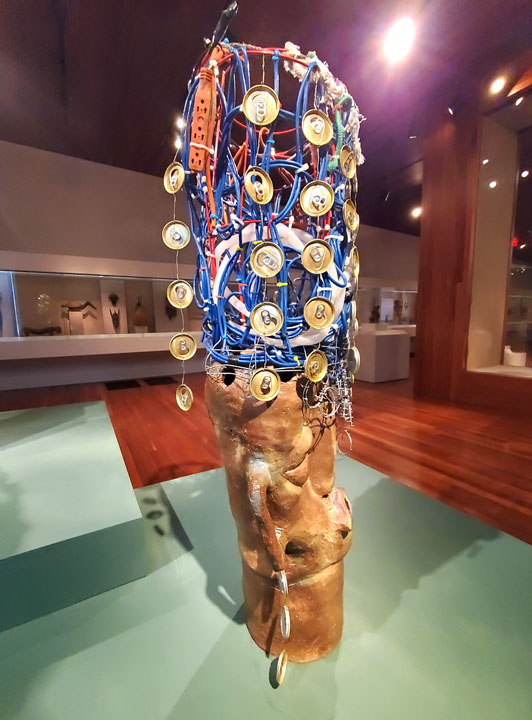
A new exhibit at the de Young Art Museum in San Francisco, called We Have a History, features the art of Leilah Babirye. At first, Leilah Babirye’s sculptures look like traditional African forms, but on closer look, the complex decorations turn out to be a colorful mixture of found objects—can tops, electrical wire, extension cords, PVC pipe, and whatever else she has happened to find. 

Auntie Muzumganda by Leilah Babirye, Ceramic, wire, and found objects.

Detail.

Leilah Babirye, born in Uganda, works in New York, creating busts, masks, and figures from ceramic and wood. This is her first solo museum show in the United States. Her work highlights the connection between the past and present in African art.

R. Peaceful Bride of Mwanga II, Leilah Babirye, Wood, wax, nails, wire, glue and found objects.

I saw Leilah Babirye’s exhibit when I was at the de Young Museum in July. Her art is displayed in the Art of Africa gallery, alongside the permanent exhibits of masks, paintings and other objects, thus tying Babirye’s work to the larger African tradition. 

Dance mask, Bogadjin people; Headrests, Tami people.

I was intrigued by her use of ordinary household objects and the way they become transformed into vibrant art when incorporated in the sculptures.

Carved wooden figure, Leilah Babirye.

Included in the exhibit is a video installation where we see Leilah Babirye at work in her studio. We see the intense and energetic way she attacks materials, turning them into the forms she intends. As she works we hear her talk about them.  Leilah Babirye’s sculptures, busts and masks are portraits of her LGBTQ+ community. Each one speaks for itself, inviting the viewer to take a closer look.

The exhibit, on the second floor of the museum, runs through October 26, 2025. 

For more information about visiting the de Young Museum of Art, click HERE.