Monday, September 19, 2022

FASHION AS ART: Guo Pei Couture Dresses at the Legion of Honor, San Francisco, CA


Guo Pei: Couture Fantasy at the Legion of Honor, San Francisco, CA

The Guo Pei fashion/art show at the Legion of Honor art museum in San Francisco is amazing--more like sculpture and costumes than real clothes. And it is not just the clothes--it is the shoes, hats, hair, jewelry--all designed to go together. Part of the show is downstairs in the special exhibition gallery. Upstairs the models are placed next to pieces in the permanent collection. 

Painting by Peter Paul Rubens. Portrait of Rogier Clarisse, ca. 1621

The figures are very cleverly positioned --like a model wearing a dress with a ruffled skirt next to a 17th century portrait of a man with a ruffed collar, or a patterned dress placed in front of a tapestry
. One of my favorites is a figure with a large helmet shaped headpiece standing under a large domed ceiling—like a pair of nesting eggs.

Ensemble (dress and hood) from the Legends collection, Spring/Summer 2017. Silk embroidered with synthetic fiber, embellished with synthetic opals and Swarovski crystals and rhinestones.

The Guo Pei exhibit opened in April and has been extended to November 27, 2022, due to popular demand. For more information and to reserve tickets, go to the Legion of Honor website.

Each room in the exhibition gallery is devoted to a particular collection, each with a theme. The exhibit in the opening room, called “Inheritance” displays two traditional embroidered Chinese robes and explains how opulent embroidery, inspired by this ancient art, is a signature of Guo Pei’s work.
(Throughout the exhibit information panels, in both English and Chinese, provide information about the dresses and about where they fit in Guo Pei’s career.)


As a young girl growing up during the Cultural Revolution, Guo Pei found solace and inspiration in her maternal grandmother whose stories of elaborately embroidered robes enthralled the future couturier. As a young designer working for brand-name companies, Guo Pei longed to design embroidered clothing. However, richly embellished clothing, forbidden during the Cultural Revolution, had not yet regained popularity as fashionable dress.

Today, Guo Pei’s studio employs 450 craftspeople, of which 300 are embroiderers. Guo Pei and her team have developed their own interpretation of traditional needlework, creating a style that combines techniques from Chinese embroidery with Indian, Russian, and European stitches.(Notes from an exhibition panel.)

Guo Pei: Couture Fantasy celebrates the extraordinary designs of Guo Pei—hailed as China's first couturier—and includes more than 80 works from the past two decades highlighting her most important collections shown on Beijing and Paris runways.

The dresses in the exhibit range from elegant to whimsical to bizarre to almost impossible to wear. (You can go online to view fashion shows of Guo Pei’s designs, with models actually walking down the runway.)

This gown is a puppet theater, complete with puppet dolls dangling on strings! A monkey puppeteer on the bodice controls the dolls with a string.

Each Guo Pei dress is unique.   

The skirt on this dress, made of metal strips, weighs 20 pounds and is attached to a belt that sits on the model's hips.

It was impossible to resist taking photos. Here are just a few of my favorites.

Playful birds perch on this model's pigtails. Collection: Alternate Universe, Fall/Winter 2019-2020.

This model appears ready to take flight.

Like a giant wearable playing card, this elaborate dress features a long train. Collection: Himalaya, Spring/Summer 2020.

In her Fall/Winter 2019-2020 collection, Alternate Universe, Guo Pei envisioned an afterlife in which animals preside over humanity.

It is hard to believe that one could walk in these shoes.

The dress, made of pleated silk and embroidered with 24-karat gold metallic threads, is from the Collection of the Dragon, 2012.

These dresses are inspired by the typical blue and white designs on traditional Chinese ceramics.

“The culture of China is just like the blood that runs through my veins, it’s my life…China has more than 5,000 years of history, even longer culturally speaking. That history has greatly enriched my designs and is essentially a foundation of my work.” Guo Pei

Monday, September 12, 2022

BUTTERFLY WALK: UC Botanical Garden, Berkeley, CA

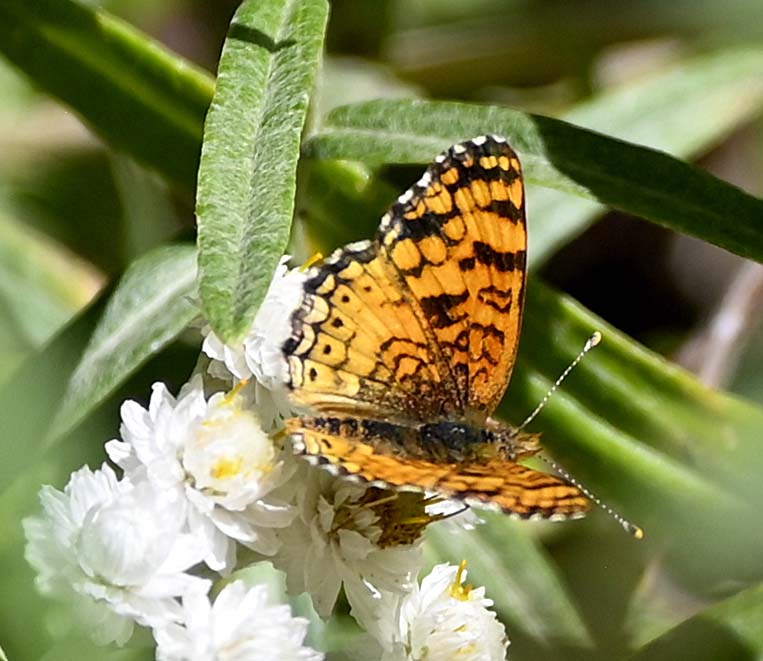
Mylitta Crescent butterfly at the UC Botanical Garden, Berkeley, CA

It is said that only mad dogs and Englishmen go out in the midday sun. Add to that list: butterfly enthusiasts. Butterflies like the sun—using it to heat their bodies—and the best time to see them is on a warm, sunny day. So, on a warm, August afternoon we joined a group at the UCBotanical Garden in Berkeley, California, for a one hour guided butterfly walk through the garden.

Viewing photos and caterpillars at the entrance to the garden.

We were met at the entrance to the garden by our leaders, Sally Levinson, the “caterpillar lady”, who had brought samples of anise swallowtail caterpillars for us to see up close while we waited for the group to assemble, and Sarab Seth the “butterfly guy”, who would lead us on our tour.

Looking for butterflies in the desert section of the garden.

When I was growing up in the Midwest, my brothers and I collected butterflies--catching them in a net, killing them, and mounting them in glass-fronted boxes for our home “museum.” We learned to be careful as we handled them, not to touch their delicate wings and rub off the tiny colored scales. We also learned how to distinguish a butterfly from a moth by looking at the antennae—club shaped for butterflies and feather-like for moths. Now I prefer to appreciate butterflies free in the wild—although it is much harder to get a close-up look at them.

Before we set out on our walk, we each got a checklist for the species we hoped to see. It was divided into three sections: Likely sightings (5), Less Likely (5), and Even less likely (4). At the end of the walk we had spotted all five likely species (Acmon blue, Cabbage white, Field Crescent, Gray Buckeye, Mylitta Crescent), two of the less likely (Common checkered skipper, Monarch), and one that was not even on the list—a fritillary!

Mylitta Crescent on an aster

Of all the butterflies we saw, the only one that stayed still long enough for a good photograph (taken by Art) was a Mylittta Crescent.  And I got reasonably close to an Acmon Blue for a photo. But the other butterflies were too far away, even with a telephoto lens.

Acmon Blue butterfly

The butterflies that I am familiar with—monarchs, swallowtails, cabbage whites—are easy to spot in the wild. But many of the butterflies on the list were small—some less than an inch across—as well as speedy fliers. Once spotted, we hoped they would land so we could at least see their markings through binoculars. We were impressed by Sarab Seth’s ability to identify them in flight, even from a distance. Along the way, Sarab Seth pointed out which plants were preferred by each species—which helped in knowing where to look for the butterflies.

Anise swallowtail caterpillar.

Our first stop was at an angelica plant, a favorite of the anise butterfly. Sarab pointed out a caterpillar, still eating but which would soon be ready to form a chrysalis. 

Anise swallowtail butterfly egg on an angelica leaf. (Look for the tiny white spot.)

Sarab also showed us a single anise butterfly egg (which he had discovered earlier on the same plant), tucked carefully under a leaf. In a few days it would hatch into a tiny caterpillar, which would then grow rapidly over the next few weeks, continuing the cycle.

Monarch butterfly, photographed in our Oakland neighborhood

The largest butterfly we spotted during our walk was a monarch—hard to miss with its handsome orange and black coloring. We see them often on walks in our Oakland neighborhood. When asked about the annual monarch migration, Sarab said that the monarch butterflies tend to stick around all year in the garden (unlike in the past when they gathered in clusters in trees along the California coast) because so many people plant milkweed in their gardens.

At the end of our walk we returned to the shade—leaving the bright sunny spots to the butterflies. I was glad I learned about these California butterflies that make the UC Botanical Garden their home. At the bottom of our checklist Sarab gave us the link to his Facebook page with photographs he has taken of 44 butterfly species in the garden. They are gorgeous! Click to enjoy—without having to go out in the midsummer sun!

Wildflower in the UC Botanical Garden.


Monday, September 5, 2022

MILLS COLLEGE, OAKLAND, CA: Nature Walk and Window Onto History

Mills College, Oakland, CA
In the middle of Oakland sits the campus of Mills College, an island of greenery around academic buildings and a place where local residents go to play sports on the playing fields, walk along tree lined paths, birdwatch, and generally enjoy nature. Established as a women’s college in 1885, Mills College will transform to a campus of Northeastern University in Boston in the fall of 2022.

Mills Young Ladies Seminary, about 1873. Mills Hall and students.

Mills College began as a Young Ladies Seminary in 1852 in Benicia, CA, moved to Oakland in 1871, and was chartered as a college in 1885. Juliet Fish Nichols (1859-1947), the subject of my new book, Keeper of the Light: Juliet Fish Nichols Fights the San Francisco Fog, was one of the first graduates. 

Olin Library at Mills College. 

Earlier this year, on a Sunday afternoon in June, Art and I took a walk on the Mills campus. I wanted to see Mills Hall, the building where Juliet had lived and attended classes when she was a student.

Mills Hall, 2022.

It is likely that one of the girls seated on the lawn in the 1873 photograph is Juliet, then fourteen years old. (The identity of the girls is not noted on the photograph.) At the time, Mills Hall was the only structure on campus. It contained classrooms and offices as well as housing for faculty and the young women who were the students. Now it is used as an administration building. 

The Bell Tower, designed by architect Julia Morgan. 

Gradually, the college grew, with facilities for the arts, sciences, music, sports and other disciplines. In 1904, the bell tower, El Campanil, designed by Julia Morgan was built in the southeast quadrant of the campus, across from Mills Hall.

A grove of California Bay Laurel trees on the Mills College campus.

In the first years the land around the new campus was quite open except for a few native oak trees. More than one thousand trees were planted, now grown to stately heights. As you walk around the campus today, you feel like you are in an arboretum, with trees and plants identified, and a nature trail along Leona Creek, which flows through the campus. 

A bridge crosses Leona Creek, which flows from the Oakland hills to San Francisco Bay.

The day I visited was shortly after graduation (chairs were still set up on the lawn) and few people were around. It was easy to imagine what it must have been like more than one hundred years ago when Juliet was a student.

Juliet Fish was born in Shanghai, China, where her father, Dr. Melancthon Fish, was serving as a medical missionary and United States consul. The family returned to the United States when Juliet was three. Juliet grew up in Oakland, California, and attended Mills Seminary for Young Ladies, where the goals were good health and a classical education. A daily outdoor walk of at least one mile was required. Students also worked out with dumbbells, Indian clubs and wands—so Juliet was well prepared for the physical demands of her later lighthouse work.

When Juliet was a student at Mills, she would have walked along shaded paths like this one lined with blackberry vines.

In 1888, Juliet married Commander Henry Nichols of the U.S. Navy, who became Superintendent of the 12th Lighthouse District along the coast of California. They had no children. In 1899, Henry Nichols was sent to the Philippines during the Spanish-American War, where he died of heat stroke, leaving Juliet without financial support.

Angel Island Lighthouse and Bell Station, as it appeared when Juliet lived there.

When Juliet learned that the lighthouse keeper on Angel Island was retiring, she applied for the job. Juliet served as lighthouse keeper at Point Knox on Angel Island from 1902 to 1914. Upon her retirement, Juliet lived the rest of her life in Oakland. She is buried in the family plot at Mountain View Cemetery in Oakland.

Except for her lighthouse log and official letters and reports, Juliet Fish Nichols left few clues to her personal life. As I walked around the Mills Campus, I felt that in a small way I was able to share Juliet’s experience as a student and get a bit of insight to her life.

I donated at copy of my book Keeper of the Light to the Olin Library at Mills College in honor of Juliet Nichols. 

For more about Juliet Fish Nichols and Angel Island go to my posts of September 2017 and July 2012.

Additional information about Juliet Nichols, her log, Angel Island, the Point Knox Lighthouse, 1906 San Francisco earthquake, and more is at https://carolinearnoldart.blogspot.com/p/extra-material-for-keeper-of-light.html .