Showing posts with label Berkeley. Show all posts

Monday, September 23, 2024

AROUND THE WORLD WITH PLANTS at the UC Botanical Garden, Berkeley, CA

View of San Francisco Bay from the UC Botanical Garden, Berkeley, CA.

Fifty years ago, my daughter Jennifer and I posed in front of the sunflowers I was growing along our garden fence in Millbrook, New York. Several weeks ago, on our visit to the University of California Botanical Garden in Berkeley, Jennifer posed in front of a sunflower again, planted in the Crops of the World section.

With Sunflower, 1974.

With Sunflower 2024.

When Jennifer was young and we lived in a house in the country, we planted a huge garden, growing flowers and most of our own vegetables. Today, I still enjoy growing flowers in pots on my patio, but I buy my vegetables from our local Farmer’s Market.


A trip to the Botanical Garden in Berkeley is always a favorite outing with family and friends when we are at our house in Oakland. The 34-acre UC Botanical Garden is the third largest in the United States, featuring more than 10,000 kinds of plants from around the world. It specializes in plants that thrive in a Mediterranean climate similar to that of the San Francisco Bay Area.

Cactus bloom.

After buying our tickets at the front gate, we began our walk, first visiting the exhibits of orchids, cycads and carnivorous plants in the glass houses located just beyond the entrance. 

Gunnera tinctoria, also known as Chilean rhubarb.

From there we followed the paved and gravel paths through the deserts of the Americas, then upward through the Africa, Asian, Australasian, Mediterranean and South American sections, ultimately reaching the garden of old roses with its magnificent view of the garden and San Francisco Bay beyond. It was a warm, but overcast day, perfect for photography. 

Here are a few of our favorite photos from our expedition.

Cactus fruits.


Cactus viewed from above.

The garden was abuzz with bees collecting nectar.

Eryngium Paniculatum, from Argentina.

Sundial in the Garden of Old Roses.


The UC Botanical Garden has a lovely gift shop as well as a garden shop with plants. It puts on many programs for the public, including a monthly Butterfly Walk in summer, which we enjoyed a year ago. (Click on link for my blogpost about the butterfly walk.)


For directions and more information about the UC Botanical Garden, go to their website.


Monday, September 12, 2022

BUTTERFLY WALK: UC Botanical Garden, Berkeley, CA

Mylitta Crescent butterfly at the UC Botanical Garden, Berkeley, CA

It is said that only mad dogs and Englishmen go out in the midday sun. Add to that list: butterfly enthusiasts. Butterflies like the sun—using it to heat their bodies—and the best time to see them is on a warm, sunny day. So, on a warm, August afternoon we joined a group at the UCBotanical Garden in Berkeley, California, for a one hour guided butterfly walk through the garden.

Viewing photos and caterpillars at the entrance to the garden.

We were met at the entrance to the garden by our leaders, Sally Levinson, the “caterpillar lady”, who had brought samples of anise swallowtail caterpillars for us to see up close while we waited for the group to assemble, and Sarab Seth the “butterfly guy”, who would lead us on our tour.

Looking for butterflies in the desert section of the garden.

When I was growing up in the Midwest, my brothers and I collected butterflies--catching them in a net, killing them, and mounting them in glass-fronted boxes for our home “museum.” We learned to be careful as we handled them, not to touch their delicate wings and rub off the tiny colored scales. We also learned how to distinguish a butterfly from a moth by looking at the antennae—club shaped for butterflies and feather-like for moths. Now I prefer to appreciate butterflies free in the wild—although it is much harder to get a close-up look at them.

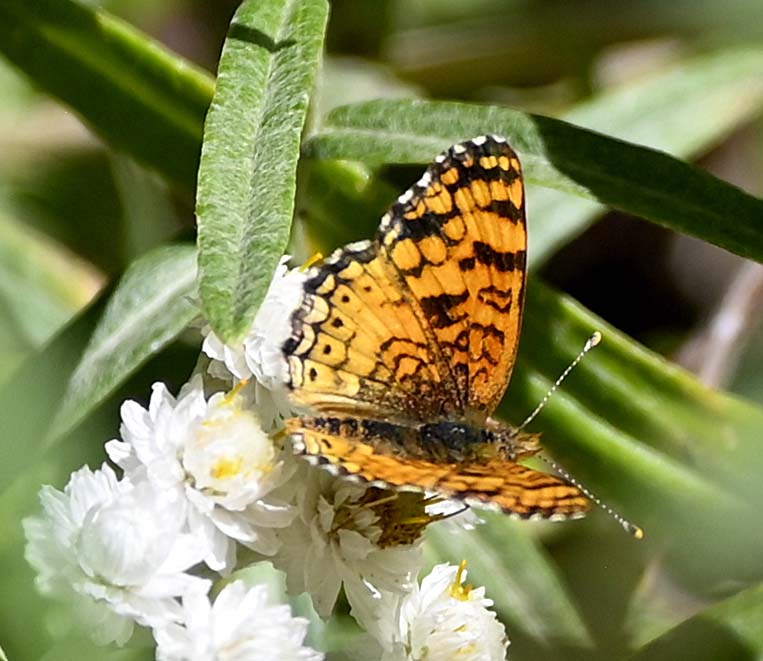
Before we set out on our walk, we each got a checklist for the species we hoped to see. It was divided into three sections: Likely sightings (5), Less Likely (5), and Even less likely (4). At the end of the walk we had spotted all five likely species (Acmon blue, Cabbage white, Field Crescent, Gray Buckeye, Mylitta Crescent), two of the less likely (Common checkered skipper, Monarch), and one that was not even on the list—a fritillary!

Mylitta Crescent on an aster

Of all the butterflies we saw, the only one that stayed still long enough for a good photograph (taken by Art) was a Mylittta Crescent.  And I got reasonably close to an Acmon Blue for a photo. But the other butterflies were too far away, even with a telephoto lens.

Acmon Blue butterfly

The butterflies that I am familiar with—monarchs, swallowtails, cabbage whites—are easy to spot in the wild. But many of the butterflies on the list were small—some less than an inch across—as well as speedy fliers. Once spotted, we hoped they would land so we could at least see their markings through binoculars. We were impressed by Sarab Seth’s ability to identify them in flight, even from a distance. Along the way, Sarab Seth pointed out which plants were preferred by each species—which helped in knowing where to look for the butterflies.

Anise swallowtail caterpillar.

Our first stop was at an angelica plant, a favorite of the anise butterfly. Sarab pointed out a caterpillar, still eating but which would soon be ready to form a chrysalis. 

Anise swallowtail butterfly egg on an angelica leaf. (Look for the tiny white spot.)

Sarab also showed us a single anise butterfly egg (which he had discovered earlier on the same plant), tucked carefully under a leaf. In a few days it would hatch into a tiny caterpillar, which would then grow rapidly over the next few weeks, continuing the cycle.

Monarch butterfly, photographed in our Oakland neighborhood

The largest butterfly we spotted during our walk was a monarch—hard to miss with its handsome orange and black coloring. We see them often on walks in our Oakland neighborhood. When asked about the annual monarch migration, Sarab said that the monarch butterflies tend to stick around all year in the garden (unlike in the past when they gathered in clusters in trees along the California coast) because so many people plant milkweed in their gardens.

At the end of our walk we returned to the shade—leaving the bright sunny spots to the butterflies. I was glad I learned about these California butterflies that make the UC Botanical Garden their home. At the bottom of our checklist Sarab gave us the link to his Facebook page with photographs he has taken of 44 butterfly species in the garden. They are gorgeous! Click to enjoy—without having to go out in the midsummer sun!

Wildflower in the UC Botanical Garden.


Monday, April 8, 2019

HOMAGE TO SUNDIALS: Eight Year Anniversary of The Intrepid Tourist

Giant wall Sundial at Redlands University, Redlands, CA
Eight years ago I launched The Intrepid Tourist as an outlet for my travel writing. Since then I have posted a new article once a week, accumulating a whopping total of more than 500 posts--some about far away places, others much closer to home. Most are about my own travel experiences, but others are about the trips made by family and friends. I thank all my guest posters who have contributed reports of their adventures on The Intrepid Tourist and shared their personal views of the world.
Berkeley Botanical Garden, Berkeley, CA
In many of my travels, I have come across sundials and been fascinated by both their beauty and technology. In celebration of the beginning of a new year of The Intrepid Tourist I an sharing a few of my sundial photos. 
Sundial Bridge, Redding, CA
Ranging in size from the giant sundial bridge at Turtle Bay in Redding, California, to a small garden decoration sundial at the Clark Library in Los Angeles, each one has its own special character.
Sundial by Eric Gill, UCLA Clark Library garden, Los Angeles, CA
The oldest known sundial was found in Egypt found in the Valley of the Kings (c. 1500 BC). I have never been to Egypt, but in Rajasthan, India, there is a collection of nineteen architectural astronomical instruments built by the Rajput king Sawai Jai Singh II, and completed in 1734. It features the world's largest stone sundial. I visited this amazing UNESCO world Heritage site when I was in India in 2000.
Stone sun dial at Jantar Mantar, Rajasthan, India
The marker, or gnomen, at the center of the sundial casts its shadow as the sun moves across the sky and indicates the time of day. Importantly, its angle must be equivalent to the Earth's latitude at that point.
Sundial at the Santa Barbara Zoo, California at 4:00 p.m.
A simple way of telling time by the sun is with your own shadow. At the Santa Barbara Zoo, in Santa Barbara, California, is a sundial that is read by standing in the center and casting your own shadow.
Alpha and Omega Sundial in memory of Harriet M. Gale, Grinnell College, Grinnell, Iowa. Paul T. Granlund, Sculptor
At Grinnell College a sundial in the center of campus honors the wife of a retired physics professor. At the University of North Carolina, the Morehead Sundial is on a plaza near the center of campus and has an accompanying plaque that tells us exactly where we are on Earth. I love sundials. They are beautiful and functional and as long as the sun is shining, will always tell the time.
Happy 8th Anniversary to The Intrepid Tourist!
Morehead Sundial Plaque, UNC Campus, Chapel Hill, North Carolina


Monday, October 10, 2011

UC Botanical Garden, Berkeley: A Plant Lover's Paradise

Oak Knoll in the California Section
Research and Conservation
Nestled in the Berkeley hills, just above the Cal campus, more than 13,000 different species of plants on 34 acres grow in the University of California Botanical Garden, a scientific collection of plants from around the world and a wonderful place to spend the morning or afternoon.  I recently went there for the first time.  The garden is a living museum, created as a research garden but open to the public.
Old Rose Garden with view of Berkeley and San Francisco Bay
A network of paths takes you through the garden, which is arranged according to the plants’ geographic origin. These include Mediterranean, South America, Mexico/Central America, Eastern North America, Australasia, Asia, Southern Africa, New World Desert, and California. The garden’s website cautions visitors that it is virtually impossible to see everything on one visit.  It says that to see every plant in one two-hour visit, one would have to see one hundred different plants a minute!

Edible Plants
One of my favorites parts of the garden was the section on crops of the world.  In one corner was the “Three Sisters Garden” so-called by Native Americans referring to the interplanting of beans, corn, and squash.  The beans fix nitrogen in the soil, which feeds the corn so it will be tall and healthy.  The corn provides a structure for the beans to climb on.  The squash plants provide ground cover to keep the soil moist and free of weeds.  Recent studies have shown that this method produces higher yields than the typical planting of a single crop (monoculture).
Tomatillos in the World Crops Section

Changes With the Seasons
Every season has its highlights, making the garden a worthwhile visit at any time of year.  We visited the garden in August, when late summer flowers were blooming, while earlier blooming varieties were reaching maturity.  In the garden of old roses, bushes were lush with old-fashioned varieties.  It was a warm afternoon, but paths through shady groves and along ponds and streams provided welcome places to stop and rest.
Japanese Pool in the Asia Section
The garden is also a haven for wildlife.  As we meandered through the various zones, lizards skittered across the path, hummingbirds hovered over the flowers, and bees and butterflies were abundant. Throughout the garden, helpful signs identify plants, sometimes with additional information.  But, even if you don’t want to know the plants’ names, you can enjoy them for their natural beauty.  It’s better not to try to see one hundred plants a minute, but to enjoy a few at a time.  I plan to go back in several months and explore some new paths and see what is growing at a different time of year.

Directions:  The garden is located at 200 Centennial Drive, Berkeley, CA 94720 (midway between the UC Berkeley Memorial Stadium and the Lawrence Hall of Science.) Phone:  510-643-2755. For directions and more information, go to the garden's website
Tours: Docent tours of the garden are offered at 1:30 on Thursdays, Saturdays, and Sundays.
Smelling the Roses in the Old Rose Garden