Showing posts with label caterpillar. Show all posts

Monday, August 5, 2024

BUGGING OUT IN GLACIER NATIONAL PARK, Guest Post by Paige Arnold


My granddaughter Paige spent five weeks participating in a summer research project at Glacier National Park sponsored by the Keck Geology Consortium at Macalester College in St. Paul, Minnesota. I thank her for her perceptive thoughts about her encounters with bugs during her time at Glacier NP. "Bugging Out in Glacier National Park" is republished from the Keck Geology Blog, where you can also find posts by other members of the research team.

My first day in the field, I felt a bit like a moth in the daytime. Surrounded by unfamiliar sights, sounds, and creatures (fellow Keck students included), I felt completely out of my element and like I was being pulled in every direction possible. The overwhelming environment around me led me to focus my gaze on something smaller, something more familiar that would allow me to start with details rather than the full picture: bugs. 

Glacier National Park is full of bugs, the most notable of which to most is the mosquito (impossible not to notice if even one manages to sneak into your tent overnight or if you stand still for a second too long). If you look a bit further, though, there are plenty of insects hiding just out of sight or perhaps below a particularly large rock. 


Some disguise themselves as other species, like the hover fly which adopts the patterning of a bee as a survival strategy. Some are so prominent and strange-looking that even a bug-enjoyer like myself has to stop and ask “oh my god how did that even HAPPEN” (looking at you, sawyer beetle). Some are enjoyed by all, like the Chlosyne Palla butterfly that stopped some of us in our tracks during a particularly busy coring day, and some are widely disliked, like the mosquito (self explanatory). 


No matter how high or low we were, the amount of bugs surrounding us never seemed to drop. We saw the same anise swallowtails and hover flies both down near Swiftcurrent Lake where one minute out of the shade made my vision swim, and up near Iceberg lake, where the ground stays covered by snow in the middle of July. 


Over time, the environment that once felt blinding started to feel promising, and instead of shying away from it I began to drink it in, like a caterpillar eating every leaf in sight in preparation for its eventual metamorphosis. Though my appreciation for Glacier’s bugs started out as an independent pursuit, as I began to feel more at home my interest became more widespread throughout the group. Some bugs we named and held dear to our hearts (Francis, Margo, Margo 2, Margo n+1), and some we briefly admired (or peeked at from a safe distance) before moving on. 


Near the end of the trip, I resonated with many of the bugs I had seen during my time in the park. Over time and continuous exposure, I developed a thicker outer shell like a beetle’s, which allowed me to enjoy the park despite the weather, long days, and unfamiliar camping lifestyle. Near the middle, I began to separate from my cocoon as I gained comfort among the environment and my peers, tentatively beginning to take steps outside my comfort zone. As opposed to the beginning of the trip where I felt like a moth under the sun, in the very last days I felt like the moths we saw on bathroom breaks from stargazing; content, peaceful, and at rest.

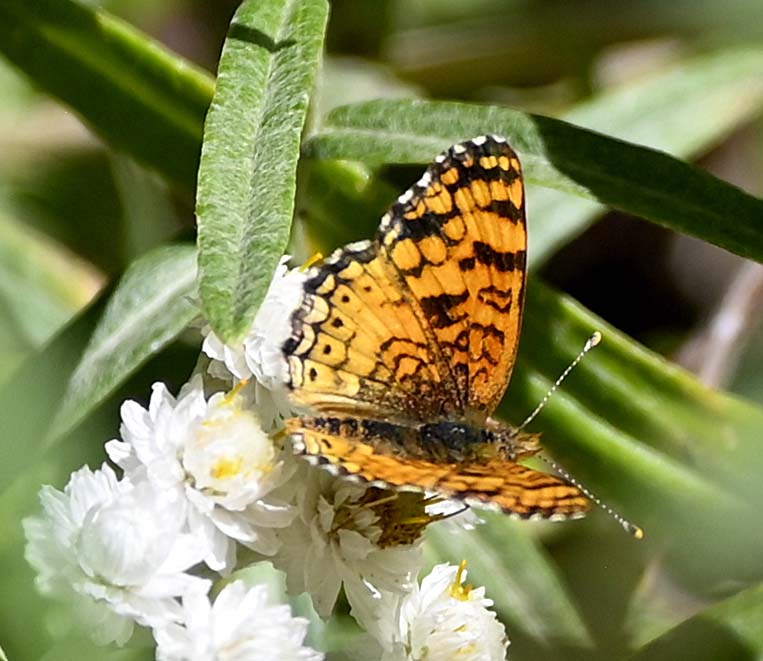
 For more about this and other Keck Geology programs, go to the Keck Geology website.

Monday, September 12, 2022

BUTTERFLY WALK: UC Botanical Garden, Berkeley, CA

Mylitta Crescent butterfly at the UC Botanical Garden, Berkeley, CA

It is said that only mad dogs and Englishmen go out in the midday sun. Add to that list: butterfly enthusiasts. Butterflies like the sun—using it to heat their bodies—and the best time to see them is on a warm, sunny day. So, on a warm, August afternoon we joined a group at the UCBotanical Garden in Berkeley, California, for a one hour guided butterfly walk through the garden.

Viewing photos and caterpillars at the entrance to the garden.

We were met at the entrance to the garden by our leaders, Sally Levinson, the “caterpillar lady”, who had brought samples of anise swallowtail caterpillars for us to see up close while we waited for the group to assemble, and Sarab Seth the “butterfly guy”, who would lead us on our tour.

Looking for butterflies in the desert section of the garden.

When I was growing up in the Midwest, my brothers and I collected butterflies--catching them in a net, killing them, and mounting them in glass-fronted boxes for our home “museum.” We learned to be careful as we handled them, not to touch their delicate wings and rub off the tiny colored scales. We also learned how to distinguish a butterfly from a moth by looking at the antennae—club shaped for butterflies and feather-like for moths. Now I prefer to appreciate butterflies free in the wild—although it is much harder to get a close-up look at them.

Before we set out on our walk, we each got a checklist for the species we hoped to see. It was divided into three sections: Likely sightings (5), Less Likely (5), and Even less likely (4). At the end of the walk we had spotted all five likely species (Acmon blue, Cabbage white, Field Crescent, Gray Buckeye, Mylitta Crescent), two of the less likely (Common checkered skipper, Monarch), and one that was not even on the list—a fritillary!

Mylitta Crescent on an aster

Of all the butterflies we saw, the only one that stayed still long enough for a good photograph (taken by Art) was a Mylittta Crescent.  And I got reasonably close to an Acmon Blue for a photo. But the other butterflies were too far away, even with a telephoto lens.

Acmon Blue butterfly

The butterflies that I am familiar with—monarchs, swallowtails, cabbage whites—are easy to spot in the wild. But many of the butterflies on the list were small—some less than an inch across—as well as speedy fliers. Once spotted, we hoped they would land so we could at least see their markings through binoculars. We were impressed by Sarab Seth’s ability to identify them in flight, even from a distance. Along the way, Sarab Seth pointed out which plants were preferred by each species—which helped in knowing where to look for the butterflies.

Anise swallowtail caterpillar.

Our first stop was at an angelica plant, a favorite of the anise butterfly. Sarab pointed out a caterpillar, still eating but which would soon be ready to form a chrysalis. 

Anise swallowtail butterfly egg on an angelica leaf. (Look for the tiny white spot.)

Sarab also showed us a single anise butterfly egg (which he had discovered earlier on the same plant), tucked carefully under a leaf. In a few days it would hatch into a tiny caterpillar, which would then grow rapidly over the next few weeks, continuing the cycle.

Monarch butterfly, photographed in our Oakland neighborhood

The largest butterfly we spotted during our walk was a monarch—hard to miss with its handsome orange and black coloring. We see them often on walks in our Oakland neighborhood. When asked about the annual monarch migration, Sarab said that the monarch butterflies tend to stick around all year in the garden (unlike in the past when they gathered in clusters in trees along the California coast) because so many people plant milkweed in their gardens.

At the end of our walk we returned to the shade—leaving the bright sunny spots to the butterflies. I was glad I learned about these California butterflies that make the UC Botanical Garden their home. At the bottom of our checklist Sarab gave us the link to his Facebook page with photographs he has taken of 44 butterfly species in the garden. They are gorgeous! Click to enjoy—without having to go out in the midsummer sun!

Wildflower in the UC Botanical Garden.


Monday, July 13, 2020

BUTTERFLIES OF KIBALE FOREST NATIONAL PARK, Uganda, Part 3, Guest Post by Karen Minkowski

Euphaedra eusemoides, butterfly in Kibale National Park, Uganda
My friend Karen Minkowski, truly an intrepid tourist, has spent much of her life in the field observing wild animals. She spent several months last year in Africa, including time in Kibale Forest National Park. In this three part series she shares her photos and observations of some of the wildlife there, particularly the wonderful diversity of butterflies. (Part 1, 6/29/20; Part 2, 7/6/20)
Butterfly larvae may not be as graceful or elegant as what they eventually metamorphose into, but I loved the variety of spikes, hairs, colors and pattern –  evolutionary adaptations to warn predators to keep away.

Richard also found insects fascinating and helped me spot them.
Euphaedra alacris butterfly
Euphaedra alacris caterpillar (larva)
I could identify only the larva of Euphaedra alacris, above with feathery appendages. Above it is the butterfly it will become.
Noctuid moth caterpillar that has been paratisitized by a Braconid wasp
Here is more drama in the insect world, this time in slow motion: a Braconid wasp has parasitized the larva (caterpillar) of a Noctuidae moth. By laying her eggs inside the larva's body, the wasp has turned it into an unwitting host that is supporting the developmental stages of her young. When the wasp's eggs hatched as larvae, they fed on the host's bodily fluids until they were ready to pupate. They then gnawed their way through the caterpillar's skin and spun their pupae - the white appendages - on its body. The Noctuidae larva will die before it can metamorphose into a moth, while adult Braconid wasps will emerge from their pupae and fly away.

Blue Mother of Pearl (Protogoniomorpha temora aka Junonia temora). 1971


Blue Mother of Pearl (Protogoniomorpha temora aka Junonia temora). 2019

Eventually I saw my purpley-blue butterfly. On top is the photograph I took in 1971 with a Miranda camera and either Kodachrome II or Ektachrome film. Below it is an image of the same species taken last year with my digital “bridge” camera, the Sony RX10v3. I often miss the warmth and saturation of Kodachrome film, even if those long ago images lacked the sharpness of today's digital photos.
I'm curious to see how the butterflies distribute themselves during Kibale's dry season. When dung is not diluted by rain do they still feed on it? Or do more of them drink nectar, like this unidentified butterfly is doing? And will I see species that show up only when the forest is drier? When it is again safe to travel, I hope to go find out.
Meanwhile, here are a few more of Kibale's amazing butterflies and moths:
Euphaedra preussi
    Cyclophora diplostica, a Geometrid moth     

 Kallimoides rumia; Cymothoe lurida
Euphaedra harpalyce
Brown pansy (Junonia hedonia)
Common dotted border (Mylothris agothina)

*****
I am very grateful to Dr. David Tumusiime and Mr. Innocent Kato for welcoming me as a volunteer at the Makerere University Biological Field Station and for their hospitality and support during my stay from April 9 to June 19, 2019. Many others on the MUBFS staff and in the Kanyawara community helped me as well. I thank Nelson Guma of Uganda Wildlife Authority for expediting permission for me to reside and work in Kibale for that time period. It was a remarkable experience that I will always treasure. Thanks to Dr. Freerk Molleman, who kindly made available for download his Butterflies of Uganda: Kibale Forest (2012) and also identified some of my photos. Likewise, Dr. Sille Holm identified several moths and the family of a moth larva. I also consulted The Anglia Ruskin University guide to butterflies of Kibale Forest, Uganda, by Alvin J. Helden, Fabrizio Manco and Sophie Mowles, v.2 (2018); A Field Guide to the Butterflies of East Africa, by John G. Williams (1969); and the internet. Any errors in identification are my own.