Showing posts with label Angel Island. Show all posts

Monday, September 16, 2024

ANGEL ISLAND IMMIGRATION STATION: Poetry on the Walls

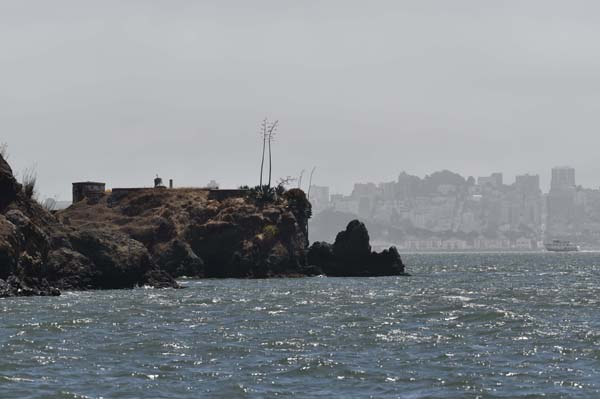
View of Angel Island in San Francisco Bay from the Tiburon Ferry.

Angel Island sits in the middle of San Francisco Bay, not far from the much smaller island of Alcatraz. It can be reached by ferry from San Francisco, Oakland, or Tiburon (in Marin County). In 2013, when I visited Angel Island, I took a tram tour and heard about the island's long history, including the story of lighthouse keeper, Juliet Nichols, and how she kept the fog bell ringing by hand on an extremely foggy night and day in the summer of 1906. That became the inspiration for my children's picture book, Keeper of the Light: Juliet Fish Nichols Fights the San Francisco Fog (Cameron Kids/Abrams, 2022).

Arriving at the dock in Ayala Cove on Angel Island, August 2024.

A few weeks ago I visited Angel Island for the first time since Keeper of the Light was published. It was a beautiful day and the ferry from Tiburon was crowded with people going to Angel Island for a day of hiking, biking and enjoying the out of doors in the state park.

Map of Angel Island. We followed the blue perimeter road to the Immigration Station on the north side of the island.

On all my previous visits to the island I had focused my attention on the southwest side of the island where Juliet’s lighthouse had been located (marked with a yellow X on the map) and where the story of my book takes place. But this time I wanted to visit the former Immigration Station on the other side of the island, where thousands of immigrants, mostly from China, had been detained between 1910, when it was built, and 1940, when it was closed after the main administration building burned down. So, after disembarking at Ayala Cove, Art and I followed the path past the Visitor Center and up the hill to the perimeter road, for a half-hour walk to the entrance of the Immigration Station.

View of Tiburon from the perimeter road. Can you find us in the reflection?

At 12 square miles, Angel Island is the largest island in San Francisco Bay. When Juan Manuel de Ayala y Aranza, the first European to visit the island arrived in 1775, he encountered the indigenous Miwoks, who had been coming there to hunt, fish and gather acorns and other wild plants for thousands of years. Over the next half century, the regional Miwok population was decimated due to resettlement and introduced diseases, and their use of the island as a hunting ground ended. In 1848, at the end of the Mexican-American War, California became part of the United States. Two years later the Federal Government became the official owner of Angel Island.

Dormitory in the Detention Barracks as it might have looked while immigrants waited for decisions on their cases. They slept in bunk beds, six between each set of poles.

The Immigration Station on Angel Island opened in 1910. It was the West Coast’s primary immigration facility, where immigrants, mostly from China and Japan, but other countries as well, were brought to be interrogated, often being detained for weeks, months or even years, and in many cases deported. The Chinese Exclusion Act, passed by the U.S. Congress in 1882, prohibited most Chinese from immigrating to the U.S. (It was repealed in 1942.)

Detention Barracks are in the upper left of the photo. In the lower left is the large water tank which provided fresh water for cooking and bathing. Both the Detention Barracks and Hospital Monument are now museums.

In 1962, the military left Angel Island and soon after it became a California State Park. The former Immigration Station is now open to the public. In the Detention Barracks Museum you can see rows of narrow bunk beds in the large room where detainees slept, examples of some of the clothing and items they had brought with them, games they played, the guards' office, and more. While most of the detainees at the Immigration Station were men, there were also women and children, who were kept separately. (Note that there is a $5 fee to see the Detention Barracks Museum. It is well worth it!)

Examples of the writing on the wall.

What is most unique about the Detention Barracks Museum is the writing on the wall. Many detainees wrote or carved their thoughts into the wooden walls of the barracks. These inscriptions, many written as poems, form a personal record of their experience and have become a unique and valuable record of the immigrant experience. Over the years, the walls were painted, obscuring the writing. When we first walked into the room we said—but where is the writing?—until the docent showed us by shining her phone light onto the wall to catch the shadows of the engraved characters. Poems were everywhere!

Island of Sadness. You can press the button to hear the poem read aloud.

Signboards provide information about different kinds of Chinese poetry and give examples. And one display allows you to listen to a poem being read aloud in both English and Chinese. When you listen to the Chinese, even if you don't understand the words, you can hear the rhythm and rhyme.

Fog Bell at the Immigration Station Memorial. 

The Immigration Station also had a giant fog bell, much like the one Juliet Nichols rang on that foggy night in 1906. Unlike Juliet’s bell, which is inaccessible, but still in place on the rock where the bell house once stood, the Immigration Station bell is part of a memorial to the immigrants who once came to the island. It has a clapper, which you can swing to make the bell ring. We ate our picnic lunch on a shaded bench next to the bell.

The Immigration Station on Angel Island was declared a National Historic Landmark in 1997.

During my visit I finally got to meet Park Interpreter Casey Dexter Lee in person, who had been so helpful with my research for my book. It was a pleasure to talk with her and learn more about Angel Island’s history.

Keeper of the Light is for sale at the kiosk gift shop.

Before we caught the ferry back to Tiburon, I visited the kiosk gift shop near the dock, where I was pleased to see Keeper of the Light displayed. All profits from sales in the gift shop go to support the Angel Island Conservancy.

Ferry landing, Tiburon.

For our visit to Angel Island we had bought our ferry tickets ahead of time online, showing the QR code as we boarded in Tiburon in the morning and where we were given a ticket for the return trip. We made sure to be on time for the 3:20 ferry back to Tiburon, the last trip of the day. If you miss the last ferry you are stuck on the island! And unless you brought camping gear, there is no place to stay. There is a small café in Ayala Cove, but services are limited on the island.

For more information about Angel Island and the Immigration Station check online.

View from inside the Detention Barracks.

For my post about my visit to Angel Island in 2017, click HERE.

Monday, September 5, 2022

MILLS COLLEGE, OAKLAND, CA: Nature Walk and Window Onto History

Mills College, Oakland, CA
In the middle of Oakland sits the campus of Mills College, an island of greenery around academic buildings and a place where local residents go to play sports on the playing fields, walk along tree lined paths, birdwatch, and generally enjoy nature. Established as a women’s college in 1885, Mills College will transform to a campus of Northeastern University in Boston in the fall of 2022.

Mills Young Ladies Seminary, about 1873. Mills Hall and students.

Mills College began as a Young Ladies Seminary in 1852 in Benicia, CA, moved to Oakland in 1871, and was chartered as a college in 1885. Juliet Fish Nichols (1859-1947), the subject of my new book, Keeper of the Light: Juliet Fish Nichols Fights the San Francisco Fog, was one of the first graduates. 

Olin Library at Mills College. 

Earlier this year, on a Sunday afternoon in June, Art and I took a walk on the Mills campus. I wanted to see Mills Hall, the building where Juliet had lived and attended classes when she was a student.

Mills Hall, 2022.

It is likely that one of the girls seated on the lawn in the 1873 photograph is Juliet, then fourteen years old. (The identity of the girls is not noted on the photograph.) At the time, Mills Hall was the only structure on campus. It contained classrooms and offices as well as housing for faculty and the young women who were the students. Now it is used as an administration building. 

The Bell Tower, designed by architect Julia Morgan. 

Gradually, the college grew, with facilities for the arts, sciences, music, sports and other disciplines. In 1904, the bell tower, El Campanil, designed by Julia Morgan was built in the southeast quadrant of the campus, across from Mills Hall.

A grove of California Bay Laurel trees on the Mills College campus.

In the first years the land around the new campus was quite open except for a few native oak trees. More than one thousand trees were planted, now grown to stately heights. As you walk around the campus today, you feel like you are in an arboretum, with trees and plants identified, and a nature trail along Leona Creek, which flows through the campus. 

A bridge crosses Leona Creek, which flows from the Oakland hills to San Francisco Bay.

The day I visited was shortly after graduation (chairs were still set up on the lawn) and few people were around. It was easy to imagine what it must have been like more than one hundred years ago when Juliet was a student.

Juliet Fish was born in Shanghai, China, where her father, Dr. Melancthon Fish, was serving as a medical missionary and United States consul. The family returned to the United States when Juliet was three. Juliet grew up in Oakland, California, and attended Mills Seminary for Young Ladies, where the goals were good health and a classical education. A daily outdoor walk of at least one mile was required. Students also worked out with dumbbells, Indian clubs and wands—so Juliet was well prepared for the physical demands of her later lighthouse work.

When Juliet was a student at Mills, she would have walked along shaded paths like this one lined with blackberry vines.

In 1888, Juliet married Commander Henry Nichols of the U.S. Navy, who became Superintendent of the 12th Lighthouse District along the coast of California. They had no children. In 1899, Henry Nichols was sent to the Philippines during the Spanish-American War, where he died of heat stroke, leaving Juliet without financial support.

Angel Island Lighthouse and Bell Station, as it appeared when Juliet lived there.

When Juliet learned that the lighthouse keeper on Angel Island was retiring, she applied for the job. Juliet served as lighthouse keeper at Point Knox on Angel Island from 1902 to 1914. Upon her retirement, Juliet lived the rest of her life in Oakland. She is buried in the family plot at Mountain View Cemetery in Oakland.

Except for her lighthouse log and official letters and reports, Juliet Fish Nichols left few clues to her personal life. As I walked around the Mills Campus, I felt that in a small way I was able to share Juliet’s experience as a student and get a bit of insight to her life.

I donated at copy of my book Keeper of the Light to the Olin Library at Mills College in honor of Juliet Nichols. 

For more about Juliet Fish Nichols and Angel Island go to my posts of September 2017 and July 2012.

Additional information about Juliet Nichols, her log, Angel Island, the Point Knox Lighthouse, 1906 San Francisco earthquake, and more is at https://carolinearnoldart.blogspot.com/p/extra-material-for-keeper-of-light.html .


Monday, April 11, 2022

11th ANNIVERSARY OF THE INTREPID TOURIST: Celebrating My New Book KEEPER OF THE LIGHT, Inspired by a Trip to Angel Island

Ferry landing at Angel Island State Park, San Francisco Bay, California
This week is the 11th anniversary of my first post at The Intrepid Tourist, a report of a family trip to Gettysburg, Pennsylvania. I have continued to post a new article once a week since then. I still love to travel and sometimes, when I least expect it, a travel experience becomes the source of an idea for a new book.


I am dedicating this blog anniversary to the celebration of my new book, KEEPER OF THE LIGHT: Juliet Fish Nichols Fights the San Francisco Fog, that comes out this week and which was inspired by a visit to Angel Island State Park in San Francisco Bay ten years ago.
Tram ride around Angel Island
In July 2012, Art and I took a ferry from Tiburon to Angel Island to meet friends, who had sailed their boat from Alameda across San Francisco Bay to the harbor at Angel Island. We had a delicious lunch on the boat and then took a tram ride around the island, narrated along the way with historic details about the buildings and the people who once lived on the island, when it was the site of an army post, immigration facility, and a light and fog bell station. 

Point Knox, once site of the light and fog bell station. The giant bell remains.

Near an overlook on the south side of the island we heard about Juliet Nichols, the light keeper of the Angel Island lighthouse at Point Knox, who, during the summer of 1906, when the bay was filled with supply boats after the devastating San Francisco earthquake, heroically rang the fog bell by hand for more then twenty hours before the fog lifted.
Card catalogue, Oakland Public Library.

Juliet’s story intrigued me. It sounded like the perfect subject for a book. I began to research Juliet’s life and the history of Angel Island. I searched the internet. I went to the Oakland library to read newspaper articles and other items in the archives. (Juliet grew up in Oakland and lived there after she retired.) I looked up Census records on Ancestry.com . 

Angel Island Light House log book, 1904-1912. National Archives, Washington, DC.

I visited the National Archives in Washington, DC, to read Juliet’s lighthouse log. I went back to Angel Island several times. Although her house is gone, the giant bell can still be seen at Knox Point.
Keeper of the Light Illustration by Rachell Sumpter

It took me eight years and many rewrites to tell Juliet’s story, then two more years to see it published. I am thrilled that the book is now available and I can share it with the world. Keeper of the Light: Juliet Fish Nichols Fights the San Francisco Fog is published by Cameron Kids/Abrams and is illustrated with beautiful watercolor paintings by Rachell Sumpter. It is available at many book stores as well as Amazon and other online sources.


Monday, September 25, 2017

ANGEL ISLAND IN SAN FRANCISCO BAY: a Trip Through Time

View of Golden Gate Bridge from Camp Reynolds on Angel Island, San Francisco Bay
Several weeks ago, I went with my husband and granddaughter to Angel Island in San Francisco Bay, taking the ferry from Tiburon for the short ride to Ayala Cove.
Ferry to Angel Island--about a mile from Tiburon and three miles from San Francisco.
Angel Island, a California State Park, is a great place for hiking and watching wildlife and a chance to explore and learn about the island’s unique role in California history.
Angel Island. At 1.2 square miles Angel Island is the largest island in San Francisco Bay.
After leaving the boat, our first stop was the Visitor Center, where several rooms of displays gave an overview of the many facets of the island. 
Historic plaque near the picnic area and visitor center at Ayala Cove. Headquarters of the park are also housed in the old U.S. Public Health Service Building.
For thousands of years Native American Miwok Indians from the mainland visited the island, hunting, fishing, and gathering acorns and other wild plants. Today, native wildlife includes birds, squirrels, deer and a species of mole unique to the island.
A young mule deer stopped by, seemingly unafraid, as we ate our picnic lunch.
The first European to land on the island was Spanish explorer Juan Manuel de Ayala, who moored his ship in the small cove on the north side of the island in the fall of 1775.  Following the tradition of naming discoveries after the closest feast day, he named it Angel Island in honor of the Feast of the Angels, celebrated on October 2nd.
From 1910 to 1940 hundreds of thousands of immigrants, mostly from China, were processed at the Angel Island Immigration Station.  We did not have time on this trip to go to the Immigration Station but plan to do so on another visit. 
Angel Island has had many uses over the years. Among other things it has been a cattle ranch, military base, immigration station, and quarantine station.
The rocky platform at Point Knox where the lighthouse once stood. Only the fog bell remains. In 1960 a new, more modern lighthouse and fog station was opened at Point Blunt on Angel Island and the Point Knox lighthouse and fog station was closed and removed.
The first lighthouse on Angel Island was a fog station, built in 1886 at Point Knox, a rocky outcropping on the southwest corner of the island. A light was added in 1900. One of the keepers was Juliet Fish Nichols whose heroics after the 1906 earthquake I wrote about in an earlier post on this blog.  On foggy days and nights, her job was to set the fog bell machine in motion. The 3000 pound bronze bell at Point Knox was operated by a Gamewell Fog Bell Striker machine, in which a heavy weight suspended below the mechanism powered a mallet that struck the bell.  Once the mechanism was wound, it ran for several hours.  Gamewell mechanisms were used widely at lighthouses along the coasts of the United States for many years, but were known to be temperamental.  Juliet Fish Nichols reported in her log at least eight failures of the Point Knox bell machine.  Eventually, (after the 1930's) the fog bell at Point Knox was replaced by a much more reliable compressed air siren.
Fresnel lens on display at the Visitor Center; a photo of the Point Knox Lighthouse is behind it.
The light at Point Knox was a type known as a Fresnel lens.  The glass rings of a Fresnel lens are prisms that concentrate light from inside the lens (originally provided by an oil or kerosene lamp, later by an electric bulb) making the light visible for 20 miles or more.  The lenses came in various sizes. The light at Point Knox was a 5th order red lens, one of the smaller Fresnel lenses, but sufficient for distances in San Francisco Bay.
The barracks of Camp Reynolds, the West Garrison of Fort McDowell
The remains of Fort McDowell, both the earlier West Garrison (Fort Reynolds) and the larger East Garrison are found on the island. Thousands of soldiers left from Angel Island during World War I and II. After World War II, the military bases were closed. A Nike missile site was installed on top of the island; after it was removed in 1962, the U.S. government gave Angel Island to the state of California. It is now Angel Island State Park, a fascinating place to spend the day and to relive a bit of California history.

Facilities on Angel Island include a cafe, tram tours, and Segway and kayak rentals. For more information about Angel Island and links to ferry schedules, click HERE.
For more about the history of the island and activities, go to the Angel Island Conservancy site.

For more about Juliet Nichols, her log, Angel Island, the Point Knox Lighthouse, 1906 San Francisco earthquake, and more go to https://carolinearnoldart.blogspot.com/p/extra-material-for-keeper-of-light.html .

Monday, February 25, 2013

MOUNTAIN VIEW CEMETERY: in Oakland, CA--Bankers, Chocolate Kings and Ordinary People

View of Mountain View Cemetery from the Fish Nichols plot
On a recent sunny afternoon, I visited Mountain View Cemetery in the Piedmont area of Oakland in search of the grave site of Juliet Fish Nichols, the lighthouse keeper on Angel Island from 1902 to 1914.  I had learned about her last summer on a trip to Angel Island and about her heroic efforts to keep the fog bell ringing on a very foggy night in the summer of 1906 after the devastating San Francisco earthquake. (See my post for July 30, 2012.)  After retiring, she returned to her home in Oakland where she lived until she died in 1947. She is buried in the cemetery alongside her husband, father, and mother.

Mausoleum of Charles Crocker (1822-1888) founder of Crocker Bank
I found Julia's tombstone in the family plot, high on a hill with a spectacular view and a host of impressive neighbors–Charles Crocker of Crocker Bank, Domingo Ghiradelli, the “chocolate king”, Julia Morgan, California’s first woman architect, James Folger, the coffee producer–and many more of the people who are integral to California’s history.  Luckily, we  had picked up a brochure at the park office near the entrance on our way in along with a guide to the cemetery and the graves of some of its notable residents--a kind of crib-sheet to local history.

Crocker's tomb, upper left; Samuel Merritt, right, with pyramid on top
The brochure also included a brief history of the building of the cemetery, which was designed by the well-known landscape architect Frederick Law Olmstead, the designer of Central Park in New York City. In 1863, Olmstead was in California writing a report on Yosemite in an effort to convince Congress to make it into a national park.  The city of Oakland, rapidly growing on the East Side of San Francisco Bay, had bought 220 acres of land for a cemetery in the Oakland hills and invited Olmstead to create a design for it, which he did.  His design, an elegant blending of art and nature with majestic avenues, winding roads, shaded paths and inspiring vistas, among beautiful plantings of trees and flowers, became one of the most prominent garden cemeteries in America.

Avenue leading to top of hill
On the day we visited we saw some families tending graves, but the cemetery is so large that as we drove up the hill to find Juliet Nichols grave, we encountered few people and were aware mainly of the quiet and peacefulness of the site.  When we got to the top, we had stunning views of San Francisco and the whole Bay Area.  We were there in December and the entrance of the cemetery was decorated with a large nutcracker figure for the holidays and inside they had a special display of holiday lights.

You can take free docent led tours of the cemetery at 10:00 a.m. on the second and fourth Saturdays of each month. For more information about visiting Mountain View Cemetery and learning about its historic residents go to  http://www.mountainviewcemetery.org/.

Monday, July 30, 2012

ANGEL ISLAND: History and Nature in the Middle of San Francisco Bay

Angel Island Ferry Landing and view of Visitor Center
Angel Island sits in the middle of San Francisco Bay, a short ferry ride from San Francisco, Oakland, or Tiburon in Marin County.  Or, if you have your own boat, you can sail over and tie up at the dock during the day and moor in the bay overnight.  Once a military base and immigration center (the West Coast equivalent of Ellis Island) Angel Island is now a state park, a natural haven that is home to birds, deer, and other wildlife, and a place where city folks can spend the day hiking and relaxing.  You can also rent kayaks,  bicycles, Segways, and scooters near the ferry landing.

In early July, Art and I met friends at Angel Island for the day.  They came on their boat and we took the ferry from Tiburon, along with a group of day camp children, who delighted in watching the gulls follow the boat and dive after the fish that were stirred up in its wake.  Later, we watched the kids trying to catch their own fish off the dock, but no one had any luck.

Camp Reynolds (West Garrison)
After arriving at the dock and meeting our friends, we followed the path past the picnic area and visitor center to the main road around the island.  We walked for about a third of the way around the island before returning for lunch.  We had a picnic, but you can also buy food at the small cafĂ© at the ferry landing.

After lunch, we took the tram ride around the island, which takes about an hour and is an opportunity to hear some of the history of Angel Island and see the variety of the landscape on the different sides of the island.  The tram stopped for photos at an overlook where we had a spectacular view of the San Francisco skyline, Alcatraz, the Bay Bridge, the Golden Gate Bridge, and the Marin headlands.  We were told that if we hiked the steep trail to the top of the island on a clear day, we would get a 360 degree view of the whole San Francisco Bay area.
Angel Island Tram
We had a beautifully clear, warm, and sunny day for our visit.  But San Francisco Bay can also be quite foggy.  For ships traveling through the Golden Gate, the rocky coast around Angel Island can be a hazard. One of the stories we heard on our tram ride was about the people who operated the fog bell at the Point Knox Lighthouse on the island in the early days.  The bell was designed with a mechanism that struck it automatically.  But, one foggy day in 1906, the mechanism for the bell failed and the only person home at the time was Juliet Fish Nichols, who had become the lighthouse keeper in 1902.  The bay was full of ships bringing in supplies after the recent San Francisco earthquake and Juliet knew she had to do something to warn them to keep a safe distance from the island.  So she took a sledge hammer to hit the large bell by hand, which she continued to do for twenty hours straight until the fog lifted. Juliet later received commendation for her heroic effort.  Although the lighthouse building at Point Knox is long gone, the large bell remains as a reminder of earlier days.
View of Alcatraz and San Francisco from Angel Island
Angel Island is a great place to spend the day.  For links to ferry schedules and more information about Angel Island's history and facilities, go to the Angel Island State Park site. [Note: some services have changed since this article was written.]

For more about Juliet Nichols, her log, Angel Island, the Point Knox Lighthouse, 1906 San Francisco earthquake, and more go to https://carolinearnoldart.blogspot.com/p/extra-material-for-keeper-of-light.html .