Showing posts with label winery. Show all posts

Monday, June 2, 2025

CANARY ISLANDS NATURE TOUR, Part 2: Guest Post by Susan Kean


View from the top of crater over to Las Palmas. Canary Islands.
My friend Susan Kean and her partner George recently toured the Canary Islands on a nature tour. I thank her for sharing her impressions and terrific photos with The Intrepid Tourist.

Today’s adventure in the Gran Canaria was learning about their indigenous people and checking out the main volcanic crater on the island. Relevant to today’s times, the Canary Island folks were very grateful to the CIA who gave them a heads up in 1971 about an impending earthquake. In those days Spain had no earthquake prediction systems and the CIA were in the Atlantic and observed some activity. This early warning helped save lives.

Cave. (Note tiny cars on lower right for scale.)

It is believed that the earliest people came to Gran Canaria in the 3rd Century. They were from North Africa, similar to the Berbers in Morocco. It is not known how they got there but they may have been brought by the Romans. 

Skeleton.

The early people came prepared--bringing seeds, animals, everything they needed for existence. They lived in caves, similar to those of some indigenous people in the North America.
We had a Tapas lunch in a cave restaurant. Our restaurant was in a cave dug into the hillside.

Center statue is a model of an indigenous statue found on a hillside.

The last day of our Nature Trek trip to Gran Canaria was spent near our hotel at Valley Agaete Necropolis where we learned how the indigenous people buried their dead in raised stone tombs because it was impossible to dig graves in the lava rock. This was during 7th to 11th century.

Stone tomb.

We also had a wonderful time wine tasting and lunch at Finca La Laja farm where they grow coffee, grapes, all kinds of citrus, bananas and every fruit you can think of--almost. The climate is a bit cooler than California and has more rain.

Winery at Finca La Laia.

Opuntia.

Opuntia (prickly pear cactus) was imported from America to grow the cochineal insect to produce red coloring. The cactus is everywhere now.
Feral cats.

Ferry approaching the pier in small harbor near our hotel. I found the lava cliffs coming down to the ocean spooky. 
Part 1 of Susan's trip to the Canary Islands posted last week, May 26, 2025. Part 3 will post next week, June 9, 2025.

Monday, August 23, 2021

DISCOVERING SANTORINI'S MAGIC, Guest Post by Catherine Mayone

 52 Places to Go: Week 34


The island of Santorini, Greece. Oia architecture

My niece Cathy and her husband Mike just returned from a wonderful vacation on Santorini and sent me this terrific report. 
In the lead up to my trip to the Island of Santorini, Greece, a friend of mine gave me some tips but refused to give too many details for fear of spoiling the surprises.  So I’ll try not to reveal too much and use only one adjective, “magical”, to describe the experience.  My husband and I spent six days in late May 2018 staying in two different locations and exploring the landscape, architecture, ancient ruins, quaint cliff top towns, vineyards, and just doing nothing but staring out at the azure Aegean Sea.
Sunset in Oia
Santorini, also known as Thira, was formed in the 16th century BC when a large volcanic eruption created its current landscape.   At 28 square miles, it offers the perfect size for exploring by land and sea.  We opted to rent a car for the entire period -- at 17 euros / day it was more cost effective than taxis and provided us the freedom to wander as we pleased.  We found our tiny Fiat convertible easy for navigating the small alley ways and a blast to drive, and didn’t have issues finding free parking.  In the height of the summer season I imagine driving and parking would not be as fun; the public bus system is very affordable and comfortable in coach style buses.  ATVs, scooters, or a daily car rental are also options.
View from our Oia "cave house"
We split up our stay between the towns of Oia (pronounced “eeya”) and Imerovigli.  In Oia, our twp bedroom AirBnB cave house with a sweeping patio provided a unique experience.  In Imerovigli, our stay at the Hotel Afroessa provided a spectacular view of the sunset and the friendly welcome and hospitality of a superb staff.
Hike from Oia to Fira
It was easy to spend our first few days exploring the ancient town of Oia with a hike down to the fishing port Amoudi Bay and browsing the artsy shops, the best on the island.  We also hiked the 11K trail from Oia over the ridge, with sea views in all directions, through Imerovigli, and into the capital city of Fira, which is the port of call for the cruise ships with sidewalks full of day-trippers.

On day 4, we opted for a self-guided driving tour of the Island since we had to check out of the AirBnB and into our hotel.  We quickly learned GPS systems have a hard time in Santorini as we kept trying different roads to find our hotel. Since you rarely just pull up to a hotel and drop off your bags, porters are adept at flinging multiple suitcases over their shoulders while you’re struggling to keep up as they seem to glide up and down all of the steep, no railing, natural stone stairs.
Ancient Thera
Our first driving destination was Ancient Thera, the highest point on the island, that was home to settlements from the 9th century BC until 726 AD, where you can see the expansive remains including the evidence of the Greek theater, Roman Baths, city center, and many private dwellings.  Since it was hard for us to get there, it’s amazing that populations long ago made it their home.  To access ancient Thera today, you can either hike up from Perissa, or hike or drive up the very windy, narrow road from Kamari.  Since we didn’t have a lot of time and the site closes at 3pm, we opted for the drive up, which is not for the faint-hearted!
Gaia winery in Kamari
We were ready for some nourishment and relaxation so our next stop was a vineyard.  Santorini is home to 1,100 hectares of vines and is well known for its white grape varieties Assyrtiko, Athiri, and Aidani.  Winemakers have invented an ungrafted vine growing process, which keeps the grapes growing in a circular tube and low to the ground to avoid the wind and heat exposure that has killed crops.  The GPS once again failed us so we gave up on our selected vineyard and stumbled upon another one – even better – Gaia Winery in Kamari by the sea on the shore of a black beach.  A waiter later marveled that we went there since tourists often opt for the bigger, fancier wineries like Boutari Winery, Santo Winery, and Estate Argyros.  It was easy to pass a couple of hours sipping wine, nibbling on the cheese platter, and learning about each bottle of wine which our hostess explained in detail, that feature unique flavors from the volcanic soil and salt from the sea.

By now, we turned the GPS off and my navigating went something like “this looks right” and “how wrong can we be since we can see the sea”.  Last stop was Megalochori for a brief walk through the ancient town, a café break, and a visit to its local bakery.

On day 5, we wanted to see the island from the water and went on an 18 person catamaran tour by Spiridakos around the southern shores of the Island.  They did an excellent job with a BBQ and Greek style sit down lunch and swim stops at the volcanic “hot springs” (warm but not hot), white beach and red beach.  The water at the beaches is crystal clear and, while brisk in shoulder season, we enjoyed a swim.  You won’t find a lot of fish for snorkeling or eating in the Aegean waters.  We were told much of the fishing industry was destroyed by the dynamite fishing technique that brought fish to the surface; the fish are only starting to re-populate.
Skaros rock in Imerovigli
We had been staring at Skaros rock from our Imerovigli hotel balcony and so it was beckoning a brief hike on day 6.  You can do it as part of your hike between Fira and Oia, but we were glad we saved it for another day so we could comfortably explore it and the chapel that sits on a perch on the back side of the rock.  There are more than 600 chapels and churches on Santorini, the products of fishermen who used to vow to build a church if they returned home safely from a long sea voyage.

Santorini has everything you could want in an Island vacation.  As gorgeous as photographs are, you must experience the sights, sounds, air, water, tastes and people yourself to reveal its surprises and magic.

We highly recommend our cave house AirBnB in Oia or Hotel Afroessa in Imerovigli.
 
This article was first published  6/25/18.

Monday, June 25, 2018

DISCOVERING SANTORINI'S MAGIC, Guest Post by Catherine Mayone


The island of Santorini, Greece. Oia architecture

My niece Cathy and her husband Mike just returned from a wonderful vacation on Santorini and sent me this terrific report. 
In the lead up to my trip to the Island of Santorini, Greece, a friend of mine gave me some tips but refused to give too many details for fear of spoiling the surprises.  So I’ll try not to reveal too much and use only one adjective, “magical”, to describe the experience.  My husband and I spent six days in late May 2018 staying in two different locations and exploring the landscape, architecture, ancient ruins, quaint cliff top towns, vineyards, and just doing nothing but staring out at the azure Aegean Sea.
Sunset in Oia
Santorini, also known as Thira, was formed in the 16th century BC when a large volcanic eruption created its current landscape.   At 28 square miles, it offers the perfect size for exploring by land and sea.  We opted to rent a car for the entire period -- at 17 euros / day it was more cost effective than taxis and provided us the freedom to wander as we pleased.  We found our tiny Fiat convertible easy for navigating the small alley ways and a blast to drive, and didn’t have issues finding free parking.  In the height of the summer season I imagine driving and parking would not be as fun; the public bus system is very affordable and comfortable in coach style buses.  ATVs, scooters, or a daily car rental are also options.
View from our Oia "cave house"
We split up our stay between the towns of Oia (pronounced “eeya”) and Imerovigli.  In Oia, our twp bedroom AirBnB cave house with a sweeping patio provided a unique experience.  In Imerovigli, our stay at the Hotel Afroessa provided a spectacular view of the sunset and the friendly welcome and hospitality of a superb staff.
Hike from Oia to Fira
It was easy to spend our first few days exploring the ancient town of Oia with a hike down to the fishing port Amoudi Bay and browsing the artsy shops, the best on the island.  We also hiked the 11K trail from Oia over the ridge, with sea views in all directions, through Imerovigli, and into the capital city of Fira, which is the port of call for the cruise ships with sidewalks full of day-trippers.

On day 4, we opted for a self-guided driving tour of the Island since we had to check out of the AirBnB and into our hotel.  We quickly learned GPS systems have a hard time in Santorini as we kept trying different roads to find our hotel. Since you rarely just pull up to a hotel and drop off your bags, porters are adept at flinging multiple suitcases over their shoulders while you’re struggling to keep up as they seem to glide up and down all of the steep, no railing, natural stone stairs.
Ancient Thera
Our first driving destination was Ancient Thera, the highest point on the island, that was home to settlements from the 9th century BC until 726 AD, where you can see the expansive remains including the evidence of the Greek theater, Roman Baths, city center, and many private dwellings.  Since it was hard for us to get there, it’s amazing that populations long ago made it their home.  To access ancient Thera today, you can either hike up from Perissa, or hike or drive up the very windy, narrow road from Kamari.  Since we didn’t have a lot of time and the site closes at 3pm, we opted for the drive up, which is not for the faint-hearted!
Gaia winery in Kamari
We were ready for some nourishment and relaxation so our next stop was a vineyard.  Santorini is home to 1,100 hectares of vines and is well known for its white grape varieties Assyrtiko, Athiri, and Aidani.  Winemakers have invented an ungrafted vine growing process, which keeps the grapes growing in a circular tube and low to the ground to avoid the wind and heat exposure that has killed crops.  The GPS once again failed us so we gave up on our selected vineyard and stumbled upon another one – even better – Gaia Winery in Kamari by the sea on the shore of a black beach.  A waiter later marveled that we went there since tourists often opt for the bigger, fancier wineries like Boutari Winery, Santo Winery, and Estate Argyros.  It was easy to pass a couple of hours sipping wine, nibbling on the cheese platter, and learning about each bottle of wine which our hostess explained in detail, that feature unique flavors from the volcanic soil and salt from the sea.

By now, we turned the GPS off and my navigating went something like “this looks right” and “how wrong can we be since we can see the sea”.  Last stop was Megalochori for a brief walk through the ancient town, a café break, and a visit to its local bakery.

On day 5, we wanted to see the island from the water and went on an 18 person catamaran tour by Spiridakos around the southern shores of the Island.  They did an excellent job with a BBQ and Greek style sit down lunch and swim stops at the volcanic “hot springs” (warm but not hot), white beach and red beach.  The water at the beaches is crystal clear and, while brisk in shoulder season, we enjoyed a swim.  You won’t find a lot of fish for snorkeling or eating in the Aegean waters.  We were told much of the fishing industry was destroyed by the dynamite fishing technique that brought fish to the surface; the fish are only starting to re-populate.
Skaros rock in Imerovigli
We had been staring at Skaros rock from our Imerovigli hotel balcony and so it was beckoning a brief hike on day 6.  You can do it as part of your hike between Fira and Oia, but we were glad we saved it for another day so we could comfortably explore it and the chapel that sits on a perch on the back side of the rock.  There are more than 600 chapels and churches on Santorini, the products of fishermen who used to vow to build a church if they returned home safely from a long sea voyage.

Santorini has everything you could want in an Island vacation.  As gorgeous as photographs are, you must experience the sights, sounds, air, water, tastes and people yourself to reveal its surprises and magic.

We highly recommend our cave house AirBnB in Oia or Hotel Afroessa in Imerovigli.

Monday, January 8, 2018

HOW DO I KNOW I'M IN AUSTRALIA?

Koala joey at Hanson Bay Wildlife Sanctuary, Kangaroo Island, Australia
I love going to Australia. Since my first trip in 1983, I have been back five times, including my recent trip in December. Here are some of the things that tell me I have arrived in the land Down Under.
Clocks are five hours earlier and I have lost a day! (In the southern hemisphere winter, the time difference between California and Sydney is seven hours.) The trip across the Pacific crosses the International Date Line. On the way home, we gain a day.
Summer flowers at the Coriole winery in McLaren Vale, South Australia
The seasons are switched. When we arrive in December it is summer Down Under. Flowers are blooming and the temperature is warm.
At noon our shadows point south. While the sun still rises in the east and sets in the west, it arcs to the north in the southern hemisphere.
Late afternoon, looking east toward Remarkable Rocks on Kangaroo Island
At night the stars are upside down. Orion is standing on his head and there is no North Star. Instead, the Southern Cross points to the southern pole star.
Traffic is on the left and drivers sit on the right.  Each time I step off the curb I have to remind myself to look to the right for oncoming traffic.
It helps to be reminded to drive on the left in areas popular with tourists
Kangaroo crossing signs. Yellow signs warning drivers to watch out for wildlife (kangaroos, koalas, wombats and more) are common along highways.
Koala, kangaroo, Cape Barren goose and echidna signs--Kangaroo Island
In our rental car our luggage goes in the boot (trunk) and we fill the gas tank with petrol (gas). Although the language in Australia is English, it is full of British terms that take getting used to, not to mention expressions that are uniquely Australian (such as "putting a shrimp on the barbie.")
Everything is metric–road signs are in kilometers, petrol and milk sold in liters, and meat at the supermarket is in kilograms.
No pennies. It took me a while to remember that when getting change from a purchase, there are no pennies. Although items are sold for 99 cents and other odd amounts, the total is rounded off to the nearest five cents. Pennies were abolished a number of years ago. Over time, the difference evens out.
Electricity is 220. The electric kettle in our hotel room boils water almost instantly. And, all electric outlets have an on/off switch and need an adapter to use the American plugs on our phones, computers, etc.
The first floor of our hotel is actually the second floor, while what we consider the first floor in the U.S. is the ground floor. To get to our room on the 37th floor we take the lift (elevator).
View from our balcony at the Meriton Suites Hotel, Sydney, Australia
No tipping. Restaurant workers are paid good wages and, unlike in the U.S., tipping is not expected. If one does tip, it is typically a small amount.
Our delicious rhubarb meringue dessert at Coriole Winery Restaurant
And as everyone cheerfully says in response to any concern--
No worries!

Monday, July 10, 2017

SIENA, ITALY, Guest Post by Cathy Bonnell


View of the Duomo, Siena, Italy
My friend Cathy Bonnell, a school librarian (now retired) in Phoenix, Arizona, loves to travel. Recently, she went to Italy, visiting Florence, Siena, and Milan with her daughter Courtney. I thank her for sharing the joys and discoveries of this special trip and for being one of my most faithful followers of The Intrepid Tourist. Here is Part 2, about her visit to Siena.
 
After a short train ride from Florence we arrived in Siena and checked into Villa Scacciapensieri Hotel on the outskirts of town. 
Grounds of the Villa Scacciapensieri
We felt like we were in the forest with lots of trees, manicured gardens and a beautiful rooftop terrace.   
Campo area of Siena with view of the Palazzo Pubblico
After a short bus ride back into Siena, we headed for the Campo area and the huge sloped brick piazza. The sunny day brought out “hundreds” of people, kids and dogs, who were sitting, lying and enjoying the site of the Palazzo Pubblico—the spectacular town hall.  We spent several hours viewing the frescoes inside.  An interesting site back on the piazza was the end-of-term students in their robes rollicking in the many open air restaurants and bars and driving their oddly adorned old cars around the square.
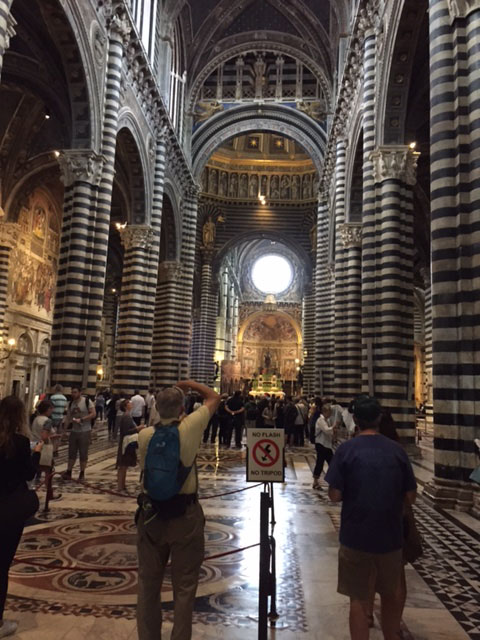
Inside the Duomo in Siena
A short walk away is the huge Duomo—very striking in its Romanesque-Gothic architecture holding so many sculptural masterpieces by Donatello and Michelanglo and others.  The black-and-white striped marble pillars are almost contemporary looking and the inlaid marble floors are stunning. 
Baptismal font by Donatello inside the Siena Duomo Baptistry
The smaller Baptistry is even more stunning with a spectacular baptismal font by Donatello.  So much beauty, effort and money poured into these churches over the centuries still made me pause to think if some of that could have gone in to helping people have better lives.
Unique Italian pottery vase found in Siena
One of the few treasures I purchased on the trip was a colorful pottery vase in a unique style—from the Ceramiche Tombelli shop behind the Baptistry.  It was shipped home and arrived in perfect shape.
Two intrepid tourists with San Gimignano and its famous towers in the background
I long wanted to make this trip to see the art I had missed years ago but in the end I think my most favorite part of the whole trip was the next two days spent with a private driver touring the many medieval villages and seeing the lush green rolling hills of the countryside –one day to the south, the next day to the north. 
Fountain in Montepulciano with Medici coat of arms at the top
The perfectly groomed vineyards, red poppies in bloom, as well as the typical Tuscan cypress tree landscapes were so soothing to these desert eyes.  
At the Castellina family winery
AND, also some of the best meals I’ve ever had were the two lunches our driver treated us to—one at the Querceto di Castellina family winery, cooking school and hotel in the Chianti area, and the other at a five star rated restaurant near Pienza with a breathtaking 180 degree view.  Pasta, pasta, and more pasta but so delicious. 
Winery buildings in foreground and traditional Tuscan home beyond