Showing posts with label duomo. Show all posts

Monday, June 30, 2025

FOUR DAYS IN MILAN, ITALY: The Duomo, Museums, Cimitero Monumentale, Canals, and More

Galleria Vittorio Emmanuele II, Milan, Italy. 

Milan is the bustling center of modern Italian design and fashion. Even babies in their strollers are well-dressed. The city also has a long history, with countless churches, palaces, museums, and historic sites to entice visitors. In early June, Art and I spent four days in Milan at the beginning of a ten-day trip to northern Italy.

Display welcoming the 2026 Winter Paralympics to Milan/Cortina.

Like all of our trips to Europe, a nine-hour time difference from our home in California, we allowed several days to adjust to the time change. We arrived in Milan on a Sunday, and after checking in at our hotel in the city center, walked to a nearby pizzeria for a light supper, ending with our favorite Italian dessert, caramel panna cotta. Every meal we ate in Italy was delicious!

The Milan Duomo (Cathedral).

The next day our focus was the Duomo, the cathedral that sits in the middle of Milan like a giant stone wedding cake. As we stood in the piazza gazing up at the roof spires, we could see tiny people walking up to the top. We then made our way to the back of the cathedral to wait for our turn to ride the elevator to the roof. (We had bought tickets online ahead of time. Alternatively, you can climb up the 165 steps to the top—a cheaper ticket and different line.) Security is strict to get into the Duomo. Women are required to have covered shoulders and knees and flip-flop sandals are not allowed. If you show up in shorts or a sleeveless top you can purchase a thin white cover-up garment.

View of Milan from the roof of the Duomo.

As we emerged from the elevator we found ourselves on the first roof level, amongst the flying buttresses and 135 statue topped spires, and with a spectacular view of all of Milan. In the distance was the modern business center of the city, with its skyscrapers and the needle-like tower, the Torre Pirelli . Until it was built (1955-60), the Duomo was the tallest building in Milan.

Walkway around the roof of the Duomo.

As we followed the route around the roof we got close-up views of the elaborate stonework and hundreds of figures perched on the spires before our final climb to the roof peak. Once again we admired the view, and then from there descended the narrow circular staircase to the inside of the Duomo.

Marble floor of the Duomo. Woman wearing cover-up over her bare arms.

Some of the 52 pillars inside the Duomo.

Sculptured panels on the central doors of the Duomo.

We had purchased an audio tour for our phone to guide us around the inside of the Duomo and this helped us appreciate the history and significance of its various parts. Everything in the cathedral is over-the-top, from the huge stained-glass windows (said to be the largest in Christendom), to the marble floor, the pillars (52 of them, one for every week of the year), the numerous side chapels, and the huge paneled doors on the front.

Detail from one of the windows of the Duomo, displayed in the Duomo Museum.

Gargoyles from the Duomo, some from the 14th Century, moved to the Museum for conservation.

The construction of the Duomo began in the 14th century but was not completed until Napoleon’s time. The Duomo Museum, next to the cathedral, displays statues, gargoyles, building models and artifacts that tell the Duomo’s 600-year history. A side doorway in the museum takes you through a courtyard to a small hidden chapel, San Gottordo in Corte, refreshing in its simplicity. A fresco from the Giotto School was recently discovered on one of its walls.

Courtyard leading to the chapel of San Gottordo in Corte.

Before returning to our hotel, we did a short tour of the Vittorio Emmanuel II shopping arcade, located at the side of the Duomo Piazza, and billed as the Rodeo Drive of Italy, with its glamorous designer stores. However, most people in the crowded mall were tourists, not shoppers, taking selfies under the magnificent domed roof.

Center of the Galleria Vittorio Emmanuelle II. 

The next day began with a visit to the weekly street fair and farmer’s market on Viale Pepiniano. The wealth of available fresh fruits and vegetables on display explains why Italian cooking is so good!  

Stall at the Tuesday farmers' market on Viale Pepiniano.

We purchased super-sweet cherries just in season. On our way back to our hotel we stopped to visit the Basilica and monastery of Sant' Ambrogio one of the most ancient churches in Milan.

Mosaic of Christ the Pantocrator (4th to 8th C.) in the apse of the Basilica of Sant' Ambrogio.

In the afternoon we met my cousin and her husband who live in Milan, who gave us a personal tour of some sites that I had read about in my guidebook but were outside the city center. (They had a car.) The first was the CimiteroMonumental, a burial ground for the rich and famous begun in Victorian times, that is more like an open-air art museum than a graveyard. (Entrance is free.) A map at the entrance marks the mausoleums and graves of particular importance. 

Reclining figure at the Cimitero Monumental.

Ziggurat-like sculpture at the Cimitero Monumental. Tomb of Antonio Berocchi, created by Giannino Castiglioni.

It seems that every Italian artist worth his salt has been invited to create a sculpture here. Themes vary from the intimate to the majestic, with many references to ancient history. The shaded walkways were welcome on the warm day of our visit and there were almost no other people there on a weekday afternoon.

The Bosco Verticale apartment building, designed by Boen Studio in the Porta Nuova area of Milan.

Our next stop was at the Bosco Verticale, or Vertical Forest, a unique pair of apartment buildings covered with so many trees and plants they appear as giant trees themselves.

Summer evening in the Navigli (canal) District, Milan, with its restaurants, shops, live music and giant video screens.

Our day ended with dinner at a restaurant in the Navigli, or canal, District. At the time that the Duomo was under construction in Milan, a system of canals was dug (including a lock designed by Leonardo) in order to transport marble from the quarries in the mountains to the city. In the last century, most of the canals were filled in, but a few remain. Today they are lined with shops and restaurants and have a lively night life. Next to the canal, a communal washing station is preserved, from the time that women gathered here to wash their clothes and chat.

Science Museum. Models of some of Leonardo's flying machines.

Science Museum. Cat drawings by Leonardo da Vinci.

We did not see Leonardo’s Last Supper, perhaps Milan’s most famous artwork. Limited tickets are available and need to be purchased months ahead of time, which we didn’t do. But, on our last day, we visited the Leonardoda Vinci National Museum of Science and Technology where most of the second floor is devoted to Leonardo’s life and many inventions, with models, drawings, artifacts and multi-media displays. One section focused on the many works of art inspired by and modeled on Leonardo's Last Supper.

On the bridge of the canal.

We didn’t visit La Scala, the Sforza Castle, or go shopping while we were in Milan. Not enough time to do everything. But we did see a lot and enjoyed delicious Italian food. And after four days we had made significant progress on our jet lag and were ready for our driving trip to the Alps.

Monday, July 10, 2017

SIENA, ITALY, Guest Post by Cathy Bonnell


View of the Duomo, Siena, Italy
My friend Cathy Bonnell, a school librarian (now retired) in Phoenix, Arizona, loves to travel. Recently, she went to Italy, visiting Florence, Siena, and Milan with her daughter Courtney. I thank her for sharing the joys and discoveries of this special trip and for being one of my most faithful followers of The Intrepid Tourist. Here is Part 2, about her visit to Siena.
 
After a short train ride from Florence we arrived in Siena and checked into Villa Scacciapensieri Hotel on the outskirts of town. 
Grounds of the Villa Scacciapensieri
We felt like we were in the forest with lots of trees, manicured gardens and a beautiful rooftop terrace.   
Campo area of Siena with view of the Palazzo Pubblico
After a short bus ride back into Siena, we headed for the Campo area and the huge sloped brick piazza. The sunny day brought out “hundreds” of people, kids and dogs, who were sitting, lying and enjoying the site of the Palazzo Pubblico—the spectacular town hall.  We spent several hours viewing the frescoes inside.  An interesting site back on the piazza was the end-of-term students in their robes rollicking in the many open air restaurants and bars and driving their oddly adorned old cars around the square.
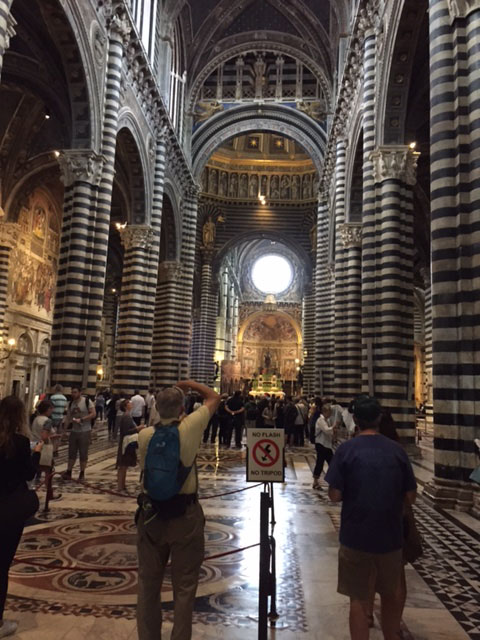
Inside the Duomo in Siena
A short walk away is the huge Duomo—very striking in its Romanesque-Gothic architecture holding so many sculptural masterpieces by Donatello and Michelanglo and others.  The black-and-white striped marble pillars are almost contemporary looking and the inlaid marble floors are stunning. 
Baptismal font by Donatello inside the Siena Duomo Baptistry
The smaller Baptistry is even more stunning with a spectacular baptismal font by Donatello.  So much beauty, effort and money poured into these churches over the centuries still made me pause to think if some of that could have gone in to helping people have better lives.
Unique Italian pottery vase found in Siena
One of the few treasures I purchased on the trip was a colorful pottery vase in a unique style—from the Ceramiche Tombelli shop behind the Baptistry.  It was shipped home and arrived in perfect shape.
Two intrepid tourists with San Gimignano and its famous towers in the background
I long wanted to make this trip to see the art I had missed years ago but in the end I think my most favorite part of the whole trip was the next two days spent with a private driver touring the many medieval villages and seeing the lush green rolling hills of the countryside –one day to the south, the next day to the north. 
Fountain in Montepulciano with Medici coat of arms at the top
The perfectly groomed vineyards, red poppies in bloom, as well as the typical Tuscan cypress tree landscapes were so soothing to these desert eyes.  
At the Castellina family winery
AND, also some of the best meals I’ve ever had were the two lunches our driver treated us to—one at the Querceto di Castellina family winery, cooking school and hotel in the Chianti area, and the other at a five star rated restaurant near Pienza with a breathtaking 180 degree view.  Pasta, pasta, and more pasta but so delicious. 
Winery buildings in foreground and traditional Tuscan home beyond

Monday, July 3, 2017

FLORENCE, ITALY: Guest post by Cathy Bonnell


Michelangelo's David, replica in the Piazza della Signora, Florence, Italy
My friend Cathy Bonnell, a school librarian (now retired) in Phoenix, Arizona, loves to travel. Recently, she went to Italy, visiting Florence, Siena, and Milan with her daughter Courtney. I thank her for sharing the joys and discoveries of this special trip and for being one of my most faithful followers of The Intrepid Tourist. Here is Part 1, about her visit to Florence.
 
In 1976 my husband and I spent one night in Florence Italy.  About all we managed to see there was the replica of Michelangelo’s David in piazza della Signoria.  Over the years I must have mentioned quite a few times how I would like to go back to Florence to see all the art I’d missed so I shouldn’t have been surprised when my 31 year old daughter gave me a trip there for my upcoming 70th birthday.  She planned it all AND paid for it all, went with me but made sure we went where I wanted to go.
Michelangelo's David, Galleria dell'Academica
One of our first stops was the Galleria dell’ Academica to see the “real” David.  Just spectacular!  Art students lined the walls near David sketching away.  Other works by Michelangelo are housed in this museum, many unfinished.  Also two Madonna paintings by Botticelli thrilled us.  Nearby is the Museo San Marco with the fabulous frescos that quickly became my favorite medium.  Each cell of the monks once housed there had small, simple frescos on the wall.
Fresco, Museo San Marco
A small group walking tour took us easily into the famous Uffizi Gallery where we saw just about every important Renaissance artist’s  work.  VERY crowded but our tour guide steered us to the important pieces and; in almost four hours I felt I saw what I’d been yearning all these years to see.  A beautiful view through a window showed us the Ponte Vecchio where we headed next.  I found a fabulous stationery store there and; many beautiful cards as well as a small etching of the Ponte Vecchio.
Ponte Vecchio over the River Arno
The next day we set off for the Palazzo Pitti only to discover a very long line due to free admission day.  With a scrumptious gelato in hand to wait we got in just as it started to rain so we didn’t go through the gardens but had a view of them from the second floor of this home of the Medici family .  My eyes were beginning to blur after seeing all the opulent art on the walls and the ceilings covered in gilded art.
Duomo, Florence
Next on to the Porcellino market where we saw and rubbed the nose of the bronze boar though we had not seen the original at the Uffizi.  We bargained with the many sellers in the stalls & found treasures to bring home.  Nearby we had a meal in a sidewalk café with views of fabulous statuary in the external niches of Orsanmichele church.  Each statue is a copy (real ones inside the church in the museum) of the patron saint of the city’s guilds.  We never stopped marveling at the age of these buildings (1300’s) that we walked by each day.
Basilica of St. Mary of the Flower, Florence
Of course there’s no missing the Duomo, the Baptistery and the Museo dell’Opera del Duomo.  Its majestic size rises above all the surrounding buildings with the colorful and intricately patterned marble sparkling in the sunlight.  I really could have just sat in one of the many sidewalk cafes, listening to street musicians, sipping prosseco and looking at this 13th century edifice all day (I did sit for about an hour doing just this while my adventurous daughter climbed the tower).  But of course one must see inside and marvel at all the frescoes and precious items in the museum including the original wood models.  Along with the gorgeous frescoes in the Duomo, the stunning Gates of Paradise on the Baptistery were my favorite.  Again, copies adorn the outside but we saw the originals in the Museum.
View of Florence from the Piazzale Michelangelo
Our last view of beautiful Florence was from the Piazzale Michelangelo with the spectacular views of the whole city. 
External Guild Statuary of the Orsanmichele Church, Florence, Italy

Monday, October 12, 2015

September in UMBRIA, ITALY, Part 3: Assisi

Assisi, approach to the lower church of the Basilica of St. Francis
It was our fourth day in Umbria, and we headed for Assisi, about a forty minute drive from Perugia across a flat, agricultural plain. This famous medieval hill town is perched at the edge of Mont Sebasio National Park, which can be seen just beyond the walls of the city. We followed signs to a car park near the Basilica di San Francesco (Basilica of Saint Francis), and walked through the gate and up narrow streets to the broad ramp that led to the entrance of the lower church.

No talking or photographs are allowed inside the Basilica so we rented audio guides–an excellent way to make sense of the abundance of art inside. Every square inch in both the upper and lower church is covered with decoration, either in carved stone or as wall paintings, the most famous being the fresco cycle in the upper church that depict scenes from the life of Saint Francis.

Poster of Giotto fresco in the Basilica
Traditionally, the frescoes are attributed to Giotto and his workshop, but today there is some question by art historians as to whether Giotto was the artist. In any case, the paintings are superb examples of Renaissance art and the use of realism and perspective. The Basilica was built on orders from the Pope just after the death of St. Francis in 1226. St. Francis is the patron saint of Italy so the church and town of Assisi draw thousands of tourists every day. But the requirement for silence inside the Basilica makes a visit there feel calm and peaceful despite all the visitors.
Streets of Assisi
Assisi's history goes back to before Roman times and historic buildings line the steep, narrow streets. Visiting Assisi is like spending the day doing stairmaster–except for a few piazzas, almost every street is slanted or stepped. My legs ached by the end of the day, especially after climbing to the top of the hill to visit the castle (Rocco Maggiore) with its 360 degree view of the town and verdant Umbrian countryside. Inside the castle we climbed the towers and visited a museum of medieval tools, weapons, and costumes. After we made a small donation we were given a small poster of the fresco in the Basilica showing St. Francis giving his cloak to a poor man. (see above)
Inside the castle walls of the Rocco Maggiore. The fortress was first built in the 12th century, then rebuilt in 1367.
On our way back down the hill we stopped at a shop selling Umbrian food specialties and bought two roast pork sandwiches, which we ate later as a picnic supper back at the hotel. Shops in Assisi are filled with saintly souvenirs and local specialties such as salami, truffles, pasta, beans and olive oil. There are also a surprising number of art galleries.
Local Umbrian specialties include pork and wild boar (chingiale)
During the day, as we toured the town, we also went into the small Baroque church of Santa Maria delle Rose, as well as the Duomo (San Rufino), an imposing Romanesque cathedral built on top of Roman ruins. Some of the ruins are visible under thick glass beneath the church aisle and in the plaza in front. It is a little disconcerting to walk across these glass "windows"--as if one is floating on air--but fascinating to see the ancient ruins below.
Carved stone figures appear to hold up the wall on the Romanesque facade of San Rufino, completed in 1253
We thoroughly enjoyed our day in Assisi. It was a warm, sunny day and although there were plenty of tourists, it didn’t seem crowded, perhaps because we visited on a weekday.
View of Assisi and Mont Subasio from the path to the Rocco Maggiore