Showing posts with label pottery. Show all posts

Monday, March 3, 2025

SOUTHWEST ROAD TRIP, Part 1, Arizona: Guest Post by Susan Kean

Hotel Monte Vista, Flagstaff, AZ, where we stayed.

My friend Susan Kean and her partner George love to travel and recently did a driving trip from Southern California to Arizona, New Mexico and the Four Corners area of Colorado and Utah. I thank her for sharing her report and wonderful photos with The Intrepid Tourist. Her post will appear in three parts.

Approaching Sedona, Arizona.

The first stop on our adventure of exploring Arizona and New Mexico was Flagstaff. I was expecting a large town like Phoenix! What an interesting place! We stayed one night in a funky hotel, the Hotel Monte Vista. 

Museum inside the old railway station in Flagstaff.

After going to the Visitor’s Center in the old Railway Station and paying our respects to Route 66 we spent a couple of hours at the Museum of Northern Arizona before continuing to the View Hotel in the NavajoTribal Park in Monument Valley. 

Northern Arizona Museum in Flagstaff. Pottery found in adobe dwellings.


View Hotel, Navajo Tribal Park in Monument Valley.

What a glorious place! I’m so glad we chose to stay two nights. 

Buttes. The butte farthest to the left is called the elephant.

We had time to wrap ourselves in the glorious desert scenery and feeling of the presence of an Almighty creator. We are trying to learn as much as possible about our country’s native peoples.
 

Buttes.

The sun literally popped up over the horizon.

Part 2 will post next week.

Monday, December 9, 2019

PORTUGAL: From Lisbon to Porto, Guest Post by Steve Scheaffer and Karen Neely, Part 2

Azulejos tiles on the side of building in Porto, Portugal
My brother Steve and his wife Karen recently spent eighteen days in Portugal and have graciously agreed to share a few of their wonderful photos of the trip. Here are their photos and a few notes from their itinerary. Part 1 posted last week. This is Part 2.
Typical Portuguese pottery
Batalha and Fatima
Monastery of Santa Maria, Batalha. Manueline and Gothic style.
Monastery of Santa Maria, Batalha
Pilgrimage site of Fatima
Classic Coimbra, a journey back to Portugal's Roman past.

2nd Century Roman ruins, Coimbra
Douro Wine Country, a drive through Portugal's most famous wine-making region, the Douro Valley.
Terraced vineyards in the Douro Valley
Vineyard Views and the bustling port city of Porto
Porto
This picture is not sideways--the statues are walking perpendicular to the wall.
Taylor's is one of the largest wine producers in Portugal
Terraced vineyards
At the bottling factory
Future wine!
I thank Steve and Karen for their vicarious trip to Portugal!

Monday, March 11, 2019

THE COLCHAGUA MUSEUM, Santa Cruz, Chile: From Shark Teeth and Pre-Columbian Pottery to Old Maps and Automobiles

Pre-Columbian sculpture from the Chancay Culture on the central coast of Peru at the Colchagua Museum, Santa Cruz, Chile
I never expected to find the giant jaws of megalodon, model ships, or the piano played Bernard O’Higgins, the founder of Chile, at a museum in a part of Chile otherwise known for its agriculture. It turns out that the Colchagua Museum, in Santa Cruz, Chile, is the largest private museum in Latin America and is packed with thousands of objects ranging from cowboy gear and weapons, to religious artifacts and pre-Columbian pottery and more. Founded by controversial tycoon Carlos Cardoen, the museum includes something for everybody.
The Colchagua Museum is located in the small city of Santa Cruz in the Colchagua valley, 110 miles from Santiago.
We visited as a day trip from Rancagua (about an hour and a half away), where we were visiting our son-in-law’s family. As we drove to Santa Cruz from there we passed orchards, vineyards, and ranches that are the heart of  this verdant valley and one of Chile’s several wine growing regions.
In the fossil and paleontology room
After purchasing our tickets at the museum entrance, we watched a short video and then set off to view the exhibits, listening to our English language wands for key explanations in each room. As you make your way from the entrance you pass through rooms containing fossils and exhibits of the early history of world, and then move forward in time through archeology of Chile, Peru and Columbia, then to the period of the conquest by Spain, to national independence, influence of the church, and up through life in the nineteenth and twentieth century. The last rooms on the main level feature old carriages, cars and farm machinery. A recently added exhibit, The Great Rescue, honors the men who were trapped and rescued from a copper mine in northern Chile 2010.
Portrait of Bernard O'Higgins, Chile's liberator, and his piano, which he imported from Europe
Every room was filled with so many fascinating objects that it is impossible to describe them all. Here are some of my favorites.
Fossil teeth in the jaw of the giant extinct shark, Megalodon. When a tooth fell out, a new one was always ready to rotate up and replace it. Megalodon could grow more than 50 feet long!
A small reptile (gekko) trapped in amber; from the Dinosaur Age
Ceramic vessel decorated with a bean design. (From the Nazca culture in Peru.) Beans (frijoles) have been a staple in South America for centuries.
Stone figure from the Pucara Culture, which developed in Peru in the area near Lake Titicaca.
Knotted strings called quipu, from the Inca culture. The knots were part of a counting system used in trade. The cords had different colors for each product and the spacing of the knots indicated the quantity sold.
Silver cup for tea (mate)and jewelry from the Mapuche culture of southern Chile.
Carvings and artifacts from Easter Island (Isla de Pascua). Easter Island, which gets its name from the day of its "discovery" by a Dutch sea captain in 1722, is part of Chile.
Our reflection, in the room at the museum displaying farm implements
We should have allowed more time to spend in the museum and to visit the associated Automobile Museum, located in a nearby vineyard, and the Chilean Craft Museum, located in a restored house in the nearby town of Lolol, featuring traditional crafts of Chile (stone carving, basket making, wood crafts, pottery, metals, naval and textiles.) As it was, after visiting the Colchagua Museum we took a walk through the center of Santa Cruz with its beautiful colonial era architecture around the main square and visited a few of the local shops before having ice cream at a favorite local restaurant. Someday we’ll have to go back to Santa Cruz to see the other museums and tour some of the vineyards.
For information about and directions to the Colchagua Museum, click HERE.
The Colchagua Valley

..

Monday, November 19, 2018

CERAMICS MUSEUM IN YINGGE and ZUSHI TEMPLE IN SANXIA: Day Trip from Taipei, Taiwan

Bridge to Zushi Temple, Sanxia, Taiwan
On our recent trip to Taiwan we had a free day and decided to take a day trip from Taipei to see the new Ceramics Museum in Yingge and the Zushi Temple nearby in Sanxia. Yingge has long been the center of the ceramics industry in Taiwan and is home to numerous ceramics factories as well as the museum and a restored “old street” with pottery shops.We arranged for a taxi driver to pick us up at our hotel in Taipei for the hour's drive to Yingge.
Gymnast ceramic sculpture, Yingge Ceramics Museum
When we arrived at the museum we bought our tickets and went inside the bright, glass-walled building where we were advised to tour the outdoor portion of the museum first. As it turned out, it was good advice, because as the day goes on the weather outdoors becomes quite warm. It is better to walk around when it is relatively cool. (The inside of the museum is air conditioned.) In the outdoor garden ceramic sculptures are arrayed over a large expanse--on lawns, along tree lined walkways, on pedestals and amongst the shrubbery.
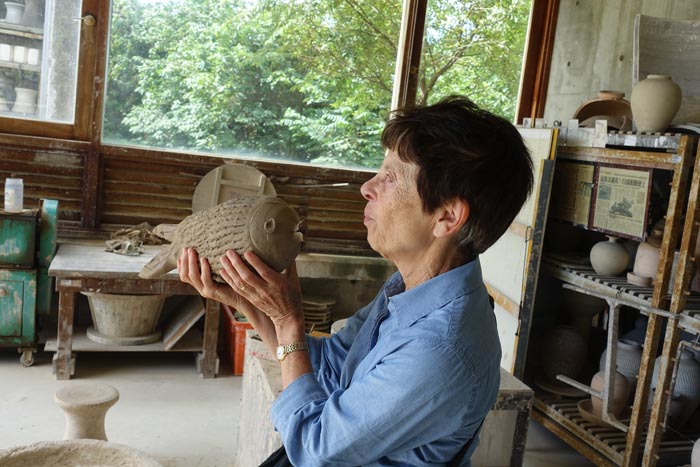
Master potter Chan Kao Hsiang; demonstration at Yingge Ceramics Museum
Workshops were going on in several buildings and there were activities for families and children. We stopped to look in on an open studio where a potter was giving a demonstration. When he saw us, he invited us down to take part in the program. He had just finished throwing a tall pot, and, as we watched, he proceeded to turn it into a clay fish, using us as his accomplices.
Breathing life into a clay fish
Although he spoke no English and we no Chinese, all this was accomplished through sign language, much to the enjoyment of the audience. It was the highlight of our day!
Ceramic roof tiles
The inside of the museum chronicles the history of Taiwan as seen through its pottery, beginning with early pots made by local tribes and continuing through the colonial period to modern times.
Vases
Objects on display include everything from dishes and roof tiles to ceramic toilets to elegant sculpture.  Exhibits are well labeled in both English and Chinese. We ate a light lunch in the museum cafeteria before leaving to visit Sanxia.
Gate to the Zushi Temple
In Sanxia our driver dropped us off at the gate to the bridge that leads to the Zushi Temple (also spelled "Tzushr") on the other side of the river. It was Sunday and the bridge was crowded with pedestrians and vendors hawking souvenirs and games of chance.
Bell tower of the Zushi Temple with modern apartment building in the background.
The Zushi Temple and its surrounding "Old Street" reflect the town as it was one hundred years ago. They stand in contrast to the surrounding modern architecture. The temple has been described as an “Eastern Palace of Art”. It is certainly a riot of color–red, yellow, green, blue, gold-- with every conceivable surface decorated with birds, animals, flowers, dragons,  human figures and more.
Incense sticks are guarded by two stone dragons.
While many of the people there were tourists like us, others were lighting incense and offering prayers at this Taoist temple. The main part of the temple was at the rear of the inner courtyard. There were smaller rooms on either side.
The drum tower and a few of the 126 hand-carved stone pillars that adorn the temple.
Stairs led to a second story with access to the bell tower on one side and the drum tower on the other.
Flowers and other offerings adorn the rooms inside the temple.
The Zushi Temple honors Qingshui Tsu-Sze, a Song-dynasty general worshiped for his power to protect the local tea industry. First erected in 1769, the current building is a restoration begun in 1947 and still in process. With its lavish decorations it was truly a feast for the eyes.
Then it was time to cross the bridge again to meet our taxi driver for the trip back to Taipei.
Realistically carved kingfisher holding its prey on a wooden screen along the temple corridor.

Monday, July 10, 2017

SIENA, ITALY, Guest Post by Cathy Bonnell


View of the Duomo, Siena, Italy
My friend Cathy Bonnell, a school librarian (now retired) in Phoenix, Arizona, loves to travel. Recently, she went to Italy, visiting Florence, Siena, and Milan with her daughter Courtney. I thank her for sharing the joys and discoveries of this special trip and for being one of my most faithful followers of The Intrepid Tourist. Here is Part 2, about her visit to Siena.
 
After a short train ride from Florence we arrived in Siena and checked into Villa Scacciapensieri Hotel on the outskirts of town. 
Grounds of the Villa Scacciapensieri
We felt like we were in the forest with lots of trees, manicured gardens and a beautiful rooftop terrace.   
Campo area of Siena with view of the Palazzo Pubblico
After a short bus ride back into Siena, we headed for the Campo area and the huge sloped brick piazza. The sunny day brought out “hundreds” of people, kids and dogs, who were sitting, lying and enjoying the site of the Palazzo Pubblico—the spectacular town hall.  We spent several hours viewing the frescoes inside.  An interesting site back on the piazza was the end-of-term students in their robes rollicking in the many open air restaurants and bars and driving their oddly adorned old cars around the square.
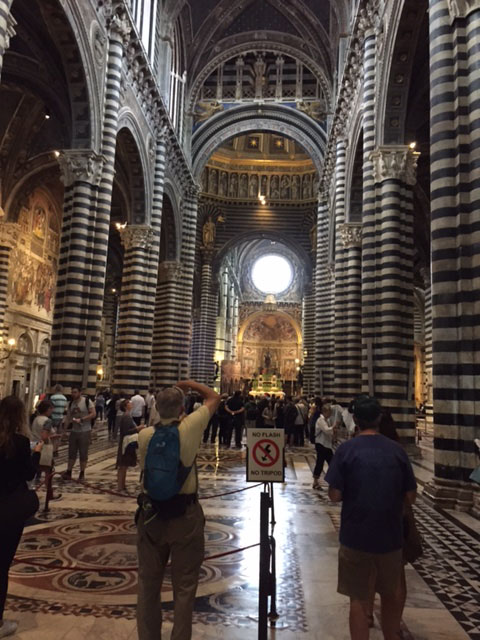
Inside the Duomo in Siena
A short walk away is the huge Duomo—very striking in its Romanesque-Gothic architecture holding so many sculptural masterpieces by Donatello and Michelanglo and others.  The black-and-white striped marble pillars are almost contemporary looking and the inlaid marble floors are stunning. 
Baptismal font by Donatello inside the Siena Duomo Baptistry
The smaller Baptistry is even more stunning with a spectacular baptismal font by Donatello.  So much beauty, effort and money poured into these churches over the centuries still made me pause to think if some of that could have gone in to helping people have better lives.
Unique Italian pottery vase found in Siena
One of the few treasures I purchased on the trip was a colorful pottery vase in a unique style—from the Ceramiche Tombelli shop behind the Baptistry.  It was shipped home and arrived in perfect shape.
Two intrepid tourists with San Gimignano and its famous towers in the background
I long wanted to make this trip to see the art I had missed years ago but in the end I think my most favorite part of the whole trip was the next two days spent with a private driver touring the many medieval villages and seeing the lush green rolling hills of the countryside –one day to the south, the next day to the north. 
Fountain in Montepulciano with Medici coat of arms at the top
The perfectly groomed vineyards, red poppies in bloom, as well as the typical Tuscan cypress tree landscapes were so soothing to these desert eyes.  
At the Castellina family winery
AND, also some of the best meals I’ve ever had were the two lunches our driver treated us to—one at the Querceto di Castellina family winery, cooking school and hotel in the Chianti area, and the other at a five star rated restaurant near Pienza with a breathtaking 180 degree view.  Pasta, pasta, and more pasta but so delicious. 
Winery buildings in foreground and traditional Tuscan home beyond