Showing posts with label Sydney. Show all posts

Monday, January 7, 2019

Broulee, Australia: Pristine Beaches and Friendly Wildlife, Guest Post by Tom Scheaffer

Broulee, Australia
My brother Tom loves to travel and is currently on an extended trip to Australia and beyond. Here is a report of one of his first stops in Australia, the beautiful beach in Broulee, on the coast of New South Wales.
Broulee Beach
In early December I left my home in San Diego and flew to Canberra, Australia, to visit friends. We drove from there for about two hours to Broulee, on the coast of New South Wales, south of Sydney. It is an idyllic seaside location with beautiful blue and turquoise green waters and amazing beaches with nobody on them.
Beach good for snorkeling
We found amazing places to swim and snorkel. The water was crystal clear and it truly was a paradise.
Broulee Island Nature Preserve is the island on the upper left
I went to the Broulee Island Nature Preserve, now connected by a sand spit to the mainland. This verdant nature area offers walks amid birds and rock pools. It is very untouched and the variety of birds was amazing.
Kookaburra
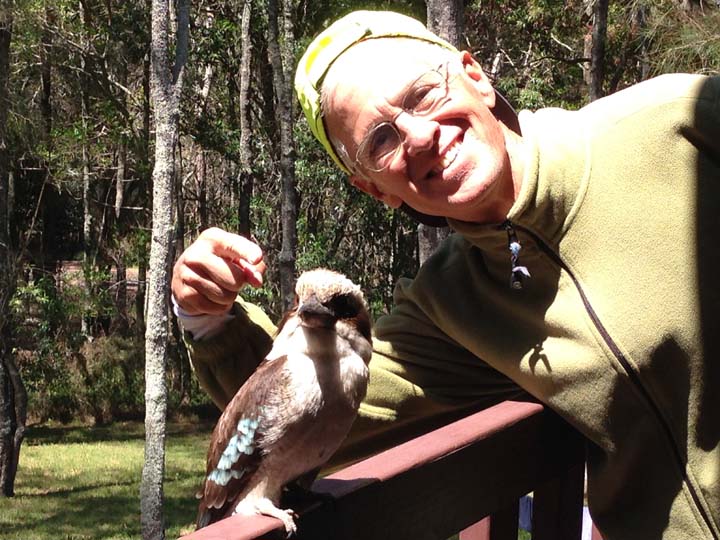
The parrots and kookaburras came onto the veranda and we saw them within an arm’s distance.
King Parrot
This was an amazing trip that I won't forget. If you ever get the chance go to Broulee, Australia, you will find pristine uninhabited beaches and amazing nature and wildlife.
Tom and friendly Kookaburra

Monday, February 26, 2018

MAMMOTHS: GIANTS OF THE ICE AGE at the Australian Museum, Sydney

Mammoths: Giants of the Ice Age at the Australian Museum, Sydney
I never expected to see mammoths wooly or otherwise in Australia, a continent where mammoths never lived. But on my recent trip to Sydney I had the opportunity to see a wonderful exhibit called Mammoths: Giants of the Ice Age at the Australian Museum, which featured not only mammoths, but mastodons, other Ice Age animals, and information about early humans who hunted and interacted with these animals.. The exhibit will remain on view until May 13, 2018.
Lyuba, which means "Love" in Russian is the most complete mammoth specimen ever found. Contents of her stomach included milk, pollen, pond algae and mammoth dung
My favorite part of the exhibit focused on Lyuba, an intact 42,000-year-old baby wooly mammoth found in Siberia, whose body had been buried in mud and almost completely preserved, down to her fur and the contents of her stomach.
A thick fur coat would have kept baby Lyuba warm
A life-size mural of Lyuba included a present-day muskox  pelt providing the opportunity to feel what mammoth hair may have been like.
Mammoth skeleton. Mammoth tusks could grow as long as 16 feet and weigh more than 350 pounds.
During the Ice Age, mammoths and mastodons roamed the northern regions of Europe, Asia and North America. The Imperial or Columbian mammoths found in North America were the largest of all.
Model.  Mammoth bone huts like this one were constructed about 15,000 years ago at Mezhirich in Ukraine.
In parts of eastern Europe people used mammoth bones and tusks as building material. In the exhibit, a model of one of these mammoth bone houses, along with tiny figures, functioned as a kind of Ice Age doll house.
The Hyde Park Mastodon
Among the many mammoth and mastodon remains found in North America is the Hyde Park mastodon, discovered in 2000 near the town of Hyde Park, New York. The bones were used to make casts for an assembled skeleton on display in the museum exhibit. I was also interested to learn that Thomas Jefferson had a collection of mammoth bones, collected for him by William Clark in 1807 from Big Lick, Kentucky.

The remains of Ice Age mammoths and hundreds of other animals can be seen not far from where I live in Los Angeles at the George C. Page Museum of La Brea Discoveries and have long fascinated me. They inspired my book When Mammoths Walked the Earth which focuses on worldwide mammoth discoveries. But I had never seen the preserved body of a baby mammoth until I went to Australia.
If you are heading to Australia before May 18th, a visit to Mammoths: Giants of the Ice Age is well worth your time.

Monday, January 8, 2018

HOW DO I KNOW I'M IN AUSTRALIA?

Koala joey at Hanson Bay Wildlife Sanctuary, Kangaroo Island, Australia
I love going to Australia. Since my first trip in 1983, I have been back five times, including my recent trip in December. Here are some of the things that tell me I have arrived in the land Down Under.
Clocks are five hours earlier and I have lost a day! (In the southern hemisphere winter, the time difference between California and Sydney is seven hours.) The trip across the Pacific crosses the International Date Line. On the way home, we gain a day.
Summer flowers at the Coriole winery in McLaren Vale, South Australia
The seasons are switched. When we arrive in December it is summer Down Under. Flowers are blooming and the temperature is warm.
At noon our shadows point south. While the sun still rises in the east and sets in the west, it arcs to the north in the southern hemisphere.
Late afternoon, looking east toward Remarkable Rocks on Kangaroo Island
At night the stars are upside down. Orion is standing on his head and there is no North Star. Instead, the Southern Cross points to the southern pole star.
Traffic is on the left and drivers sit on the right.  Each time I step off the curb I have to remind myself to look to the right for oncoming traffic.
It helps to be reminded to drive on the left in areas popular with tourists
Kangaroo crossing signs. Yellow signs warning drivers to watch out for wildlife (kangaroos, koalas, wombats and more) are common along highways.
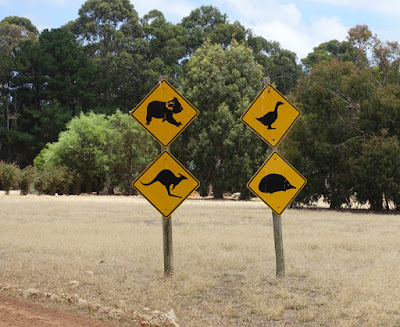
Koala, kangaroo, Cape Barren goose and echidna signs--Kangaroo Island
In our rental car our luggage goes in the boot (trunk) and we fill the gas tank with petrol (gas). Although the language in Australia is English, it is full of British terms that take getting used to, not to mention expressions that are uniquely Australian (such as "putting a shrimp on the barbie.")
Everything is metric–road signs are in kilometers, petrol and milk sold in liters, and meat at the supermarket is in kilograms.
No pennies. It took me a while to remember that when getting change from a purchase, there are no pennies. Although items are sold for 99 cents and other odd amounts, the total is rounded off to the nearest five cents. Pennies were abolished a number of years ago. Over time, the difference evens out.
Electricity is 220. The electric kettle in our hotel room boils water almost instantly. And, all electric outlets have an on/off switch and need an adapter to use the American plugs on our phones, computers, etc.
The first floor of our hotel is actually the second floor, while what we consider the first floor in the U.S. is the ground floor. To get to our room on the 37th floor we take the lift (elevator).
View from our balcony at the Meriton Suites Hotel, Sydney, Australia
No tipping. Restaurant workers are paid good wages and, unlike in the U.S., tipping is not expected. If one does tip, it is typically a small amount.
Our delicious rhubarb meringue dessert at Coriole Winery Restaurant
And as everyone cheerfully says in response to any concern--
No worries!

Monday, December 18, 2017

SYDNEY, AUSTRALIA:: A Walking Tour of the CBD


Sydney Opera House viewed from The Rocks, with one of the many harbor ferries passing by
I recently spent two weeks in Australia, beginning with three days in Sydney. Our hotel was in the CBD (Central Business District) near Chinatown, not far from many of the places I wanted to see. 
Hyde Park, Sydney, Australia
So, while my husband was attending his conference, I took myself on a self-guided walking tour.  I headed first for Hyde Park, anchored on one end by the War Memorial and the other by a large fountain bordered by a plaza where a bubble-man was surrounded by children as he created streams of giant bubbles. In one of the trees along the path I spotted a possum curled up in a hole taking a nap--possums, like many Australian animals, are nocturnal.
War Memorial
On the other side of the park was the Australian Museum (subject of a future post on this blog) and a view over the Botanical Garden. I then walked down George Street, in some ways the equivalent of 5th Avenue in New York, with crowds of people making their way to upscale stores and arcaded shopping malls. Since many of the buildings in the CBD are apartments where people live, I wondered where they went shopping for food. Then I spotted a sign for Coles, a large supermarket, with a stairway down to the store below street level. Further down the street I stopped in Dymocks bookstore, packed with Christmas shoppers. It had a huge selection of children's books on the lower floor and I enjoyed browsing, especially books by Australian writers. It also had a large display of books by English author Enid Blyton, whose books had been among my favorites when I was a child.
This historic arcade has shops on three levels bordering a central atrium
From there I made my way to The Rocks, site of Sydney's origins and earliest history of European settlement. The museum details aboriginal life in the area and its ancient history. 
Exhibits inside the Discovery Museum show Sydney from its earliest beginnings
The Rocks are a mixture of historic buildings on cobblestone streets and modern high rise buildings.
View of the city from the harbor
From The Rocks is a spectacular view of the Sydney Opera House on the other side of the harbor. As I walked along the esplanade I found myself underneath the massive Harbor Bridge.
People beginning their walk over the top of the Harbor Bridge
Then I headed back to my hotel, not far from the Chinese Friendship Garden. By no means did I cover all the sights of Sydney, but my tour gave me a good taste of the flavor of the city. 
Lion statue at entrance to Chinese Friendship Garden in Chinatown

Monday, December 11, 2017

SAILS IN THE SUNSET, Sydney Opera House, Australia

Opera House, Sydney, Australia
The white “sails” of the Sydney Opera House, soar over the entrance to the harbor and are the iconic image of Sydney, the largest city of Australia. Like a giant, earthbound ship, they greet boats entering the harbor and provide a focus for visitors.
At the Sydney Opera House on a warm summer evening
We arrived in Sydney in early December (the beginning of Australian summer), and despite our jet lag after the 15 hour flight from Los Angeles, decided that going to the Opera House to view the sunset was the perfect way to start our trip. The plaza below the Opera House was filled with people taking pictures and enjoying the view while partaking of food and drinks from the tented concessions that lined the lower level.
To the west, we watched the sun sink behind the towering skyscrapers that dominate the modern city of Sydney, while across the bay, dramatic clouds filled the sky over the bridge, another famous Sydney image. Along the top of the span, tiny figures were silhouetted against the sky as they climbed to the top. (This is a popular tourist activity–but not for one for me.)
People appear as tiny ants as they walk across the top of the Sydney Harbor Bridge
The Opera House was designed by Danish architect Jørn Utzon, winner of an international competition in 1957 to design a ‘national opera house’ for Sydney’s Bennelong Point. His vision for a sculptural, curved building on the harbor was unique and broke radically with the cube and rectangular shapes of modernist architecture up to that time.
Tiled surface of the Opera House "Sails"
The grand opening was in October 1973. As we circled the point to view the opera house from another angle, we encountered a Canadian tourist who told us that he had been at the very first opera performance in 1973. Soon after the sun set, many of the people who had been lingering on the plaza streamed inside for that evening’s program.
Moonrise over Sydney Harbor, viewed from the Opera House
Meanwhile, we watched the moon rise to the east and waited for dark and the light show, Badu Gili, to begin at the top of the Monumental Steps. Badu Gili, meaning “water light” in Gadigal language, explores ancient stories in a seven-minute video projection of colorful images derived from the traditions of the local aboriginal people.
Badu Gili light show

From birds to sea creatures, people to abstract designs, the brilliant images moved across the curved surfaces like giant kaliedescope designs. They were spectacular. (Click above to see a 24 second clip of the Badu Gili light show.)
When the show finished, we descended the steps, took one last view of the Opera House and bridge, now lit up against the dark sky, and made our way back to our hotel for a good night’s sleep. It was, indeed, the perfect beginning of our trip to the land Down Under.
Harbor Bridge at night, with Luna Park amusement park below