Showing posts with label Venice. Show all posts

Monday, January 20, 2020

ART IN VENICE: Part 2, the Accademia Gallery

Accademia Gallery, Venice, Italy
Note: This report is based on our visit to Venice in September 2019, before the devastating high tides that inundated many of the historic sites of the city. Luckily the collections of the Accademia Gallery were not damaged.
 
The Accademia Gallery is a treasure trove of Venetian art. Look up and you see the elaborately carved and painted ceilings; look down, and you walk on beautiful variegated marble tile floors; and on the surrounding walls you will find scenes crowded with endless details revealing the wealth and glory of Venice in the 15th and 16th centuries, when it dominated trade and commerce in the eastern Mediterranean. 
Annunciation by Lorenzo Veneziano 1376-1372, center of a large altarpiece
On our recent visit to Venice, we visited the Accademia Gallery, located on the Grand Canal at the foot of the Accademia Bridge. My guidebook admonished visiting in the afternoon to avoid the crowds and long ticket lines (during high season.) We went in the morning and didn't have to wait at all. After purchasing our tickets we climbed the grand staircase to the second floor where the exhibits began. I was overawed just by the elegance of the rooms-- the ceilings and floors are amazing--and by the scale of the paintings. The art ranges from golden Byzantine altarpieces to grand paintings documenting daily life in Venice and much more.
Madonna with the Red Cherubs, Giovanni Bellini 1485-1490
In a whole room of paintings by Giovanni Bellini, my favorite was the one with the red angels.  Bellini was a member of a well-known Venetian painting family. His sumptuous coloring and fluent, atmospheric landscapes had a great effect on the Venetian painting school, especially on his pupils Giorgione and Titian.
In the large paintings with dozens of figures, I was struck by how the painting as a whole functioned in the same way as today's graphic novels, with each figure and detail playing its own part in telling the larger story.

Detail from the Sacred Conversation by Giovanni Bellini, 1487
Throughout the museum I loved the glimpses of daily life revealed in the paintings--even when the main subject was religious or classical-- and was particularly charmed by the depictions of musicians and their instruments, as in Bellini's Sacred Conversation. In another painting, by Vittore Carpaccio, gondoliers crowd the canal--just as they do today, although in different costumes. Notably, one of the gondoliers is black, a reference to the fact that even in the 15th century Venice was an international center.
Detail of gondoliers, The Miracle of the Cross at the Ponte di Rialto, also known as The Healing of the Madman by Vittore Carpaccio, 1494.

Procession in Piazza San Marco, Gentile Bellini, 1496.
The Basilica San Marco has always been a focus of Venetian life. The grand scene in St. Mark's square,in the painting by Gentile Bellini (brother of Giovanni) show that the square was just as crowded then as it is today with tourists.
Detail from the Marriage of Saint Catherine by Paolo Caliari, known as Veronese, 1565-70.
As a center of trade, Venetians had access to goods from around the world, especially from the Orient. The colors and luxuriousness of the fabrics of people's clothing as depicted in the paintings is typically Venetian.

Annunciation by Paolo Veronese
I was interested to see how certain religious themes, such as the Annunciation, were treated differently by different artists.

Annunciation, Giovanni Bellini, 1490
In some, Mary is quite docile, in others, visibly surprised. In all, the angel arrives carrying lilies.

Feast in the House of Levi by Paolo Veronese
Paolo Veronese's Feast in the House of Levi fills a whole wall in one of the galleries, dwarfing onlookers. It is one of the museum's most well-known paintings. Originally titled The Last Supper, the name was changed after Inquisition leaders objected to the depiction of dogs and drunkards cavorting with the Apostles. Rather than making changes to the art, Veronese simply changed the title.

Detail from Feast in the House of Levi by Paolo Veronese
My favorite part of the painting is the detail of the dog and cat under the table. The cat has the bone and the dog looks wishful. Note the detail in the fabric of the tablecloth.
Billboard along the canal just outside the entrance to the Accademia Gallery.
The paintings in the Accademia Gallery truly are a feast for the eyes. And these are just a few! The paintings are all well-labelled in both Italian and English and we found it easy to navigate around the museum.

Poster for Baselitz Academy Exhibit, part of the Venice Biennale
In a separate wing of the museum we saw a retrospective exhibit of the living artist Georg Baselitz, whose signature style is to paint his figures upside down. His stated goal in turning the figures upside down was to separate art from life, changing the relationship between viewer and subject.

Georg Baselitz is a German artist who began working at the Villa Romana in Florence in 1965. This exhibit examines the influence of Italian artists and Renaissance traditions on his work over the course of his career.

Monday, January 13, 2020

ART IN VENICE: Part 1, The Peggy Guggenheim Collection

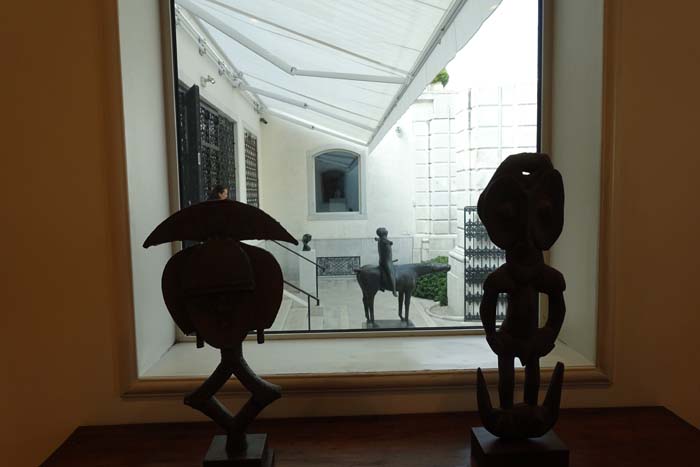
Venice, Italy. In the courtyard of the Peggy Guggenheim Museum
Note: Our visit to Venice was in September 2019, before the devastating high tides that inundated many of the historic sites of the city. Although the Peggy Guggenheim museum was closed temporarily, the director posted the following statement on Instagram: “Fortunately, the museum staff is well and safe, the museum and collections are safe and have not been damaged." The following report is an overview of our visit before the floods.

Venice is an art lover's paradise. Art is everywhere you look, from the magnificent mosaics on the walls of St. Mark’s Basilica to the interiors of churches and museums, to the galleries lining the streets along the canals.
"White Cross" by Vasily Kandinsky, 1922
On our recent visit to Venice, we visited two of Venice’s most outstanding art museums, the Peggy Guggenheim Collection, with its fabulous examples of 20th century paintings and sculpture, and the Accademia Gallery, with room after room of Venetian masterpieces and more.
Entrance to the Peggy Guggenheim Collection from the Grand Canal
The paintings and sculptures in the Peggy Guggenheim museum, housed in a palace on the banks of the Grand Canal, brought back memories of my modern art courses in college--from the cubist paintings of Picasso and Braque to the surrealist art of Dali, Magritte and Miro, to the abstract expressionist art of the 1950s.
Ticket stub with map of museum.
Peggy Guggenheim, niece of Solomon Guggenheim (whose collection is in the the famous Frank Lloyd Wright designed museum in New York), began collecting art in 1938 and in 1942 opened a gallery in New York. In 1949 she bought the Palazzo Venier dei Leoni in Venice and began filling it with art. She opened it to the public in 1951.
View across the Grand Canal from the Peggy Guggenheim Museum
A temporary exhibit in the museum shows Peggy Guggenheim when she was actually living in the house. Last year was the 70th anniversary. After Peggy Guggenheim's death in 1979 her house and collection of art became part of the Solomon R. Guggenheim Foundation, established by her uncle.
Here are just a few of my favorite pieces of art in the museum.
Man Ray, "Silhouette" 1916
Joan Miro "Dutch Interior" 1928

Corneille, "The Great Solar Symphony" 1964
The chair in the corner is a piece of art--not for sitting.
I especially liked that the pictures were hung with plenty of "breathing space" so each could be enjoyed without competing with a neighbor.
Alexander Calder "Silver Bed Head" 1945-46, detail
Several pieces by sculptor Alexander Calder were on display, both mobiles and some of his smaller pieces, like "Silver Bed Head" in which the wires and their shadows function like a playful lined drawing.
This large painting by Jackson Pollack, framed in the museum doorways, can be seen three rooms away.

Jackson Pollack, "Alchemy" 1947. A close-up view reveals the complexity of colors and textures.
Peggy Guggenheim was an enthusiastic supporter of Jackson Pollack and has eleven of his paintings in her collection, including several of his "drip" paintings. She supported him financially and in November 1943 gave him his first one-man show at her gallery in New York.
Grace Hartigan, "Ireland", 1959
The only painting by a woman in the Peggy Guggenheim collection is Grace Hartigan's "Ireland." As a woman artist in a male-dominated era, she got less recognition than abstract expressionists like Jackson Pollack and Robert Motherwell, but she is one of the few female painters to receive a level of comparable exposure. In 1957, Life magazine caller her "the most celebrated of the young American women painters."

Marino Marini, "The Angel of the City" 1948, bronze sculpture of a boy on a horse, greets visitors on the patio of the museum.
Peggy Guggenheim lived in Venice for thirty-three years. She died at age 81 in December 1979. Her ashes are placed in a corner of the garden of Palazzo Venier dei Leoni, next to the place where she customarily buried her beloved dogs.

After visiting the Peggy Guggenheim collection and browsing the gift shop, we had a nice lunch in the adjacent garden cafe. A wide variety of art galleries line the streets of Venice, especially in the area between the Peggy Guggenheim Collection and the Gallery Accademia. Here are a couple of gallery exhibits that struck my fancy as we walked by:
This portrait of Marilyn Monroe was created with tiny images of butterfly wings.
"Dog" by Fernando Bottero, 2008
These whimsical cats reflect the theatrical personality of Venice
I like to take pictures in museums and galleries to remind me of what I saw and so I can enjoy seeing the art again. My visit to the Accademia Gallery will be in Part 2 of my report on Venice art.

Monday, October 21, 2019

VENICE, ITALY: Torcello and the Outer Islands

View of Torcello and the Venice Lagoon from the top of the Bell Tower 
During our recent visit to Venice, we spent a day on Torcello, one of the small outer islands of the greater Venice archipelago. The large island at the center that we know as Venice has been a trading center in the northern Mediterranean for more than a thousand years. Densely built and intersected by a maze of canals, it hums with activity. By comparison, our visit to Torcello felt like a day in the country--the island is mostly open fields and wetlands plus an old church and museum.
Torcello vaporetto stop. Torcello is of 114 small islands spread across the Venice Lagoon.
To get to Torcello we took a vaporetto (water bus) from the Zattere stop near our hotel to the Fondamente Nove stop on other side of Venice, where we transferred to a boat that went on Torcello. The first stop was at Murano, home of the Venetian glassware industry, and where most of the passengers got off. On our first trip to Venice we had visited Murano, watched the glassblowers and visited the museum. 
Walkway to the center of Torcello and the Ponte di Diavolo (Devil's Bridge)
The “town” of Torcello is just a few houses, a church and museum. To get there we walked about a quarter mile from the boat dock along a paved path next to a small canal.
Torcello. Church of Santa Fosca
When we bought our tickets for the church and museum, the ticket seller recommended that we visit the bell tower first.
At the top of the Campanile (Bell Tower)
So we climbed the stairs to the top, where we were rewarded with a spectacular 360 degree view of the island and surrounding lagoon. It was easy to imagine that this is what the main island of Venice might have looked like in Roman times, before it was developed into an urban trading center.
Roof of the Basilica as seen from the Bell Tower
The church at Torcello, Basilica di Santa Maria Assunta, has been in existence since the 7th century,  and is the oldest church in the greater Venice lagoon. It is filled with magnificent mosaics, which are explained with an audio device that we paid for with our ticket. After visiting the church we went to the museum where artifacts from Torcello’s Byzantine past are displayed. (Photography was not permitted in either place.)
At the Ponte de Diavolo restaurant with our Aperol spritzers
Our destination for the day was the Osteria al Ponte del Diavolo restaurant, which had been recommended by a friend, and where we had a delicious lunch. (I had baby octopus for my first course!) The weather was perfect and we sat under an umbrella on the restaurant patio enjoying our leisurely meal. By the time we had finished our coffee and tiramisu dessert, it was time to catch the boat back.
On our way back from Torcello to Murano, we passed the small island of Burano, distinctive for its  brightly painted houses.
A woman in the seat next to me commented about Torcello that “there wasn’t much there.” I disagree. That’s exactly what we liked about it–a refreshing ride across the lagoon, a fascinating old church, and a relaxing day in the country.