Showing posts with label cafe. Show all posts

Monday, November 21, 2022

DELICIOUS DANISH DELICACIES: Eating Out In Copenhagen

Roast pork open-face sandwich (Smorbrod) a typical Danish specialty.

It seems that for the week of Thanksgiving, it is appropriate to talk about food, so I am thinking about the food we ate on our recent trip to Copenhagen. Eating out in Denmark was a pleasure—from simple lunches, often at a museum café, to full dinners in restaurants or at our hotel (the NH Collection.) 

Salmon (laks) for dinner at the NH Collection restaurant.

Our days started with a sumptuous breakfast in the hotel dining room, a buffet with choices ranging from eggs and bacon, to fresh baked breads, fruit, juices, yogurt and muesli, platters of meats, cheeses, salmon and herring, and, of course, classic Danish pastries. I was always amazed at how the boiled eggs were perfectly cooked.

This clipper ship is moored just outside the Christianshavn Faiergecafe.

We ate twice at a restaurant called Christianshavn Faergecafe, just a short walk from our hotel, next to a canal. We wondered about all the models and pictures of sailing vessels on the walls of the restaurant until we realized that the name means “Ferry Café” and that a historic ferry stop was outside. The café serves traditional Danish food. I ordered chicken (raised in the Danish countryside along with the fresh vegetables on my plate) and Art ordered fish. 

A small open air market offers flowers and fresh fruits and vegetables.

We returned for lunch several days later on a Sunday, ordering the famous open-faced sandwiches called “smorbrod”, bread topped with your choice of one of dozens of items on the menu. We started with herring, followed by roast pork. The idea is to eat multiple sandwiches but they were so filling that one was plenty for me.

Herring Smorbrod

We also went twice to the Wilder Café, a French restaurant not far from the hotel. On our first visit I ordered fried snails as a starter (delicious and crunchy) and the second time I had moules (steamed mussels.)

Gazpacho and fresh rolls at the Louisiana Museum of Modern Art

During our days in Copenhagen we walked around the city and visited museums. Almost every museum has a café, perfect for lunch or an afternoon coffee break. At the Louisiana Museum of Modern Art (a 40 minute train ride north of Copenhagen) we had lunch in the museum restaurant, where the floor to ceiling windows gave a view to the sea on one side and of the sculpture garden on the other. On a warmer day, we could have eaten outdoors on the patio. The menu at the Louisiana Museum is cosmopolitan. We ordered gazpacho with chorizo and cheese—a tasty combination.

Streetside cafes filled with tourists line the wharf at Nyhavn.

Most restaurants in Copenhagen have English menus, although we learned to recognize the Danish words for foods such as salmon—laks.  In a country surrounded by the sea, fish and seafood are almost always on the menu and frequently were our choice. But everything we ate was good and left us wishing we had room for more and more time to sample some of the many other restaurants in Copenhagen.


Monday, January 13, 2020

ART IN VENICE: Part 1, The Peggy Guggenheim Collection

Venice, Italy. In the courtyard of the Peggy Guggenheim Museum
Note: Our visit to Venice was in September 2019, before the devastating high tides that inundated many of the historic sites of the city. Although the Peggy Guggenheim museum was closed temporarily, the director posted the following statement on Instagram: “Fortunately, the museum staff is well and safe, the museum and collections are safe and have not been damaged." The following report is an overview of our visit before the floods.

Venice is an art lover's paradise. Art is everywhere you look, from the magnificent mosaics on the walls of St. Mark’s Basilica to the interiors of churches and museums, to the galleries lining the streets along the canals.
"White Cross" by Vasily Kandinsky, 1922
On our recent visit to Venice, we visited two of Venice’s most outstanding art museums, the Peggy Guggenheim Collection, with its fabulous examples of 20th century paintings and sculpture, and the Accademia Gallery, with room after room of Venetian masterpieces and more.
Entrance to the Peggy Guggenheim Collection from the Grand Canal
The paintings and sculptures in the Peggy Guggenheim museum, housed in a palace on the banks of the Grand Canal, brought back memories of my modern art courses in college--from the cubist paintings of Picasso and Braque to the surrealist art of Dali, Magritte and Miro, to the abstract expressionist art of the 1950s.
Ticket stub with map of museum.
Peggy Guggenheim, niece of Solomon Guggenheim (whose collection is in the the famous Frank Lloyd Wright designed museum in New York), began collecting art in 1938 and in 1942 opened a gallery in New York. In 1949 she bought the Palazzo Venier dei Leoni in Venice and began filling it with art. She opened it to the public in 1951.
View across the Grand Canal from the Peggy Guggenheim Museum
A temporary exhibit in the museum shows Peggy Guggenheim when she was actually living in the house. Last year was the 70th anniversary. After Peggy Guggenheim's death in 1979 her house and collection of art became part of the Solomon R. Guggenheim Foundation, established by her uncle.
Here are just a few of my favorite pieces of art in the museum.
Man Ray, "Silhouette" 1916
Joan Miro "Dutch Interior" 1928

Corneille, "The Great Solar Symphony" 1964
The chair in the corner is a piece of art--not for sitting.
I especially liked that the pictures were hung with plenty of "breathing space" so each could be enjoyed without competing with a neighbor.
Alexander Calder "Silver Bed Head" 1945-46, detail
Several pieces by sculptor Alexander Calder were on display, both mobiles and some of his smaller pieces, like "Silver Bed Head" in which the wires and their shadows function like a playful lined drawing.
This large painting by Jackson Pollack, framed in the museum doorways, can be seen three rooms away.

Jackson Pollack, "Alchemy" 1947. A close-up view reveals the complexity of colors and textures.
Peggy Guggenheim was an enthusiastic supporter of Jackson Pollack and has eleven of his paintings in her collection, including several of his "drip" paintings. She supported him financially and in November 1943 gave him his first one-man show at her gallery in New York.
Grace Hartigan, "Ireland", 1959
The only painting by a woman in the Peggy Guggenheim collection is Grace Hartigan's "Ireland." As a woman artist in a male-dominated era, she got less recognition than abstract expressionists like Jackson Pollack and Robert Motherwell, but she is one of the few female painters to receive a level of comparable exposure. In 1957, Life magazine caller her "the most celebrated of the young American women painters."

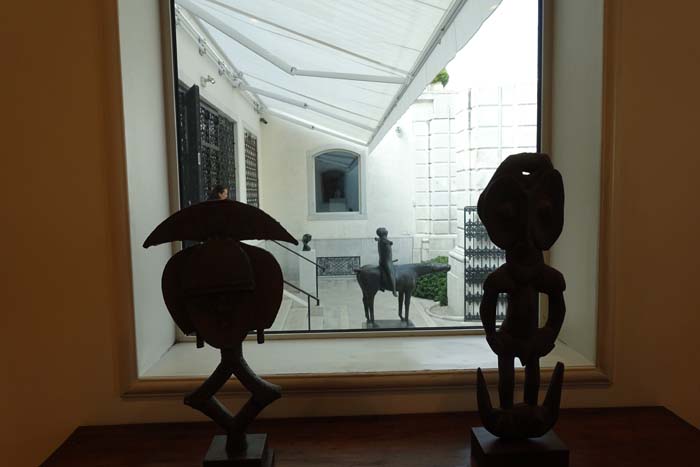
Marino Marini, "The Angel of the City" 1948, bronze sculpture of a boy on a horse, greets visitors on the patio of the museum.
Peggy Guggenheim lived in Venice for thirty-three years. She died at age 81 in December 1979. Her ashes are placed in a corner of the garden of Palazzo Venier dei Leoni, next to the place where she customarily buried her beloved dogs.

After visiting the Peggy Guggenheim collection and browsing the gift shop, we had a nice lunch in the adjacent garden cafe. A wide variety of art galleries line the streets of Venice, especially in the area between the Peggy Guggenheim Collection and the Gallery Accademia. Here are a couple of gallery exhibits that struck my fancy as we walked by:
This portrait of Marilyn Monroe was created with tiny images of butterfly wings.
"Dog" by Fernando Bottero, 2008
These whimsical cats reflect the theatrical personality of Venice
I like to take pictures in museums and galleries to remind me of what I saw and so I can enjoy seeing the art again. My visit to the Accademia Gallery will be in Part 2 of my report on Venice art.