Showing posts with label food. Show all posts

Monday, December 20, 2021

BERLIN IN WINTER: Stollen and Christmas Markets

 52 Places to Go: Week 51

Friedrichstrasse at night outside our hotel
[Diary of my trip to Berlin in November 2010]  It was the last Thursday in November and we were in Berlin, where Art was attending a conference.  We were staying at the Maritim Hotel, on Friedrichstrasse, the main shopping street of the former East Berlin, now a bustling center of commerce with huge department stores, hotels, and other businesses.  That evening we attended an elaborate buffet at the hotel with dozens of dishes and artfully prepared appetizers, many in little glass containers.  Main courses included venison and roast goose–the closest we came to a real Thanksgiving dinner.  After dinner we walked a few blocks to the intersection with Unter den Linden, a wide boulevard leading to the Brandenburg Gate, which was decked out for Christmas with sparkling lights.  The temperature was around 0 degrees Centigrade and it felt like it was going to snow.  In the morning, as I looked out our hotel window, I saw a light dusting of snow on the rooftops.
View from our hotel window

The next day while Art was attending meetings, I ate at the hotel again.  Dessert came on a plate shaped like an artist’s palette with cake, ice cream, and chocolate sauce in three “paint” compartments.  Everywhere in the hotel, walls were decorated with modern paintings, some of them huge.  Finally, on the last day of our stay I realized that the concept of the hotel was a giant art gallery!  (Hence, the palette for my dessert!)  One thing that puzzled me when I got on the elevator to go to our room was that each floor had a name on it.  I now understood that these were the names of painters and each floor was dedicated to the work of a single artist.  Our floor (the 5th) displayed paintings by German artist Bernd Zimmer.

Carved Christmas Pyramid
On Saturday afternoon, after the meeting was over, we went out shopping, stopping at a Christmas store filled with pyramids (elaborately carved wooden holiday decorations that turn from the heat of lighted candles), as well as many other kinds of other wooden objects, plus holiday table cloths, ceramics, etc.

Entrance to the Christmas Market at Gendarmensmarkt

Our real destination, though, was the Christmas market at the Gendarmensmarkt, a few blocks away, where we paid one Euro each to get in.  This huge outdoor fair had dozens of booths selling food and crafts.  On one side was a stage where entertainers danced and sang.  There was also a semi-indoor section tented off from the chilly air where there were more booths.  We toured the booths and  bought cookies and poppyseed cake to take home, puppets for the grandkids, and a Thuringer sausage on a bun for my lunch.  We also took a photo by a large decorated Berlin bear. (Bears are the symbol of Berlin. They are all over the city--something like the cows in Chicago.)  That evening, German friends took us to the Berlin Opera where we saw Mozart's Magic Flute.  The staging–lots of smoke and lights–was dramatic and creative.  It didn’t matter that I didn’t understand the German lyrics. It was all wonderful.  Afterward, we ate in the opera restaurant where Art had smoked eel and I had gnocchi.
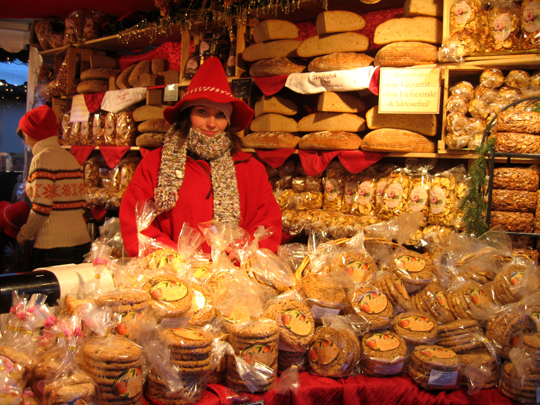

Booth selling stollen, cookies and other baked goods

On Sunday morning we bundled up and walked to the Brandenburg Gate and from there to the New National Art Museum, a large glass box not far from the symphony hall.  The main collection is German art of the early to mid-twentieth century.  From the outside, the building seems unlikely to have wall space for much art, but the inside is surprisingly spacious. In one room, they were screening a 1927 film called Symphony of Berlin, a black and white visual homage to life in the city as it was then, bustling with industry and commerce. (You can rent the film on Netflix.)  Later, we met our friends again for a traditional German Christmas tea with wonderful homemade stollen, fruit bread, cookies, and marzipan, followed by more German food for dinner at a restaurant near our hotel.  The next morning we got on a plane to go back to LA.
Caroline at the Brandenburg Gate, Berlin

Note: We have been to Berlin numerous times, usually during warmer seasons.  This was my first trip in winter.  The short days and freezing temperatures, along with the sounds of Christmas music in the streets, brought back memories of winters in Minneapolis when I was growing up.  As a child, one of the highlights of the Christmas season was going downtown to look at the displays in the department store windows.  Even though I have lived in California for most of my adult life, and have gotten used to trees being green year round and t-shirt weather in January, Christmas still never seems quite the same without snow underfoot and the air so cold you can see your breath.  In Berlin, we could definitely see our breath in the night air!

This article was first published at The Intrepid Tourist 11/21/11.

All text and photos copyright Caroline Arnold at The Intrepid Tourist.

Monday, November 29, 2021

From PIZZA to PASTA and APPETIZERS to PASTRIES: Eating in Sicily

 52 Places to Go: Week 48

All the basic ingredients of a Sicilian meal can be found at the open-air market--tomatoes, peppers, eggplant, onions, and more--all fresh from the grower
One of the joys of traveling in Italy is the seemingly endless choice of delicious foods, and our recent trip to Sicily was no exception. From breakfasts of fresh bread and coffee and more, to lunches at street cafes or buying sandwich ingredients at a local shop, to dinners at trattorias and fancier restaurants, the hardest decision was limiting ourselves to just a few items on the menu. (Servings tend to be very generous and I often had trouble finishing my meal.)
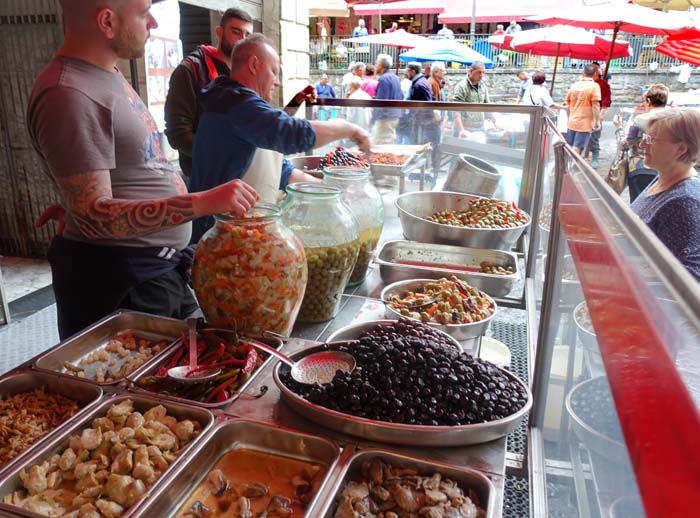
Olives, artichokes and other appetizers at a market in Catania
We enjoyed browsing at the open-air markets in Palermo and Catania, where one could buy everything from olives and octopus to cherries (which were in season) and three-foot long zucchini squashes.
At this stand in the Ballaro market in Palermo one could buy whole cooked octopus (polpo) or plates of marinated chunks of octopus ready-to-eat.
Cookies and sweets made with almonds and almond paste are a typical dessert.
  These are just a few samples of typical Sicilian foods. In both Palermo and Catania, we relied on our BandB hosts to recommend restaurants, and were not disappointed. Note: While many Italians do not eat dinner until 8 or 9 o’clock, we were often hungry earlier and tended to be the first customers when restaurants opened for dinner at 7:30. Our trip in late May was before the busiest tourist season so we almost never had trouble getting a table, even without a reservation. Here's a list of some of the restaurants where we ate:
 Ferro di Cavallo restaurant in Palermo. (Ferro di Cavallo means "horseshoe".)
Palermo restaurants:
Quattro Mani: Quiet and upscale. A good choice to celebrate our first night in Palermo.
Ciccio Passami l'Olio: Pizza restaurant. Extremely popular on weekend nights and impossible to get a reservation for a table at the last minute. We ordered takeout and ate it as a picnic in a local park.
La Cambusa: A popular tourist restaurant with typical Sicilian food and an English menu.
Ferro di Cavallo: Classic Sicilian food. We had soup for lunch there, sitting on the patio.

Busiati pasta, a curlicue pasta made from hard durum wheat, is the typical pasta in Erice and Trapani.
Erice restaurants:
Monte San Giuliano: Typical Sicilian food, including interesting appetizers (a favorite of mine was the octopus). We ate there twice.
Venus: This restaurant is advertised all over town and was the site of the conference dinner at which we were served the typical courses of an Italian dinner: appetizers, Primi Piatti (pasta), Secundi Piatti (fish or meat), and dessert. All were excellent.
Pear and prosciutto salad and caponata appetizer at La Deliciosa in Catania

Catania restaurants:
La Deliciosa: a small trattoria that was conveniently close to our BandB on Via Crociferi. The food was delicious–just like the name–and we ate there three of our five nights in Catania.
Trattoria Casalinga: this small restaurant, about a five minute walk from our BandB, featured an appetizer bar with more than a dozen items, which could easily become a whole meal. We ate there twice–once ordering from the menu and one doing just appetizers.

This article was first published 7/22/19

All text and photographs copyright Caroline Arnold

Monday, November 8, 2021

CROATIA: MY FAVORITE MEAL, Guest Post by Caroline Hatton

 52 Places to Go: Week 45

Dubrovnik, Croatia

My friend and fellow children’s writer Caroline Hatton visited Croatia in May of 2012 and has graciously written this article about her trip. You can find out more about Caroline and her books and at her website, www.carolinehattonauthor.com . She took all the photos in this post.

BREAKFAST
At the first hotel where my husband and I stayed, the room price included a hearty breakfast. We had omelets cooked to order, skipped the ham and salami, and admired the mystery packets of what looked like vanilla or chocolate pudding, liverwurst, cream cheese, jam, and butter. While exploring Croatia with a couple of American friends for two weeks, room prices included similar breakfasts, except for rooms rented out by private citizens.

For lunch, we shared a sampler of typical Croatian food, i.e., meat:
MEATLOVERS LUNCH
The finger-sized sausages were the famous, delicious, vigorously seasoned ćevapčići. The spiral sausage was the chef’s specialty. The meat chunks were chicken, pork, and beef, the standard components of the ubiquitous “mixed grill” menu item. The beans, we never saw anywhere else, a noteworthy fact for vegetarians. The red delicacy was ajvar (a red bell pepper and garlic relish that most Croatians are crazy about).

Fortunately for our waistlines, we walked for hours through the old Zagreb, up and down medieval stone stairs and streets. By dinner time, we could fathom trying another meat dish:
CHEESE STUFFED GROUND MEAT
This was punjena pljeskavica (cheese stuffed ground meat, enthusiastically seasoned). The grilled vegetables were available as a separate item on most menus, and often included carrot, eggplant, bell pepper, onion... whatever looked good at the market.
SIBENIK WALLET
Stuffed pork came in different varieties. The above “Šibenik wallets” were stuffed with prosciutto and cheese, and named after their hometown. There, the medieval pedestrian center was a captivating place to walk off calories.

Fish and seafood were widely available, often with a side of mangold (Swiss chard) and potatoes, as seen in this sea bass entrée:
SWISS CHARD POTATO SIDE
Below: a mussel; the closed and open pair was kunjka (Noah’s Ark shellfish) found only in the Adriatic and Mediterranean; and the clam was brbavica or šarga (warty venus).
SHELLFISH
For picnics on long mountain hikes, we loved to buy bùrek (filo pastry stuffed with cheese, spinach, or ground meat) from bakery shops. Lightly sweetened varieties contained a smear of fruit mush:
BUREK SWEET
We saw many garden-shed-size roasters outside of food shops, for whole pigs, but we never saw any roast pork, perhaps more common in the high summer season.

For vegetarians, commonly available proteins were eggs for breakfast and cheese any time. Beans, we saw only once on our first lunch plate, in Zagreb.

My second-most favorite meal in Croatia was in the medieval walled city of Dubrovnik on the Adriatic. Stone-paved pedestrian streets were lined with restaurant tables, leaving only a narrow lane for waiters and passers-by.

Octopus salad was on my must-try list. We saw it on the menu for the first time on our trip. We ordered it.

Before letting our waiter, a man perhaps 18 years old, walk away, I asked him to take a photo of my husband and me. As I handed him my point-and-shoot digital camera, I said, “Press this button to turn it on.” He said, authoritatively, “I know. I am young.”

Then he brought the octopus salad:
OCTOPUS SALAD
 
A minute later, the restaurant owner, a man perhaps 50 years old, brought a serving spoon and said, “Excuse my son. He is young.”

The octopus was tender, delicate, and distinctive. The balance of tomato, lettuce, and onion, and the small amount of vinaigrette and herbs, was perfect. This gourmet dish was offered at Konoba Nava in Dubrovnik Old Town.
MLJET ISLAND
My favorite meal in Croatia was on the Adriatic island of Mljet http://www.mljettravel.com/, in the hamlet of Soline, a row of about six contiguous stone houses. Between the one-lane road and the shore of the salt water lake, Veliko Jezero, the locals had set up tables and chairs on shaded patios. We were told that the lady “in that house” (I forget if it was number 3 or 4) served dinner.

We poked our heads in her open door, into a kitchen with a jolly group at a table. The lady greeted us. We asked about dinner.  She bent down to pick up a plastic bucket, from which she lifted freshly dead fish, one at a time—the day’s catch. There was only one of each kind, each one a different mottled grey.  The eel wasn’t our friends’ idea of food. So we pointed at two other big fishes, which the lady identified as škaram (barracuda) and cipal (mullet).

She brought local wine to the patio table. While we enjoyed the balmy evening, she got busy chopping a little wood for her outdoor brick barbecue, getting a fire going, preparing the fish, and grilling it to perfection. She also served a tomato salad, boiled potatoes, bread, and homemade goat cheese, and put the customary bottle of local olive oil on the table.

This was my best meal in Croatia because the fish, friendship, and serene setting were exquisite, and also because I love how the cook presented the menu choices!

Caroline is working on a horse story set in Croatia at a location similar to Linden Tree Retreat and Ranch http://www.lindenretreat.com/ where she went on an unforgettable horse ride with owner and guide, Bozidar Bruce Yerkovich.
 
This article was originally published at The Intrepid Tourist  1/12/15.


Monday, February 1, 2021

WALKING THE CORNWALL COAST: Part I, by Caroline Arnold at The Intrepid Tourist

Week 5: 52 Places to Go

Cornwall Coast: View of Tintagel from End of Rocky Valley

A Week of Fresh Air and Ancient History (September 1998)

The slate cliffs of the Cornwall coast stretched for miles to the north and south, while the sparkling waves of the Atlantic Ocean disappeared beyond the western horizon. As I peered over the cliff edge into the rocky cove below it was easy to imagine pirates or smugglers stowing their booty in a secluded sea cave. Long ago I had fallen in love with this rugged southwest corner of England as I watched the adventures of Poldark on television and read Daphne du Maurier’s Rebecca. Now I was here and ready to embark with a friend on my first walking holiday.

I had often thought that a walking trip sounded like the perfect combination of exercise and scenery, and Cornwall seemed like the ideal place to start. Not only is its jagged coast spectacularly beautiful, but it has a proud and ancient heritage dating from Neolithic times. From mysterious stone circles in south Cornwall to the reputed birthplace of King Arthur at Tintagel, the walk promised intriguing peeks into history as well as abundant opportunities to enjoy nature.

The Southwest Coast Path

The Southwest Coast Path is a public hiking trail that runs continuously along the coasts of Cornwall and Devon for more than 500 miles. It is well marked and we quickly learned to look for the acorn signposts to point us in the right direction. The portions of the Coast Path that we hiked, between Newquay and Tintagel and near Penzance, were selected both because they promised good views and because there were villages at suitable intervals where we could stay each night. (We booked rooms ahead of time.) We planned our trip for September with the idea that we would miss the summer tourist crowds and still have a chance for good weather. As it turned out, we never had a drop of rain, and although I had packed warm clothes, I didn’t need them. Cornwall does have the mildest climate in all of Britain and likes to think of itself as the English Riviera.

Setting Off
Promenade in Newquay

We spent our first night in Penzance, and then took a bus to Newquay, where gracious old hotels look over a wide beach popular with surfers. As we stepped off the bus we nearly collided with a whiskered gentleman carrying a bell and wearing a tricornered hat, embroidered coat, and knee breeches. At first we thought we had somehow landed in the wrong century, but discovered that he was the official Town Crier. He struck up a conversation and when we told him that we planned to walk nine miles that day, he seemed dubious that we would make it at all. I suppose that we did look like an unlikely pair—two middle-aged women weighed down with heavy packs. He didn’t know that we both had been taking long walks to get in shape. When we told him our plans to walk north, he insisted that we were making a big mistake because, in his view, all the best scenery was to the south!

To Porthcothan
Just outside of Newquay we picked up the Coast Path and began our walk northward toward Porthcothan. In general, the path was level except when it dipped down to a beach and we had to walk across sand. Some of the ascents to the headlands were steep, but we just stopped frequently to admire the view, take a photo, and catch our breath.
Porthcothan

Much of the Coast Path hugs the top of the cliffs and was originally used by customs officers patrolling the beaches for smugglers. As we walked along, we looked down on seagulls, seals, and the occasional shipwreck. The Cornish coast is famous for its treacherous waters, and its rocky shores have claimed countless vessels. On the landward side of the path we looked inland over the green and gold patchwork of the Cornish countryside. Most of the landscape is open and grassy due to the more or less constant wind, but tucked against walls and in protected areas we also saw purple and yellow wildflowers, scarlet rose hips and ripening blackberries. People have been farming in Cornwall since the first settlers arrived from Europe about 5000 years ago. Today's farmers are encouraged to use traditional methods, so the farmsteads, with their sagging slate-roofed houses and enclosed fields, appear much as they have for hundreds of years. Ancient walls keep most animals in their cliff top pastures, but we passed a few sheep grazing perilously on the seaward side.

Ancient Traditions
Cottage window, Mousehole

Celtic people came to Cornwall about 700 B.C.E., bringing with them the knowledge of iron making and Celtic traditions and language. “Cornwall” may come from the Cornish word “Cornovii” meaning “cliff castles.” In our walk we passed numerous Iron Age cliff castles and burial mounds, although to our inexperienced eyes, they usually looked more like grass covered lumps than ancient ruins.

Cornish, a language which is more like Welsh than English, was spoken in Cornwall until 250 years ago. It remains in place names such as Truro, the county seat of Cornwall, Delabole, which boasts Europe’s largest open slate quarry, and Penzance, the town made famous by composers Gilbert and Sullivan's Pirates of Penzance.

Shortcuts
Sharing the Path!

Occasionally we took alternate paths away from the cliff edge. Theoretically these were shortcuts, but were never marked as clearly as the Coast Path and usually required negotiating various stiles and crossing farmer’s fields. On one occasion we had a standoff with a herd of young steers but managed to get through with just being stared at.
We were not purists about walking every inch of the way or carrying our packs when it wasn’t necessary. After the first two days we were able to leave our packs at our hotel (or have them sent ahead by taxi) and then just used a small day pack for our raincoats (which we never needed) and our water and lunch. Even the tiniest villages had little cafes where we could stop for a cup of tea so we didn’t have to carry much food.

Cornish Pasties and Cream Teas
Exercise always guarantees a good appetite and for lunch we usually ate Cornish pasties, the hearty meat-filled pies that originated as a portable lunch for the local tin miners. Although the pasty—rhymes with “nasty”-- has become a fast-food staple in much of England, the best ones are still found in Cornwall. My hiking companion is of Cornish ancestry and told me that the thick dough enabled the pasty to be tossed down a mineshaft unharmed! The other food for which Cornwall is famous is clotted cream, a thick buttery spread that one slathers on fresh scones along with a dollop of strawberry jam.

Part II  (posted on 5/3/11) covers stops in Padstow, Port Isaac, Tintagel, and walks near Penzance.
Go to the end of Part II for information on getting to Cornwall, accommodations, and other details.

For more about traveling in Cornwall, see Gwen Dandridge's post CORNWALL, ENGLAND: Long Lost Kings, Mermaids, Pirates and Cream Teas, Guest Post by Gwen Dandridge.

All text and photos copyright Caroline Arnold.

Monday, January 11, 2021

SEPTEMBER IN SARDINIA, Part I: Ancient Crossroads of the Mediterranean, by Caroline Arnold at The Intrepid Tourist


Su Nuraxi:  Bronze Age tower and village built about 1500 B.C.

WEEK 2: 52 Places to Go

Grazing sheep, olive groves, and ancient vineyards stretched on either side of the road as we drove through the rolling Sardinian countryside.  Then, as we rounded a curve, the ruins of a huge, beehive-shaped tower loomed over the landscape.  We had arrived at Su Nuraxi, the remains of a neolithic settlement that had been a center of Sardinian life more than 3000 years ago.  Huge stone towers, called nuraghi, are unique to Sardinia and give the Bronze Age culture that built them its name. The Sardinian landscape is littered with Nuraghic ruins (more than 7,000 sites have been documented) as well as the remains of Etruscan, Greek, Carthaginian, Roman, and other civilizations that have put their stamp on the island.  The richness of Sardinia's ancient history was one of the reasons we wanted to visit.
My husband and I spent a week in Sardinia in September of 2011, visiting ancient ruins, hiking in the mountains and along the coast, going to museums, birdwatching, and enjoying the rich and delicious Sardinian cuisine.  With blue skies and comfortable temperatures (in the 70's), it had all the elements of a ideal vacation.

Cagliari, the Provincial Capital

Cagliari: Gate to the Citadel, location of Museum of Archeology
Sardinia is the second largest island in the Mediterranean (after Sicily). We arrived in Cagliari, the capital, in the southern part of the island. After a night at the Holiday Inn, chosen because it was near the airport and theoretically easy to get to (we got hopelessly lost trying to find it), we headed for the center of town to visit the museums in the Citadella, or citadel, the old fortified part of the city at the top of the hill above the port.  The Archeology Museum in Cagliari is the largest and most complete collection of ancient artifacts on the island.  With four floors chock full of pottery, masks, clay, bronze and iron figures, jewelry, projectile points, mosaics and more, representing Sardinia from prehistoric times through the Roman period, it was the perfect introduction to the mix of cultural influences that have created Sardinia and a clue to the wealth of ancient artifacts that have been found there.  Luckily, the introductory panels in each room, which often included maps and diagrams, were in both Italian and English.
Archeology Museum: Wrestlers, Bronze Age figures for votive offering
Sardinia has been part of modern Italy since 1861 and Italian is the official language. Children learn to speak Italian in school, but their first language is Sardi, a Latin-based language, but with words and word forms from earlier times and other cultures. Before the trip, I took a short course in Italian for travelers.  It helped a LOT because, with few exceptions, most people do not speak English in Sardinia.  If they do speak another language other than Sardi or Italian, it is most likely to be French. (The island of Corsica, which is French, is directly north of Sardinia.)

Agriturismo–Farm Stays in Italy
Throughout Sardinia and the Italian countryside, you see signs offering Agriturismo, which is basically a bed and breakfast stay at a working farm.  For our second night, we stayed at Su Boschettu, a typical agriturismo hotel about an hour’s drive from Cagliari, located in the midst of an olive grove.  It also offered dinner, advertising that everything on the menu was organic and locally grown.  The first course, antipasti, included the typical Sardinian green olives (perhaps from their own orchard), which have a delicious, slightly sharp, nutty taste, and the classic crisp Sardinian flat bread, carasau, brushed with olive oil, sprinkled with salt, and toasted.  (Throughout our stay in Sardinia, every meal began with olives and carasau.)
Olives
The bread and olives also came with a roasted eggplant dish, sauteed onions and cabbage, and a type of seafood ceviche.  This could have been enough, but was followed by ravioli filled with ricotta (the primi piatti) and salad with a plate of cold meats– sausage, duck and ribs–  (the secundi piatti).  Dessert was fruit, grapes and super-sweet melon, and a small cup of thick Italian coffee.  (I always asked for caffe decaffienato because, at full strength, I knew that the coffee would definitely keep me awake all night.)  We went to bed stuffed, leaving our window open to the fresh country air and perfect silence.

View of the village of  Pauli Arbarei from Su Boschettu

Su Nuraxi–A World Heritage Site

View from the walkway at the top of the Su Nuraxi Tower; stone walls were built without mortar
Our destination the next morning was the town of Barumini and the ancient site of Su Nuraxi, a UNESCO World Heritage site. At Su Nuraxi one can see the ruins of a large central tower, surrounded by four smaller towers and the remains of a large village.  It is the largest and most complete Nuraghic excavation in Sardinia.  From about 1500 BC onwards, villages were built around the tower-fortresses called nuraghi (Northern Sardinians call them nuraghes, Southern Sardinian call them nuraxis, plurals of nuraghe and nuraxi respectively), which were often reinforced and enlarged with battlements. The boundaries of tribal territories were guarded by smaller lookout nuraghi erected on strategic hills commanding a view of other territories.

Nuraghic model of a tower showing the flared upper story

We bought our tickets for the tour of Su Nuraxi (the only way to visit the site), and although the tour was supposed to be only in Italian, the guide generously translated everything into English for us and several other English speaking tourists.  We followed our guide up the stairs of a scaffold on the outside of the tower so we could descend the steep stone steps within the wall to the inner courtyard to enter the lower rooms and see the well. (Many nuraghi were built around wells.  Water has always been a valuable resource in Sardinia.) Only two levels of the tower remain, but originally it rose to 65 feet! Given the size of the huge stone blocks used for building, one has to marvel at the engineering.
Our ticket also got us in to several museums in Barumini.  One displayed artifacts discovered in the excavation of Su Nuraxi; another displayed farm implements and Sardinian cultural items, including the many different forms of Sardinian bread; and another explained the making and playing of a flute-like instrument called  launeddas.

Maps and Guidebooks: We relied on our Michelin map to get us around Sardinia.  You can order it online.  Our main guidebooks for sites, hotels, restaurants, etc., were the Lonely Planet Sardinia and Rough Guide Sardinia.  We also made good use of Sardinia: Car Tours and Walks by Andreas Stieglitz, which has very specific instructions for walks and driving routes.

(Look for Sardinia Part II:  The Supramonte and Sardinia Part III: Giants' Tombs, Sassari, and Sinis Peninsula posted October 24 and 31, 2011.) 

All text and photos copyright of Caroline Arnold.


Cagliari, Sardinia, view from below the Citadel

Monday, July 22, 2019

From PIZZA to PASTA and APPETIZERS to PASTRIES: Eating in Sicily

All the basic ingredients of a Sicilian meal can be found at the open-air market--tomatoes, peppers, eggplant, onions, and more--all fresh from the grower
One of the joys of traveling in Italy is the seemingly endless choice of delicious foods, and our recent trip to Sicily was no exception. From breakfasts of fresh bread and coffee and more, to lunches at street cafes or buying sandwich ingredients at a local shop, to dinners at trattorias and fancier restaurants, the hardest decision was limiting ourselves to just a few items on the menu. (Servings tend to be very generous and I often had trouble finishing my meal.)
Olives, artichokes and other appetizers at a market in Catania
We enjoyed browsing at the open-air markets in Palermo and Catania, where one could buy everything from olives and octopus to cherries (which were in season) and three-foot long zucchini squashes.
At this stand in the Ballaro market in Palermo one could buy whole cooked octopus (polpo) or plates of marinated chunks of octopus ready-to-eat.
Cookies and sweets made with almonds and almond paste are a typical dessert.
Here are just a few samples of typical Sicilian foods and a list of the restaurants where we ate. 
In both Palermo and Catania, we relied on our BandB hosts to recommend restaurants, and were not disappointed. Note: While many Italians do not eat dinner until 8 or 9 o’clock, we were often hungry earlier and tended to be the first customers when restaurants opened for dinner at 7:30. Our trip in late May was before the busiest tourist season so we almost never had trouble getting a table, even without a reservation. Here's a list of where we ate:
 Ferro di Cavallo restaurant in Palermo. (Ferro di Cavallo means "horseshoe".)
Palermo restaurants:
Quattro Mani: Quiet and upscale. A good choice to celebrate our first night in Palermo.
Ciccio Passami l'Olio: Pizza restaurant. Extremely popular on weekend nights and impossible to get a reservation for a table at the last minute. We ordered takeout and ate it as a picnic in a local park.
La Cambusa: A popular tourist restaurant with typical Sicilian food and an English menu.
Ferro di Cavallo: Classic Sicilian food. We had soup for lunch there, sitting on the patio.

Busiati pasta, a curlicue pasta made from hard durum wheat, is the typical pasta in Erice and Trapani.
Erice restaurants:
Monte San Giuliano: Typical Sicilian food, including interesting appetizers (a favorite of mine was the octopus). We ate there twice.
Venus: This restaurant is advertised all over town and was the site of the conference dinner at which we were served the typical courses of an Italian dinner: appetizers, Primi Piatti (pasta), Secundi Piatti (fish or meat), and dessert. All were excellent.
Pear and prosciutto salad and caponata appetizer at La Deliciosa in Catania
Catania restaurants:
La Deliciosa: a small trattoria that was conveniently close to our BandB on Via Crociferi. The food was delicious–just like the name–and we ate there three of our five nights in Catania.
Trattoria Casalinga: this small restaurant, about a five minute walk from our BandB, featured an appetizer bar with more than a dozen items, which could easily become a whole meal. We ate there twice–once ordering from the menu and one doing just appetizers.