Showing posts with label Catania. Show all posts

Monday, November 29, 2021

From PIZZA to PASTA and APPETIZERS to PASTRIES: Eating in Sicily

 52 Places to Go: Week 48

All the basic ingredients of a Sicilian meal can be found at the open-air market--tomatoes, peppers, eggplant, onions, and more--all fresh from the grower
One of the joys of traveling in Italy is the seemingly endless choice of delicious foods, and our recent trip to Sicily was no exception. From breakfasts of fresh bread and coffee and more, to lunches at street cafes or buying sandwich ingredients at a local shop, to dinners at trattorias and fancier restaurants, the hardest decision was limiting ourselves to just a few items on the menu. (Servings tend to be very generous and I often had trouble finishing my meal.)
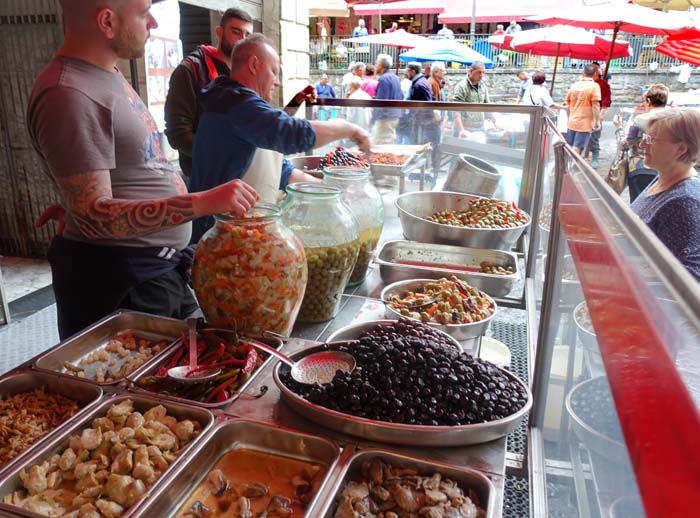
Olives, artichokes and other appetizers at a market in Catania
We enjoyed browsing at the open-air markets in Palermo and Catania, where one could buy everything from olives and octopus to cherries (which were in season) and three-foot long zucchini squashes.
At this stand in the Ballaro market in Palermo one could buy whole cooked octopus (polpo) or plates of marinated chunks of octopus ready-to-eat.
Cookies and sweets made with almonds and almond paste are a typical dessert.
  These are just a few samples of typical Sicilian foods. In both Palermo and Catania, we relied on our BandB hosts to recommend restaurants, and were not disappointed. Note: While many Italians do not eat dinner until 8 or 9 o’clock, we were often hungry earlier and tended to be the first customers when restaurants opened for dinner at 7:30. Our trip in late May was before the busiest tourist season so we almost never had trouble getting a table, even without a reservation. Here's a list of some of the restaurants where we ate:
 Ferro di Cavallo restaurant in Palermo. (Ferro di Cavallo means "horseshoe".)
Palermo restaurants:
Quattro Mani: Quiet and upscale. A good choice to celebrate our first night in Palermo.
Ciccio Passami l'Olio: Pizza restaurant. Extremely popular on weekend nights and impossible to get a reservation for a table at the last minute. We ordered takeout and ate it as a picnic in a local park.
La Cambusa: A popular tourist restaurant with typical Sicilian food and an English menu.
Ferro di Cavallo: Classic Sicilian food. We had soup for lunch there, sitting on the patio.

Busiati pasta, a curlicue pasta made from hard durum wheat, is the typical pasta in Erice and Trapani.
Erice restaurants:
Monte San Giuliano: Typical Sicilian food, including interesting appetizers (a favorite of mine was the octopus). We ate there twice.
Venus: This restaurant is advertised all over town and was the site of the conference dinner at which we were served the typical courses of an Italian dinner: appetizers, Primi Piatti (pasta), Secundi Piatti (fish or meat), and dessert. All were excellent.
Pear and prosciutto salad and caponata appetizer at La Deliciosa in Catania

Catania restaurants:
La Deliciosa: a small trattoria that was conveniently close to our BandB on Via Crociferi. The food was delicious–just like the name–and we ate there three of our five nights in Catania.
Trattoria Casalinga: this small restaurant, about a five minute walk from our BandB, featured an appetizer bar with more than a dozen items, which could easily become a whole meal. We ate there twice–once ordering from the menu and one doing just appetizers.

This article was first published 7/22/19

All text and photographs copyright Caroline Arnold

Monday, July 22, 2019

From PIZZA to PASTA and APPETIZERS to PASTRIES: Eating in Sicily

All the basic ingredients of a Sicilian meal can be found at the open-air market--tomatoes, peppers, eggplant, onions, and more--all fresh from the grower
One of the joys of traveling in Italy is the seemingly endless choice of delicious foods, and our recent trip to Sicily was no exception. From breakfasts of fresh bread and coffee and more, to lunches at street cafes or buying sandwich ingredients at a local shop, to dinners at trattorias and fancier restaurants, the hardest decision was limiting ourselves to just a few items on the menu. (Servings tend to be very generous and I often had trouble finishing my meal.)
Olives, artichokes and other appetizers at a market in Catania
We enjoyed browsing at the open-air markets in Palermo and Catania, where one could buy everything from olives and octopus to cherries (which were in season) and three-foot long zucchini squashes.
At this stand in the Ballaro market in Palermo one could buy whole cooked octopus (polpo) or plates of marinated chunks of octopus ready-to-eat.
Cookies and sweets made with almonds and almond paste are a typical dessert.
Here are just a few samples of typical Sicilian foods and a list of the restaurants where we ate. 
In both Palermo and Catania, we relied on our BandB hosts to recommend restaurants, and were not disappointed. Note: While many Italians do not eat dinner until 8 or 9 o’clock, we were often hungry earlier and tended to be the first customers when restaurants opened for dinner at 7:30. Our trip in late May was before the busiest tourist season so we almost never had trouble getting a table, even without a reservation. Here's a list of where we ate:
 Ferro di Cavallo restaurant in Palermo. (Ferro di Cavallo means "horseshoe".)
Palermo restaurants:
Quattro Mani: Quiet and upscale. A good choice to celebrate our first night in Palermo.
Ciccio Passami l'Olio: Pizza restaurant. Extremely popular on weekend nights and impossible to get a reservation for a table at the last minute. We ordered takeout and ate it as a picnic in a local park.
La Cambusa: A popular tourist restaurant with typical Sicilian food and an English menu.
Ferro di Cavallo: Classic Sicilian food. We had soup for lunch there, sitting on the patio.

Busiati pasta, a curlicue pasta made from hard durum wheat, is the typical pasta in Erice and Trapani.
Erice restaurants:
Monte San Giuliano: Typical Sicilian food, including interesting appetizers (a favorite of mine was the octopus). We ate there twice.
Venus: This restaurant is advertised all over town and was the site of the conference dinner at which we were served the typical courses of an Italian dinner: appetizers, Primi Piatti (pasta), Secundi Piatti (fish or meat), and dessert. All were excellent.
Pear and prosciutto salad and caponata appetizer at La Deliciosa in Catania
Catania restaurants:
La Deliciosa: a small trattoria that was conveniently close to our BandB on Via Crociferi. The food was delicious–just like the name–and we ate there three of our five nights in Catania.
Trattoria Casalinga: this small restaurant, about a five minute walk from our BandB, featured an appetizer bar with more than a dozen items, which could easily become a whole meal. We ate there twice–once ordering from the menu and one doing just appetizers.

Monday, June 17, 2019

SPRINGTIME IN SICILY, Part 3: Catania, Piazza Armerina, Agrigento and Mount Etna

Catania, Sicily. View from the rooftop patio of the Crociferi BandB.
At the end of May, Art and I took a two week trip to Sicily, staying in Palermo, Erice and Catania, and taking day trips to the ancient Greek ruins at Selinunte, Segesta and Agrigento and to the ancient Roman villa filled with mosaics at Piazza Armerina. The weather was warm, but not hot, and hillsides were covered with a host of wild flowers.  Here is the third of several reports of our trip.
 
For the last part of our trip to Sicily we were based in Catania, on the island’s east coast, traveling there by train from Palermo. We stayed in the Band B Crociferi, where we had the top floor suite with our own private patio and a stunning view of the city. (Climbing the stairs from the ground floor helped keep us fit for walking around the city!)
World War II Museum, Catania.Under the command of U.S. General George Patton and British General Bernard Montgomery, American, British and Canadian forces invaded Italy from North Africa on July 9, 1943. In just 38 days they had conquered all of Sicily.
During our first week in Sicily, the weather had been near perfect–sunny, blue skies and temperatures in the low seventies. But when we woke up on our first morning in Catania, the sky was grey and wet. We decided to head for the Museum of the Allied Landings in Sicily near the train and bus station, about a 20 minute walk in a light rain. The entire museum is dedicated to the American invasion of Sicily in 1943, which gave the Allies a foothold in Europe, ultimately leading to the end of the war. The first room of the museum is a recreation of a WW II Italian village and a docent gave an introduction to the museum (in Italian–we got a printout in English.) She then herded us into a dark bomb shelter where we sat on shaking benches while listening to the sound of bombs exploding (like a Disneyland ride) so we could experience what it would have been like to be in Sicily at the time.
Life size diorama of the signing of the armistice between Italy and the Allies, September 13, 1943
From there we made our way on our own through two floors of exhibits containing displays of photos, newspaper headlines, uniforms, letters, equipment, plus life-size dioramas--a meeting of Churchill and Roosevelt, signing of the Italian surrender, a Red Cross hospital tent, the inside of a bunker, and more. While most labels were only in Italian, each room had a panel of information translated into English.
Contact sheets of photos taken by Phil Stern of the Sicily campaign.
On the ground floor we discovered an exhibit of stunning photos by American photographer Phil Stern, who had landed with the troops. At age 93 (in 2013) he returned for the inauguration of the exhibit of his Sicily photos, now a permanent part of the museum.
Mosaics at Villa Romana de Casale in Piazza Armerina. The excellent condition of the mosaics is due to a landslide that sealed off the area for 600 years and protected the art. Excavations began in the 1930s. It is the largest collection of Roman floor mosaics ever found in situ. It is a World Heritage Site.
Before our trip we made the decision that we wouldn’t drive in Sicily, even though we typically rent a car when we go on vacation. But the reputation of crazy Italian drivers and the narrow cobblestone streets, built long before cars were ever invented, convinced us that we would be happier having someone else behind the wheel. So we arranged for a small group tour (there was only one other couple) to go to Piazza Armerina and Agrigento. Our guide, Carlo, was an excellent driver.
The most famous room at the Villa Romana shows “bikini girls”–female figures dressed for physical exercise.
We headed first to Piazza Armerina and the Villa Romana de Casale, nestled at the bottom of a valley about three miles from the town. Built in about A.D, 300 by a powerful Roman magistrate, its many spacious rooms are filled with lavish mosaics of people, animals, flowers, plants, that seem to go on forever as you make your way around the elevated walkways for a birds-eye view of the rooms. One long hallway is filled with depictions of animals from Africa, which were captured and brought to Sicily on their way to the Coliseum on Rome.
Lunch in the old town of Piazza Armerina
For lunch Carlo took us to a small wine shop, Siciliartegusto, in the old part of Piazza Armerina, where a Sicilian “snack” had been prepared for us–cold cuts, cheese, bread, focaccia, and arancini (a kind of filled rice croquette) along with red wine from grapes grown on the slopes of Mount Etna.

Agrigento. Temple of Concordia. Built in 435 B.C., this is one of the best preserved Greek temples in the world. A workman inside reveals the grand scale of the temple.
From Piazza Armerina it was about an hour and a half drive to Agrigento, another World Heritage Site, to see the Greek temple ruins. Called the Valley of the Temples, the ruins are actually on a hill and spread over many acres.

Temple of Juno. Yellow genestra flowers grow wild all over Sicily.
Carlo let us off at the highest point of the archeological park, and we walked downhill from there to meet him at another parking area at the other end. On our way we passed Greek ruins in various states of repair, early Christian burial caves, the house of English archeologist Alexander Hardcastle, and a herd of goats, a breed unique to Sicily.
As we walked across the loose lava it felt like a combination of moonscape and miracle of life, as we stepped around tiny plants taking a foothold in the mineral rich lava. (Note the tiny figures on the far rim.)
The next morning we went on another small group tour, this time to Mount Etna. Marco was our driver and guide. We stopped to pick up lunch food in the town of Zafferena, and then went to the north side of the mountain–which according to Marco had better weather and was less crowded. We took a relatively short walk to climb one of the cinder cones, then stopped to see where a recent lava flow had engulfed a hotel, and finally, after eating our picnic lunch, toured a lava cave.

Interior of Chiesa di San Francesco Borgia on Via Crociferi
Our last day in Sicily was devoted to sightseeing in Catania. On our way down Via Crociferi (a Unesco Heritage site, named for the several churches that line the street), we stopped at the Chiesa di San Francesco Borgia to see a display of liturgical silver and to admire the complex colored marble inlay of the walls, floors, altars, etc.--the Baroque version of Byzantine mosaics--and the soaring painting on the inside of the dome.
The elephant with an Egyptian obelisk on its back is the symbol of Catania. It sits at the center of Piazza del Duomo.
From there we went to the piazza in front of the Duomo and took a brief look at the cathedral--all white stone on the inside..
Dried beans and nuts at the Catania fish market.
After a wander through the fish and produce market, we headed to the Teatro Romano, a Greek open air theater rebuilt in Roman times and which includes the renovation of a 19th century house that had been incorporated into one of the ancient walls.
Teatro Romano with the bell towers of the Duoma visible behind.
Then, after a pizza lunch at an outdoor café, we walked up the main street, Via Etna, looking for souvenirs at the market stalls along the side streets–buying some pistachio paste, saffron marmalade and a small ceramic box.
Fruit stand with oranges and pomegranates at Piazza Mazzini. On one corner is an outdoor cafe, Trattoria Enoteca, where we ate lunch under the colonnade.
In our two weeks in Sicily we got a taste of its many layers of history, the variety of its landscape, and, of course, the wealth of its delicious food. As our plane took off from the Catania airport as we headed home, we got a good view of Mount Etna towering over the city. Just three days later, the top of Etna erupted, spewing fiery lava into the air. In some ways, we wished we had been there  to see it in person. But in other ways we were glad we were safe back in Los Angeles.
Mount Etna, May 28, 2019.  Smoke is hovering over the crater and patches of snow from the previous winter still cling to its sides.

Monday, January 25, 2016

SICILY: Mount Etna and Taormina, Guest Post by Tom Scheaffer

Hiking to the top of Mount Etna, Sicily
My brother Tom loves to travel and Italy is one of his (and my) favorite places. Here is his report from his most recent trip, in December 2015 and January 2016. 
Tom near the top of  Mount Etna; Mount Etna is a World Heritage Site
I recently visited Sicily, Italy for one month. I climbed Mount Etna with a group of friends after taking a cable car up the first steep stretch. Mount Etna, 10,922 feet, is the largest of the three active volcanoes in Italy. It is one of the most active volcanoes in the world and is in an almost constant state of activity. In fact, it erupted just a few weeks before I arrived in Catania.
House buried by ash from earlier eruptions of Mount Etna
One can see houses that have been buried by the volcanic ash on the lower slopes of the volcano.

The view from near the summit of the blue Mediterranean Sea are breathtaking, and fortunately there was not too much snow so we were able to hike easily. 
Taormina, Sicily
Taormina is a charming coastal town just north of Catania at the base of Mount Etna. My friend and I visited the Greek Theater which is just a few blocks from the Old Town. It overlooks the sea and Mt. Etna in the background and is still used for concerts and is the site of the annual Taormina Film Festival.
Ancient Greek Theater at Toarmina
Famous actors like Richard Burton and Elizabeth Taylor have received awards in this spectacular open air theater. It was built by the Romans upon the foundations of an older theater of the Greek period. What remains today dates from the second century A.D.

For our visit to Taormina and Mount Etna we stayed in Sciacca at the Torre Del Barone Resort.