Showing posts with label Christmas. Show all posts

Monday, December 23, 2024

HAPPY HOLIDAYS from THE INTREPID TOURIST

Scheaffer family in apartment at NENH, 1950.

"On Christmas Eve, after my brothers and I are asleep, my parents arrange “Santa’s” gifts under the tree. On Christmas morning, after everyone is awake, my father turns on the tree lights and gives the signal to enter. We rush in, each going straight to our own pile. Santa’s gifts are unwrapped and it is obvious who they are for—a doll for me, a train for Steve, stacking blocks for Peter, a stuffed toy for Tom."  

From Chapter 7: Family Christmas at NENH, SETTLEMENT HOUSE GIRL: Growing Up in the 1950s at North East Neighborhood House, Minneapolis, Minnesota.

 I have fond memories of celebrating Christmas when I was a child. Now, many years later, from my home in California, I send best wishes to you and all my faithful readers.

HAPPY HOLIDAYS

2024


Monday, December 27, 2021

LALIBELA, ETHIOPIA: Rock Cut Churches and Christmas Celebration, Guest Post by Kathryn Mohrman

 52 Places to Go: Week 52

Pilgrims came to Lalibela from all over Ethiopia--by plane, bus, car, van, donkey, and on foot.
My friend, Kathryn Mohrman, an avid and excellent photographer, recently visited the highlands of Ethiopia on a photo tour with about a dozen other photographers.  She has graciously agreed to share some of her photos and impressions of the trip. Kathryn is a professor at Arizona State University and travels widely for her job as director of several projects with partner universities in China and Vietnam. You can see photos from her trip to Morocco last year at her 2/4/13 post on this blog.  I have known Kathryn since we were students together at Grinnell College in Iowa. This post was first published at The Intrepid Tourist 2/17/14.
This is the approach to the church of St. George (you are looking at the roof of the church).  Notice that the church is free standing--there is an open area all the way around the structure.
Orthodox Christians in Ethiopia celebrate Christmas in early January. In the 12th century, King Lalibela created a group of churches hewn out of rocky cliffs in the northern highlands to form a "new Jerusalem" for believers. Today many devout Ethiopian Christians make a pilgrimage to Lalibela to celebrate the birth of Christ. Lalibela is a UNESCO World Heritage site.
The heart of Lalibela is a series of churches hewn out of rocky cliffs.
Lalibela is in the highlands of Ethiopia at about 8000 ft or 2400 m above sea level.  This was winter so it was fairly dry with no crops growing.We saw lots of livestock grazing in the fields--and walking down the roads.  In fact, I was almost run over by a bunch of galloping mules.
A few of the churches had frescoes painted on the ceilings; others had Bible scenes on canvas or wood as wall decorations. Passageways were carved through the rock to connect one church to the next.
Many thousands of pilgrims crowded the little town of Lalibela.  Often they had to wait quite a while to get access to the sacred sites. We saw informal preaching, singing and dancing in the courtyards surrounding some of the churches.  People were having a good time in addition to celebrating Jesus' birth. Turbans signify priests--they are expected to marry and have families.  Monks are celibate.
Priests would shake this instrument to accent the rhythm of their hymns.
We visited a monastery where we saw a number of precious objects.  This beautiful book was created in the 9th century when Europe was in the Dark Ages.
In the past there were hermits in little caves near the churches.  No hermits today, at least not in the main areas in Lalibela. 

People were expected to remove their shoes to go inside the churches.  Most pilgrims took off their shoes in the courtyards as well.
There is a Bible verse that says "it is easier for a camel to go through the eye of a needle than for a rich person to enter the Kingdom of God!"  Historic Jerusalem had a Needle's Eye gate and this is the Lalibela version.
As Christmas drew near, more and more people crowded into the courtyards.  On the night of Christmas Eve, many people camped out overnight in or near the churches to be ready for dawn on Christmas Day when a huge procession culminated the celebrations. (Read more about the celebration in this Smithsonian article.)

Several hours before dawn on Christmas Day, pilgrims were jockeying for position.  Many of them carried tall tapers although some used LED flashlights or their cell phones for light. Some priests, especially those who were collecting donations, wore beautiful robes and carried decorative umbrellas.
A large group of pilgrims came in several buses, complete with portable kitchen equipment.  After the final ceremony, the group gathered near my hotel for lunch before heading home.

 Noon on Christmas Day. 
This guy was one of my favorites.  I learned a proper greeting in Amharic which I said to him as he passed.  He walked a few steps, then turned around and blew kisses to me.  !!!

Monday, December 20, 2021

BERLIN IN WINTER: Stollen and Christmas Markets

 52 Places to Go: Week 51

Friedrichstrasse at night outside our hotel
[Diary of my trip to Berlin in November 2010]  It was the last Thursday in November and we were in Berlin, where Art was attending a conference.  We were staying at the Maritim Hotel, on Friedrichstrasse, the main shopping street of the former East Berlin, now a bustling center of commerce with huge department stores, hotels, and other businesses.  That evening we attended an elaborate buffet at the hotel with dozens of dishes and artfully prepared appetizers, many in little glass containers.  Main courses included venison and roast goose–the closest we came to a real Thanksgiving dinner.  After dinner we walked a few blocks to the intersection with Unter den Linden, a wide boulevard leading to the Brandenburg Gate, which was decked out for Christmas with sparkling lights.  The temperature was around 0 degrees Centigrade and it felt like it was going to snow.  In the morning, as I looked out our hotel window, I saw a light dusting of snow on the rooftops.
View from our hotel window

The next day while Art was attending meetings, I ate at the hotel again.  Dessert came on a plate shaped like an artist’s palette with cake, ice cream, and chocolate sauce in three “paint” compartments.  Everywhere in the hotel, walls were decorated with modern paintings, some of them huge.  Finally, on the last day of our stay I realized that the concept of the hotel was a giant art gallery!  (Hence, the palette for my dessert!)  One thing that puzzled me when I got on the elevator to go to our room was that each floor had a name on it.  I now understood that these were the names of painters and each floor was dedicated to the work of a single artist.  Our floor (the 5th) displayed paintings by German artist Bernd Zimmer.

Carved Christmas Pyramid
On Saturday afternoon, after the meeting was over, we went out shopping, stopping at a Christmas store filled with pyramids (elaborately carved wooden holiday decorations that turn from the heat of lighted candles), as well as many other kinds of other wooden objects, plus holiday table cloths, ceramics, etc.

Entrance to the Christmas Market at Gendarmensmarkt

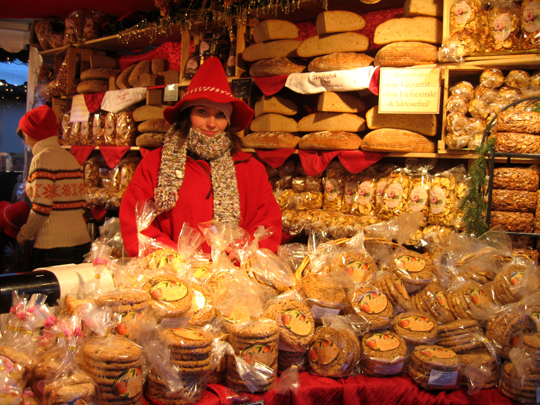
Our real destination, though, was the Christmas market at the Gendarmensmarkt, a few blocks away, where we paid one Euro each to get in.  This huge outdoor fair had dozens of booths selling food and crafts.  On one side was a stage where entertainers danced and sang.  There was also a semi-indoor section tented off from the chilly air where there were more booths.  We toured the booths and  bought cookies and poppyseed cake to take home, puppets for the grandkids, and a Thuringer sausage on a bun for my lunch.  We also took a photo by a large decorated Berlin bear. (Bears are the symbol of Berlin. They are all over the city--something like the cows in Chicago.)  That evening, German friends took us to the Berlin Opera where we saw Mozart's Magic Flute.  The staging–lots of smoke and lights–was dramatic and creative.  It didn’t matter that I didn’t understand the German lyrics. It was all wonderful.  Afterward, we ate in the opera restaurant where Art had smoked eel and I had gnocchi.


Booth selling stollen, cookies and other baked goods

On Sunday morning we bundled up and walked to the Brandenburg Gate and from there to the New National Art Museum, a large glass box not far from the symphony hall.  The main collection is German art of the early to mid-twentieth century.  From the outside, the building seems unlikely to have wall space for much art, but the inside is surprisingly spacious. In one room, they were screening a 1927 film called Symphony of Berlin, a black and white visual homage to life in the city as it was then, bustling with industry and commerce. (You can rent the film on Netflix.)  Later, we met our friends again for a traditional German Christmas tea with wonderful homemade stollen, fruit bread, cookies, and marzipan, followed by more German food for dinner at a restaurant near our hotel.  The next morning we got on a plane to go back to LA.
Caroline at the Brandenburg Gate, Berlin

Note: We have been to Berlin numerous times, usually during warmer seasons.  This was my first trip in winter.  The short days and freezing temperatures, along with the sounds of Christmas music in the streets, brought back memories of winters in Minneapolis when I was growing up.  As a child, one of the highlights of the Christmas season was going downtown to look at the displays in the department store windows.  Even though I have lived in California for most of my adult life, and have gotten used to trees being green year round and t-shirt weather in January, Christmas still never seems quite the same without snow underfoot and the air so cold you can see your breath.  In Berlin, we could definitely see our breath in the night air!

This article was first published at The Intrepid Tourist 11/21/11.

All text and photos copyright Caroline Arnold at The Intrepid Tourist.

Monday, December 13, 2021

CHRISTMAS CRECHES FROM AROUND THE WORLD

 52 Places to Go: Week 50

Gourd Creche from Chile
Over the years my family has collected a variety of Christmas creches from all over the world.  Some of been souvenirs of our travel, others have been gifts, and some we have purchased at museum gift shops.  We get them out each holiday season and are reminded of all the different cultures that celebrate Christmas.  Here are a few of our favorites.
Knitted Creche from Chile
West African Nativity Figures

Haitian Nativity
Corn Husk Nativity from Mexico
Tin Nativity from Mexico
Ceramic Nativity from Mexico
Swedish cast iron Nativity candle holder
Russian Nesting Doll Nativity

Monday, December 25, 2017

HAPPY HOLIDAYS

Nativities from around the world displayed in the Connecting Cultures Mobile Museum remind me of our own collection, gathered over the years, often as we have traveled around the world. As we celebrate this holiday season with its message of joy, hope, peace and goodwill, we send best wishes to all of you for a very
HAPPY HOLIDAY
and
JOYOUS NEW YEAR!

Monday, February 17, 2014

LALIBELA, ETHIOPIA: Rock Cut Churches and Christmas Celebration, Guest Post by Kathryn Mohrman

Pilgrims came to Lalibela from all over Ethiopia--by plane, bus, car, van, donkey, and on foot.
My friend, Kathryn Mohrman, an avid and excellent photographer, recently visited the highlands of Ethiopia on a photo tour with about a dozen other photographers.  She has graciously agreed to share some of her photos and impressions of the trip. Kathryn is a professor at Arizona State University and travels widely for her job as director of several projects with partner universities in China and Vietnam. You can see photos from her trip to Morocco last year at her 2/4/13 post on this blog.  I have known Kathryn since we were students together at Grinnell College in Iowa.
This is the approach to the church of St. George (you are looking at the roof of the church).  Notice that the church is free standing--there is an open area all the way around the structure.
Orthodox Christians in Ethiopia celebrate Christmas in early January. In the 12th century, King Lalibela created a group of churches hewn out of rocky cliffs in the northern highlands to form a "new Jerusalem" for believers. Today many devout Ethiopian Christians make a pilgrimage to Lalibela to celebrate the birth of Christ. Lalibela is a UNESCO World Heritage site.
The heart of Lalibela is a series of churches hewn out of rocky cliffs.
Lalibela is in the highlands of Ethiopia at about 8000 ft or 2400 m above sea level.  This was winter so it was fairly dry with no crops growing.We saw lots of livestock grazing in the fields--and walking down the roads.  In fact, I was almost run over by a bunch of galloping mules.
A few of the churches had frescoes painted on the ceilings; others had Bible scenes on canvas or wood as wall decorations. Passageways were carved through the rock to connect one church to the next.
Many thousands of pilgrims crowded the little town of Lalibela.  Often they had to wait quite a while to get access to the sacred sites. We saw informal preaching, singing and dancing in the courtyards surrounding some of the churches.  People were having a good time in addition to celebrating Jesus' birth. Turbans signify priests--they are expected to marry and have families.  Monks are celibate.
Priests would shake this instrument to accent the rhythm of their hymns.
We visited a monastery where we saw a number of precious objects.  This beautiful book was created in the 9th century when Europe was in the Dark Ages.
In the past there were hermits in little caves near the churches.  No hermits today, at least not in the main areas in Lalibela. 

People were expected to remove their shoes to go inside the churches.  Most pilgrims took off their shoes in the courtyards as well.
There is a Bible verse that says "it is easier for a camel to go through the eye of a needle than for a rich person to enter the Kingdom of God!"  Historic Jerusalem had a Needle's Eye gate and this is the Lalibela version.
As Christmas drew near, more and more people crowded into the courtyards.  On the night of Christmas Eve, many people camped out overnight in or near the churches to be ready for dawn on Christmas Day when a huge procession culminated the celebrations. (Read more about the celebration in this Smithsonian article.)

Several hours before dawn on Christmas Day, pilgrims were jockeying for position.  Many of them carried tall tapers although some used LED flashlights or their cell phones for light. Some priests, especially those who were collecting donations, wore beautiful robes and carried decorative umbrellas.
A large group of pilgrims came in several buses, complete with portable kitchen equipment.  After the final ceremony, the group gathered near my hotel for lunch before heading home.

 Noon on Christmas Day. 
This guy was one of my favorites.  I learned a proper greeting in Amharic which I said to him as he passed.  He walked a few steps, then turned around and blew kisses to me.  !!!   

Monday, December 23, 2013

HOLIDAY GREETINGS!

Amaryllis.  Native to South Africa, they are now cultivated all over the world.
Every year at holiday time I like to buy amaryllis bulbs.  There is something magical about the way the bulb suddenly springs to life, producing a green shoot that grows almost visibly day by day and then blossoms into gigantic flowers.  Last year one of my plants timed its flowering perfectly for Christmas, with blooms so heavy it had to be supported so it didn’t topple over. When it finished blooming, the leaves continued to grow, renewing the bulb for another season.
Christmas is a time of renewed hope and celebration. I am looking forward to celebrating with family and friends and I send you
best wishes for a very 
Happy Holiday Season
and Joyous New Year!

Monday, December 24, 2012

Folk Art from the Czech Republic: A Christmas Creche

Paper Cut-Out Creche from the Czech Republic
HAPPY HOLIDAYS 2012!
Note:  This piece was originally posted in December 2010 on my Art and Books blog.  I thought I would share it again as our family celebrates Christmas and gets out our creches, which remind us of the many places around the world that they come from and which embody the joy of the season.

It’s Christmas season and time to get out our creche collection. We just added a new one, a paper cut out creche from the Czech Republic. A week ago we got back from a trip to Prague and Berlin, where we spent Thanksgiving. Christmas lights were up, street stands and shops were filled with traditional Christmas foods (stollen, lebkuchen, mulled wine) and whole stores specialized in hand made decorations, including various forms of creches. I have always been fond of folk art and the simple forms, bright colors have been an influence on my own art. I look forward to cutting out the new creche with my grandchildren when we get together for Christmas.

Monday, December 19, 2011

Christmas Creches from Around the World

Gourd Creche from Chile
Over the years my family has collected a variety of Christmas creches from all over the world.  Some of been souvenirs of our travel, others have been gifts, and some we have purchased at museum gift shops.  We get them out each holiday season and are reminded of all the different cultures that celebrate Christmas.  I'd like to share a few of them and send you best wishes for a VERY HAPPY HOLIDAY SEASON!
Knitted Creche from Chile
West African Nativity Figures

Haitian Nativity
Corn Husk Nativity from Mexico
Tin Nativity from Mexico
Ceramic Nativity from Mexico
Swedish cast iron Nativity
Russian Nesting Doll Nativity