Showing posts with label octopus. Show all posts

Monday, November 29, 2021

From PIZZA to PASTA and APPETIZERS to PASTRIES: Eating in Sicily

 52 Places to Go: Week 48

All the basic ingredients of a Sicilian meal can be found at the open-air market--tomatoes, peppers, eggplant, onions, and more--all fresh from the grower
One of the joys of traveling in Italy is the seemingly endless choice of delicious foods, and our recent trip to Sicily was no exception. From breakfasts of fresh bread and coffee and more, to lunches at street cafes or buying sandwich ingredients at a local shop, to dinners at trattorias and fancier restaurants, the hardest decision was limiting ourselves to just a few items on the menu. (Servings tend to be very generous and I often had trouble finishing my meal.)
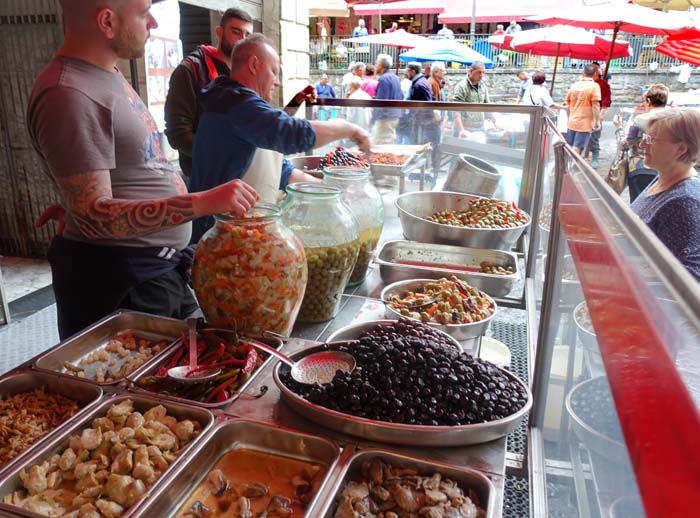
Olives, artichokes and other appetizers at a market in Catania
We enjoyed browsing at the open-air markets in Palermo and Catania, where one could buy everything from olives and octopus to cherries (which were in season) and three-foot long zucchini squashes.
At this stand in the Ballaro market in Palermo one could buy whole cooked octopus (polpo) or plates of marinated chunks of octopus ready-to-eat.
Cookies and sweets made with almonds and almond paste are a typical dessert.
  These are just a few samples of typical Sicilian foods. In both Palermo and Catania, we relied on our BandB hosts to recommend restaurants, and were not disappointed. Note: While many Italians do not eat dinner until 8 or 9 o’clock, we were often hungry earlier and tended to be the first customers when restaurants opened for dinner at 7:30. Our trip in late May was before the busiest tourist season so we almost never had trouble getting a table, even without a reservation. Here's a list of some of the restaurants where we ate:
 Ferro di Cavallo restaurant in Palermo. (Ferro di Cavallo means "horseshoe".)
Palermo restaurants:
Quattro Mani: Quiet and upscale. A good choice to celebrate our first night in Palermo.
Ciccio Passami l'Olio: Pizza restaurant. Extremely popular on weekend nights and impossible to get a reservation for a table at the last minute. We ordered takeout and ate it as a picnic in a local park.
La Cambusa: A popular tourist restaurant with typical Sicilian food and an English menu.
Ferro di Cavallo: Classic Sicilian food. We had soup for lunch there, sitting on the patio.

Busiati pasta, a curlicue pasta made from hard durum wheat, is the typical pasta in Erice and Trapani.
Erice restaurants:
Monte San Giuliano: Typical Sicilian food, including interesting appetizers (a favorite of mine was the octopus). We ate there twice.
Venus: This restaurant is advertised all over town and was the site of the conference dinner at which we were served the typical courses of an Italian dinner: appetizers, Primi Piatti (pasta), Secundi Piatti (fish or meat), and dessert. All were excellent.
Pear and prosciutto salad and caponata appetizer at La Deliciosa in Catania

Catania restaurants:
La Deliciosa: a small trattoria that was conveniently close to our BandB on Via Crociferi. The food was delicious–just like the name–and we ate there three of our five nights in Catania.
Trattoria Casalinga: this small restaurant, about a five minute walk from our BandB, featured an appetizer bar with more than a dozen items, which could easily become a whole meal. We ate there twice–once ordering from the menu and one doing just appetizers.

This article was first published 7/22/19

All text and photographs copyright Caroline Arnold

Monday, November 8, 2021

CROATIA: MY FAVORITE MEAL, Guest Post by Caroline Hatton

 52 Places to Go: Week 45

Dubrovnik, Croatia

My friend and fellow children’s writer Caroline Hatton visited Croatia in May of 2012 and has graciously written this article about her trip. You can find out more about Caroline and her books and at her website, www.carolinehattonauthor.com . She took all the photos in this post.

BREAKFAST
At the first hotel where my husband and I stayed, the room price included a hearty breakfast. We had omelets cooked to order, skipped the ham and salami, and admired the mystery packets of what looked like vanilla or chocolate pudding, liverwurst, cream cheese, jam, and butter. While exploring Croatia with a couple of American friends for two weeks, room prices included similar breakfasts, except for rooms rented out by private citizens.

For lunch, we shared a sampler of typical Croatian food, i.e., meat:
MEATLOVERS LUNCH
The finger-sized sausages were the famous, delicious, vigorously seasoned ćevapčići. The spiral sausage was the chef’s specialty. The meat chunks were chicken, pork, and beef, the standard components of the ubiquitous “mixed grill” menu item. The beans, we never saw anywhere else, a noteworthy fact for vegetarians. The red delicacy was ajvar (a red bell pepper and garlic relish that most Croatians are crazy about).

Fortunately for our waistlines, we walked for hours through the old Zagreb, up and down medieval stone stairs and streets. By dinner time, we could fathom trying another meat dish:
CHEESE STUFFED GROUND MEAT
This was punjena pljeskavica (cheese stuffed ground meat, enthusiastically seasoned). The grilled vegetables were available as a separate item on most menus, and often included carrot, eggplant, bell pepper, onion... whatever looked good at the market.
SIBENIK WALLET
Stuffed pork came in different varieties. The above “Šibenik wallets” were stuffed with prosciutto and cheese, and named after their hometown. There, the medieval pedestrian center was a captivating place to walk off calories.

Fish and seafood were widely available, often with a side of mangold (Swiss chard) and potatoes, as seen in this sea bass entrée:
SWISS CHARD POTATO SIDE
Below: a mussel; the closed and open pair was kunjka (Noah’s Ark shellfish) found only in the Adriatic and Mediterranean; and the clam was brbavica or šarga (warty venus).
SHELLFISH
For picnics on long mountain hikes, we loved to buy bùrek (filo pastry stuffed with cheese, spinach, or ground meat) from bakery shops. Lightly sweetened varieties contained a smear of fruit mush:
BUREK SWEET
We saw many garden-shed-size roasters outside of food shops, for whole pigs, but we never saw any roast pork, perhaps more common in the high summer season.

For vegetarians, commonly available proteins were eggs for breakfast and cheese any time. Beans, we saw only once on our first lunch plate, in Zagreb.

My second-most favorite meal in Croatia was in the medieval walled city of Dubrovnik on the Adriatic. Stone-paved pedestrian streets were lined with restaurant tables, leaving only a narrow lane for waiters and passers-by.

Octopus salad was on my must-try list. We saw it on the menu for the first time on our trip. We ordered it.

Before letting our waiter, a man perhaps 18 years old, walk away, I asked him to take a photo of my husband and me. As I handed him my point-and-shoot digital camera, I said, “Press this button to turn it on.” He said, authoritatively, “I know. I am young.”

Then he brought the octopus salad:
OCTOPUS SALAD
 
A minute later, the restaurant owner, a man perhaps 50 years old, brought a serving spoon and said, “Excuse my son. He is young.”

The octopus was tender, delicate, and distinctive. The balance of tomato, lettuce, and onion, and the small amount of vinaigrette and herbs, was perfect. This gourmet dish was offered at Konoba Nava in Dubrovnik Old Town.
MLJET ISLAND
My favorite meal in Croatia was on the Adriatic island of Mljet http://www.mljettravel.com/, in the hamlet of Soline, a row of about six contiguous stone houses. Between the one-lane road and the shore of the salt water lake, Veliko Jezero, the locals had set up tables and chairs on shaded patios. We were told that the lady “in that house” (I forget if it was number 3 or 4) served dinner.

We poked our heads in her open door, into a kitchen with a jolly group at a table. The lady greeted us. We asked about dinner.  She bent down to pick up a plastic bucket, from which she lifted freshly dead fish, one at a time—the day’s catch. There was only one of each kind, each one a different mottled grey.  The eel wasn’t our friends’ idea of food. So we pointed at two other big fishes, which the lady identified as škaram (barracuda) and cipal (mullet).

She brought local wine to the patio table. While we enjoyed the balmy evening, she got busy chopping a little wood for her outdoor brick barbecue, getting a fire going, preparing the fish, and grilling it to perfection. She also served a tomato salad, boiled potatoes, bread, and homemade goat cheese, and put the customary bottle of local olive oil on the table.

This was my best meal in Croatia because the fish, friendship, and serene setting were exquisite, and also because I love how the cook presented the menu choices!

Caroline is working on a horse story set in Croatia at a location similar to Linden Tree Retreat and Ranch http://www.lindenretreat.com/ where she went on an unforgettable horse ride with owner and guide, Bozidar Bruce Yerkovich.
 
This article was originally published at The Intrepid Tourist  1/12/15.


Monday, July 22, 2019

From PIZZA to PASTA and APPETIZERS to PASTRIES: Eating in Sicily

All the basic ingredients of a Sicilian meal can be found at the open-air market--tomatoes, peppers, eggplant, onions, and more--all fresh from the grower
One of the joys of traveling in Italy is the seemingly endless choice of delicious foods, and our recent trip to Sicily was no exception. From breakfasts of fresh bread and coffee and more, to lunches at street cafes or buying sandwich ingredients at a local shop, to dinners at trattorias and fancier restaurants, the hardest decision was limiting ourselves to just a few items on the menu. (Servings tend to be very generous and I often had trouble finishing my meal.)
Olives, artichokes and other appetizers at a market in Catania
We enjoyed browsing at the open-air markets in Palermo and Catania, where one could buy everything from olives and octopus to cherries (which were in season) and three-foot long zucchini squashes.
At this stand in the Ballaro market in Palermo one could buy whole cooked octopus (polpo) or plates of marinated chunks of octopus ready-to-eat.
Cookies and sweets made with almonds and almond paste are a typical dessert.
Here are just a few samples of typical Sicilian foods and a list of the restaurants where we ate. 
In both Palermo and Catania, we relied on our BandB hosts to recommend restaurants, and were not disappointed. Note: While many Italians do not eat dinner until 8 or 9 o’clock, we were often hungry earlier and tended to be the first customers when restaurants opened for dinner at 7:30. Our trip in late May was before the busiest tourist season so we almost never had trouble getting a table, even without a reservation. Here's a list of where we ate:
 Ferro di Cavallo restaurant in Palermo. (Ferro di Cavallo means "horseshoe".)
Palermo restaurants:
Quattro Mani: Quiet and upscale. A good choice to celebrate our first night in Palermo.
Ciccio Passami l'Olio: Pizza restaurant. Extremely popular on weekend nights and impossible to get a reservation for a table at the last minute. We ordered takeout and ate it as a picnic in a local park.
La Cambusa: A popular tourist restaurant with typical Sicilian food and an English menu.
Ferro di Cavallo: Classic Sicilian food. We had soup for lunch there, sitting on the patio.

Busiati pasta, a curlicue pasta made from hard durum wheat, is the typical pasta in Erice and Trapani.
Erice restaurants:
Monte San Giuliano: Typical Sicilian food, including interesting appetizers (a favorite of mine was the octopus). We ate there twice.
Venus: This restaurant is advertised all over town and was the site of the conference dinner at which we were served the typical courses of an Italian dinner: appetizers, Primi Piatti (pasta), Secundi Piatti (fish or meat), and dessert. All were excellent.
Pear and prosciutto salad and caponata appetizer at La Deliciosa in Catania
Catania restaurants:
La Deliciosa: a small trattoria that was conveniently close to our BandB on Via Crociferi. The food was delicious–just like the name–and we ate there three of our five nights in Catania.
Trattoria Casalinga: this small restaurant, about a five minute walk from our BandB, featured an appetizer bar with more than a dozen items, which could easily become a whole meal. We ate there twice–once ordering from the menu and one doing just appetizers.

Monday, February 6, 2017

MONTEREY BAY AQUARIUM: Sea Otters, Jellyfish, Octopuses and More, Monterey, CA

Jellyfish at the Monterey Bay Aquarium, Monterrey, CA
In late December I went with my family to the Monterey Bay Aquarium in California. At this world-famous museum, perched at the edge of Monterey Bay in a building that was once part of the real Cannery Row in the days of John Steinbeck, and now at the heart of a thriving tourist area, one can watch sea otters doing acrobatics in their giant tank, see a diver in a kelp bed, witness sharks being fed, gaze at jellyfish floating like undersea spaceships, and much much more.
Kelp Forest
We arrived early in the day, at 10:00 when the Aquarium opened, having bought our tickets ahead of time. Even so, the museum was crowded due to the holiday break and we had to be patient to get our turn at each window. Shortly after we arrived, the sea otters were being fed, but there were so many people around their tank, that we decided to return later. When we did, we got a close-up look as the otters glided past the underwater window and we were glad we waited.
Jellyfish with bioluminesence
We headed toward the popular jellyfish exhibit, stopping on the way to watch the school of sardines whirl around and around in their circular tank. I never lose my sense of wonder at the variety of shapes and colors of jellyfish and watching the delicate pulsations that propel them through the water–some of them resemble tiny lanterns and others are more like underwater hot-air balloons.
Octopus
I was particularly interested in seeing the cephalopod exhibit, new since my last visit to the Aquarium a number of years ago. Cephalopods are the group that include octopuses, squid and the chambered nautilus. At the entrance to the exhibit is a fascinating display of how these animals have been perceived in art and literature since ancient times. I had learned about the amazing ability of octopuses when I wrote my book Octopuses: Escape Artists of the Sea. In the recent movie, Finding Dory, I noticed that the octopus character, although humanized, displays many of the talents of the real animal.
Cuttlefish
On the cover of my book, Living Fossils: Clues to the Past, is a depiction of a chambered nautilus, an animal that closely resembles its ancient relatives. The chambered nautilus is only found in deep waters of the South Pacific, and although I was familiar with is beautiful shell, this was the first time I had seen it alive.
Chambered Nautiluses
One of my favorite exhibits at the Aquarium is the kelp forest, depicting the environment the otters inhabit in the bay outside the museum.  My granddaughter’s favorite is the tunnel where a giant wave washes over the see-through walls making one feel immersed in the ocean without actually getting wet. We then stopped to explore the touch-tank with its crabs and tide pool life, watch the penguins, and check out a new exhibit featuring life in Baja California. It was a beautiful day and we finished on the outdoor patio after lunch in the museum cafe, enjoying the sunshine and sea air.
Under the giant wave
One can go back to the Monterey Bay Aquarium again and again, preferably on a day when it is not so busy. But there is always something new and the exhibits are a reminder that the ocean and the life in it are an essential part of our world and need to be understood and conserved for future generations.
For our visit,we drove down for the day from the San Francisco Bay area, a one way trip of about two hours.
For directions and information about tickets to the Monterey Bay Aquarium, go to their website. The Monterey Bay Aquarium is a nonprofit institution, devoted to research, conservation and educating the public.