Monday, December 12, 2022

EVOLUTION GOES ON EVERY DAY and Scientists Are On To It! Guest Post by Dorothy Hinshaw Patent


Congratulations to Dorothy Hinshaw Patent on her new book The Lizard 
Scientists: Studying Evolution in Action, available at Amazon and at your favorite bookstore. I have known Dorothy for many years, sharing an interest in writing about wildlife in books for children. In this guest post she shares the process of creating The Lizard Scientists, taking us behind the scenes in an author’s research.

I have a weakness for wildlife films, and I've always loved lizards. As a child growing up in Marin County California, I was allowed to have pets, more than just a dog, and lizards were high on my list.

When the International Wildlife Film Festival in my then hometown of Missoula, MT, featured a film called "Laws of the Lizard" I could hardly wait to see it.

This green anole in Parkland, Florida, seems to be checking me out as I watch it.

The film chronicled the work of scientists studying Caribbean lizards in the anole family that beautifully illustrates how evolution takes place. These lizards have a very short generation time. They grow up fast, and a new generation can appear in less than a year. That way, effects from changes in the environment can show up very quickly, and scientists can follow them. As I watched, I knew I had to write about these beautiful and adaptable creatures and the scientists who study them.

Here are Neil (foreground) and Nate on the job.

Luckily, the film makers themselves, Neil Losin and Nate Dappen, are also Ph.D. scientists who studied anoles in their own research. The idea of a book about this research really appealed to them, so we were off on a joint book-creating adventure. The result after five years of research, photography, writing, and editing, is our book, The Lizard Scientists: Studying Evolution in Action (Harper Collins, Dec 13, 2022).

Neil and Nate connected me with Jonathan Losos, the “guru” of anole research, and with several other anole scientists. I learned they traveled to islands in The Bahamas to carry out their research. I always try to join scientists in person to see how they do their work, but Jonathan let me know right away that this wasn’t possible with this research—their boats are small and the islands have no docks—no room for an extra body, especially one that isn’t used to leaping like a lizard from a dingy onto a rocky shore! 

After seeing this photo, I truly understood how tagging along with these scientists just wouldn’t work!

Jonathan suggested I contact a postdoc in his laboratory, James Stroud. James studies anoles in Florida, where several species from the Caribbean now live. James graciously invited me to spend a few days with him during his research on anoles at the Fairchild Tropical Botanic Garden in Coral Gables, just south of Miami.

Fairchild Garden is known for its beautiful orchids. Here’s one of countless gorgeous flowers in the park. 

I found a weeklong rental, set up a meeting time with James, and got a ride to the park. As I awaited James, I looked around at tropical greenery and spectacular blossoms, many of them rare and treasured orchids. I loved the abundant greenery and display of brightly colored flowers.

Meanwhile, lizards already began to show themselves, and the rustling of leaves along the path indicated there were more of them than I could see.


A plain colored female rainbow agama lizard looks as if she’s asking, “What are you doing here?” A male, whose bright colors give these lizards their name, hung out nearby.

James soon arrived, accompanied by photographer Neil Losin, who lives in the Miami area.  As we strolled towards James’s research location, James snagged an anole lizard from a railing.

James gently holds the anole while pointing out its features.

“This is a male crested anole. See the loose skin on his throat? This expands into what’s called a dewlap. The dewlap of each species is a different color. You can also see the enlargements on his toes. These are toepads, that help him stick to surfaces as he moves around. Anoles are the only lizards with both dewlaps and toe pads.”

Here’s a brown anole with his dewlap fully extended.

James studies changes in the five species of anoles on his research island over time to see if he can spot changes in their physical features or their behavior from one generation to the next as they adapt to one another.

James reaches up high with his modified fishing pole to snag a lizard.

James does his best to capture all the anoles in his study area every six months. He puts each one into its own plastic bag and takes to his onsite laboratory.

When the lizards are caught, a colored ribbon is tied at the exact spot where it was found. Then it’s returned to the same spot when released.

The next day, I joined Neil on a field trip to the countryside near the city of Parkland. Some other species of anoles live there that he wanted to photograph.

Here’s Neil taking photos of a lizard high up in the bushes.

This Knight Anole is called a crown-giant. It lives in and near the tops of the trees.

Neil takes portraits of some of the lizards he finds here, using his portable photo setup.

On my last day, I visited the Jose Marti MAST 6-12 Academy in North Miami, a school enrolled in a special program called “Lizards on the Loose.” Sixth grade students in the school explore the ‘arboretum’ that’s on their campus, where several species of anoles make their homes.

The arboretum has great lizard habitat, with lots of bushes and small trees.

Several different schools are in the program, so the researchers can learn where the different anole species live in the greater Miami area. The students’ findings add information that wouldn’t be known otherwise.  James said, for example, that they had found a population of one species that researchers hadn’t located before.

A girl found an anole egg and showed it to me.


A couple of boys hunt for anoles in the bushes.

My Florida adventure provided lots of experience and information that helped me understand the basics of anole lizard life, but there is so much more—researchers are learning about how these lizards adapt to life in cities, how they manage to survive hurricanes, and more.

I wish I could have visited with more of these scientists who use anoles to study the details of evolution as it occurs in nature and who also love anoles for their fascinating lizardness!

*****

With many thanks to Dorothy for sharing her research process with The Intrepid Tourist. For more about Dorothy and her books for children, go to her website www.dorothyhinshawpatent.com .


Monday, December 5, 2022

MADAGASCAR: Guest Post by Karen Minkowski

Red-fronted brown lemur, Madagascar

My friend Karen Minkowski, a frequent contributor to The Intrepid Tourist and definitely an intrepid traveler, is currently in Africa, a place that she has visited often. She writes:

As well protected from Covid as I could be, I decided it was time to return to southern Africa.  When I called my friend who lives in Zimbabwe and told her “I’m ready”, she said “Great, how about joining us in Madagascar first”?  Madagascar had never called to me, but without giving it two seconds’ thought I said “Yes!”.  I’m happy that I did. We saw landscapes and wildlife that were completely new to me and enjoyed many amazing experiences.

A full report of Karen's trip to Madagascar, filled with her wonderful photographs, is HERE  Just click to download the PDF. Karen's report is filled with incredible close-ups of lemurs, lizards, birds and other unique Madagascar wildlife as well as pictures of her tour group visiting Tsingis de Bemaraha National Park, where you have to cross a rope bridge to reach the other side, remote villages of the Zafimanairy people, and other World Heritage sites. Karen's text makes you feel as if you are a vicarious visitor to Madagascar. Enjoy!

Chameleon

Madagascar Paradise Flycatcher

Tsingis de Bemaraha National Park, a World Heritage Site

Rice paddies in village of Antoetra

The photos in this post are just a small sample of the more than two dozen amazing photos in Karen's report linked above as a PDF. 


Monday, November 28, 2022

VIEW FROM THE TREETOPS: Redwood Sky Walk, Eureka, California

Redwood Sky Walk, Sequoia Park Zoo, Eureka, CA

On my visit to Humboldt County in October for the children’s author festival I had the opportunity, along with the other festival authors, for a guided tour of the new sky walk at the Sequoia Park Zoo.  The Redwood Sky Walk in Eureka is the highest skywalk among redwood trees in the world and the longest sky walk in the Western U.S. Just under a quarter mile to the end and back, the Redwood Sky Walk is 100 feet above ground within the city of Eureka's treasured Sequoia Park and Sequoia Park Zoo.

Before I got there I was worried about climbing steps to the walkway but discovered that there are no steps at all! One ascends from ground level on a very long ramp, so gradual that it hardly seemed like we were going uphill.

At the end of the ramp we reached the first tree platform. From there suspended wooden bridges connected a series of further platforms securely attached to sturdy tree trunks. Below us the ground sloped away, increasing our distance from the earth. 


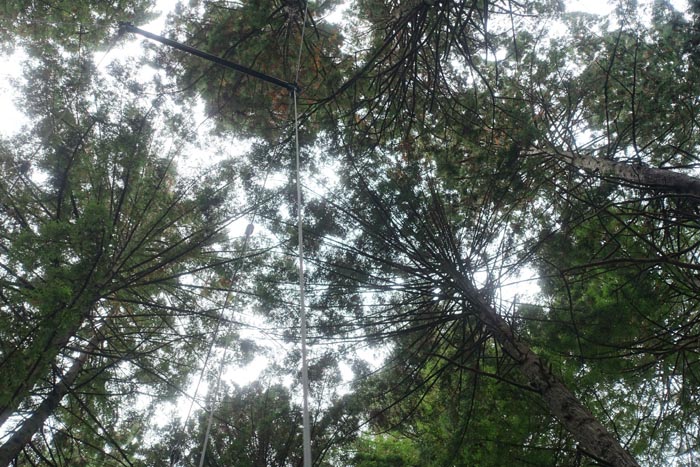
And yet, even though we were high above the ground, the tops of the trees still towered above. A redwood can grow up to 400 feet tall!


The Sky Walk begins at the launch deck and is basically a circle made of two parts: the first part, made of solid wooden bridges (that don’t move when you walk along them and are accessible by wheelchair), ends at a large platform called the accessibility turnaround. At that point you can retrace your steps; or, you can continue around the circle via hanging (wiggly) bridges. 


With a little trepidation, I followed the group across the hanging bridges, clutching the handrails as I moved forward.  After crossing the first one, I felt more confident on the rest.


The thrill of doing the Sky Walk is the view—up at the tree canopy, across to other platforms, down at the ground. Far below we could see people walking and biking along the trails through the forest. Every platform also featured informative signs—about forest wildlife, the history of the park and the redwoods, the life cycle of the trees, the ecosystem of the forest and more. We learned from our guide, the zoo director, that he climbs the trees periodically to check the security of all the cables and make sure everything is safe.


Besides the Sky Walk, the Sequoia Park Zoo also has plenty of other things to see and do. We arrived just as it was time to feed the river otters and we watched them somersault and cavort in the water as they dove after fish. At the end of our visit, after the Sky Walk, we stopped briefly to see the red panda and some of the other animals. Altogether, it was a great day at the zoo!


For information and tickets for the Sequoia Park Zoo and the Redwood Sky Walk go to the zoo website.

Monday, November 21, 2022

DELICIOUS DANISH DELICACIES: Eating Out In Copenhagen

Roast pork open-face sandwich (Smorbrod) a typical Danish specialty.

It seems that for the week of Thanksgiving, it is appropriate to talk about food, so I am thinking about the food we ate on our recent trip to Copenhagen. Eating out in Denmark was a pleasure—from simple lunches, often at a museum café, to full dinners in restaurants or at our hotel (the NH Collection.) 

Salmon (laks) for dinner at the NH Collection restaurant.

Our days started with a sumptuous breakfast in the hotel dining room, a buffet with choices ranging from eggs and bacon, to fresh baked breads, fruit, juices, yogurt and muesli, platters of meats, cheeses, salmon and herring, and, of course, classic Danish pastries. I was always amazed at how the boiled eggs were perfectly cooked.

This clipper ship is moored just outside the Christianshavn Faiergecafe.

We ate twice at a restaurant called Christianshavn Faergecafe, just a short walk from our hotel, next to a canal. We wondered about all the models and pictures of sailing vessels on the walls of the restaurant until we realized that the name means “Ferry Café” and that a historic ferry stop was outside. The café serves traditional Danish food. I ordered chicken (raised in the Danish countryside along with the fresh vegetables on my plate) and Art ordered fish. 

A small open air market offers flowers and fresh fruits and vegetables.

We returned for lunch several days later on a Sunday, ordering the famous open-faced sandwiches called “smorbrod”, bread topped with your choice of one of dozens of items on the menu. We started with herring, followed by roast pork. The idea is to eat multiple sandwiches but they were so filling that one was plenty for me.

Herring Smorbrod

We also went twice to the Wilder Café, a French restaurant not far from the hotel. On our first visit I ordered fried snails as a starter (delicious and crunchy) and the second time I had moules (steamed mussels.)

Gazpacho and fresh rolls at the Louisiana Museum of Modern Art

During our days in Copenhagen we walked around the city and visited museums. Almost every museum has a café, perfect for lunch or an afternoon coffee break. At the Louisiana Museum of Modern Art (a 40 minute train ride north of Copenhagen) we had lunch in the museum restaurant, where the floor to ceiling windows gave a view to the sea on one side and of the sculpture garden on the other. On a warmer day, we could have eaten outdoors on the patio. The menu at the Louisiana Museum is cosmopolitan. We ordered gazpacho with chorizo and cheese—a tasty combination.

Streetside cafes filled with tourists line the wharf at Nyhavn.

Most restaurants in Copenhagen have English menus, although we learned to recognize the Danish words for foods such as salmon—laks.  In a country surrounded by the sea, fish and seafood are almost always on the menu and frequently were our choice. But everything we ate was good and left us wishing we had room for more and more time to sample some of the many other restaurants in Copenhagen.


Monday, November 14, 2022

THE GRAND HERRENHAUSEN GARDENS, Hanover, Germany: From Baroque to Contemporary


Gate to Herrenhausen Palace, Hanover, Germany

On our recent visit to Europe, Art and I spent three days in Hanover, once the seat of the Saxon Kings of Germany. While Art attended a conference, held at the site of the original palace, I toured the elaborate and enormous formal gardens, considered to be one of the most important baroque gardens in Europe.

The gardens are a heritage of the Kings of Hanover. More than 300 years old, they are a striking example of grand horticultural style. 

 
Herrenhausen Gardens

The Herrenhausen Gardens are located in Herrenhausen, an urban district of Lower Saxony's capital of Hanover are made up of the Great Garden, the Berggarten, the Georgengarten and the Welfengarten. 


It was early October and many of the garden beds had already been prepared for winter, but there were still fall flowers blooming. And the hundreds of statues lining the avenues and decorating fountains remain a highlight year-round.


I started my walk in front of the palace, proceeding down the main avenue, passing pools and fountains and stopping along the way to explore the enclosed themed gardens. I could imagine fine ladies in long dresses and gentlemen in formal knee britches strolling among the plants long ago.


On my way back to the garden entrance I spotted a kestrel perched on one of the statues—perhaps scouting for something to eat. When I got too close, it flew away.


My final stop was at the Grotto—a building that was once an artificial cave with water jets and spring water, and decorated with shells, bronze and crystals. These were all been removed 150 years ago. I got a peek at myself in the mirror of one of the new windows.

In 1999, French/American artist Niki de Saint Phalle was inspired to modernize the Grotto in her own typical modern style. It was her last major work before her death in 2002. The three rooms are adorned with glass mosaics and sculptures that are intended to be an interpretation of human life.


The central room, which the artist named "Spirituality" is a spiral of luminous yellow, red and gold, interspersed with river pebbles spanning out over the ceiling and walls.


The silver mirror room with its fountain figure "Nana of Herrenhausen" represents the motto "Day and Life". 


The blue room "Night and Cosmos" shows illustrations of shooting stars leading dancing female figures into the cosmos.


I never expected to find such a contrast in styles--the very formal designs of the large garden side by side with the exuberant colors and images of the Grotto. I think the royalty of long ago, if they came back today, would be surprised too!


Monday, November 7, 2022

MODERN ART AT THE EDGE OF THE SEA: Louisiana Museum of Modern Art, Denmark

Two piece reclining figure by Henry Moore, Louisiana Museum of Modern Art, Denmark

One of our four days in Denmark was devoted to an excursion to the stunning Louisiana Museum of Modern Art, about 40 minutes north of Copenhagen by train. It is built at the edge of the sea (you can see Sweden on the other side of the water!) with art both inside and out. The museum, actually a series of interconnected structures (some underground) is built around large outdoor spaces, where a variety of sculptures are installed. The permanent collection includes paintings and lots of sculpture and a room of Giacometti figures. 

As Long as the Sun Sets, sculpture by Alex da Corta

When we visited the museum in late September, one of the featured exhibits was the work of Alex da Corta. Perched on the top of a hill overlooking the water was his large red stabile/mobile, "As Long as the Sun Sets". Big Bird sat in a swing suspended on a wire swaying in the wind. In a special room for children in the museum (the Bornehus) kids could make their own mini-versions of the sculpture and decorate them with found materials.

Humdrum Days by Swedish artist Mamma Andersson

The museum begins and ends in the gift shop. From there we proceeded to a series of underground galleries featuring paintings from the permanent collection--by Picasso, Warhol, Rauschenberg and others.

Frame, Catherine Opie, photographer
The next room was an exhibit of objects in Elizabeth Taylor's house photographed by Catherine Opie, appropriately book ended with a portrait by Andy Warhol.

Elizabeth Taylor by Andy Warhol

Half-way around the museum complex we stopped for a delicious lunch (gazpacho with bufalo mozzarella and chorizo) at the museum restaurant. Although there is outdoor seating, we opted to sit inside, out of the wind and rain. 
Through the glass we had a view of a large work of art by Jean Dubuffet.

Manoir d'Essor by Jean Dubuffet

Walking Man by Giacometti

After lunch we proceeded through a long corridor, stopping at a room filled with Giacometti sculptures—skeletal figures silhouetted against the forest.

Mr. Remember exhibit by Alex da Corta

The final exhibit, titled "Mr. Remember", filled numerous rooms, and featured work by Venezuelan/American artist Alex da Corta with all kinds of neon, brightly colored paintings and objects, plus a few geese.  He 
uses an array of different materials and references: from low-cost, mass produced objects to high-end design; from children's TV to the masters of art history; from French poetry to American pop music. The net result is both fun and a bit unsettling. Families with kids loved all the video. 

Peeking through neon lit windows to view objects inside the hut.

The lower level of the exhibit felt like a Halloween fun-house, with dark passages lit by flashing neon,  revealing hidden objects inside small cabin-like structures.

Pars pro Toto by Alicja Kwade

To get to the Louisiana Museum from Copenhagen, we took on of the regional trains from the main station to Humlebaek, then followed the signs for a half-mile walk to the museum.
For information about visiting the Louisiana Museum and links to its history, click HERE.