Congratulations to Dorothy
Hinshaw Patent on her new book The Lizard Scientists: Studying Evolution in
Action, available at Amazon and at your favorite
bookstore. I have known Dorothy for many years, sharing an
interest in writing about wildlife in books for children. In this guest post she
shares the process of creating The Lizard Scientists, taking us behind the
scenes in an author’s research.
I have a weakness for
wildlife films, and I've always loved lizards. As a child growing up in Marin
County California, I was allowed to have pets, more than just a dog, and
lizards were high on my list.
When the International
Wildlife Film Festival in my then hometown of Missoula, MT, featured a film
called "Laws of the Lizard" I could hardly wait to see it.
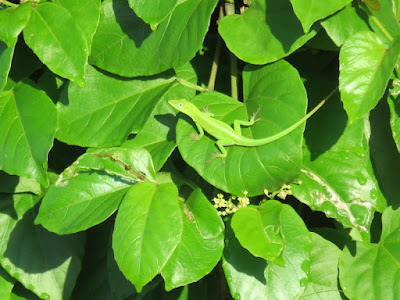 |
| This green anole in Parkland, Florida, seems to be checking me out
as I watch it. |
The film chronicled the work
of scientists studying Caribbean lizards in the anole family that beautifully
illustrates how evolution takes place. These lizards have a very short
generation time. They grow up fast, and a new generation can appear in less
than a year. That way, effects from changes in the environment can show up very
quickly, and scientists can follow them. As I watched, I knew I had to write
about these beautiful and adaptable creatures and the scientists who study
them.
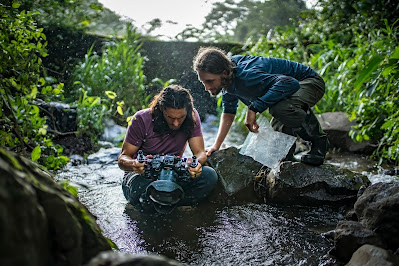 |
| Here are Neil (foreground) and Nate on the job. |
Luckily, the film makers
themselves, Neil Losin and Nate Dappen, are also Ph.D. scientists who studied
anoles in their own research. The idea of a book about this research really
appealed to them, so we were off on a joint book-creating adventure. The result
after five years of research, photography, writing, and editing, is our book, The
Lizard Scientists: Studying Evolution in Action (Harper Collins, Dec 13, 2022).
Neil and Nate connected me
with Jonathan Losos, the “guru” of anole research, and with several other anole
scientists. I learned they traveled to islands in The Bahamas to carry out
their research. I always try to join scientists in person to see how they do
their work, but Jonathan let me know right away that this wasn’t possible with
this research—their boats are small and the islands have no docks—no room for
an extra body, especially one that isn’t used to leaping like a lizard from a
dingy onto a rocky shore!
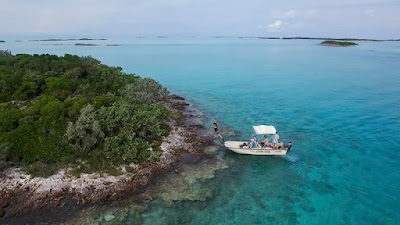 |
| After seeing this photo, I truly understood how tagging along with these
scientists just wouldn’t work! |
Jonathan suggested I contact
a postdoc in his laboratory, James Stroud. James studies anoles in Florida,
where several species from the Caribbean now live. James graciously invited me
to spend a few days with him during his research on anoles at the Fairchild
Tropical Botanic Garden in Coral Gables, just south of Miami.
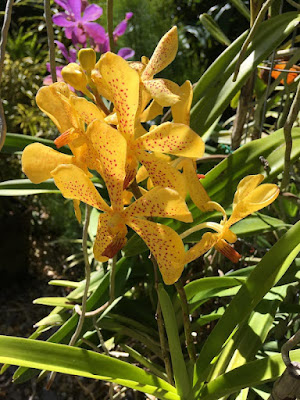 |
| Fairchild Garden is known for its beautiful orchids. Here’s one of
countless gorgeous flowers in the park. |
I found a weeklong rental,
set up a meeting time with James, and got a ride to the park. As I awaited
James, I looked around at tropical greenery and spectacular blossoms, many of
them rare and treasured orchids. I loved the abundant greenery and display of
brightly colored flowers.
Meanwhile, lizards
already began to show themselves, and the rustling of leaves along the path
indicated there were more of them than I could see.
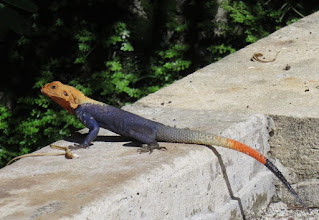 |
| A plain colored female rainbow agama lizard looks as if she’s asking,
“What are you doing here?” A male, whose bright colors give these lizards their
name, hung out nearby. |
James soon arrived,
accompanied by photographer Neil Losin, who lives in the Miami area. As
we strolled towards James’s research location, James snagged an anole lizard
from a railing.
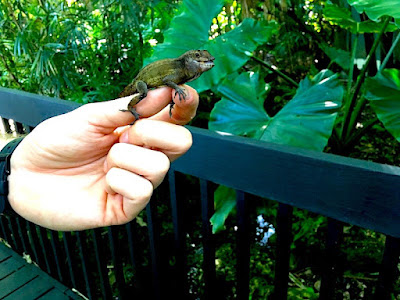 |
| James gently holds the anole while pointing out its features. |
“This is a male crested
anole. See the loose skin on his throat? This expands into what’s called a
dewlap. The dewlap of each species is a different color. You can also see the
enlargements on his toes. These are toepads, that help him stick to surfaces as
he moves around. Anoles are the only lizards with both dewlaps and toe pads.”
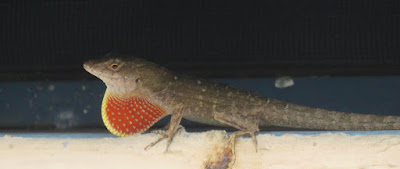 |
| Here’s a brown anole with his dewlap fully extended. |
James studies changes in the
five species of anoles on his research island over time to see if he can spot
changes in their physical features or their behavior from one generation to the
next as they adapt to one another.
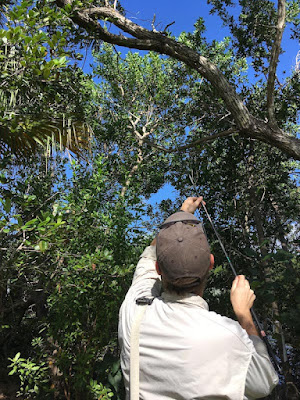 |
| James reaches up high with his modified fishing pole to snag a lizard. |
James does his best to
capture all the anoles in his study area every six months. He puts each one
into its own plastic bag and takes to his onsite laboratory.
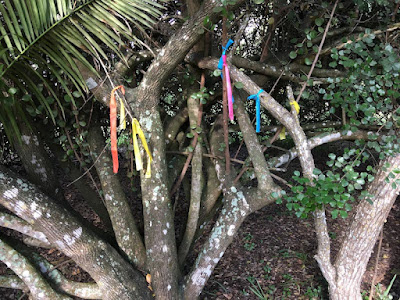 |
| When the lizards are caught, a colored ribbon is tied at the exact spot
where it was found. Then it’s returned to the same spot when released. |
The next day, I joined Neil
on a field trip to the countryside near the city of Parkland. Some other
species of anoles live there that he wanted to photograph.
 |
| Here’s Neil taking photos of a lizard high up in the bushes. |
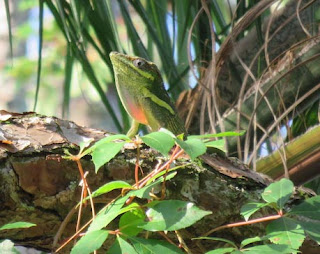 |
| This Knight Anole is called a crown-giant. It lives in and near the tops
of the trees. |
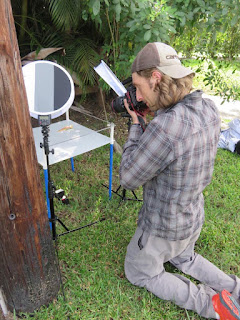 |
| Neil takes portraits of some of the lizards he finds here, using his
portable photo setup. |
On my last day, I
visited the Jose Marti MAST 6-12 Academy in North Miami, a school enrolled
in a special program called “Lizards on the Loose.” Sixth grade students in the
school explore the ‘arboretum’ that’s on their campus, where several species of
anoles make their homes.
 |
| The arboretum has great lizard habitat, with lots of bushes and small
trees. |
Several different schools are
in the program, so the researchers can learn where the different anole species
live in the greater Miami area. The students’ findings add information that
wouldn’t be known otherwise. James said, for example, that they had found
a population of one species that researchers hadn’t located before.
 |
| A girl found an anole egg and showed it to me. |
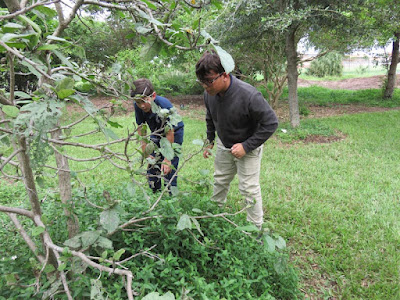 |
| A couple of boys hunt for anoles in the bushes. |
My Florida adventure provided
lots of experience and information that helped me understand the basics of
anole lizard life, but there is so much more—researchers are learning about how
these lizards adapt to life in cities, how they manage to survive hurricanes,
and more.
I wish I could have visited
with more of these scientists who use anoles to study the details of evolution
as it occurs in nature and who also love anoles for their fascinating
lizardness!
*****
With many thanks to Dorothy for sharing her research process with The Intrepid Tourist. For more about Dorothy and her books for children, go to her website www.dorothyhinshawpatent.com .


