Monday, March 29, 2021

BACK YARD WILDLIFE, Guest Post by Karen Minkowski at The Intrepid Tourist

52 Places to Go: Week 13

Hooded oriole (male)

My friend Karen Minkowski, a dedicated wildlife watcher and keen photographer, has made the most of her Covid confinement by discovering the wealth of wildlife in her Southern California back yard. I thank her for sharing her observations and wonderful photographs with The Intrepid Tourist.

2020 was the year my hiking shoes didn’t get much use…

I stopped walking in LA’s Santa Monica Mountains shortly before the March lockdown was imposed and after that didn’t leave my rented home much at all. Soon, I turned my attention to our suburban backyard, a patch of boring grass partly surrounded by tall mature trees with dense foliage and low maintenance non-native plants. Like millions of other people in their homes, I discovered that my backyard was a safe place to try to connect with a tiny bit of the natural world. And over the next year I saw more wildlife in the yard than I ever expected.

Black phoebe

The diversity of bird species that pass
through the yard is impressive. Some, like this Black Phoebe, visit almost daily. They perch out in the open to ensure a straight flight path to air-borne insects or those hiding in the lawn. Many birds forage in the trees, obscured by the foliage and moving too rapidly for me to capture a clear image, either in my mind or with the camera.

Crows

Crows are common, noisy and highly visible. Here’s one about to feed a begging
youngster.

Eastern fox Squirrel

The ubiquitous Eastern Fox Squirrels are
an introduced (non-native) species in southern California. Their ability to thrive in fragmented habitat has led to the displacement of the Western Gray squirrel, which requires mostly undisturbed wooded or forested areas and now occupies the foothills and mountainous areas. Nonetheless, Fox Squirrels are fun to watch as they dig up edibles buried who knows when from caches they’ve dug in the ground; tumble as they chase each other across the lawn; gnaw on a fallen clothespin; or stretch along a tree limb to soak up the morning sun.

Opossum

Early in the pandemic’s
first spring we spotted an opossum. As I photographed it over the next half hour, it seemed more curious than wary as it watched me. I never saw it again.

Hooded oriole (female)

In April the very vocal Hooded Orioles were likely breeding in the neighbors’ palm
trees. I would see them mostly when they were foraging. They remained in the area for several weeks before migrating south.

A Jacaranda tree dominates the backyard. 

Allen's hummingbird and jacaranda blossoms

Bee feeding on jacaranda blossom

Squirrel eating jacaranda flower

It bloomed in early spring, and by May its purple
blossoms were falling, providing food for at least three different families of animals: Allen’s hummingbird and honeybees drink the nectar, while squirrels ingest the whole flower.
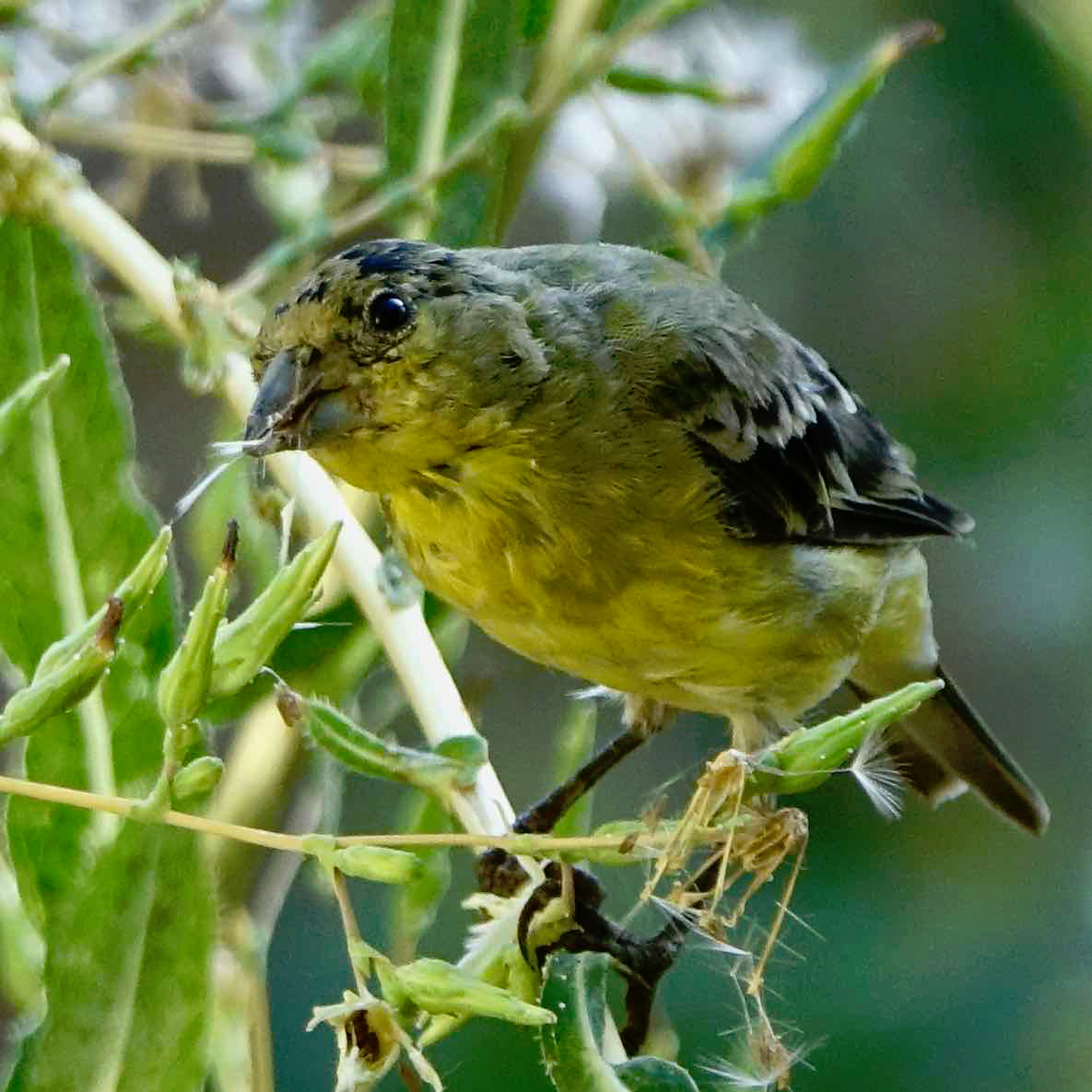
Lesser goldfinch

During late spring and summer I often stood on
a ladder to watch birds in the neglected backyard of the house next door. Filled with flowering weeds, it attracted seed-eaters like this young Lesser Goldfinch (above) and the House Finch (below). 

House finch

One summer morning a bulldozer destroyed this productive patch of
suburbia gone wild, which is now almost completely covered by a construction project to extend and enlarge the existing house.

Cooper’s hawk. This common raptor in the San Fernando Valley nests here beginning in late-March.

For a few days in July a beautiful juvenile
Cooper’s hawk hung out in the backyard.

Allen's hummingbird.

In July I hung a hummingbird feeder and have enjoyed seeing Allen’s hummingbirds many times a day since then.


One early morning in autumn the crows were cawing relentlessly. I went outside to see what was disturbing them and glimpsed the silhouette of what resembled a large house cat high up in a tree. 


Great-horned owl

But something about the shape didn’t seem quite cat-like, and soon the increasing light revealed that we had a spectacular Great-horned Owl in our backyard. The owl rested here for a good twelve hours, rarely moving from its perch and seemingly unperturbed by the incessant vocal harassment of the crows, perched as close as six feet away. Next morning the owl was gone. Months later I still check the tree, awaiting its return.

Yellow-rumped warbler

Winter arrived… Occasionally I spot “new” bird species, like this lovely Yellow-rumped warbler.
It paused just long enough for me to snap its portrait as it darted quickly in search of insects, the winter diet for many omnivorous birds.

Bushtit, another insect eater.

Cedar waxwing

As winter began to wane and vaccines arrived my feet were
itching to walk through forests and woods. 


One day I put on my hiking shoes and drove to Franklin Canyon. Below are a few images of my first 2021 forays.

Red-shouldered hawk

Ruby-crowned kinglet. (The crown is seen only when a male becomes excited during the breeding season.)


California thrasher, singing his lovely song after the rain had stopped.

I still check my backyard, but
enjoying much more my return to LA’s more natural environments.

Monday, March 22, 2021

BIRDS, BEACH AND SUN: A Spring Weekend in La Jolla, CA, by Caroline Arnold at The Intrepid Tourist

 Week 12: 52 Places to Go

Surfers and gulls at La Jolla Shores, California
Until I moved to California I never knew how to pronounce La Jolla, the name of the beach town just north of San Diego famous for swimming, surfing and beautiful ocean views, not realizing the “j” sounds like “h” and the two “l’s” are like a “y”. The correct pronunciation is “ la hoya”.
Hang gliders above La Jolla
Brown pelicans
On a warm weekend in March 2018, Art and I spent a weekend at La Jolla Shores and enjoyed walking along the sand, exploring tidepools, and observing birds and seals from the cliff top path at nearby La Jolla Cove.
Cliff top path at La Jolla Cove
On our first day, we headed north along the sand toward the Scripps pier. (The buildings of the Scripps Research Institute are on the bluff above.) Fleets of pelicans zoomed overhead, sharing the sky with hang gliders, who had launched themselves just up the coast at Torrey Pines. The tide was out and flocks of gulls and shorebirds patrolled the water’s edge looking for tidbits in the sand.
Marbled Godwits
Beyond the birds, where the waves were breaking, surfers in wetsuits waited for the next big wave.  We stayed dry. It was early spring and the water was cold--although apparently not for swimmers we saw making their way between the buoy markers.
It was a great day for photography. Broken shells, bits of seaweed, and even a jellyfish had washed up on shore, creating nature's own abstract compositions.
Nature as artist--one stone with kelp washed up on the sand
On the next day, we went in the other direction, following the path along the top of the cliff at La Jolla Cove. Hundreds of cormorants perched on the rocks below, many of them tending nests.
This Brandt's cormorant has three hungry chicks to feed
We continued around the point and walked to Children’s Beach, now taken over by seals and sea lions. 
Sea Lions enjoying the sun. (Sea lions have external ears; seals do not.)

People are no longer permitted to use Children's Beach, but a walkway along the breakwater provides a close look at the animals–who were mostly sleeping and enjoying a warm day in the sun--just as we were.As we looked down from the walkway, we could see our shadows next to the tidepools.
For my report on a previous visit to Jolla Cove, see my post for February 10, 2014.


  All text and photos copyright Caroline Arnold
www.theintrepidtourist.blogspot.com

Monday, March 15, 2021

THE GREAT WILDEBEEST MIGRATION, TANZANIA by Owen Floody at The Intrepid Tourist

52 Places to Go: Week 11
Migrating wildebeest crossing the Mara River, Tanzania, Africa
Our friend Owen Floody, who recently retired from a career of teaching and research at Bucknell University in Pennsylvania, has had the good fortune of being able to travel frequently. His trips have been divided between treks and safaris, reflecting his interests in seeing (and photographing) interesting landscapes and wildlife. Here is his report on his safari to Tanzania in late July and early August of 2017.  
Grey-crowned crane
Though I have visited Africa many times, I never had focused on, or adequately seen, the Great Migration of more than a million wildebeest, zebra and other animals that is concentrated in Tanzania’s Serengeti National Park.
Wildebeest launching themselves into the Mara River to begin their crossing
In one sense the Great Migration is difficult to miss: Rather than being confined to a fraction of the year, its clockwise circulation of animals continues nearly year-round.  Still, there are parts of the migration that are more dramatic than others and one of the most dramatic of all seems to be that at which the animals are forced to cross the Mara River, near Serengeti’s northern border.  It is at this point that the wildebeest probably are at greatest risk of death due to drowning or predation by crocodiles.  It is estimated that about 6,500 wildebeest drown in the Mara each year, injecting tons of nutrients into the river ecosystem in the process (Proceedings of the National Academy of Sciences, 114, 7647, 2017).
Wildebeest entering the Mara River
My desire to see a river crossing led me to work with Warrior Trails, my favorite Tanzanian tour operator, to plan a trip to the northern Serengeti in late July and early August, when crossing seemed likely.  Our plan committed us to five nights at a tented camp within striking distance of the Mara. It seemed most prudent to give ourselves several opportunities to catch crossings, assuming that we had guessed right on the time of year.
Wildebeest emerging from the river at the end of the crossing
So, did we see our crossing?  Yes, we did, and on the second day of our time in the north.  As crossings go, this seemed extremely benign: The river was low and slow, and the crocodiles must still have been digesting their meals from prior days as none of them made an appearance.  Nevertheless, the crossing was one of the most exciting spectacles I have seen.  And I did not feel cheated in the least by the uniform success of the animals we saw crossing: There was adequate evidence of past (and likely future) failures, and I did not really need to directly observe these.
Lion
This focus made for a relatively simple itinerary.  We flew into Kilimanjaro Airport, near Arusha, and essentially made a beeline for the northern Serengeti, a transfer that involved many hours of often dusty driving.  Upon the completion of our time there, we returned to Arusha almost as directly.  What terrible hardships we endured!  Lest you feel too sorry for us, bear in mind that we made several stops en route, at Lake Manyara National Park and in the central Serengeti on the way north, in central Serengeti again and at the Ngorongoro Crater on the return.  Also, bear in mind that Serengeti is varied and wonderful, possibly my favorite place in earth.  What a privilege to be “forced” to spend a couple of weeks there.
Female Leopard
Our early success freed us for a succession of game drives exploring different nearby parts of the Serengeti.  It exposed us to some of the variety of habitats that the park incorporates and helped to put the Great Migration in context by contrasting areas that the migrating animals were vacating versus occupying.  In addition, it provided us with the time we needed to find, view and enjoy some of the other wildlife (and scenery) for which the Serengeti is so famous.  
Grey-headed Kingfisher
In preparing for an African safari, I think it generally best to not become too invested in particular sightings: The chance element is too strong and there are too many wonderful things to be seen, any subset of which is likely to be thrilling. Altogether, our trip could not have been much more successful or pleasant.
Note: A wildebeest is a large dark antelope with a long head, a beard and mane, and a sloping back. It is also called a gnu. 
 
All text and photos copyright Caroline Arnold at The Intrepid Tourist
www.theintrepidtourist.blogspot.com

Monday, March 8, 2021

ANIMALS OF HWANGE NATIONAL PARK, ZIMBABWE by Karen Minkowski at The Intrepid Tourist


52 Places to Go: Week 10
Impala at Hwange National Park, Zimbabwe
My friend Karen Minkowski spent several months in Africa in 2018-2019 and sent me some of her wonderful photos taken on a trip to Hwange National Park in Zimbabwe. Karen and I were on the same memorable trip to East Africa in 1971 that I wrote about in my post on May 16, 2011. Karen has been back to Africa many times since then, both for work and for pleasure. I thank her for sharing her terrific photos and observations of African wildlife with The Intrepid Tourist.

I've been coming to Zimbabwe almost yearly since 2009, and at the end of 2018 I returned, hoping to spend six months volunteering for a foundation, while also seeing as much wildlife and birds as possible. Not long after arriving, an unexpected opportunity came up to spend four nights at a wonderful lodge in Hwange National Park at a special "rainy season" rate. Here are some of the highlights of this visit.
Young eland
The rainy season is birthing time for many antelope and gazelle  – here are some young eland from a herd of about 200, the largest eland group I've ever seen. Below, a bull, with his velvety coat.
Bull (male) eland
Hwange has one of the largest elephant populations in Africa, between 49 and 60 thousand.  In the dry season elephants concentrate in and around water holes. With the rains they disperse widely, as water is everywhere, and we saw elephants only once. This young teenager mock-charged our vehicle several times before rubbing his rear on a dead tree stump. As we started to drive away, he approached our vehicle, raised his trunk and trumpeted at us, convinced he was chasing us away.
Young elephant
When I go to Hwange I am accustomed to joining a walking safari. I love this way of seeing wildlife, following the tracker as he picks up the spoor of a lion or rhino. There's nothing between me and the wildlife, and ... I get to walk. On this safari we viewed everything from a vehicle, but I did appreciate that we were able to approach wildlife more closely without disturbing them and saw many more animals than when on foot.

Hwange has a great diversity of ungulates (hoofed mammals.)
Resting waterbuck
 
Sable
The sable is one of the most beautiful of all antelopes. We saw them in woodlands and grasslands.
Impala
Impala are one of Africa's most common gazelles, but I never tire of seeing these elegant, graceful animals. One afternoon we watched in amazement as a group of young impala raced round and round in large circles, seemingly for the pure joy of running and kicking their legs high in the air...they continued for quite a while.
Zebras are very affectionate!
In this season of abundant food and water, the animals seemed more relaxed than during the dry months – the need to be vigilant for predators is always present, but there's also time for fun and play and socializing. Meanwhile, the black-backed jackal (below) often hangs around on the grasslands, awaiting perhaps a lion kill? The jackal scavenges and preys opportunisticly.
Jackal
While parked late one afternoon to enjoy drinks and watch the sunset. A lion begin to roar from perhaps 1/2 a mile away; soon he came into view, about 100 meters from us, still roaring. It is the best sound in the universe, soothing and comforting when you know you are in a safe place.
Lion
We continued watching as he roared his way towards one of Africa's spectacular sunsets...
 
For more about Hwange National Park, see Karen's post The Birds of Hwange National Park from March 4, 2019.
 
All text and photos copyright Caroline Arnold at The Intrepid Tourist
www.theintrepidtourist.blogspot.com

Monday, March 1, 2021

AKUMAL, MEXICO, Place of the Sea Turtles by Caroline Arnold at The Intrepid Tourist

52 Places to Go: Week 9
Green Sea Turtle, Chelonia mydas.  On the beach at Aventuras Akumal, Mexico.

Turtles have been swimming in the oceans of the world since dinosaur times. Only during nesting season do they come on shore, and then just for a few hours in the middle of the night. We were lucky to see this yearly ritual on a vacation in the summer of 2013 in the Yucatan Peninsula, whose beaches along the Caribbean coast (known as the Maya Riviera) are historic nesting sites for sea turtles. For six days, we rented a beach house near the tiny town of Akumal, a Mayan word meaning “place of the turtles”. 

All along the beach near our house, just above the tide line, were hundreds of stakes with signs in Spanish and English saying Por Favor, No Tocar Nido Natural de Tortuga Marina–Please Don’t Touch, Natural Nest of Sea Turtle.On the first morning when we woke up, we saw the characteristic “tire tracks” showing that a sea turtle had visited during the night.


In this case, she hadn’t stayed to build a nest.  But on the next night, we got up twice to find turtles laying eggs right in front of our house and a team of volunteers monitoring the process. We were instructed to be quiet and not to use bright lights.  The monitors used small red flashlights, which allowed them to see but not disturb the turtles as they checked their health and took measurements.
 
Volunteers from Program de Proteccion y Conservacion de Tortuga Marina marking a new nest
One of the amazing things about sea turtles is that when they are ready to mate and lay eggs, they return to the beach where they were hatched.  Apparently sea turtles can recognize their natal beach by its smell.  Mating is done in the ocean.  Only the females come on shore.  When a female turtle is ready to lay eggs, she swims to shore, sniffs the sand, and, if it smells right, pulls herself up the beach with her large front flippers.  Once above the tide line, she uses her front flippers to dig a shallow pit for her body.  Then, using her back feet, she digs a hole about 18 inches deep.  Then, lowering her tail, she begins to drop her leathery, ping pong sized eggs.  As we watched, we could hear the plop, plop, plop, as each egg fell into the hole.  (In that nest, the monitors counted 130 eggs!  A female turtle may nest several times a season, laying about 100 eggs each time.)  After the eggs were laid, the turtle filled the nest with sand, returned to the sea and we went back to bed.
When we came out to see the second turtle of the night, the sky was getting light.  The turtle was already filling her hole and the sand was flying.  The whole process takes several hours and we had missed the first part.
Finally, just after sunrise, the turtle seemed satisfied that the hole was covered.  She turned and heaved her huge body out of the pit. One doesn’t think of turtles being fast on land, but once out of the hole she moved with surprising speed across the sand and in less than a minute had disappeared into the surf.
About two months after eggs are laid, the baby turtles, which are the size of a silver dollar, hatch and scramble to the sea. The nesting season for sea turtles in Mexico is May to October. We were there in the middle of July, at the end of the nesting time and the beginning of hatching time.  When we stopped at the Ecology Center in Akumal (next to the Dive Shop) to learn about turtles we were told that the eggs in one of the May nests were about to hatch that night. We could have signed up to go along with the monitors to watch. It would have been exciting to see that, but after staying up much of one night already, we passed on that opportunity.  If you visit Akumal when it isn’t nesting or hatching season, you can watch a turtle video at the Ecology center and see other informational displays.

At some beaches where sea turtles used to nest, they no longer come. Sea turtles are endangered because of predation by both humans and animals, from housing developments along the beaches where they nest, from pollution, and from global warming. We were lucky to see sea turtles close-up in nature.  You can find out more about the sea turtles along the Caribbean Coast of Quintana Roo on the Yucatan peninsula here.

Note:  Green sea turtles live and nest all over the world including on the beaches of Viet Nam. To see a short video of the egg laying process and some amazing shots of the newly hatched turtles scuttling to the sea, click here. 

 All text and photos copyright Caroline Arnold
www.theintrepidtourist.blogspot.com


Monday, February 22, 2021

HIKING THE ANDES, the HUAYHUASH TREK: Owen’s Peruvian Adventures, Part 2, Guest Post by Owen Floody at The Intrepid Tourist


Week 8: 52 Places to Go
Glacial Lakes on the Huayhuash Circuit, Peru
In 2017 our friend Owen Floody was in the midst of a series of three treks in Peru--Machu Picchu in May 2015 (Part 1 of Owen's Peruvian Adventures), Huayhuash in July 2015 (Part 2)--and Cordillera Blanca in mid-2017. Owen recently retired from a career of teaching and research at Bucknell University in Pennsylvania. He has always been an avid photographer and in his retirement has taken numerous trips that allow him to pursue his passion. He is a frequent contributor to The Intrepid Tourist. Here is the report of his Huayhuash trek and a few of his excellent photographs.
One of our camps.
The Huayhuash Range (Cordillera Huayhuash, pronounced “why wash”) is a compact cluster of mountains in the Peruvian Andes, approximately 225 miles from Lima.  It only extends over about 20 miles but contains more than 20 peaks, six of which exceed 6000 meters (19,685 ft) in height.  One of these is Siula Grande, the scene of the adventure described by Joe Simpson in the book and movie “Touching the Void.”
Our pack animals awaiting their day’s assignments.
My trek encircled much of the range, covering roughly 85 miles in 12 days.  As the area is very remote and sparsely populated (e.g., we never did pass through a village), we camped throughout, though the excellent support provided by our tour operator, Peruvian Andes Adventures (PAA), freed us of many of the normal rigors of camping: We were able to hike with just day packs, avoid the hassle of setting up or breaking down camps, and enjoy great meals all due to the efforts of the PAA staff and animals.
On the Huayhuash Track
Though the distance we covered may suggest a rigorous trek, the real challenge was in the altitude.  Most of our time was spent above 13,000 feet and most days saw us crossing at least one pass exceeding 15,000 feet, the highest of these at 16,400 feet.  One can prepare for some aspects of such a trek with an appropriately challenging exercise program, ideally including a healthy dose of actual hiking wherever you can find significant ascents and descents.  But how can most of us prepare for altitudes such as encountered here? 
Day hike from Huaraz
What I did was to arrive in Huaraz (the trek’s starting point and PAA’s base) four days early and then take full advantage of the many half-day and day hikes offered by PAA.  These covered beautiful ground and were graded in difficulty, making it possible to put together a package of pre-trek acclimatization hikes that were manageable and enjoyable, and that very much helped me to prepare for what was to come.
Soaring snow-covered peaks of the Andes and wetlands
The scenery encountered on this trek was spectacular, the most impressive of any of the seven major treks that I’ve done. Many of the types of scenes that we enjoyed are the ones that you would predict, i.e., soaring snow-covered peaks, high mountain passes, pristine valleys and meadows, wetlands.  But the Huayhuash is especially well known for its beautiful glacial lakes.  Some of these treated us to the sights and sounds of repeated avalanches. And many, if not all, presented an array of contrasting and beautiful colors. 
Avalanche
Altogether, then, this trek around the Huayhuash circuit provided an outstanding visual feast.  But this did come at the cost of considerable effort.  Why go to the trouble of trekking, especially when so many outstanding scenes can be seen from roads?  One answer is that the Huayhuash and like destinations are so remote as to be accessible in few ways other than by foot. 
 
All text and photographs copyright by Caroline Arnold at the Intrepid Tourist