Showing posts with label Part 2. Show all posts

Monday, August 15, 2022

ENGLAND, A CHILDREN’S LITERATURE TOUR, Part 2, Mary Poppins and More, Guest Post by Cathy Bonnell

Mary Poppins Sculpture, Leicester Square, London

My friend Cathy Bonnell, a retired school librarian who lives in Phoenix, Arizona, loves to travel and recently spent two weeks in England with her daughter Courtney, a journalist. Cathy has contributed previously to The Intrepid Tourist. I thank her for sharing her photos and report of her trip in July to London and the Lake District, with an eye to special connections to children’s literature.

Clifford the Big Red Dog and Cathy

After three days in The Lake District we were
back in London and a visit to Leicester Square to see these literary statues—very whimsical. 

Gene Kelly

Paddington Bear

Harry Potter

Lots of school groups out viewing them also.

Covent Garden Market

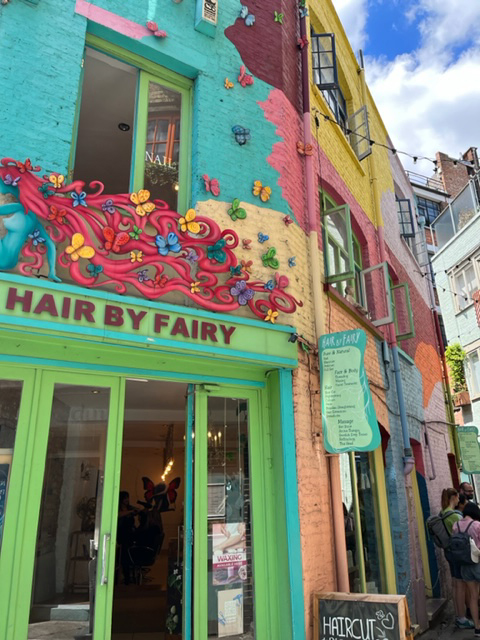
Covent Garden neighborhood

Covent Garden neighborhood

Spent some time wandering through Covent Garden before the theater to see Tina, which was excellent!

The London Eye Giant Ferris Wheel

Since we have seen the usual tourist attractions before, we didn’t take in many on this trip, except during a rest by the Thames, where we had an excellent view of the giant Ferris wheel, the London Eye, built for the Millenium.

Historical marker on house where Monty Python film maker lived 1976-1987.

Unfortunately my second week in London was spent in quarantine when Covid struck.  Still, it was a memorable trip and time with my daughter!

Part 1 of Cathy's trip to England posted on August 8, 2022.

Monday, February 22, 2021

HIKING THE ANDES, the HUAYHUASH TREK: Owen’s Peruvian Adventures, Part 2, Guest Post by Owen Floody at The Intrepid Tourist


Week 8: 52 Places to Go
Glacial Lakes on the Huayhuash Circuit, Peru
In 2017 our friend Owen Floody was in the midst of a series of three treks in Peru--Machu Picchu in May 2015 (Part 1 of Owen's Peruvian Adventures), Huayhuash in July 2015 (Part 2)--and Cordillera Blanca in mid-2017. Owen recently retired from a career of teaching and research at Bucknell University in Pennsylvania. He has always been an avid photographer and in his retirement has taken numerous trips that allow him to pursue his passion. He is a frequent contributor to The Intrepid Tourist. Here is the report of his Huayhuash trek and a few of his excellent photographs.
One of our camps.
The Huayhuash Range (Cordillera Huayhuash, pronounced “why wash”) is a compact cluster of mountains in the Peruvian Andes, approximately 225 miles from Lima.  It only extends over about 20 miles but contains more than 20 peaks, six of which exceed 6000 meters (19,685 ft) in height.  One of these is Siula Grande, the scene of the adventure described by Joe Simpson in the book and movie “Touching the Void.”
Our pack animals awaiting their day’s assignments.
My trek encircled much of the range, covering roughly 85 miles in 12 days.  As the area is very remote and sparsely populated (e.g., we never did pass through a village), we camped throughout, though the excellent support provided by our tour operator, Peruvian Andes Adventures (PAA), freed us of many of the normal rigors of camping: We were able to hike with just day packs, avoid the hassle of setting up or breaking down camps, and enjoy great meals all due to the efforts of the PAA staff and animals.
On the Huayhuash Track
Though the distance we covered may suggest a rigorous trek, the real challenge was in the altitude.  Most of our time was spent above 13,000 feet and most days saw us crossing at least one pass exceeding 15,000 feet, the highest of these at 16,400 feet.  One can prepare for some aspects of such a trek with an appropriately challenging exercise program, ideally including a healthy dose of actual hiking wherever you can find significant ascents and descents.  But how can most of us prepare for altitudes such as encountered here? 
Day hike from Huaraz
What I did was to arrive in Huaraz (the trek’s starting point and PAA’s base) four days early and then take full advantage of the many half-day and day hikes offered by PAA.  These covered beautiful ground and were graded in difficulty, making it possible to put together a package of pre-trek acclimatization hikes that were manageable and enjoyable, and that very much helped me to prepare for what was to come.
Soaring snow-covered peaks of the Andes and wetlands
The scenery encountered on this trek was spectacular, the most impressive of any of the seven major treks that I’ve done. Many of the types of scenes that we enjoyed are the ones that you would predict, i.e., soaring snow-covered peaks, high mountain passes, pristine valleys and meadows, wetlands.  But the Huayhuash is especially well known for its beautiful glacial lakes.  Some of these treated us to the sights and sounds of repeated avalanches. And many, if not all, presented an array of contrasting and beautiful colors. 
Avalanche
Altogether, then, this trek around the Huayhuash circuit provided an outstanding visual feast.  But this did come at the cost of considerable effort.  Why go to the trouble of trekking, especially when so many outstanding scenes can be seen from roads?  One answer is that the Huayhuash and like destinations are so remote as to be accessible in few ways other than by foot. 
 
All text and photographs copyright by Caroline Arnold at the Intrepid Tourist


Monday, January 23, 2017

MADAGASCAR: Leaping Lemurs, Guest Post by Owen Floody, Part 2


A pair of Coquerel’s sifakas, Madagascar

In June 2016, our friend Owen Floody planned and led a trip to Madagascar.  Owen recently retired from a career of teaching and research at Bucknell University in Pennsylvania. He has always been an avid photographer and in his retirement has taken several trips that allow him to pursue his passion. He has been a frequent contributor to The Intrepid Tourist. Here is part 2 of a short reflection on his Madagascar trip and a few of his excellent photographs. 

The second half of my Madagascar trip involved an extended drive down the central spine of the country, from Tana in the central highlands to Tulear, on the southwest coast.  As this was a long trip along one of Madagascar’s main roads, it gave us the chance to see a lot of the country, including many towns, villages and local markets.  Some in my group relished the opportunities this created for people-watching, other cultural experiences, and shopping.
Isalo National Park
I was primarily interested in exploring a series of national parks promising dramatic contrasts in their environments and wildlife.  Chief on my list were Ranomafana, Andringitra and Isalo National Parks.  The first two comprise one third of the Rainforests of the Atsinanana, a World Heritage Site.  In its emphasis on rainforests, this designation applies perfectly to Ranomafana but strikes me as slightly misleading in the case of Andringitra.  Ranomafana is one of Madagascar’s premier rainforests.  Likewise, it is one of the country’s prime sites for lemur-focused research and tourism.  In contrast, Andringitra’s claim to fame is based more on its mountainous landscape, unusual vegetation and opportunities for hiking.  And quite distinct from both of these, Isalo National Park features expanses of dry grassland, rare endemic plants, and especially striking sandstone formations and canyons.
Ranomafana National Park
In Ranomafana, the forest itself was the star attraction.  We did see lemurs, although they were difficult to spot, let alone view clearly, in the dense vegetation.  On the other hand, the absence of large predators makes it possible to search for wildlife at night as well as during the day.  Indeed, we were able to do this in most of the parks and reserves we visited, and these walks were very productive, since a significant number of lemurs that are nocturnal.
Mouse lemur
In Andringitra, we did two demanding hikes, one up onto a high plateau known for its lunar landscape, the other into one of the bands of rainforest extending into this park.  The first of these was especially rewarding despite the mist that obscured much of the landscape on the day of our hike.
“Dancing” Verreaux’s sifaka
Finally, we had a great time at Isalo.  One highlight was a hike up a canyon leading to the Cascade des Nymphes.  We had rewarding encounters here with lemurs, both on the hike and immediately afterwards, as we attracted quite an audience to our picnic lunch.  
Ring-tailed lemur
The other Isalo highlight was the viewing of sunset at La Fenètre (the window), a natural opening in a rock formation through which the setting sun can be viewed.  I strongly think, however, that the far better sunset views here are those looking away from the sun and at the glowing slabs of fantastically-shaped sandstone basking in the sun’s dying rays.
Sunset from La Fenetre
If you haven’t ever considered a trip to Madagascar, you should give it some thought.  The remaining natural areas and wildlife need the support of foreign tourists.  Furthermore, some of these areas are as impressive as I’ve seen anywhere and there simply cannot be any animal anywhere that is as endearing as a lemur.

Note: I devised the trip itinerary, which was ably implemented by Cortez, USA, a California-based tour-operator that specializes in Madagascar.  In the past, Madagascar has been criticized for the quality of its tourism infrastructure.  With respect to the roads, this was and still is justified.  In all other respects (accommodations, food, guides), however, I thought that we were extremely well treated on this trip and so would urge others, especially those with an interest in unusual wildlife, to give Madagascar a try.

Monday, January 9, 2017

HIKING THE ANDES, the HUAYHUASH TREK: Owen’s Peruvian Adventures, Part 2, Guest Post by Owen Floody


Glacial Lakes on the Huayhuash Circuit, Peru
Our friend Owen Floody is in the midst of a series of three treks in Peru, with two down--Machu Picchu in May 2015 (see his post for 1/2/17), Huayhuash in July 2015--and one coming up in mid-2017, Cordillera Blanca. Owen recently retired from a career of teaching and research at Bucknell University in Pennsylvania. He has always been an avid photographer and in his retirement has taken numerous trips that allow him to pursue his passion. He is a frequent contributor to The Intrepid Tourist. Here is the report of his Huayhuash trek and a few of his excellent photographs.
One of our camps.
The Huayhuash Range (Cordillera Huayhuash, pronounced “why wash”) is a compact cluster of mountains in the Peruvian Andes, approximately 225 miles from Lima.  It only extends over about 20 miles but contains more than 20 peaks, six of which exceed 6000 meters (19,685 ft) in height.  One of these is Siula Grande, the scene of the adventure described by Joe Simpson in the book and movie “Touching the Void.”
Our pack animals awaiting their day’s assignments.
My trek encircled much of the range, covering roughly 85 miles in 12 days.  As the area is very remote and sparsely populated (e.g., we never did pass through a village), we camped throughout, though the excellent support provided by our tour operator, Peruvian Andes Adventures (PAA), freed us of many of the normal rigors of camping: We were able to hike with just day packs, avoid the hassle of setting up or breaking down camps, and enjoy great meals all due to the efforts of the PAA staff and animals.
On the Huayhuash Track
Though the distance we covered may suggest a rigorous trek, the real challenge was in the altitude.  Most of our time was spent above 13,000 feet and most days saw us crossing at least one pass exceeding 15,000 feet, the highest of these at 16,400 feet.  One can prepare for some aspects of such a trek with an appropriately challenging exercise program, ideally including a healthy dose of actual hiking wherever you can find significant ascents and descents.  But how can most of us prepare for altitudes such as encountered here? 
Day hike from Huaraz
What I did was to arrive in Huaraz (the trek’s starting point and PAA’s base) four days early and then take full advantage of the many half-day and day hikes offered by PAA.  These covered beautiful ground and were graded in difficulty, making it possible to put together a package of pre-trek acclimatization hikes that were manageable and enjoyable, and that very much helped me to prepare for what was to come.
Soaring snow-covered peaks of the Andes and wetlands
The scenery encountered on this trek was spectacular, the most impressive of any of the seven major treks that I’ve done. Many of the types of scenes that we enjoyed are the ones that you would predict, i.e., soaring snow-covered peaks, high mountain passes, pristine valleys and meadows, wetlands.  But the Huayhuash is especially well known for its beautiful glacial lakes.  Some of these treated us to the sights and sounds of repeated avalanches. And many, if not all, presented an array of contrasting and beautiful colors. 
Avalanche
Altogether, then, this trek around the Huayhuash circuit provided an outstanding visual feast.  But this did come at the cost of considerable effort.  Why go to the trouble of trekking, especially when so many outstanding scenes can be seen from roads?  One answer is that the Huayhuash and like destinations are so remote as to be accessible in few ways other than by foot.