Showing posts with label cormorants. Show all posts

Monday, April 17, 2023

CORMORANTS IN LA JOLLA, CA: The Perfect Place to See These Seabirds Up Close

Brandt's Cormorant, La Jolla, CA

If you are in San Diego and want a taste of nature, the half-mile cliff walk in La Jolla is the perfect place to go.  There you can view hundreds of birds roosting on the rocks and flying about above the cliffs, as well as playful sea lions frolicking in the water and basking on the rocks along the shore.  On a nice day (and these are what you expect when you go to Southern California!) you can see kayakers and paddle boarders enjoying the ocean as well.


Our most recent trip to La Jolla was in the spring of 2018 and as we walked along the cliff we looked down on hundreds of cormorant nests, busy with parents looking after their chicks. My brother Tom, who lives in San Diego, recently visited the cormorant colony again and got this terrific video of feeding time at the nest.

Defending the nest.

Cormorants are seabirds with mostly black feathers, long necks, and short stiff tails. They dive for fish in the ocean, using their webbed feet to speed through the water. Brandt’s cormorant is found only in North America, with a range extending from Alaska to Mexico. Breeding birds have a blue skin patch on their chins called the gular pouch.

Non-nesting cormorants and a few pelicans.

For more information about getting to the trail and where to park, go to this post at Natural Born Hikers. http://www.naturalbornhikers.com/trails/lajolla.html

A pair of cormorants waiting for their eggs to hatch. Both parents will care for the young.


Monday, March 22, 2021

BIRDS, BEACH AND SUN: A Spring Weekend in La Jolla, CA, by Caroline Arnold at The Intrepid Tourist

 Week 12: 52 Places to Go

Surfers and gulls at La Jolla Shores, California
Until I moved to California I never knew how to pronounce La Jolla, the name of the beach town just north of San Diego famous for swimming, surfing and beautiful ocean views, not realizing the “j” sounds like “h” and the two “l’s” are like a “y”. The correct pronunciation is “ la hoya”.
Hang gliders above La Jolla
Brown pelicans
On a warm weekend in March 2018, Art and I spent a weekend at La Jolla Shores and enjoyed walking along the sand, exploring tidepools, and observing birds and seals from the cliff top path at nearby La Jolla Cove.
Cliff top path at La Jolla Cove
On our first day, we headed north along the sand toward the Scripps pier. (The buildings of the Scripps Research Institute are on the bluff above.) Fleets of pelicans zoomed overhead, sharing the sky with hang gliders, who had launched themselves just up the coast at Torrey Pines. The tide was out and flocks of gulls and shorebirds patrolled the water’s edge looking for tidbits in the sand.
Marbled Godwits
Beyond the birds, where the waves were breaking, surfers in wetsuits waited for the next big wave.  We stayed dry. It was early spring and the water was cold--although apparently not for swimmers we saw making their way between the buoy markers.
It was a great day for photography. Broken shells, bits of seaweed, and even a jellyfish had washed up on shore, creating nature's own abstract compositions.
Nature as artist--one stone with kelp washed up on the sand
On the next day, we went in the other direction, following the path along the top of the cliff at La Jolla Cove. Hundreds of cormorants perched on the rocks below, many of them tending nests.
This Brandt's cormorant has three hungry chicks to feed
We continued around the point and walked to Children’s Beach, now taken over by seals and sea lions. 
Sea Lions enjoying the sun. (Sea lions have external ears; seals do not.)

People are no longer permitted to use Children's Beach, but a walkway along the breakwater provides a close look at the animals–who were mostly sleeping and enjoying a warm day in the sun--just as we were.As we looked down from the walkway, we could see our shadows next to the tidepools.
For my report on a previous visit to Jolla Cove, see my post for February 10, 2014.


  All text and photos copyright Caroline Arnold
www.theintrepidtourist.blogspot.com

Monday, April 9, 2018

BIRDS, BEACH AND SUN: A Spring Weekend in La Jolla, CA

Surfers and gulls at La Jolla Shores, California
Until I moved to California I never knew how to pronounce La Jolla, the beach town just north of San Diego famous for swimming, surfing and beautiful ocean views, not realizing the “j” sounds like “h” and the two “l’s” are like a “y”. The correct pronunciation is “ la hoya”.
Hang gliders above La Jolla
Brown pelicans
Recently, on a warm weekend in March we spent a weekend at La Jolla Shores and enjoyed walking along the sand, exploring tidepools, and observing birds and seals from the cliff top path at nearby La Jolla Cove.
Cliff top path at La Jolla Cove
On our first day we headed north along the sand toward the Scripps pier. (The buildings of the Scripps Research Institute are on the bluff above.) Fleets of pelicans zoomed overhead, sharing the sky with hang gliders, who had launched themselves just up the coast at Torrey Pines. The tide was out and flocks of gulls and shorebirds patrolled the water’s edge looking for tidbits in the sand.
Marbled Godwits
Beyond the birds, where the waves were breaking, surfers in wetsuits waited for the next big wave.  We stayed dry. It was early spring and the water was cold--although apparently not for swimmers we saw making their way between the buoy markers.
It was a great day for photography. Broken shells, bits of seaweed, and even a jellyfish had washed up on shore, creating nature's own abstract compositions.
Nature as artist--one stone with kelp washed up on the sand
On the next day we went in the other direction, following the path along the top of the cliff at La Jolla Cove. Hundreds of cormorants perched on the rocks below, many of them tending nests.
This Brandt's cormorant has three hungry chicks to feed
We continued around the point and walked to Children’s Beach, now taken over by seals and sea lions. 
Sea Lions enjoying the sun. (Sea lions have external ears; seals do not.)
People are no longer permitted to use the beach but a walkway along the breakwater provides a close look at the animals–who were mostly sleeping and enjoying a warm day in the sun--just as we were.

For my report on a previous visit to Jolla Cove, see my post for February 10, 2014.
Our shadows from the walkway above the tidepools on the other side of Children's Beach

Monday, April 3, 2017

Birdwatching at NATURAL BRIDGES STATE BEACH, Santa Cruz, CA


Snowy egrets and dunlins, Natural Bridges State Beach, Santa Cruz, CA
The city of Santa Cruz sits at the north end of the wide half circle of Monterey Bay on the California coast. At Natural Bridges State Beach, named for the large arched rock just offshore, one can get down on the beach for a close-look at wildlife and, on a warm day, splash in the waves.
Natural Bridge rock formation, Santa Cruz, CA
A week ago I was visiting a friend who lives near the park and we took a morning walk along the beach. Overhead, gulls and ravens circled in the air and pelicans glided by like fleets of  tiny fighter jets. On shore, groups of tiny dunlins skittered in unison along the water’s edge searching for tidbits in the wet sand.
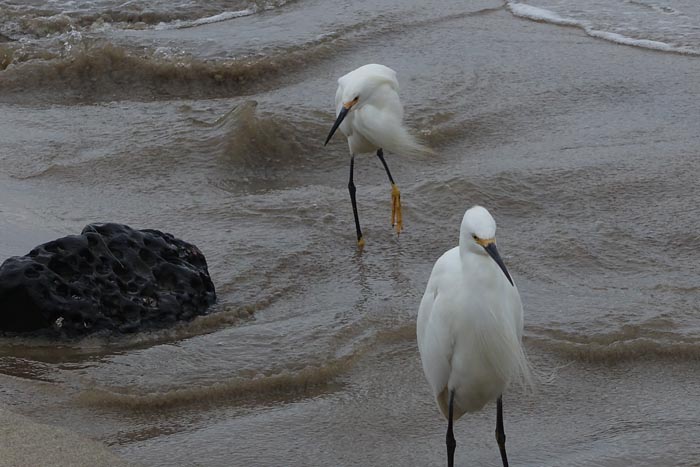
Snowy egrets
The tide was going out and a group of egrets was foraging in the shallow water at the edge of the waves and along the creek that empties into the bay. We were able to get surprisingly close to the birds as they stalked their prey.
View of the beach and outlet of Moore Creek
We then climbed up from the beach for a walk along the bike path that runs along the top of the cliff next to the water. Our goal was an overlook onto a rock shelf that is a rookery of Brandt’s cormorants.
Brandt's cormorants
Pairs of birds were building nests and we watched as they jostled one another and males extended their necks in courtship displays.It was, in fact, the first day of spring. Soon the birds will be laying eggs and another cycle of life will begin.
A variety of wildlife can be seen in the different tidal zones
In addition to bird watching at Natural Bridges State Beach, one can explore the tidepools at low tide, and, in winter, see monarch butterflies in the Monarch Butterfly Natural Preserve within the park. One can also picnic and hike along the trails through the park.

For information about visiting Natural Bridges State Beach and about the various activities available, click HERE.

Monday, February 10, 2014

SEA BIRDS AND SEA LIONS: Walking the Coast Trail, La Jolla, CA

Cliff walk, La Jolla, California
If you are in San Diego and want a taste of nature, the half-mile cliff walk in La Jolla is the perfect place to go.  There you can view hundreds of birds roosting on the rocks and flying about above the cliffs, as well as playful sea lions frolicking in the water and basking on the rocks along the shore.  On a nice day (and these are what you expect when you go to Southern California!) you can see kayakers and paddle boarders enjoying the ocean as well.

Cormorants perched in tree along the path
I recently had the chance to take this short hike on a day trip to San Diego. From the parking area we descended stairs to the dirt path that winds its way along the top of the cliffs.  From the path there is a spectacular view across the bay toward downtown La Jolla and as you round the bend toward the viewing platform at the end of the trail you can look back and see the sea caves along the bottom of the cliffs.

Gulls and pelicans
A group of cormorants perched in a tree greeted us as we approached, and then as we got closer we could see and smell hundreds of the black birds clinging to the cliffs below.  Next to them was a group of pelicans and some gulls, who seemed to preferred the flatter rocks for perching.  As we watched the sea lions diving in the water we saw flashes of orange, which I assume were garibaldis, the large colorful fish common in southern California waters, which were swimming just below the surface. No doubt, the reason so many birds and sea lions live here is the abundance of available food.
California sea lions
It was a glorious day and we just enjoyed being in the outdoors, listening to the calls of the birds and barking of the sea lions as we soaked up the fall sunshine.  I am always surprised that even so close to a large urban area, the natural world just goes about its business as usual and gives us the opportunity to marvel at the wonders of nature.
Cormorants on the cliff

For more information about getting to the trail and where to park, go to this post at Natural Born Hikers. http://www.naturalbornhikers.com/trails/lajolla.html

Monday, July 25, 2011

Japan Alps, Nagoya, Gifu: Part III

Gifu.  Statue of Cormorant fisherman wearing traditional clothing.
Gifu and Nagoya (Trip to Japan, September 2008)
After our visit to the Japan Alps, we took a train back to Gifu from Takayama and arrived in Gifu by 11:30. We bought food for lunch at a market in Gifu station and pastries at a French bakery for my breakfast the next morning, and got a taxi to the Miyako Hotel, a 15 minute ride from the center of town. Our room the 10th floor overlooked the river and was the perfect spot to watch herons, kites and the cormorant boats at night.  
View of river and Mount Kinka from our room at the Miyako Hotel
Tuesday, September 9
Got up at 5:00 for a taxi to Gifu station for a 5:58 train to Nagoya.  I changed there at Kanayama station for Kosoji Station.  All went like clockwork; the trains were not crowded and left precisely on schedule.  While Art attended his conference, I spent the day doing an author visit at the Nagoya International School.  After school, my hosts took me to the 100 yen store (like a dollar store) where I picked up a basket full of toys and souvenirs.

Sidebar on Japanese toilets: Japanese toilets never cease to amaze.  In public places, such as the airport, one has a choice of traditional–a hole in the floor over which you squat–or western style. The western style seat in the airport was 3-way: a regular seat for adults, a smaller flip-down seat for a child, and a baby seat, on a hook on the wall, which could be inserted for a very small child.  Many toilet seats, including the ones at the Best Western, come with a console that allows you to heat the seat and/or the water.  Another button triggers a spray of water on your bottom or converts the toilet to a bidet.  My hosts had a further addition to their toilet.  A small basin mounted on top of the toilet tank has a spout that gushes water when you flush the toilet.  You can use the water to rinse your hands.  The water runs until the tank is refilled.  Apparently another teacher at the school had a toilet with an electric eye that lifts the lid when you open the bathroom door! 
Coffee in a Can 
Typical vending machine.
Wednesday, September 10
Got up early for another day's school visit and had bacon, eggs, fruit, yogurt and coffee from a can.  You can buy canned coffee (and almost any other kind of drink) in vending machines, which are ubiquitous. You pour the coffee into your cup and heat it in the microwave.  It is surprisingly good!

Fish Cookies, an Insect Museum, and Tame Squirrels 
The Nawa Insect Museum displays insects collected from all over the world.
Thursday, September 11
   I spent the morning walking with a friend along the river by the hotel and shopping and sightseeing on the other side.  We bought some fish shaped cookies (fish are a theme throughout Gifu) and peeked in at a temple with a giant golden lacquer Buddha.  At the park, we went to the insect museum.  After lunch I returned to the park and rode the “ropeway” (a cable car) to the top of Mount Kinka to see the view and tour the Shogun era castle, now a museum.  Before leaving, I stopped at the featured squirrel village where I was given a glove and food so I could feed the squirrels, who scampered about in their enclosed "village".  Apparently Japanese people think that squirrels are exotic and feeding them is a treat!  Perhaps they don’t have squirrels being a nuisance in their yards and stealing food from their bird feeders. 

Traditional Cormorant Fishing
Cormorant fishing.  (Itai) The fish are attracted to the surface of the water by a fire suspended from a basket at the front of the fisherman’s boat.
In the evening, Art’s host at the conference  took us on a boat to see the traditional cormorant fishing.  As in the children’s book Ping (one of my favorites as a child), the cormorants are trained to catch fish for their master.  A ring around the cormorant’s neck prevents it from swallowing the fish it catches. One at a time, the birds are hauled in to disgorge their fish into a basket.


Bakery in Gifu.  Colorful sweet cakes are filled with bean paste.
Friday, September 12
In the morning, Art and I toured the cormorant fishermen’s village and then went shopping for souvenirs at a bakery across the river.  Then I left for the airport to return to Los Angeles and Art left for Kyoto and Fukuoka, where he attended another conference.