Showing posts with label SANTA CRUZ. Show all posts

Monday, March 11, 2019

THE COLCHAGUA MUSEUM, Santa Cruz, Chile: From Shark Teeth and Pre-Columbian Pottery to Old Maps and Automobiles

Pre-Columbian sculpture from the Chancay Culture on the central coast of Peru at the Colchagua Museum, Santa Cruz, Chile
I never expected to find the giant jaws of megalodon, model ships, or the piano played Bernard O’Higgins, the founder of Chile, at a museum in a part of Chile otherwise known for its agriculture. It turns out that the Colchagua Museum, in Santa Cruz, Chile, is the largest private museum in Latin America and is packed with thousands of objects ranging from cowboy gear and weapons, to religious artifacts and pre-Columbian pottery and more. Founded by controversial tycoon Carlos Cardoen, the museum includes something for everybody.
The Colchagua Museum is located in the small city of Santa Cruz in the Colchagua valley, 110 miles from Santiago.
We visited as a day trip from Rancagua (about an hour and a half away), where we were visiting our son-in-law’s family. As we drove to Santa Cruz from there we passed orchards, vineyards, and ranches that are the heart of  this verdant valley and one of Chile’s several wine growing regions.
In the fossil and paleontology room
After purchasing our tickets at the museum entrance, we watched a short video and then set off to view the exhibits, listening to our English language wands for key explanations in each room. As you make your way from the entrance you pass through rooms containing fossils and exhibits of the early history of world, and then move forward in time through archeology of Chile, Peru and Columbia, then to the period of the conquest by Spain, to national independence, influence of the church, and up through life in the nineteenth and twentieth century. The last rooms on the main level feature old carriages, cars and farm machinery. A recently added exhibit, The Great Rescue, honors the men who were trapped and rescued from a copper mine in northern Chile 2010.
Portrait of Bernard O'Higgins, Chile's liberator, and his piano, which he imported from Europe
Every room was filled with so many fascinating objects that it is impossible to describe them all. Here are some of my favorites.
Fossil teeth in the jaw of the giant extinct shark, Megalodon. When a tooth fell out, a new one was always ready to rotate up and replace it. Megalodon could grow more than 50 feet long!
A small reptile (gekko) trapped in amber; from the Dinosaur Age
Ceramic vessel decorated with a bean design. (From the Nazca culture in Peru.) Beans (frijoles) have been a staple in South America for centuries.
Stone figure from the Pucara Culture, which developed in Peru in the area near Lake Titicaca.
Knotted strings called quipu, from the Inca culture. The knots were part of a counting system used in trade. The cords had different colors for each product and the spacing of the knots indicated the quantity sold.
Silver cup for tea (mate)and jewelry from the Mapuche culture of southern Chile.
Carvings and artifacts from Easter Island (Isla de Pascua). Easter Island, which gets its name from the day of its "discovery" by a Dutch sea captain in 1722, is part of Chile.
Our reflection, in the room at the museum displaying farm implements
We should have allowed more time to spend in the museum and to visit the associated Automobile Museum, located in a nearby vineyard, and the Chilean Craft Museum, located in a restored house in the nearby town of Lolol, featuring traditional crafts of Chile (stone carving, basket making, wood crafts, pottery, metals, naval and textiles.) As it was, after visiting the Colchagua Museum we took a walk through the center of Santa Cruz with its beautiful colonial era architecture around the main square and visited a few of the local shops before having ice cream at a favorite local restaurant. Someday we’ll have to go back to Santa Cruz to see the other museums and tour some of the vineyards.
For information about and directions to the Colchagua Museum, click HERE.
The Colchagua Valley

..

Monday, September 11, 2017

SANTA CRUZ, California: A Walk Along the Cliff

View from the cliff, Santa Cruz, California
Two weeks ago I drove from Oakland to Santa Cruz, on the California coast, for lunch and a visit with a friend who had recently moved there. It was a beautiful day–clear skies and a warm breeze off the ocean. We enjoyed a casual and delicious lunch at Kelly’s, a combination bakery and café on Swift Street, eating outdoors under umbrellas. Then, to work off our calories, we took a walk on the path that follows the cliff top at the University of Santa Cruz Marine Science campus.
The level dirt path, open to the public, goes around the edge of the campus and through the open areas around the various buildings.
Wooden benches are conveniently positioned along the way where one can rest and enjoy the view. Each bench bears a memorial plaque honoring the person it is named after and with a short message.
As the path turns inland toward the classroom buildings, the skeleton of a grey whale is mounted at the corner, with a sign describing the migrating and feeding habits of these huge cetaceans that pass by each winter on their way to and from their breeding grounds in Baja California and back to their summer home in Alaska. I'm told that in the winter you can see the whales in the ocean as you walk along the path. 
It is only when one stands next to the giant bones that the extreme size of these mammals is appreciated.
As we walked along the path gulls swooped overhead and platoons of pelicans sped by, searching for fish in the water below. To the south we could see people playing in the water at Natural Bridges State Park. The tide was going out, leaving small pools in the rock shelf, filled with anemones and other sea life. 
After our walk it was time for the two hour drive back to Oakland. We had certainly enjoyed a full and refreshing day.
As Henry David Thoreau once wrote:
We can never have enough of nature. We must be refreshed
by the sight of inexhaustible vigor, vast and titanic features,
the sea-coast with its wrecks, the wilderness with its living
and its decaying trees, the thunder-cloud, and the rain.


Note: We did not have time to visit  the Seymour Marine Center located on the large campus. It features a fascinating aquarium, shark pool, and touch pool filled with starfish, sea urchins, hermit crabs, and sea anemones. The Exhibit Hall educates visitors about oceanic research as well as topics such as elephant seal behavior and the sea otters' ecosystem.
We’ll have to put the Marine Center on our list of things to do the next time we go to Santa Cruz. 

Monday, April 3, 2017

Birdwatching at NATURAL BRIDGES STATE BEACH, Santa Cruz, CA


Snowy egrets and dunlins, Natural Bridges State Beach, Santa Cruz, CA
The city of Santa Cruz sits at the north end of the wide half circle of Monterey Bay on the California coast. At Natural Bridges State Beach, named for the large arched rock just offshore, one can get down on the beach for a close-look at wildlife and, on a warm day, splash in the waves.
Natural Bridge rock formation, Santa Cruz, CA
A week ago I was visiting a friend who lives near the park and we took a morning walk along the beach. Overhead, gulls and ravens circled in the air and pelicans glided by like fleets of  tiny fighter jets. On shore, groups of tiny dunlins skittered in unison along the water’s edge searching for tidbits in the wet sand.
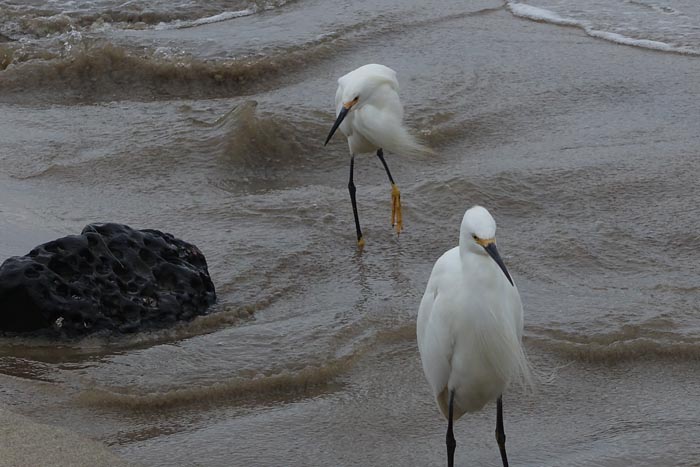
Snowy egrets
The tide was going out and a group of egrets was foraging in the shallow water at the edge of the waves and along the creek that empties into the bay. We were able to get surprisingly close to the birds as they stalked their prey.
View of the beach and outlet of Moore Creek
We then climbed up from the beach for a walk along the bike path that runs along the top of the cliff next to the water. Our goal was an overlook onto a rock shelf that is a rookery of Brandt’s cormorants.
Brandt's cormorants
Pairs of birds were building nests and we watched as they jostled one another and males extended their necks in courtship displays.It was, in fact, the first day of spring. Soon the birds will be laying eggs and another cycle of life will begin.
A variety of wildlife can be seen in the different tidal zones
In addition to bird watching at Natural Bridges State Beach, one can explore the tidepools at low tide, and, in winter, see monarch butterflies in the Monarch Butterfly Natural Preserve within the park. One can also picnic and hike along the trails through the park.

For information about visiting Natural Bridges State Beach and about the various activities available, click HERE.

Sunday, April 26, 2015

SANTA CRUZ, CA: From Redwoods to the Seashore

View from cliff walk, Wilder Ranch State Park, Santa Cruz, CA
Perched at the north end of Monterey Bay on the California coast, the town of Santa Cruz has something for everyone–a beautiful shoreline, forested hillsides with tall redwoods, great food, a University of California campus with all its accompanying activities, a lively arts and crafts scene, a boardwalk, and more. In late March, a visit to a friend in Santa Cruz provided us with the opportunity to relax and enjoy some of the area’s striking natural beauty.
Gull
A wide variety of hiking trails are available around Santa Cruz. One of our walks was at the Wilder Ranch State Park just north of town along Highway 1. The path leads from the parking area across open fields to a trail along the top of cliffs overlooking the ocean. It was a beautiful day, slightly breezy but not cold. As we walked, gulls soared overhead and a few spring wildflowers bloomed along the path.
Harbor seals
As we looked down to the water’s edge, we saw a clump of seals resting on a rock just above the waves. They too seemed to be enjoying the afternoon sunshine.
Henry Cowell Redwoods State Park

The next morning we took a hike among the redwoods in Henry Cowell Redwoods State Park. Our trail took us down a steep hill lined with ferns and other plants and then followed the river that flows along the bottom of the valley and eventually into Monterey Bay.

Our friend’s house overlooks Natural Bridges State Beach. On one side is a sandy beach facing the large rocks after which the park is named. On the other side, shallow pools with a variety of sea life are exposed at low tide. Before leaving Santa Cruz we scrambled down to the tide pools to see what we could find and discovered various sea anemones, a multitude of mussels, and other ocean life.
Tidepool with sea anemones


It had been a long time since our last visit to Santa Cruz many years ago. This trip made us realize that we should visit more often!