Showing posts with label Van Gogh. Show all posts

Monday, October 21, 2024

A TREASURE HOUSE OF "MODERN" ART: The Phillips Collection, Washington, D.C.

Phillips Collection, Washington, D.C.

Among my favorite art museums in Washington, D.C. is the Phillips Collection, which I had the chance to visit last week. It had been five years since my previous visit, and I discovered that although many of the paintings on exhibit were familiar, there were new ones I hadn't seen before.


In 1921, Duncan Phillips, and his wife, Marjorie Acker Phillips, a painter, turned the family art collection into a public museum, the Phillips Memorial Gallery, in their home near Dupont Circle in Washington, D.C. The collection soon expanded and the family moved across the street, turning over the entire house to art.

From the beginning, the collection focused on “modern” art, acquiring paintings by French Impressionists such as Monet and Renoir, and Cubists such as Picasso and Braque. Giving equal focus to American and European artists, Phillips juxtaposed works by Winslow Homer, Thomas Eakins, Maurice Prendergast, James Abbott McNeill Whistler and Albert Pinkham Ryder, with canvases by Pierre Bonnard, Édouard Vuillard, and Danish painter Peter Ilsted.

Luncheon of the Boating Party by Auguste Renoir.

The painting that makes the museum famous and draws the most visitors is Renoir’s Luncheon of the Boating Party. It still has pride of place, filling one wall in a room on the second floor of the museum.

The Rothko Room.

As the collection expanded over the years it became necessary to add a new wing to the museum. Every room is filled with remarkable art. One small room is devoted to four paintings by Mark Rothko, each intense canvas taking up most of each wall. Standing in the middle one feels bathed in color on every side.

Migration series by Jacob Lawrence. Top: "Families arrived at the station very early. They did not wish to miss their travel north." Bottom: "The migration spread."

Another room contains the paintings of the Jacob Lawrence Immigration Series, depicting the migration of African Americans from the rural South to the urban North.  As one circles the room, it is like reading a book. Jacob Lawrence wrote text to go with each painting, and in the gallery it is placed underneath the paintings. In the excellent gift shop on the first floor, you can buy a book in which all the paintings and text have been assembled as a story.

Detail, Three Lawyers by Honore Daumier.

In another room, one wall features a painting and drawings by the French artist Honore Daumier, a master at capturing facial expressions and body language, a skill he used to critique social norms of the 19th Century. Not much has changed in the 170 years since Daumier painted the Three Lawyers. The three men, aught in conversation, feel contemporary. 

The Road Menders by Vincent Van Gogh.

Detail of The Road Menders.

As I made my way through the museum, I became intrigued by the titles of paintings, finding that my first impression of what the painting was about wasn’t always reflected in the title. For instance, in Vincent Van Gogh’s painting Road Menders, I had to look hard to find the tiny figures in the center of the painting making repairs on the road.

The Blue Armchair by Guy Pene du Bois.

In another painting, The Blue Armchair by Guy Pene du Bois, the chair all but swallows the figure sitting in it, making the title fit perfectly.

Part of the Where We Meet exhibit. L-R: Black Girl by Elizabeth Catlett; Breeze Rustling Through Fall Flowers by Alma W. Thomas; Girl in a Turban by William H. Johnson.

On the second floor of the museum is a room devoted to an exhibit called Where We Meet, in which pieces from the Phillips Collection and the Howard University Museum of Art are shown together “in conversation”. This exhibit is new since my last visit. 

These are just a small sample of the art on display at the Phillips Collection. To see my posts about my visit in 2019, go to:

The Phillips Collection, Part 1: America's First Museum of Modern Art. 

and

The Phillips Collection, Part II: What Do You Hang Over the Fireplace?

And to learn about the Family Gallery at the museum, a guide to looking at art with children, go to my recent post at my Art and Books blog.


Monday, May 21, 2018

SIX DAYS IN LONDON, Part 2: Guest Post by Paige Arnold


Shakespeare's Globe Theater, London
My granddaughter Paige, age 12, spent six days in London with her parents during her spring break. She kept a diary of her daily activities (a family tradition) and has written them up in this blogpost. I am impressed with the number of things they did and the detail of her report. I thank her for her excellent report! Part 1 posted last week.

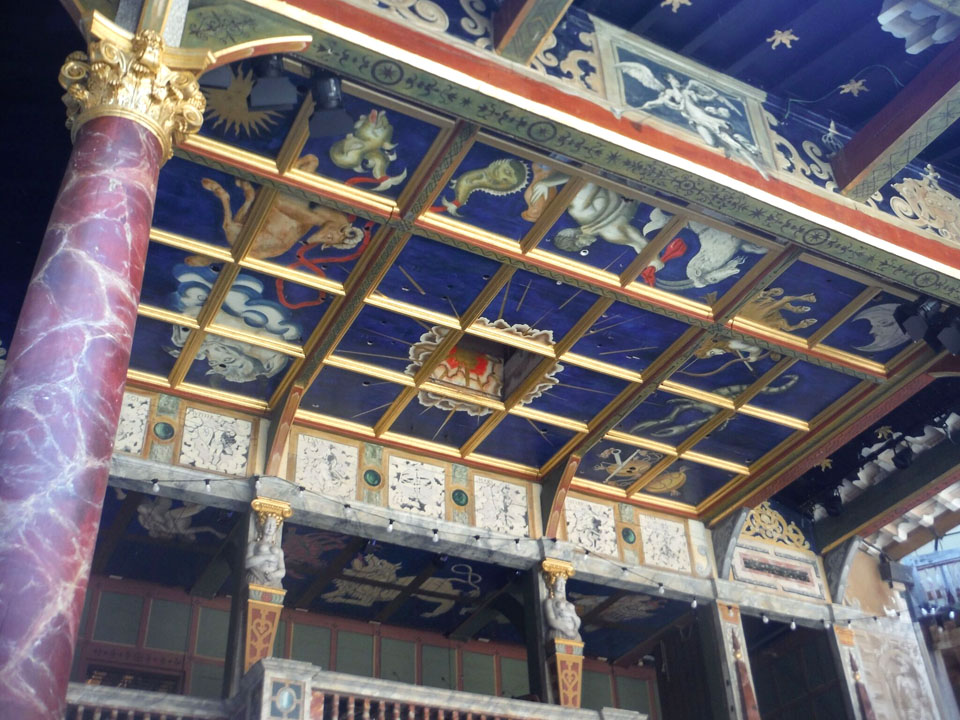
Day five, we went to Shakespeare’s Globe. The tour guide showed us the outside of the Globe.  It’s not the original, because the first one burned down, and the second one broke down.  It’s the third version.  The inside was very intricately decorated, especially the ceiling above the stage.  There are trapdoors on the ceiling above the stage and in the floor in the middle of the stage. 
Ceiling above the stage of the Globe Theater
The ceiling one was used for god-like characters to enter through.  The bottom one was for, well, the opposite.  Characters coming from hell would enter from the ground trapdoor.  In the middle of the tour, we sat down and watched actors practice for their play that they would be performing later for the public.  One of the actors was deaf, so she was acting with sign language and there was a translator on stage for her.   

Tate Modern, Mao by Andy Warhol
After that, we went to the Tate Modern Museum for a little while.  The art there was really, really cool.  We only stayed for a short while, because we had to go to lunch.  We ate somewhere called Padella.  It’s a pasta restaurant right outside of Borough market.  The pasta was exceptional and I would have gotten more, but I was stuffed.  
Footbridge across the Thames to the Tate Modern
After that, we walked back to the Tate Modern Museum and looked at the rest of the exhibits.  It filled my mind to the point of overflowing with new ideas and thoughts.  Then we walked home.  For dinner, we went to a tapas place.  We got many little plates, which were all fantastic.  My favorite dish was the jamon croquettes.  They are deep fried mashed potatoes and ham.  I also liked the shrimp.  It was just shrimp in olive oil with herbs, but it was so good! 
Underground in Churchill's Bunker used in WW II
On the last day, we went to lots of places.  First, we walked to Churchill’s bunkers.  We got very lucky, because the people in the front of the line had to wait 1 hour 30 minutes, but we only had to wait about 5-7 minutes.  The inside was really cool, and a lot of the stuff inside had actually been there during the war.  You had to have an audio tour, so it was really quiet when you took off the headset.  In the middle, there was more of a museum part, but the rest of the tour was just the bunkers. 
St. James Park on a warm April afternoon
After that, we went to Saint James Park so I could draw.  There were lots of people because it was a beautiful day.  There is a small lake in the middle, and there were lots of pretty waterfowl.   
Swan
There was an abundance of storks, swans, ducks, coots, and pigeons.  We just had hotdogs for lunch.  They were pretty good.  
Mounted soldier at Buckingham Palace
Then, we went to Buckingham Palace.  We didn’t know this, but the day before was the queen’s 92nd  birthday. Also, the streets were blocked because the day after was the London marathon.  It was cool because they had the traditional guards with the tall black fluffy hats and red jackets, but they also had police officers on the side.
Nike statue at Trafalgar Square
Next, we went to Trafalgar Square.  There were two floating people in Yoda costumes, and two other floating people in costumes.  
Yoda mime at Trafalgar Square
There was someone in a giant Pikachu costume, and a mime or two.  Oh, and there was also a concert going on.  There was a lot of stuff.

Van Gogh's Sunflowers at the National Gallery
We then took a quick look inside the National Gallery.  They had the famous Van Gogh sunflower painting.  They also had lots of Monet and Murillo paintings.  We took the subway back home and rested for a bit.  After that, we went to dinner at an Indian restaurant called Mango.  The food was spicier than I was used to, but it was very good.  That was our last day in London.  I had a great time there, and I hope some of you will also go there.

Photographs by Paige and Matt Arnold 
Paige and her dad, Matt
 

Monday, August 14, 2017

THE CHICAGO ART INSTITUTE: From Paperweights to Impressionists and More

Two stately lions guard the entrance to the Art Institute of Chicago, one of the oldest and largest art museums in the United States, and one of my favorites. As I walked up the steps from Michigan Avenue and opened the door, stickers proclaimed it to be Chicago's number one museum choice on TripAdvisor
Rainy Day, Paris, Gustave Caillabotte, 1877
My visit to the museum on a recent trip to Chicago was an opportunity to become reacquainted with some of the museum's most famous paintings, including George Seurat's Sunday Afternoon on La Grande Jatte, Vincent Van Gogh's Bedroom at Arles and a number of Claude Monet's haystack paintings. 
Detail, Sunday Afternoon on La Grande Jatte by George Seurat
I have fond memories of visiting the Art Institute as a child and when I was in college and art school in Iowa (we rode to Chicago on the train.) I haven't been back since, so it was a delight to visit again. The museum has grown enormously with several additional modern wings.
Sculptures in the Modern Wing
Like most large museums, it is impossible to see everything in one visit so I decided to focus on the modern European and American wings. But on my way, I saw a sign pointing downstairs to an exhibit of paperweights and a special photography exhibit.
Paperweights from the collection of philanthropist Arthur Rubloff
My parents had their own small collection of paperweights so I was intrigued to see that exhibit–hundreds of glass paperweights arranged in artful designs.It is one of three premier collections of paperweights in the world. Other well-known paperweight collectors include Truman Capote, who wrote that the paperweight was like "some fragment of a dream."
Juvisy, France, photograph by Henri Cartier-Bresson
I am always interested in photography, so I went to see that exhibit too. It was a selection of photographs acquired by Hugh Edwards, curator of photography from 1959 to 1970. Edwards wrote about a photo by Cartier-Bresson of children playing by the Seine, "There are many great photographs by Cartier-Bresson, but this always remains my favorite."
Haystacks by Claude Monet
My visit to the museum was short and I was able to see only a fraction of the pieces on exhibit. I hope it won't be so long before I go back again.
A special exhibit of Gauguin paintings opened June 25th and will be open until September 10th.
Paul Gauguin: Artist as Alchemist, exhibit

Monday, November 17, 2014

DEGAS' Little Dancer and Works by ANDREW WYETH at the National Gallery, Washington, DC

Little Dancer Aged Fourteen, Original Wax Sculpture by Edgar Degas
On a recent trip to Washington, DC, I spent the morning at the National Gallery of Art, focusing on two of the current special exhibits, Degas’ Little Dancer Aged Fourteen, and a show of Andrew Wyeth paintings and drawings.  I have seen the Little Dancer by Degas several times before–in Paris, at the Norton Simon Museum in Pasadena, and in another exhibit at the National Gallery–but they were all casts made after his death.  In this exhibit at the National Gallery is Degas’ original wax sculpture of the Little Dancer from which the casts were made so for the first time I could see how the surface was modeled.  The figure is made of wax over a metal armature to which the artist added wood, rope, and even old paintbrushes in the arms.  Then a wig of human hair was added as well as a cotton-and-silk tutu, a cotton faille bodice, and linen slippers. Her turned out toes, erect posture and raised chin seem to convey an inner determination. Little Dancer Aged Fourteen will be on view from October 5, 2014 to January 11, 2015.
Ballet Scene, Edgar Degas, Pastel
The Little Dancer was first exhibited in 1881 in Paris with other Impressionist works.  Fittingly, her surroundings at the National Gallery are paintings and drawings of other dancers by Degas, as well as works by other Impressionist and Post-Impressionist artists including Monet, Renoir, Van Gogh, and Cezanne. Many of the paintings are familiar from my art history classes but there were also some new ones such as Van Gogh's Green Wheat Fields, recently acquired by the museum. Van Gogh's characteristic layered brushstrokes pulsate across the surface of the painting.
Vincent van Gogh, Green Wheat Fields, Auvers, 1890
Another featured exhibit currently at the National Gallery is Andrew Wyeth: Looking Out, Looking In, which shows one of Wyeth’s  most famous paintings Wind from the Sea and explores his lifelong fascination with windows, a subject he depicted in more than three hundred works. Wyeth’s ability to paint the same subject over and over, each time seeing it in a new light and giving it new life is one of the pleasures of this exhibit.  Photographs were not allowed.  It will be on view until November 30, 2014.
Andrew Wyeth Exhibit at the National Gallery of Art, Washington, DC
On our way to the two exhibits we passed many rooms of art that we didn’t have time to stop and view. The National Gallery is huge and impossible to see in one day. Our visit only encompassed the West Wing.  The East Wing galleries are currently closed for renovation.  On another trip we’ll go back to see more.
National Gallery of Art, West Wing