Showing posts with label UK. Show all posts

Monday, November 16, 2026

THE COTSWOLDS: England's Storybook Villages Trapped in Time

Market Square, Stow on the Wold, England

The Cotswolds, in the rolling hills of southern England, are storybook villages that dot the countryside, many dating back a thousand years, and some to Roman times. 
(“Wold” is an Old English word meaning “rolling hills.”) Protected as part of England’s history, little has changed over the years. If they feel like a movie set, it is because they often provide the background for period dramas on film and television.

Porch House, Oldest Inn in England. From 947 A.D.

In early October, when visiting Oxford, we booked a day tour to the Cotswolds--about a 40-minute drive from Oxford. It was a small group tour (four other people) and the driver of our van, Robert, was also our tour leader. He was both knowledgeable and entertaining—he said he liked learning quirky facts. 
At each of the five stops he pointed out significant sites and filled in historical details. 

Farmland, Oxfordshire, England.

Besides tourism, agriculture is the main industry in the Cotswolds. Before travelling to England we had watched several episodes of Clarkson’s Farm, a television series about Jeremy Clarkson, a British tv personality who bought a large farm in the Cotswolds and decided to farm it himself, despite knowing nothing about how to run a farm. Recently he has opened a pub on his property, The Farmer’s Dog, which we passed on our way to our first stop, Stow on the Wold.

Stow on the Wold

Rear doors of St. Edward's Church.

In Stow on the World we parked in the market square and stopped to see Porch House, said to be the oldest continuously operating inn in England. The other main tourist site is at the back of the Church of St. Edward, where the tree lined doors may have been the inspiration for J.R.R. Tolkien’s Doors of Durin in the Lord of the Rings.

This narrow passage may have been used to lead sheep to the market square.

Walking trips are popular in the Cotswolds. I noticed a group of people dressed in hiking gear, who appeared to be ready to set out on one of the two major long-distance walking trails that go through the area, the Cotswold Way and the Monarch’s Way. The Monarch’s way is the route taken by Charles I on his way to France after being defeated by Cromwell.

Bourton on the Water

Bridges over the canal at Bourton on the Water.

Dooryard roses at a house along the canal.

Our next stop was Bourton on the Water, which touts itself as the Venice of the Cotswolds after the canal that runs through the town. The water was once used to run a mill. Today the canal is mostly a home for ducks and a nice background for photos. 
Bourton on the Water is known for its canal.

Model village. 

The model was opened on Coronation Day in 1937 and completed in 1940.

A popular attraction for visitors in Bourton on the Water is a model village, a recreation of the town at 1/9th scale. It requires a ticket (5 pounds) but I thought it was well worth it. The detail is remarkable. Within the model there is another tiny model and within that an even tinier one. It is only when you see visitors next to the buildings that you get a sense of the scale.

Cirencester

Corinium was first recorded by Ptolemy AD 150. Cirencester market place was recorded in the Domesday Survey of 1086

Our third and lunch stop was in Cirencester, a town originally established by the Romans, who called it Corinium.

Roman mosaic found in Cirencester. (Ashmoleon Museum, Oxford.)

Cirencester is one of the largest towns in the Cotswolds. We had numerous pubs and eateries to choose from for our lunch. We bought a sandwich at local bakery made with delicious homemade bread. A major sight in Cirencester is the large church, fronted with an elaborate porch built with money donated by wealthy sheep farmers.

Elaborately carved porch of Cirencester church.

Bibury

Except for the car and tourists, this scene hasn't changed in 300 years.

Bibury. Path to weavers' cottages.

We then drove to the small village Bibury, famous for its row of 17th century weavers’ cottages. Bibury has been called the prettiest village in the Cotswolds.

Burford

Tomb of Sir Lawrence Tanfield and his wife Elizabeth, who lived in Burford Priory from 1585.

Our last stop was in Burford. Here we visited a side chapel in the church where Robert told the story of a cruel landowner and his wife, whose elaborate tomb fills the space.


We enjoyed our day in the Cotswolds. The weather was good (cool but pleasant) and we saw a lot. Ordinarily when travelling, we like to do our driving and sightseeing on our own, but we were glad that Robert was behind the wheel as he negotiated the maze of narrow country roads that are typical of the Cotswolds. Perhaps someday we’ll go back on our own and stay longer.

Stone is the primary building material in the Cotswolds--stone walls, stone roofs, stone fences.

We booked our 
Cotswold Day Tour with Footprints Tours. We did it online with TripAdvisor.


Monday, October 7, 2019

MOUNTSFIELD PARK: One of London's Many Green Spaces, Guest Post by Gretchen Woelfle


Autumn colors, London style. Mountsfield Park, Hither Green (South London)

My friend and fellow children's book writer Gretchen Woelfle loves to travel and frequently goes to London, living in local neighborhoods. Here is a post about one of her recent visits.

London has some magnificent famous parks: Regents Park, Hyde Park, Hampstead Heath among others. But I especially love London neighborhood parks. Many of them are the sites of homes (long gone) of landowning squires, or transformed farmers’ fields. A few include land reclaimed from World War II bombsites. 
Dragonfly gates at entrance to Mountsfield Park
I spent a month in Hither Green (south London) right across from Mountsfield Park, not famous but lovely just the same.  
A path with light and shade under green, leafy arches
I took a daily stroll (along with locals and their dogs) across large expanses of guilt-free (for a SoCal resident) lawns where people of all genders and ages play soccer, under tall stately trees, across wild places where the grass isn't mown and shrubbery isn't trimmed, with winding paths through it all. 
Girl power!

Lots of coffee at the tea shop.
I lingered at a tea shop, a rose garden, a wildflower meadow, a community vegetable garden, tennis courts, and a playground.
Hidden sculpture tucked in the trees.
There are carved wooden sculptures hidden here and there and heaps of logs placed to provide habitat for an endangered English beetle.
Berries ripe for autumn harvest.
The autumn colors were out – subtle but stunning. I love the wild foxes that roam the parks and gardens all over London.  Residents call them vermin, but they are exotic to me, with their long bushy tails. I see them crossing the street into the park at dusk.  And one morning as I was retrieving my bike from the back garden shed, I startled one out of the next-door overgrown garden.
Community garden.
Google tells me that 47% of London is “green”. The website below lists 111 parks and Mountsfield isn’t even one of them. Wherever you happen to land in London, there’s probably a park – or a garden or a common or a heath – nearby where you can enjoy the pleasures of the English countryside in the heart of the city.

https://secretldn.com/london-parks-gardens-list/: Here’s the list of 111 parks
https://en.wikipedia.org/wiki/Mountsfield_Park tells the history of Mountsfield park.
Scarlet highlights.

Monday, May 21, 2018

SIX DAYS IN LONDON, Part 2: Guest Post by Paige Arnold


Shakespeare's Globe Theater, London
My granddaughter Paige, age 12, spent six days in London with her parents during her spring break. She kept a diary of her daily activities (a family tradition) and has written them up in this blogpost. I am impressed with the number of things they did and the detail of her report. I thank her for her excellent report! Part 1 posted last week.

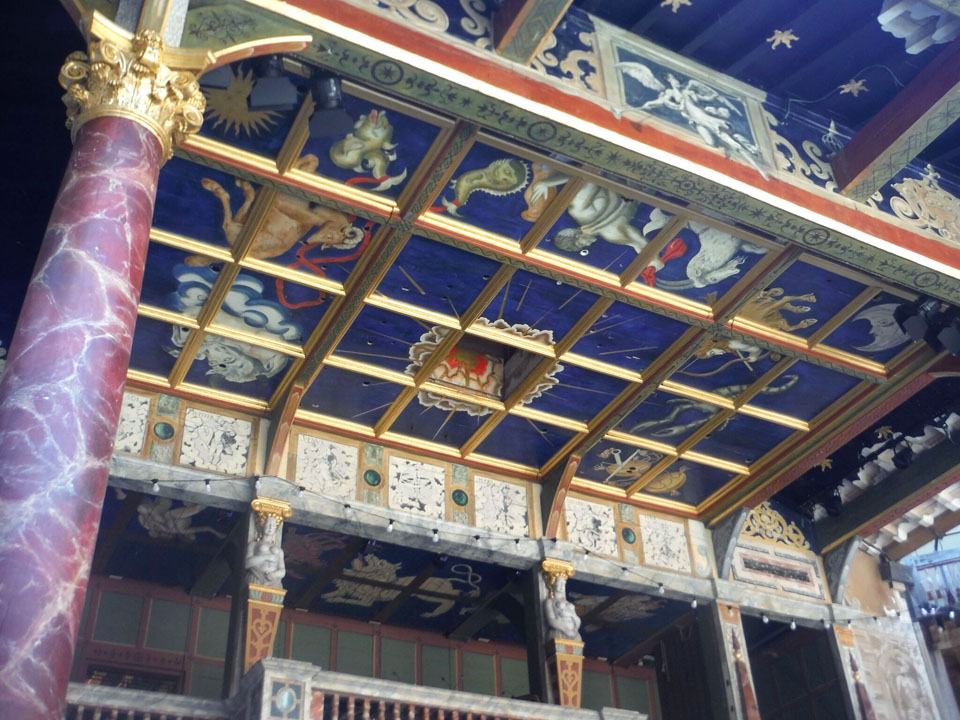
Day five, we went to Shakespeare’s Globe. The tour guide showed us the outside of the Globe.  It’s not the original, because the first one burned down, and the second one broke down.  It’s the third version.  The inside was very intricately decorated, especially the ceiling above the stage.  There are trapdoors on the ceiling above the stage and in the floor in the middle of the stage. 
Ceiling above the stage of the Globe Theater
The ceiling one was used for god-like characters to enter through.  The bottom one was for, well, the opposite.  Characters coming from hell would enter from the ground trapdoor.  In the middle of the tour, we sat down and watched actors practice for their play that they would be performing later for the public.  One of the actors was deaf, so she was acting with sign language and there was a translator on stage for her.   

Tate Modern, Mao by Andy Warhol
After that, we went to the Tate Modern Museum for a little while.  The art there was really, really cool.  We only stayed for a short while, because we had to go to lunch.  We ate somewhere called Padella.  It’s a pasta restaurant right outside of Borough market.  The pasta was exceptional and I would have gotten more, but I was stuffed.  
Footbridge across the Thames to the Tate Modern
After that, we walked back to the Tate Modern Museum and looked at the rest of the exhibits.  It filled my mind to the point of overflowing with new ideas and thoughts.  Then we walked home.  For dinner, we went to a tapas place.  We got many little plates, which were all fantastic.  My favorite dish was the jamon croquettes.  They are deep fried mashed potatoes and ham.  I also liked the shrimp.  It was just shrimp in olive oil with herbs, but it was so good! 
Underground in Churchill's Bunker used in WW II
On the last day, we went to lots of places.  First, we walked to Churchill’s bunkers.  We got very lucky, because the people in the front of the line had to wait 1 hour 30 minutes, but we only had to wait about 5-7 minutes.  The inside was really cool, and a lot of the stuff inside had actually been there during the war.  You had to have an audio tour, so it was really quiet when you took off the headset.  In the middle, there was more of a museum part, but the rest of the tour was just the bunkers. 
St. James Park on a warm April afternoon
After that, we went to Saint James Park so I could draw.  There were lots of people because it was a beautiful day.  There is a small lake in the middle, and there were lots of pretty waterfowl.   
Swan
There was an abundance of storks, swans, ducks, coots, and pigeons.  We just had hotdogs for lunch.  They were pretty good.  
Mounted soldier at Buckingham Palace
Then, we went to Buckingham Palace.  We didn’t know this, but the day before was the queen’s 92nd  birthday. Also, the streets were blocked because the day after was the London marathon.  It was cool because they had the traditional guards with the tall black fluffy hats and red jackets, but they also had police officers on the side.
Nike statue at Trafalgar Square
Next, we went to Trafalgar Square.  There were two floating people in Yoda costumes, and two other floating people in costumes.  
Yoda mime at Trafalgar Square
There was someone in a giant Pikachu costume, and a mime or two.  Oh, and there was also a concert going on.  There was a lot of stuff.

Van Gogh's Sunflowers at the National Gallery
We then took a quick look inside the National Gallery.  They had the famous Van Gogh sunflower painting.  They also had lots of Monet and Murillo paintings.  We took the subway back home and rested for a bit.  After that, we went to dinner at an Indian restaurant called Mango.  The food was spicier than I was used to, but it was very good.  That was our last day in London.  I had a great time there, and I hope some of you will also go there.

Photographs by Paige and Matt Arnold 
Paige and her dad, Matt