Showing posts with label modern art. Show all posts

Monday, August 17, 2026

BILBAO: THE HEART OF SPAIN'S BASQUE COUNTRY, Guest Post by Jennifer Arnold

Bilbao, Spain. View from the River Nervion.

In June, my daughter Jennifer and a friend took a trip to northern Spain, visiting Bilbao and the surrounding area before going to conference in San Sebastian. I thank her for sharing her excellent photos and impressions of her trip with The Intrepid Tourist. This is Part 1 of her report. Part 2 will post next week.

Bilbao, river and bridge.

Before my trip to Bilbao I was told that Bilbao is the best city in the world. After three days visiting, I am inclined to believe it. Bilbao sits near the northern coast of Spain in Basque Country. It is a medium-sized city with a population of 352,000. It’s very densely packed (according to one site, more dense than San Francisco but less than New York). It is beautifully designed, with multiple meticulously-maintained public parks. The beautiful Nervion river runs through it, bordered by pedestrian paths and numerous pedestrian bridges to cross. 

A lion statue on top of a building is a famous site in Bilbao.

It is easy to get around Bilbao on trams, busses, metro or just by walking. We walked almost everywhere so we didn’t try the trams or metro.

Seafood for sale at the mercado de la Ribera; Europe’s largest covered market.

Bilbao is famous for its culinary attractions. Most notable are pintxos (pronounced pinchos) which are tapas (small bites) in the Basque style, often with seafood or ham on bread with other sauces and seasonings. 

Pintxos for sale at the mercado de la Ribera, which also has tables to eat at.

Every bar has pintxos, and a typical evening could include bar hopping to try the specialties of each one.

Pintxos at the Plaza Nueva in Bilbao (famous for its Idiazabal soup from Gure Toki).

Bilbao is also famous for the Guggenheim Museum designed by American architect Frank Gehry, which is itself a piece of architectural art.  The museum has a collection of masterpieces from around the world, and also hosts visiting shows.

Jennifer outside the Guggenheim Museum in Bilbao.

In a three-day visit, we went to the Guggenheim Museum, rode the funicular, saw the Santiago Cathedral, and took a day trip to see the towns of Gaztelugatche, Mundaka and Guernica (see my post next week). But much of our time was spent seeing the city on foot, enjoying the unique architecture and food.

The Puerta del Angel (Angel’s Gate) at the Bilbao Cathedral.

View of Bilbao from the hill after taking the funicular Artxanda.

1.      

Monday, October 21, 2024

A TREASURE HOUSE OF "MODERN" ART: The Phillips Collection, Washington, D.C.

Phillips Collection, Washington, D.C.

Among my favorite art museums in Washington, D.C. is the Phillips Collection, which I had the chance to visit last week. It had been five years since my previous visit, and I discovered that although many of the paintings on exhibit were familiar, there were new ones I hadn't seen before.


In 1921, Duncan Phillips, and his wife, Marjorie Acker Phillips, a painter, turned the family art collection into a public museum, the Phillips Memorial Gallery, in their home near Dupont Circle in Washington, D.C. The collection soon expanded and the family moved across the street, turning over the entire house to art.

From the beginning, the collection focused on “modern” art, acquiring paintings by French Impressionists such as Monet and Renoir, and Cubists such as Picasso and Braque. Giving equal focus to American and European artists, Phillips juxtaposed works by Winslow Homer, Thomas Eakins, Maurice Prendergast, James Abbott McNeill Whistler and Albert Pinkham Ryder, with canvases by Pierre Bonnard, Édouard Vuillard, and Danish painter Peter Ilsted.

Luncheon of the Boating Party by Auguste Renoir.

The painting that makes the museum famous and draws the most visitors is Renoir’s Luncheon of the Boating Party. It still has pride of place, filling one wall in a room on the second floor of the museum.

The Rothko Room.

As the collection expanded over the years it became necessary to add a new wing to the museum. Every room is filled with remarkable art. One small room is devoted to four paintings by Mark Rothko, each intense canvas taking up most of each wall. Standing in the middle one feels bathed in color on every side.

Migration series by Jacob Lawrence. Top: "Families arrived at the station very early. They did not wish to miss their travel north." Bottom: "The migration spread."

Another room contains the paintings of the Jacob Lawrence Immigration Series, depicting the migration of African Americans from the rural South to the urban North.  As one circles the room, it is like reading a book. Jacob Lawrence wrote text to go with each painting, and in the gallery it is placed underneath the paintings. In the excellent gift shop on the first floor, you can buy a book in which all the paintings and text have been assembled as a story.

Detail, Three Lawyers by Honore Daumier.

In another room, one wall features a painting and drawings by the French artist Honore Daumier, a master at capturing facial expressions and body language, a skill he used to critique social norms of the 19th Century. Not much has changed in the 170 years since Daumier painted the Three Lawyers. The three men, aught in conversation, feel contemporary. 

The Road Menders by Vincent Van Gogh.

Detail of The Road Menders.

As I made my way through the museum, I became intrigued by the titles of paintings, finding that my first impression of what the painting was about wasn’t always reflected in the title. For instance, in Vincent Van Gogh’s painting Road Menders, I had to look hard to find the tiny figures in the center of the painting making repairs on the road.

The Blue Armchair by Guy Pene du Bois.

In another painting, The Blue Armchair by Guy Pene du Bois, the chair all but swallows the figure sitting in it, making the title fit perfectly.

Part of the Where We Meet exhibit. L-R: Black Girl by Elizabeth Catlett; Breeze Rustling Through Fall Flowers by Alma W. Thomas; Girl in a Turban by William H. Johnson.

On the second floor of the museum is a room devoted to an exhibit called Where We Meet, in which pieces from the Phillips Collection and the Howard University Museum of Art are shown together “in conversation”. This exhibit is new since my last visit. 

These are just a small sample of the art on display at the Phillips Collection. To see my posts about my visit in 2019, go to:

The Phillips Collection, Part 1: America's First Museum of Modern Art. 

and

The Phillips Collection, Part II: What Do You Hang Over the Fireplace?

And to learn about the Family Gallery at the museum, a guide to looking at art with children, go to my recent post at my Art and Books blog.


Monday, September 25, 2023

KEITH HARING, ARTIST AND ACTIVIST: The Broad Art Museum, Los Angeles, CA

Keith Haring, Art is for Everyone at The Broad Museum in Los Angeles

For months I had seen light pole banners along the streets of Los Angeles promoting the Keith Haring exhibit at The Broad museum of modern art in downtown LA. Playful polka-dotted creatures danced across each banner. I wanted to see more. 

T-shirts, posters, books, are among the many ways Keith Haring's expressed his creativity.

Keith Haring, Art for Everyone, is an amazing collection of paintings, drawings, sculptures, pottery, t-shirts, and art on just about any surface he could draw on. A rotating slide show of his public art on buildings in NYC, subway stations, and elsewhere is projected on the wall outside the entrance to the exhibit. Inside the exhibit his paintings are so numerous they are double-hung to fit them all in.

As a child, Haring learned to draw using Disney characters and Dr. Seuss books a models.

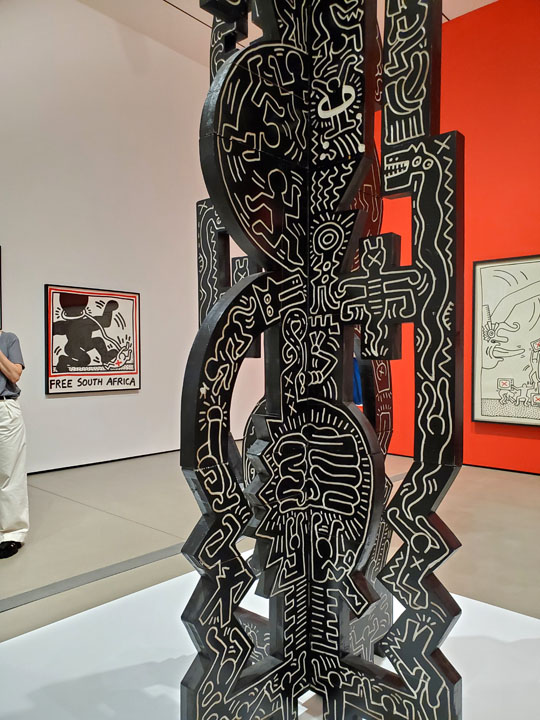
Strong black lines, bright colors, animals (especially snakes) and other imaginative creatures, characterize Haring’s work. 

I couldn't resist having my photo taken through this decorated window.

His art reflects the influence of other artists of the time such as Andy Warhol, Jean-Michel Basquiat and Roy Lichtenstein. (You can see examples of their work upstairs at The Broad in the permanent collection.)

Haring designed posters and flyers to promote AIDS awareness.

Keith Haring, born in 1958, worked in New York City in the 1970s and 1980s, producing an enormous quantity of work before dying of AIDS in 1990. In 1988 he created the Keith Haring Foundation to 
continue his artistic legacy and to provide funding to AIDS organizations for education, research, and care, as well as to groups that work with children and marginalized communities.

Haring protested apartheid in South Africa through his art.

His commitment to speaking out about issues he believed in grew stronger throughout his career. “Haring’s activism was central to his practice. He used his imagery and celebrity to protest apartheid in South Africa, raise awareness of the crack cocaine epidemic, and the AIDS crisis, and support causes from nuclear disarmament to UNICEF.”

In the last room of the exhibit are some of Keith Haring's final works, including a painting with an unfinished corner, providing a clue to his method.

The Keith Haring exhibit at The Broad is the first exhibit of his work in Los Angeles. The exhibit requires a timed paid ticket, available online. (The rest of the art museum is free.) The Keith Haring exhibit closes on October 8, 2023. See it while you can. 

Moses and the Burning Bush, 1985