Showing posts with label masks. Show all posts

Monday, May 4, 2026

MASKS AT THE HULT CENTER IN EUGENE, OREGON, Guest Post by Caroline Hatton

Mythical Masks by M. Nelson & L. Bowers at the Hult Center in Eugene, Oregon

My friend Caroline Hatton, a children’s writer and frequent contributor to this blog, took the photos in this post in November 2025 when she went to a Eugene Symphony concert. "We arrived early and I love looking at the masks in the performing arts center. So I zipped around snapping pictures! This is a permanent display, so it is available year round as long as the building stands." 

Mask display at the Hult Center.

If you like masks or if you enjoy seeing how differently different artists can respond to the same challenge, you might like the permanent display at the performing arts center in Eugene, Oregon. Rows of masks by many creators line the walls of the stair landings to the mezzanine and balcony.

The Hult Center opened in 1982, the first performing arts center in the United States built without state or federal funding—with community funding only. It is the home of four resident companies (ballet and concert). Its roofline evokes the nearby Cascades Mountains and its beams of Douglas fir, the local forests. Blue stair railings symbolize local rivers. Public art graces interior spaces: statues, paintings, and sculptures, including masks, the focus of this blog post.


Each artist created a series of about six to nine masks, which are variations on a theme under a single title. My photos show only two or three examples of each artist’s works. The above photo shows some of the Masks by Laura Wuori.

a

Above: some of the Raku Life Masks by Dan Corbin.


Above: some of the Clay Masks by Claire Barr.


Above: some of the Chorus by Anita Griffith, the most hilarious series!


Above: some of the Masks by Eric Gronborg.


Above: some of the Stylized Masks by Susan St. Michael.


Above: some of the Faces by Mike Imes.

Just when I thought I had photographed samples of every mask artist’s work on display, I would come around a corner and discover another series, and another one.


Above is my favorite, one of the Mythical Masks by M. Nelson & L. Bowers, because the mouth is genius: echoing the lines and angles of the overall star design perfectly, and unmistakably shouting for joy, despite its unnatural shape.

Monday, August 25, 2025

TOTEM POLES AND MORE: Museum of Anthropology (MOA) at UBC, Vancouver, BC:

Great Hall, Museum of Anthropology, UBC, Vancouver, Canada.

A “must see” when you are visiting Vancouver, BC, Canada’s gateway to the Pacific, is the Museum of Anthropology on the campus of the University of British Columbia. Nowhere are there more totem poles and other artifacts of the Northern Pacific Coast indigenous cultures in one place.

There are 35 languages and many dialects in the Pacific Northwest. This exhibit shows the word for "paddle" in eleven different languages.

After walking down the center ramp of the museum to the Great Hall you find yourself in a large light-filled space filled with totem poles more than two stories high, giant carved figures, ceremonial objects and much more. 

Animal images carved and painted on a totem pole.

The enormous scale of the totem poles becomes obvious as you crane your neck to see the top. Only at eye level can you see the details of the paint and carving up close.

Totem poles and carved figures.

Through the tall windows the objects inside the museum appear to merge with the outdoor scenery.

Mask and ceremonial bowls.

In one exhibit, which at first glance seems to be a riding toy for children, is actually a series of ceremonial feast dishes. Such dishes were passed down from father to son.  Panels describe the tradition of the potlach, at which such vessels would be used. At a potlach, hereditary chiefs and their families displayed claims of certain rights and privileges in front of invited guests. They are feasted and paid gifts for accepting the host’s claims and remembering all that has happened at the event. It is an ancient ceremonial tradition. The potlach ceremony was outlawed in Canada from 1889 to 1951.


While the totem poles and other objects inside the museum are protected from the weather, other totem poles and examples of traditional log houses are exhibited outside. Informational panels explain how indigenous communities were decimated by diseases introduced by Europeans, causing them to abandon their villages. A drawing of one of these villages, made from information found in the village ruins, shows what it would have looked like when it was inhabited.

Drawing of reconstruction of abandoned village.


Painted figure.

Figures made of broken ceramic tiles and mirrors, by Sally Michener, 1994. in the Koerner European Ceramics Gallery.

Although most of the museum focuses on the cultures of the Northwest Coast indigenous people, there is more. In the Koerner European Ceramics Gallery, there is a surprising focus on the art of ceramic tile stoves--both artistic and useful! They are believed to have had their origin in the Alps in the 16th century..

Tiled  stove from Germany or Slovakia, ca 1560..

On the lower level of the museum are galleries filled with display cases crammed with smaller objects—baskets, masks, tools, clothing—both from Northwest Coast indigenous people, and from cultures around the world.

Traditional Northwest Coast masks are among the thousands of items displayed in the lower galleries.

Stick puppets from Asia.

But the main draw of the museum is the wealth of native American material, accompanied by excellent informational panels.
A visit to the Anthropology Museum is an opportunity to appreciate the richness of the indigenous cultures of the Pacific Northwest, which continue many of the traditions that have been practiced for centuries, as well as to see cultural objects from around the world. 
An excellent gift shop is on the entrance level of the museum, as well as a coffee shop with drinks and snacks. 

Pond, walking path, and totem pole behind the museum.


Monday, October 14, 2024

NEW MEETS OLD: Contemporary African Art by Leilah Babirye at the de Young Museum, San Francisco, CA

Masks by Leilah Babirye at the de Young Museum in San Francisco.

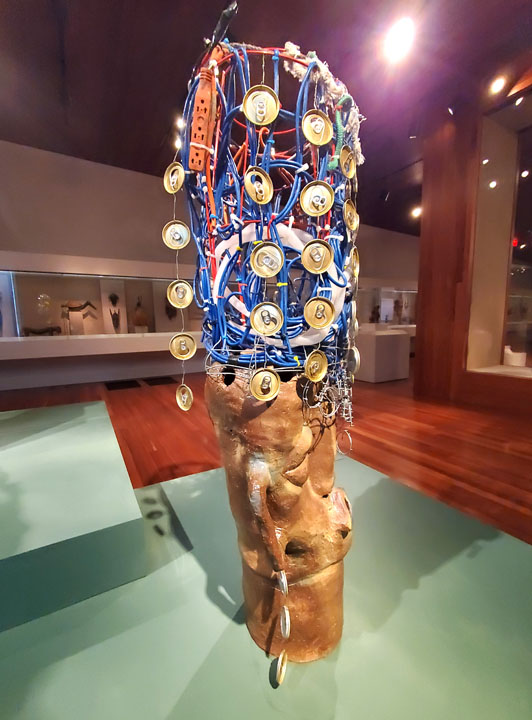
A new exhibit at the de Young Art Museum in San Francisco, called We Have a History, features the art of Leilah Babirye. At first, Leilah Babirye’s sculptures look like traditional African forms, but on closer look, the complex decorations turn out to be a colorful mixture of found objects—can tops, electrical wire, extension cords, PVC pipe, and whatever else she has happened to find. 

Auntie Muzumganda by Leilah Babirye, Ceramic, wire, and found objects.

Detail.

Leilah Babirye, born in Uganda, works in New York, creating busts, masks, and figures from ceramic and wood. This is her first solo museum show in the United States. Her work highlights the connection between the past and present in African art.

R. Peaceful Bride of Mwanga II, Leilah Babirye, Wood, wax, nails, wire, glue and found objects.

I saw Leilah Babirye’s exhibit when I was at the de Young Museum in July. Her art is displayed in the Art of Africa gallery, alongside the permanent exhibits of masks, paintings and other objects, thus tying Babirye’s work to the larger African tradition. 

Dance mask, Bogadjin people; Headrests, Tami people.

I was intrigued by her use of ordinary household objects and the way they become transformed into vibrant art when incorporated in the sculptures.

Carved wooden figure, Leilah Babirye.

Included in the exhibit is a video installation where we see Leilah Babirye at work in her studio. We see the intense and energetic way she attacks materials, turning them into the forms she intends. As she works we hear her talk about them.  Leilah Babirye’s sculptures, busts and masks are portraits of her LGBTQ+ community. Each one speaks for itself, inviting the viewer to take a closer look.

The exhibit, on the second floor of the museum, runs through October 26, 2025. 

For more information about visiting the de Young Museum of Art, click HERE.


Monday, December 18, 2023

FOWLER MUSEUM, UCLA: Intersections

Intersections: World Arts/Local Lives. Fowler Museum of Cultural Arts.

One of my favorite museums in Los Angeles is the Fowler Museum of Cultural Arts, located on the UCLA campus just north of the Janss Steps. Housing more then 120,000 art and ethnographic objects and 600,000 archaeological objects it is a treasure house of ancient, traditional, and contemporary cultures of Africa, Native and Latin America, and Asia and the Pacific. It is also a space for a wide variety of wonderful temporary exhibits.

Cloth constructed from recycled metal tabs, from Africa. Intersections exhibit.

Inside the museum, surrounding a garden/atrium, are four galleries. Two are for temporary exhibits. In one of the other galleries is the permanent installation of the silver collection of the Fowler Family (after whom the museum is named.) Among my favorites in this room is the set of Apostle spoons and a painting depicting a royal banquet at which silver dishes like those in the collection were used. This blog post is devoted to a brief overview of some of the exhibits in the main gallery, Intersections, a sampling of objects from the Fowler collection..

Masks.

Intersections: World Arts/Local Lives, first opened to the public in 2006 and since then has showcased objects that inspire conversation and reflection. 

Wooden carvings.

The exhibits in the gallery explore how arts from Africa, Asia and the Pacific and the Americas conceptually intersect with each other. Major sections of the exhibition consider how these arts served as vehicles of action, knowledge, power and transformation.                                                      

Memories and Transcendence: Tree of Life and other objects.

An exceptional collection of more than 900 Mexican works was donated in 1997 by the Daniel Family and includes a magnificent ceramic Trees of Life, Day of the Dead figurines, and masks from Metepec, Oaxaca, Michoacan, Jalisco, Puebla, and Guanajuato.

Spirit's Walk, painting on bark from East Arnhem Land, Australia

Mexican Day of the Dead figures.

A small room within Intersections is for temporary exhibits. (See my earlier post on Armenian Lace.)

In addition to the two galleries for temporary exhibits, an exhibition space for photographs is on the walls of the hallway surrounding the atrium of the museum. (The most recent exhibit there was Remain in Light: Visions of Home and the Diaspora , striking black and white photos, often with dramatic skies, depicting contemporary life in Armenia.) I make regular trips to the Fowler as new exhibits are mounted, but I always return to the Intersections gallery. It is the heart of the museum.


PS And the Fowler Museum gift shop is a perfect place to find gifts for the holidays--or any other time of year!

Monday, February 5, 2018

TREKKING EVEREST, Guest Post by Owen Floody


Everest with the famous Khumbu Icefall; view from
Kala Patthar

Our friend Owen Floody has embarked on numerous treks in the past year and a half, including the ambitious "Ultimate Everest" trek in the Himalayas. Owen recently retired from a career of teaching and research at Bucknell University in Pennsylvania. He has always been an avid photographer and in his retirement has taken numerous trips that allow him to pursue his passion. He is a frequent contributor to The Intrepid Tourist. Here is the report of his Everest trek and a few of his excellent photographs.
 
Since my retirement in mid-2012, I have completed 12 international treks.  Of these, the longest and most demanding was Wilderness Travel’s “Ultimate Everest”, a trek that extended over 25 days in November-December of 2016.  My group of five trekkers assembled in Kathmandu and spent several days exploring this and other sites and royal cities in the Kathmandu Valley.  We then were flown to Lukla, where the trekking began.  The trek’s initial leg took us to the vibrant town of Namche Bazaar.  Beyond this point, our route followed an elongated loop, with the town of Lobuche at its far end.  At Lobuche, we spent several days following a spur out to and back from the Mount Everest base camp before circling back to Namche Bazaar along a different route.  Though we had hiked from Lukla to Namche Bazaar at the trek’s start, all in my group opted to return to Lukla by helicopter.  In addition to its obvious attraction of ease, this provided a very useful bird’s eye perspective on some of the terrain through which we had trekked.  Except in Kathmandu, we stayed in basic lodges and were fed well by our own traveling kitchen staff.
Everest (marked by the leftmost cloud) is just behind the Nuptse Ridge, with Lhotse to the right and below the larger cloud formation
As you would expect, views of Everest and other Himalayan peaks (especially Ama Dablam, Lhotse and Nuptse) were a primary goal and achievement.  However, the closest and best views of these (e.g., Everest with the famous Khumbu Icefall ) were not easy to come by, requiring climbs to 17,500 ft (at Gokyo Ri) and 18,365 ft (at Kala Patthar).  To some extent, but only this, the earlier parts of the trek prepared us for later demands by exposing us to gradually increasing altitudes.  For example, our lodges on days 4, 8 and 12 were at 11,270, 12,650 and 14,100 ft, respectively.  And Lobuche, the gateway to the base camp, sits at 16,200 ft.  Still, there is a significant difference between 14,000-16,000 and 17,000-18,000 ft and all of us found our highest climbs to be very challenging, even with the help of the Diamox that we took to ward off altitude sickness.  One tip I would give future Ultimate Everest trekkers is to strenuously avoid exposure to colds or other illnesses borne by fellow travelers.  All in my group paid the price for failing to do this.
Icefield at the top of Cho La Pass
Most of this trek’s figurative highpoints coincided with literal highpoints.  These included the aforementioned views of Ama Dablam, Everest, Lhotse and Nuptse.  In addition, I very much enjoyed the Cho La Pass, Ngozumba Glacier and some of the mountain views near the town of Dingboche. 
Views from Dingboche
In contrast, I found our visit to the Mount Everest base camp to be anticlimactic: The time of year at which the trek runs is not the Everest climbing season so that the base camp amounted to a sign-posted rock field, not a bustling climbers’ village.
Mani Rimdu Festival
On the other hand, an unexpected personal high point was the opportunity to see the Mani Rimdu Festival in Tengboche, as we passed through this town.  This visit was an option on just one of the season’s three Ultimate Everest treks and I would strongly urge any future trekkers to take advantage of the opportunity, if available.  
The festival highlights a set of 16 masked dances performed by the monks at the Tengboche monastery.  These dances depict the establishment of Buddhism in the Himalayas, partly by representing the struggle between the legendary Padmasambhava (aka Guru Rinpoche) and demonic forces.  They were complex, incredibly colorful and provided the opportunity to hear traditional Nepalese musical instruments and music.
All told, this trek was very demanding but also unique in both artistry and landscapes.  What other trek can boast sightings of two of the four tallest mountains in the world (Everest and Lhotse) that begin early and continue to improve as you approach the ultimate destination more and more closely?  If this sort of experience appeals to you and you’re ready for the challenging altitudes, then this trek belongs on your bucket list.

Monday, December 31, 2012

CONNECTING CULTURES: Mobile Museum Brings the World to Kids

On a recent visit to my neighborhood middle school (Palms Middle School, Los Angeles, CA) I walked into the library and was amazed to discover that it had been temporarily converted to a multi-cultural museum.  Instead of books, the long tables were filled with bowls, drums, bells, masks, puppets, clothing, musical instruments, and hundreds of other objects from all over the world, each with a label describing its use and where it came from.  Vertical panels displayed more items. I love to go to museums, and here was a mini-museum right in my neighborhood. What a perfect way for students to learn about the diverse world we live in!


Valerie Lezin, Director, Connecting Cultures Mobile Museum
Connecting Cultures Mobile Museum (CCMM) offers students a unique hands-on experience with a comprehensive collection of more than 2,000 artifacts from more than 70 countries...right in their own schools. Students need only walk down the hall to a museum-quality exhibition representing every human endeavor across ancient and modern times. No buses. No lost days of instruction. With three discrete, thematic exhibitions and presentations, CCMM encourages students to become familiar with both the historic and current customs of their own families, their classmates, and those of the world.

Because no picture in a textbook can substitute for the experience of handling an object or viewing it in three dimensions, CCMM gives students an opportunity to hold a piece of history and world culture in their hands, serving to personalize and vivify what they have read in their textbooks.

In the 2011-2012 school year, the CCMM visited fourteen schools in the LAUSD.  In 2012-2013, it is expanding its program to reach even more schools.  Kids love it.  Teachers love it. For everyone, a visit to the CCMM is a virtual trip around the world.  For a wonderful article about CCMM's visit to a school in Ventura in the fall of 2012, click here.