Showing posts with label Cathedral. Show all posts

Monday, February 23, 2026

COPPER CANYON TRIP, Chihuahua, Mexico, Part 1: Guest Post by Susan Kean

Chihuahua, Mexico.

In January my friend Susan Kean and her partner George took a ten-day Road Scholar trip to Copper Canyon in Mexico, a canyon four times greater than the Grand Canyon in the United States. She has graciously agreed to share her thoughts and photos about the trip.

Our trip to Copper Canyon, Mexico, began in El Paso, Texas, where we met our bus to take us to the border. We crossed through at the Santa Teresa crossing, about 20 miles from El Paso. All very peaceful and easy.

Pancho Villa. Always on a horse.

One of Pancho Villa's many saddles.

Our bus then drove us to Chihuahua--a rich town developed thanks to the silver trade. On arrival, our first stop was the Pancho Villa Museum, which is housed in his home. His wife lived there until 1980 (She was much younger than he was.)

Decor inside house. Picture of Pancho Villa.

Beautiful citrus in courtyard.

Pancho Villa is seen in a lot of different lights but he was the leader of the Mexican Revolution in the northern part of Mexico. He went on to become mayor of Chihuahua. He was shot in his car in 1923.

Car where Pancho Villa was shot.

Mural of Revolution depicting woman revolutionary at the Pancho Villa Museum in Chihuahua.

Many women fought for the Revolution, often dressed as men so they could fight. We learned they tried out different forms of Government after the Revolution and settled for Democracy

Early the next morning we took a walking tour of downtown Chihuahua before heading to the Canyon.

Municipal buildings in downtown Chihuahua in the early morning.

Cathedral in Chihuahua.

As near as we came to an actual chihuahua.

Note: Part 2 will post next week.

Monday, August 11, 2025

CRUISING THE RHINE, Part 2: Castles, Churches, Cuckoo Clocks and More, Guest Post by Monique McLay Shore

Strausberg, Germany.

My friend and fellow Grinnellian, Monique McLay Shore, went on a one-week cruise of the Rhine River last May with her mother and sister Deidre. I thank her for sharing her report and excellent photos with The Intrepid Tourist. This post is adapted from Monique’s day by day reports she wrote on Facebook during the trip. It is in two parts—Days 1-4, followed by Days 5-7 a week later.

Speyer.

Day 5:  May 19

Today had a relaxed start as we didn't reach our excursion point until after lunch. But once we arrived in Speyer I had one of my trip highlights - a reunion with one of my dear college friends, Nadia! Meanwhile, Mom and Deidre were touring the town, doing a bit of shopping, and working on their selfie skills. 

Romanesque Cathedral in Speyer.

Speyer is a delightful town with a lovely Romanesque Cathedral. It has a markedly simpler design
aesthetic and quite lovely. As with most towns here, there are remnants of ancient city walls and layers of centuries of history.

Day 6:  May 20

Tram in Strausberg, Germany.

Today we explored a few corners of Strausberg, Germany. Because of its location it has actually changed from being French to German and back again many times over the centuries, giving it a solid footing in both cultures. This also makes it a great seat of power for the EU. 

Cathedral, Strausberg.

It has a beautiful cathedral that is also home to a mindboggling astronomical clock. And the area known as La Petite France is right out of a medieval sketchbook. Mom and Deidre went on a more limited tour
in the morning and mainly saw the cathedral while
I explored Petite France with another group.

Strausberg.

After lunch back on the ship Deidre and I went back to explore some more. I logged more than 20,000 steps as here was no easy transport between the various places. But it was totally worth it.


We were rewarded with a festive German feast for dinner onboard, the most spectacular sunset of the week, some festive cocktails, and then the excitement of moving through the first of several locks that will take us upstream.

Tomorrow looks to be a rainy day visit to the Black Forest region before we disembark for good in the predawn hours on Thursday.

Day 7:  May 21

Breisach.

Today was our last full day on the ship. In addition to beautiful scenery, we also had rain, an exciting bus ride to the mountains that included a detour on the autobahn, and delays at the locks to start and end our days. We had been looking forward to today being restful, with nothing scheduled but the bus ride up the mountain. But then Deidre and I opted to take a quick peak around the quaint village of Breisach,

View of Breisach from the Cathedral.

Deidre thought we should give the cathedral a quick peak.... Of course the cathedral is at the top of this early walled city. So up, up, up we went! The view from the top was fabulous and the cathedral was great. Of course, then we had to come down, down, down. Needless to say, it was not the restful day I had been hoping for! As we ate lunch we could all see the storm clouds rolling in. Just after we boarded the buses the skies opened up.

Rainy day in the Black Forest.

We had a very rainy drive to the Black Forest but you could still see the beauty of the area. Once at the top there was a wonderful cuckoo clock store and a shop filled with beautiful hand-blown glass from area artists. There was also a massive cuckoo clock in the square that we watched strike four. On the ride back, we took a more direct route, only to be stopped by a traffic jam caused by a crash in one of the tunnels on the Autobahn. We then hit a backlog of ships at the locks. We just went through one and we think we have two more before we dock in Basel. I guess we shall see in a few hours if we will really get off at 4:15am as planned.

Sunset in Strausberg.

Home again: My Mom and sister and I had a great time on our Viking River cruise on the Rhine River!
 

Monday, June 30, 2025

FOUR DAYS IN MILAN, ITALY: The Duomo, Museums, Cimitero Monumentale, Canals, and More

Galleria Vittorio Emmanuele II, Milan, Italy. 

Milan is the bustling center of modern Italian design and fashion. Even babies in their strollers are well-dressed. The city also has a long history, with countless churches, palaces, museums, and historic sites to entice visitors. In early June, Art and I spent four days in Milan at the beginning of a ten-day trip to northern Italy.

Display welcoming the 2026 Winter Paralympics to Milan/Cortina.

Like all of our trips to Europe, a nine-hour time difference from our home in California, we allowed several days to adjust to the time change. We arrived in Milan on a Sunday, and after checking in at our hotel in the city center, walked to a nearby pizzeria for a light supper, ending with our favorite Italian dessert, caramel panna cotta. Every meal we ate in Italy was delicious!

The Milan Duomo (Cathedral).

The next day our focus was the Duomo, the cathedral that sits in the middle of Milan like a giant stone wedding cake. As we stood in the piazza gazing up at the roof spires, we could see tiny people walking up to the top. We then made our way to the back of the cathedral to wait for our turn to ride the elevator to the roof. (We had bought tickets online ahead of time. Alternatively, you can climb up the 165 steps to the top—a cheaper ticket and different line.) Security is strict to get into the Duomo. Women are required to have covered shoulders and knees and flip-flop sandals are not allowed. If you show up in shorts or a sleeveless top you can purchase a thin white cover-up garment.

View of Milan from the roof of the Duomo.

As we emerged from the elevator we found ourselves on the first roof level, amongst the flying buttresses and 135 statue topped spires, and with a spectacular view of all of Milan. In the distance was the modern business center of the city, with its skyscrapers and the needle-like tower, the Torre Pirelli . Until it was built (1955-60), the Duomo was the tallest building in Milan.

Walkway around the roof of the Duomo.

As we followed the route around the roof we got close-up views of the elaborate stonework and hundreds of figures perched on the spires before our final climb to the roof peak. Once again we admired the view, and then from there descended the narrow circular staircase to the inside of the Duomo.

Marble floor of the Duomo. Woman wearing cover-up over her bare arms.

Some of the 52 pillars inside the Duomo.

Sculptured panels on the central doors of the Duomo.

We had purchased an audio tour for our phone to guide us around the inside of the Duomo and this helped us appreciate the history and significance of its various parts. Everything in the cathedral is over-the-top, from the huge stained-glass windows (said to be the largest in Christendom), to the marble floor, the pillars (52 of them, one for every week of the year), the numerous side chapels, and the huge paneled doors on the front.

Detail from one of the windows of the Duomo, displayed in the Duomo Museum.

Gargoyles from the Duomo, some from the 14th Century, moved to the Museum for conservation.

The construction of the Duomo began in the 14th century but was not completed until Napoleon’s time. The Duomo Museum, next to the cathedral, displays statues, gargoyles, building models and artifacts that tell the Duomo’s 600-year history. A side doorway in the museum takes you through a courtyard to a small hidden chapel, San Gottordo in Corte, refreshing in its simplicity. A fresco from the Giotto School was recently discovered on one of its walls.

Courtyard leading to the chapel of San Gottordo in Corte.

Before returning to our hotel, we did a short tour of the Vittorio Emmanuel II shopping arcade, located at the side of the Duomo Piazza, and billed as the Rodeo Drive of Italy, with its glamorous designer stores. However, most people in the crowded mall were tourists, not shoppers, taking selfies under the magnificent domed roof.

Center of the Galleria Vittorio Emmanuelle II. 

The next day began with a visit to the weekly street fair and farmer’s market on Viale Pepiniano. The wealth of available fresh fruits and vegetables on display explains why Italian cooking is so good!  

Stall at the Tuesday farmers' market on Viale Pepiniano.

We purchased super-sweet cherries just in season. On our way back to our hotel we stopped to visit the Basilica and monastery of Sant' Ambrogio one of the most ancient churches in Milan.

Mosaic of Christ the Pantocrator (4th to 8th C.) in the apse of the Basilica of Sant' Ambrogio.

In the afternoon we met my cousin and her husband who live in Milan, who gave us a personal tour of some sites that I had read about in my guidebook but were outside the city center. (They had a car.) The first was the CimiteroMonumental, a burial ground for the rich and famous begun in Victorian times, that is more like an open-air art museum than a graveyard. (Entrance is free.) A map at the entrance marks the mausoleums and graves of particular importance. 

Reclining figure at the Cimitero Monumental.

Ziggurat-like sculpture at the Cimitero Monumental. Tomb of Antonio Berocchi, created by Giannino Castiglioni.

It seems that every Italian artist worth his salt has been invited to create a sculpture here. Themes vary from the intimate to the majestic, with many references to ancient history. The shaded walkways were welcome on the warm day of our visit and there were almost no other people there on a weekday afternoon.

The Bosco Verticale apartment building, designed by Boen Studio in the Porta Nuova area of Milan.

Our next stop was at the Bosco Verticale, or Vertical Forest, a unique pair of apartment buildings covered with so many trees and plants they appear as giant trees themselves.

Summer evening in the Navigli (canal) District, Milan, with its restaurants, shops, live music and giant video screens.

Our day ended with dinner at a restaurant in the Navigli, or canal, District. At the time that the Duomo was under construction in Milan, a system of canals was dug (including a lock designed by Leonardo) in order to transport marble from the quarries in the mountains to the city. In the last century, most of the canals were filled in, but a few remain. Today they are lined with shops and restaurants and have a lively night life. Next to the canal, a communal washing station is preserved, from the time that women gathered here to wash their clothes and chat.

Science Museum. Models of some of Leonardo's flying machines.

Science Museum. Cat drawings by Leonardo da Vinci.

We did not see Leonardo’s Last Supper, perhaps Milan’s most famous artwork. Limited tickets are available and need to be purchased months ahead of time, which we didn’t do. But, on our last day, we visited the Leonardoda Vinci National Museum of Science and Technology where most of the second floor is devoted to Leonardo’s life and many inventions, with models, drawings, artifacts and multi-media displays. One section focused on the many works of art inspired by and modeled on Leonardo's Last Supper.

On the bridge of the canal.

We didn’t visit La Scala, the Sforza Castle, or go shopping while we were in Milan. Not enough time to do everything. But we did see a lot and enjoyed delicious Italian food. And after four days we had made significant progress on our jet lag and were ready for our driving trip to the Alps.

Monday, November 6, 2023

ROAD TRIP: THE BEAUTIFUL DORDOGNE REGION OF FRANCE, Guest Post by Susan Kean

Market in Sarlat, town in the Dordogne region of France.

My friend Susan Kean and her partner George recently went on a driving trip from Lisbon in Portugal, through Spain, to the Dordogne region in the South of France, where they visited friends and toured the countryside, including a visit to the famous painted caves of Lascaux (a replica). Susan has graciously agreed to share her photos with The Intrepid Tourist. I have divided them into three sections, starting with the first leg of the trip, Lisbon to the Pyrenees; the second part, sightseeing in the Dordogne; the third, a visit to the Lascaux Caves. This is part 2. Susan writes:

Sunrise in Dordogne.

After a 3 day 1000 mile drive from Lisbon through Portugal, Spain, and South of France, we were thrilled to arrive in the Dordogne area of France to the Air B&B home of our friends. The
next day we enjoyed breakfast in Sarlat and experienced the ‘old’ town. We shopped at the local market for dinner ingredients. By the time we got to the meat stall everything was gone except a shoulder of lamb, so that is what we cooked (it turned out great!)

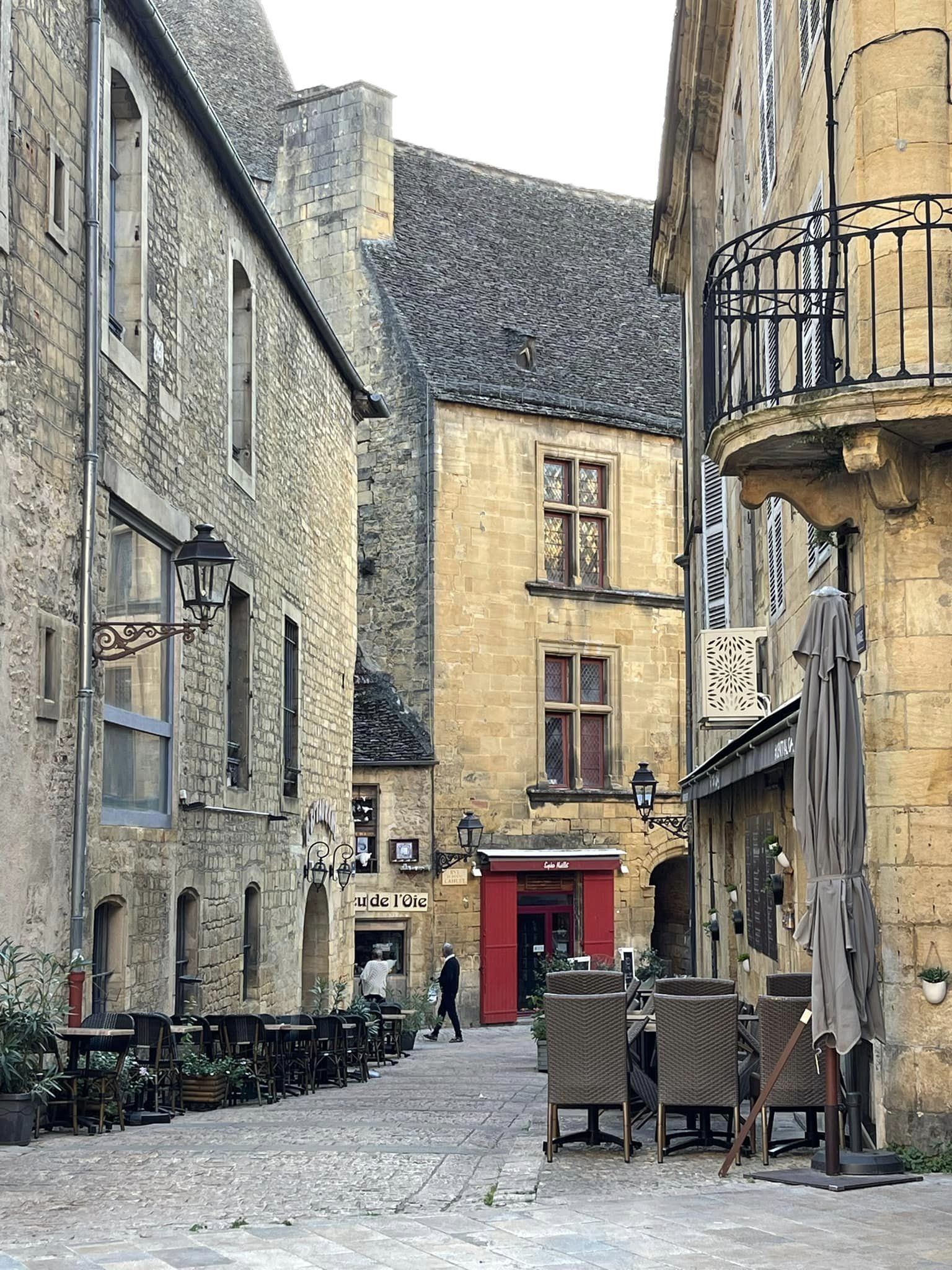
Wonderful streets of Sarlat.

This is a glorious part of France. In fact, I’d forgotten what a beautiful country France is. Everything we have seen so far is spotless and well kept.

Author signing his book.

We decided to buy a children’s book and one of the authors sketched the inside cover before signing.

Sarlat Cathedral.

A gaggle of geese.

This is Fois Gras country. The goose is revered

The Truffle Museum in Sarlat.

Also Truffle country.

View of Bynac Castle from our canoe.

Canoeing down the Dordogne river is amazing. I was concerned I’d find it a bit challenging getting in and out but our captain
made it easy!

Canoeing on the Dordogne River.

Susan's next post:
LASCAUX CAVES, DORDOGNE, FRANCE. November 13, 2023