Showing posts with label artist. Show all posts

Monday, October 20, 2025

RUTH ASAWA RETROSPECTIVE: Spectacular Hanging Wire Sculptures and Much More

Wire Sculptures, Ruth Asawa Retrospective, SFMOMA.

When I was in Oakland in August, I took BART to San Francisco to see the Ruth Asawa exhibit at SFMOMA, just before it ended. The exhibit, a retrospective of Asawa’s life’s work, will open in New York at the Museum of Modern Art on October 19. It is an amazing show, featuring not only Ruth Asawa's unique wire sculptures, but a wealth of her other work--drawings, paintings, and other media. 

Photograph of Ruth and her young son in front of a sculpture in San Francisco.

Ruth Asawa (1926-2013) began her art career at Black Mountain College (BMC) in North Carolina in 1946. In 1949 she moved to San Francisco with her husband, Albert Lanier, an architect, who had also been a student at BMC. They had six children! Ruth spent the rest of her life living and working in San Francisco and was active in the art community.

Meander, ink on paper, 1948-49.

The exhibit is arranged chronologically, and fills twelve rooms of the museum, beginning with her student work at Black Mountain College.

Ruth had a job in the college laundry. This design was created with the stamp that marked the college linens.

Folded paper design.

Throughout her early works you can see Ruth’s fascination with repetitive motifs, from folded paper, fabric designs, to pen and ink drawings.

 In these two pieces, one chair is defined with positive strong black strokes, the other by negative space.

Detail of chair. Created by repeated dabs of a felt tip marker.

Ruth’s first wire works were baskets, inspired by a trip to Mexico in 1947 where a craftsman showed her how he made egg baskets by looping wire.
 

Early works--baskets.

But what has made Ruth Asawa famous are her hanging wire creations of all sizes and shapes--some with shapes nestled within one another, some exploding outward, some resembling giant teddy bears, others like tear drops or space ships, some elegant, others whimsical, and some even calling to mind an extraterrestrial! In room after room the hanging sculptures were the center of attention in the SFMOMA exhibit. Although suspended by wires from the ceiling, they seemed to float in space.


One large room of the exhibit reproduces the living room of Ruth Asawa’s Noe Valley house in San Francisco, which was filled with hanging wire sculptures and other works of art, both hers and those of friends. Many of the same pieces seen in the photo were displayed in the room at the museum.


Photograph by Rondal Partridge of Ruth Asawa's family in her living room.

Ruth loved her garden. Among my favorite pieces in the room were watercolor paintings of a geranium and a detailed drawing of a sunflower.


The exhibit is huge, with more than 300 works of art. Truth be told, my friend and I only looked closely at half the exhibit, spending the first two hours in the first six rooms looking at each and every item. By then we were starving for lunch, and walked quickly through the remaining six rooms in order to exit through the gift shop, stopping briefly to look at just a few pieces. We had a tasty lunch in the museum café on the fifth floor. We could have reentered the exhibit after lunch, but would have had to stand in a long line, so decided not to. In any case I felt I had a good experience and I knew I would enjoy the exhibit again and again as I looked at my photos at home.


Casts of Ruth Asawa's hands.


Monday, October 14, 2024

NEW MEETS OLD: Contemporary African Art by Leilah Babirye at the de Young Museum, San Francisco, CA

Masks by Leilah Babirye at the de Young Museum in San Francisco.

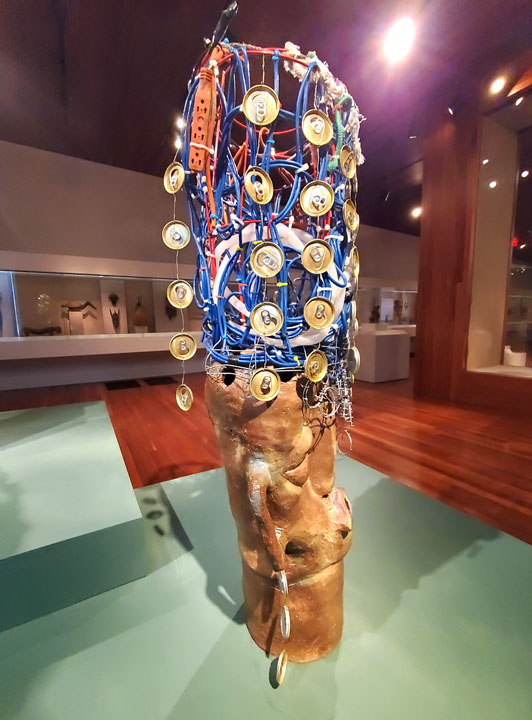
A new exhibit at the de Young Art Museum in San Francisco, called We Have a History, features the art of Leilah Babirye. At first, Leilah Babirye’s sculptures look like traditional African forms, but on closer look, the complex decorations turn out to be a colorful mixture of found objects—can tops, electrical wire, extension cords, PVC pipe, and whatever else she has happened to find. 

Auntie Muzumganda by Leilah Babirye, Ceramic, wire, and found objects.

Detail.

Leilah Babirye, born in Uganda, works in New York, creating busts, masks, and figures from ceramic and wood. This is her first solo museum show in the United States. Her work highlights the connection between the past and present in African art.

R. Peaceful Bride of Mwanga II, Leilah Babirye, Wood, wax, nails, wire, glue and found objects.

I saw Leilah Babirye’s exhibit when I was at the de Young Museum in July. Her art is displayed in the Art of Africa gallery, alongside the permanent exhibits of masks, paintings and other objects, thus tying Babirye’s work to the larger African tradition. 

Dance mask, Bogadjin people; Headrests, Tami people.

I was intrigued by her use of ordinary household objects and the way they become transformed into vibrant art when incorporated in the sculptures.

Carved wooden figure, Leilah Babirye.

Included in the exhibit is a video installation where we see Leilah Babirye at work in her studio. We see the intense and energetic way she attacks materials, turning them into the forms she intends. As she works we hear her talk about them.  Leilah Babirye’s sculptures, busts and masks are portraits of her LGBTQ+ community. Each one speaks for itself, inviting the viewer to take a closer look.

The exhibit, on the second floor of the museum, runs through October 26, 2025. 

For more information about visiting the de Young Museum of Art, click HERE.


Monday, December 6, 2021

FESTIVALS OF MEXICO, The Blessing of the Animals, Guest Post by Ann Stalcup

52 Places to Go: Week 49

Blessing of the Animals, Los Angeles, CA
My friend and fellow author Ann Stalcup has been fascinated by Mexican customs and culture for many years. She has taken numerous photographs in the Mexican communities of Los Angeles, California, where cultural events are celebrated frequently throughout the year. She has also visited areas of Mexico where she has observed many of the traditional festivals including The Blessing of the Animals, The Day of the Dead, and A Mexican Christmas. Here are a few of her photos and comments on the Blessing of the Animals.


THE BLESSING OF THE ANIMALS is celebrated each year on Saturday, the day before Easter. In Los Angeles, California, people gather with their pets at the historic center of the city on Olvera Street for this festival. Their pets can be as large as a horse or as small as a mouse, and each one is decorated with ribbons, hats, or flowers. Every type of pet is welcome. Many participants dress in colorful Mexican costumes. Everyone waits patiently in line as the robed priest sprinkles each pet with holy water and blesses it, thus ensuring a happy, healthy year ahead.
The Blessing of the Animals is a ceremony that has been a tradition for many years in some of the cities, towns, and villages of Mexico. Children bring their birds, crickets, frogs, lizards and other pets to be blessed.  There are rabbits and turtles, rats, guinea pigs, and monkeys.  There are parrots, canaries, and fish. Sometimes there is even a pet tarantula in the parade!
Mariachi Band
Before the parade begins a mariachi band of men dressed in elegant grey trousers and jackets perform their lively music.  Trumpets in harmony with violins get everyone in the mood for the fiesta.
At last the priest appears in his long robes.  He is usually one of the bishops of Los Angeles. People line up to have their animals blessed.  They celebrate on the plaza afterward.
Blessing of the Animals, Mural by Leo Politi
Near the plaza on Olvera Street is a beautiful mural of The Blessing of the Animals.  It was painted by Leo Politi, a Los Angeles artist.  He loved to paint children and wrote and illustrated many books for children about the special events that occurred in the city he loved.
Leo Politi at work on the mural

Ann Stalcup is the author of Leo Politi: Artist of the Angels (Silver Moon Press, 2004). For more information about Ann and her published work, visit her at her website: www.annstalcup.com

This post was first published at The Intrepid Tourist 9/8/14.

Monday, October 28, 2019

ANDY WARHOL: From A to B and Back Again, Exhibit at SFMOMA, San Francisco, CA

Andy Warhol, Self Portrait, at SFMOMA exhibit Andy Warhol: From A to B and Back Again
At the end of August, when I was in Oakland, I took the BART to San Francisco to see the fabulous Andy Warhol retrospective at the San Francisco Museum of Modern Art, Andy Warhol: From A to B and Back Again. (The title of the exhibit is taken from Andy Warhol's book, The Philosophy of Andy Warhol, 1975.) The show ended September 2nd but is  now at the Art Institute of Chicago where it opened on October 20th. (Previously, the show was at the Whitney Museum in New York.) 
Portraits of Elizabeth Taylor and Marilyn Monroe
The exhibit encompasses Andy Warhol’s career from his growing up years in Pittsburgh and early career in New York in the fashion industry, to his ground breaking conversion of soup cans and Brillo boxes to pop art, to portraits of Marilyn Monroe, Elizabeth Taylor, Jackie Kennedy, and much, much more.
Painting of S and H Green Stamps, created by making a stamp from a rubber eraser.
His painting of S and H green stamps (apparently inspired by helping his mother paste them into books) brought back similar memories of mine, filling books with stamps my family got at grocery stores and gas stations and then turning them in to redeem prizes. In the same room at the museum a pile of Brillo boxes and a diagram of dance steps to do the Lindy were displayed.
A pair of diagrams showing the pattern of foot-steps (one for the man, one for the woman) doing the Lindy, a popular dance originating in the 1920s
The exhibit was so big that at MOMA in San Francisco it took up space on three floors (plus one more if you count the examples of his black and white photographs displayed on the third floor of the museum.)
Mylar silver cloud pillows. Recreation of 1966 exhibit of helium filled Mylar balloons at the Castelli Gallery.
In one room, giant silver balloons formed a popular interactive exhibit. Visitors, especially children, enjoyed batting the cloud-like pillows into the air, creating a constantly changing 3-D art piece.
Flower paintings and cow wallpaper
The variety of Andy Warhol's creativity is astounding, ranging from painting and pop-art, to video, television, interactive and performance pieces, to magazines (Interview) and advertising.
The large Rorschah painting was inspired by the "ink blot test" created by Swiss psychiatrist Hermann Rorschach.  Warhol folded the canvas in half vertically to make a mirror image of the design.
Although I had long been aware of Andy Warhol’s soup cans and extravagant life style during the 1970s in New York, I never appreciated the breadth and brilliance of his creativity until I saw the exhibit of his work at SFMOMA.
A few of Andy Warhol's commissioned portraits.
Among my favorites were his portraits, displaying both his painterly style as well his impeccable sense of design and ability to capture the essence of his subject. From 1967 to 1987, Warhol made hundreds of commissioned portraits, typically using a combination of Polaroid photography, screen prints, and paint. One room at SFMOMA is dedicated to these portraits.
The giant image of Mao was created by Andy Warhol in 1972. (Acrylic paint, silkscreen ink, pencil on linen.)
To appreciate the giant painting of Mao Tse Tung one has to stand on the other side of the room. It is mounted on a recreation of the Mao wallpaper that was on the walls of Andy Warhol's studio.
Wilhelmina Ross
Andy Warhol often painted the same subject over and over, as in the case of Wilhelmina Ross. He painted her 73 times, originally as part of a commission by an Italian art dealer in 1974 for a series of 105 portraits of drag queens.
A matchbook with "Drink Coca-Cola" on its cover, has been blown up to giant size in this painting.
But what most people will remember about Andy Warhol is his elevation of ordinary objects, such as a bottle or glass of Coca-Cola, to the status of art, making us think twice about the role these objects play in our lives and our culture.

Monday, September 8, 2014

FESTIVALS OF MEXICO, The Blessing of the Animals, Guest Post by Ann Stalcup

My friend and fellow author Ann Stalcup has been fascinated by Mexican customs and culture for many years. She has taken numerous photographs in the Mexican communities of Los Angeles, California, where cultural events are celebrated frequently throughout the year. She has also visited areas of Mexico where she has observed many of the traditional festivals including The Blessing of the Animals, The Day of the Dead, and A Mexican Christmas. Here are a few of her photos and comments on the Blessing of the Animals.


THE BLESSING OF THE ANIMALS is celebrated each year on Saturday, the day before Easter. In Los Angeles, California, people gather with their pets at the historic center of the city on Olvera Street for this festival. Their pets can be as large as a horse or as small as a mouse, and each one is decorated with ribbons, hats, or flowers. Every type of pet is welcome. Many participants dress in colorful Mexican costumes. Everyone waits patiently in line as the robed priest sprinkles each pet with holy water and blesses it, thus ensuring a happy, healthy year ahead.
The Blessing of the Animals is a ceremony that has been a tradition for many years in some of the cities, towns, and villages of Mexico. Children bring their birds, crickets, frogs, lizards and other pets to be blessed.  There are rabbits and turtles, rats, guinea pigs, and monkeys.  There are parrots, canaries, and fish. Sometimes there is even a pet tarantula in the parade!
Mariachi Band
Before the parade begins a mariachi band of men dressed in elegant grey trousers and jackets perform their lively music.  Trumpets in harmony with violins get everyone in the mood for the fiesta.
At last the priest appears in his long robes.  He is usually one of the bishops of Los Angeles. People line up to have their animals blessed.  They celebrate on the plaza afterward.
Blessing of the Animals, Mural by Leo Politi
Near the plaza on Olvera Street is a beautiful mural of The Blessing of the Animals.  It was painted by Leo Politi, a Los Angeles artist.  He loved to paint children and wrote and illustrated many books for children about the special events that occurred in the city he loved.
Leo Politi at work on the mural
Ann Stalcup is the author of Leo Politi: Artist of the Angels (Silver Moon Press, 2004). For more information about Ann and her published work, visit her at her website: www.annstalcup.com