Monday, February 11, 2019

THE OLD GURUNG MUSEUM IN GHANDRUK, NEPAL Guest Post by Caroline Hatton at The Intrepid Tourist


Nepal. Old Gurung Museum and women wearing traditional clothing
Photo courtesy of guide Gyanendra Karki

My friend and fellow children’s book author Caroline Hatton went trekking in the Annapurna region of the Nepal Himalaya in November 2018. She took all but two of the photos in this post. For info about her books, visit www.carolinehattonauthor.com.

Northwest of Kathmandu, in the Himalayas, rises the mythic Annapurna mountain range. Below its snowy peaks, the verdant foothills are the homeland of the Gurung, one of many ethnic groups inhabiting Nepal. Some aspects of the Gurungculture are its own language and distinctive clothing.

Hugely popular treks such as those to the Poon Hill view point or Annapurna Base Camp and the Annapurna Circuit go through the region, which is a part the Annapurna Conservation Area, the largest national park in Nepal. Trekking here means walking up and down ancient trade routes, through villages and terraced fields, admiring magnificent scenery and a range of traditional to contemporary architecture, clothing, and technology. At lunch time, dal bhat (lentil soup and rice) comes in a traditional brass platter and bowl, and Coca-Cola in a plastic bottle.

The best glimpse I had of the daily life of long ago was at the Old Gurung Museum in Ghandruk, the second largest Gurung town. Ghandruk is also spelled Ghandrung, which can be confusing for jet lagged tourists.

The museum is inside what was once a traditional Gurung house. Its ground floor room is stuffed with a wealth of objects labeled in English with a description of their use. People exercised creativity and skill to make everything they needed from what they had—same as anywhere. Yet, I was thrilled to see the local rendition of this universal truth, from a straw basket for grain, woven tightly enough to keep mice out, to bamboo fencing strong enough to keep a buffalo in. Bamboo containers for milk were large, medium, or small, for cow, sheep, or goat milk, respectively.
Bamboo containers for milk
Bamboo was good for making cages for chickens, shelters for people, and baskets for every need: according to the label on a small one, “I use this basket to harvest the wheat and millet from the field. When it is full, I empty it into a larger basket. This way I don’t have to carry the large basket all day.”
Bamboo baskets
The shiny brass pots and pans, platters, plates, bowls, and cups, were like the ones still used today to serve dal bhat.
Brass containers
On a post hung a brass noodle maker, not to make noodles out of brass, but a brass tool used to make rice noodles, as seen in this short video: https://www.youtube.com/embed/h3WUu576s1k

Wool blankets had designs in some of my favorite colors, ivory, beige, and brown. Musical instruments, such as the one with a bow like a small violin, hung here and there. Wood was used to make beds, spinning and weaving tools, and all kinds of containers.
Wooden yogurt container, making me hungry.
As usual, I made all the others in our group of four trekkers, two porters, and one guide, wait outside forever, while I examined and photographed things inside. I love rustic stuff even though I grew up in fancy France, exposed to fine china and crystal and silverware. Perhaps this is because it suits my taste for natural materials and preference for minimizing the use of resources.
Gurung traditional clothing (over a contemporary jacket)
Photo courtesy of guide Gyanendra Karki
Visitors can request to try on traditional Gurung clothing, as in the top and bottom photos in this post. The patterns, colors, women’s jewelry, and men’s hats distinguish them from those of other Nepali tribes.

To experience family-style Gurung hospitality, you can request a stay at Nani’s teahouse in Tolka (see my Jan 14, 2019 post on this blog) by e-mailing English-speaking guide Gyanendra Karki at guidegyanendra@gmail.com. Until then, say goodbye by putting your hands together and saying, “Namaste!”

For more info:

Read about the Gurung (Tamu) Ethnographic Museum  in Pokhara, the city through which visitors come to Ghandruk. Tamu is what Gurungs call themselves in their own language.

Visiting Nepal: the essential information.
 
All text and photos copyright Caroline Arnold 

Monday, February 4, 2019

From EMPANADAS to PISCO SOURS: Enjoying Chile’s Favorite Foods

Individual bowls of Pastel de Choclo, a favorite Chilean dish, ready to bake in the clay oven.
On our recent trip to Chile it seemed that every meal was a feast–ranging from sumptuous hotel buffets to large family holiday parties to picnics in the country to meals in local restaurants–each time giving us tastes of delicious Chilean foods.
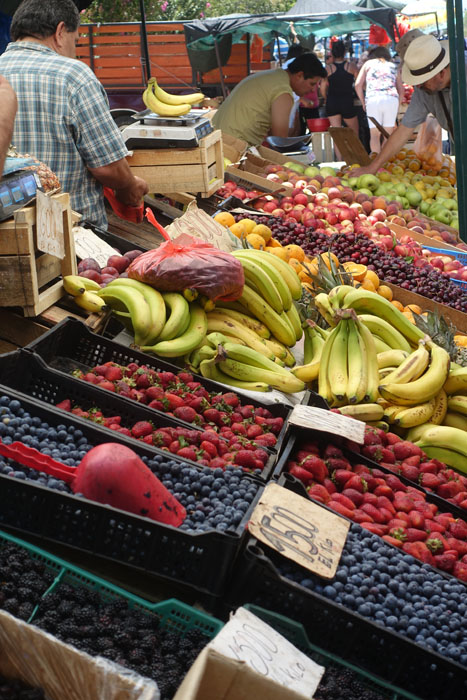
Blackberries, blueberries, strawberries and more fill the summertime farmer's markets.
It was December, the beginning of the southern summer, and the markets, or ferias, were full of juicy, locally grown, ripe fruits and vegetables. Many meals were eaten outdoors, often cooked on a barbecue or in a woodburning clay oven (horno.) And every meal included side dishes of tomatoes (tomates, always peeled), lettuce (lechuga), sliced cucumbers (pepinos) and avocados (palta.)
Typical side dishes. String beans, julienned and served as a cold salad, are a traditional Christmas dish.
A classic dish of Chile is pastel de choclo, a kind of casserole made of beef, chicken, onions, olives, raisins, and a wedge of hard boiled egg, which is then covered in a corn pudding topping and baked in a clay oven. We had pastel de choclo at a family party where guests formed an assembly line to prepare the ingredients. Each serving was cooked in the outdoor clay oven in its own ceramic bowl and then served steaming hot at a long picnic table.
Humitas. They can be made savory, sweet, or sweet and sour, served with added sugar, chile pepper, salt and paprika
The same corn mixture was used to make humitas, similar to tamales, but cooked in fresh rather than dried corn husks. I helped to make the humitas–my job was to secure the husks with a string made from a thin strip of a long leaf, making them look like fat bowties. The humitas were then steamed in a large pot on top of the stove.
Empanadas ready to bake.
Another classic dish of Chile, and elsewhere in South America, is the empanada, a kind of individual meat pie. They are fried or baked (empadanas del horno.)  Empanadas can be filled with meat, cheese, vegetables or other ingredients, but the typical filling in Chile is pino, a meat mixture made of beef, onions and herbs.
Clay oven with  empanadas inside.
During our trip, we spent three days in the country where our son-in-law’s father lives, enjoying fresh milk and vegetables every day from his neighbor’s farm and eating homemade empanadas.
Roadside stand for "The place where you can buy houseplants, beans, tomatoes, and lettuce."
The project of the visit was not only to make the empanadas (I helped roll the dough) but to build the clay oven!
At another family party during our trip, the main dish was cocimiento, a rich stew of vegetables, beef, chicken, fish and seafood (clams and mussels), flavored with wine and cooked slowly in a large pot over a barbecue. It is a bit like paella without the rice. Fish is delicious in Chile and we enjoyed it at several meals during our stay. With a coastline 2,653 miles long, a wide assortment of fish and seafood is always fresh and available.
"The King of Mote con Huesillo" offers drinks at his stand in the main plaza in Temuco. In the background are Chilean palm trees, whose flowers are used by bees to make honey.
Mote con Huesillo. The barley and peach sink to the bottom.
A typical summer drink in Chile is called mote con huesillo, made from dried peaches soaked in water to make a kind of tea, to which sugar and cooked barley is added. On a warm day it is very refreshing!
Enjoying a cafe helado.
On one of our restaurant visits my grandchildren ordered café helados another favorite Chilean treat. It sounds like it should be iced coffee, but café helado is actually an ice cream soda made with coffee, ice cream, and topped with whipped cream and wafer cookies–more like a dessert than a drink!
And, of course, on New Year’s Eve we drank the classic pisco sours, a lemon flavored drink similar to a whiskey sour, but flavored instead with pisco, a distilled alcohol made from grapes that is unique to Peru and Chile. (My only photos are of empty glasses so you'll have to imagine what our pisco sours looked like!)
And these are just a sample of Chile's delicious foods! 


Monday, January 28, 2019

HUILO HUILO BIOLOGICAL RESERVE: Volcanoes, Waterfalls and Towering Rainforests, Chile’s Lake District, Part 2

Huilo Huilo, Chile: On the deck at the top of the teleferico (aerial tramway) facing the volcano
On our second morning at Huilo Huilo we slept in again (getting used to the time change–five hours earlier than California), but got up in time to have breakfast and be at the stables for a horseback ride at 11:00.
During our horseback ride all the horses much preferred eating the daisies!
It was a warm spring day and flowers were everywhere. We rode through a field of daisies, lupins, Queen Anne's Lace, and wild roses, and then into a forest, before looping back through the flower field to the stables.

Before our ride we had taken a short walk to Salto Huilo Huilo, a magnificent waterfall located nearby.
Salto Huilo Huilo gives the reserve its name. In Mapudungan, the language of the Mapuche, Huilo Huilo means "deep crack" or "deep fissure"
The Spanish word for waterfall, salto, is from the verb saltar, to jump, and the masses of water were truly jumping over the brink to the river below, showing the power of nature in full force.
The tunnel provides access to the Salto de Puma falls through the thick foliage at the water's edge.
After lunch at a restaurant in Neltume (I had a churrasco sandwich–meat and avocado in a large roll) we drove to the trail head for another waterfall, the Salto de Puma, a longer walk ending in a path through a tunnel made of dried bamboo.
Salto de Puma. Although pumas, or cougars, are known to live in the reserve, they are rarely seen.
At the end of the tunnel is a dramatic opening to a platform in front of the falls, which thunders into the pool below..
View of the town of Neltume from the top of the teleferico. Neltume gets its name from two Mapudungun words meaning “To go to freedom” (Neltún: let free, Men: to go there).
We then returned to the hotel for a short rest before going to the cable car (teleferico) station near the museum for a ride to the top of the mountain. For dinner we had pizza in the cafe at the Petermann Brewery across the road from the hotel--where one can also see the vats where the beer is brewed.
The path to the waterfalls goes through a cave formed by a lava tube.
On our last morning, after another sumptuous buffet breakfast at the hotel, we checked out and headed back to Temuco, stopping along the way for one last walk–this time to a lava tube cave and then to another waterfall.
Rapids below the waterfall
The path was marked as a circular trail and ended up being much longer than we expected, descending to the river level to see the waterfall, then hiking back up to the entrance past an electricity generating station.
And then it was time to get back in the car for our ride back to Temuco and our flight to Santiago.Our three days in Huilo Huilo had been full of activities enhanced by perfect weather--warm but not hot and clear blue skies. We wished we could have stayed longer but it was time to go celebrate Christmas with family. It was the perfect beginning to our third trip to Chile.
Adventurous hikers could follow the path behind the waterfall, but risked getting wet!
For a report of our previous trip to Chile, in December 2009, when we went to the far north and visited the Atacama Desert, click HERE for Part 1, and HERE for Part 2. 

Monday, January 21, 2019

HUILO HUILO BIOLOGICAL RESERVE: Volcanoes, Waterfalls and Towering Rainforests, Chile’s Lake District, Part 1

Volcano Mocho-Choshuenco rises above Lake Panguipulli in Chile's southern lake district.
It was the first day of summer in the southern hemisphere. Birds were singing and a profusion of wildflowers blanketed fields and roadsides as we made our way toward Huilo Huilo Biologic Reserve at the base of the Andes in Chile’s lake district. (Huilo Huilo, pronounced, WEEL-oh-WEEL-oh, is a private for profit natural reserve and ecotourism project in southern Chile.)
Huilo Huilo is in the Patagonian Rainforest
We had landed at the Temuco airport, where we rented a car for the two and a half hour drive–made a little longer by our stop to take photos at the dramatic viewpoint on Lake Panguipulli toward the snowcapped volcano Mocho-Choshuenco, rising 2413 meters (about 7500 feet) into the blue sky.
The road to Huilo Huilo follows the shore of long Lake Panguipulli
After checking in at our hotel, we spent the next three days exploring the reserve, hiking, horseback riding, and learning about the unique life in this southern temperate rainforest. Plastic wristbands gave us free entry into most trails and facilities.
A spiral walkway around the atrium of the Nothofagus hotel leads to rooms facing the treetops.
This was a family vacation with our daughter, her husband, and their two teenage children, and there were activities for all ages to enjoy. We were staying at the Nothofagus Hotel, named after the tall trees endemic to the area. The hotel, built almost entirely of wood, surrounds a Nothofagus trunk and resembles a treehouse, with rooms looking out into the canopy.
Cheerful yellow plastic birds mark the trails in the Huilo Huilo reserve.
From our deck we could hear the roar of the river a short distance from the hotel. Before dinner we took a short walk along the river path to Salto de la Leona, one of several waterfalls in the reserve where masses of water from spring snowmelt were crashing over the edge.
A full moon rises over the mountains in the east (the Andes)
At sunset we went up to the roof deck to watch the sun disappear behind the volcano. Later, we watched the full moon rise in the east, so bright that it eclipsed most of the stars.
A herd of red deer gathers at feeding time. In December (spring in Chile) the male's antlers are covered in velvet.
On our first morning at Huilo Huilo  we crossed the road and  followed the trails (senderos) leading to the large enclosure where a herd of deer (ciervos) lived and to another smaller enclosure with a group of wild boars (jabali). We were able to observe the animals up close via raised walkways and they appeared quite oblivious of us.
A lively group of young boars, still with their striped coats, were frolicking in the enclosure.
We then walked around a large pond and its border of giant leaves to the nearby Volcanoes Museum.
Mapuche woman
Silver jewelry made by the Mapuche displayed in the Volcanoes Museum. The Mapuche (meaning "people of the land") are the largest ethnic group in Chile and constitute approximately 10% of the population (more than 1,000,000 people.)
The Volcanoes Museum is filled with exhibits of animals, minerals, fossils, history of the indigenous Mapuche people, a reproduction of a copper mine, and, rather oddly, a carved mammoth tusk from China.
Stone markers in the Mapuche style outside the Volcanoes Museum
After a lunch of empanadas, the classic Chilean meat filled pastries, that we had purchased from a stand in the local town of Neltume, we spent the afternoon relaxing in the hotel spa. We were still recovering from jet lag--the time difference in December between California and Chile is five hours. At dinner that evening in Puerto Fuy, just a few kilometers down the road, Art and I enjoyed our pisco sours, the classic drink of Chile. Back at our hotel that evening Art, Jennifer and Humberto attended a free workshop–learning how to make the perfect pisco sour, or the Huilo Huilo variation, which adds blueberries to the mix.
Pisco sour workshop.
Plans for our next day included horseback riding and a ride on the teleferico (funicular) up the mountain. Part 2 of our visit to Huilo Huilo will post next week.

For a map and directions for getting to Huilo Huilo click HERE.

Monday, January 14, 2019

A MOUNTAIN TEAHOUSE STAY IN NEPAL Guest Post by Caroline Hatton at The Intrepid Tourist


Nani's Teahouse in Tolka, Nepal
My friend and fellow children’s book author Caroline Hatton went trekking in the Annapurna region of the Nepal Himalaya in November 2018. She took all but one of the photos in this post. For info about her books, visit www.carolinehattonauthor.com.

For the grand finale of a spectacular hiking trek in the Annapurna region of the Himalaya, our Nepali guide, Gyanendra, gave our group the option of staying at a small teahouse instead of a big tourist lodge. My husband and I and the other couple in our group all jumped at the chance.

Our guide, Gyanendra
(Selfie courtesy of Gyanendra)
When we arrived at the teahouse in Tolka, the hostess, Nani, welcomed us warmly. Our duffle bag was already in our room. It contained our night stuff (sleeping bags, towels, toiletries…). Our porter, Vishnu, carried it on his back all day every day, then delivered it to our room every afternoon.

Our hostess, Nani
We dropped our two daypacks in our room. These contained what we needed hiking all day: water, snacks, sunscreen, jacket, first-aid kit… same as when day hiking at home in California. We never carried lunch food, because every day, we ate lunch at a restaurant on the way.

Everything at Nani’s teahouse was basic but impeccably clean: rooms, beds, one shared toilet, and one shared shower. The shower water temperature was exquisitely hot at 42o C (~108 o F).
Room for two
“Would you like to see Nani’s goats and buffalo?” Gyanendra asked, bravely—he knew, after guiding our group for a week, that I love animals and can make him wait forever while I take photos. Two of us followed him up steep stone steps to visit terraced fields where Nani grows different crops (spinach, millet, chilies…). Above the chicken coop level, steps carved in the brown soil led up a slope that felt nearly vertical. I’ll never be able to go down this, I thought. But I didn’t say a word because I really wanted to see the animals.

I made it to the shelter where a baby goat and mama goat were busy sharing a meal of fresh greens with a buffalo. I took tons of photos. I would have taken more, but the buffalo kept giving me concerned stares, so I backed away, afraid I’d give it indigestion.
Nani’s goat and buffalo shelter
The sun was going down. It was time for me to go down too. But how? Slide down on my bottom? Instead, I turned to face the slope and climbed down, as if on a ladder. On the way, Gyanendra picked tree tomatoes and different chilies for dinner.
Front to back: tree tomatoes, balsam apples, chilies, egg
In the cozy kitchen, lit only by the wood fire under the wok and one electric light, Nani offered to teach us how to make momos, the popular, quintessential Himalayan dumplings. Filled with seasoned, minced vegetables or ground meat, they are steamed or deep fried, then served with chutney. One member of our group was thrilled to sink her hands in wheat flour and water to knead dough and roll it out to make momo wrappers. She minced vegetables for the stuffing and made momos, some balls, some crescents.

Gyanendra cut up buffalo meat and used a stone to grind seasonings for his secret curry recipe. As for me, my favorite part of cooking is inventing excuses to avoid doing it, such as the need to take photos. The two husbands peeked in from the open doorway.
Gyanendra cuts buffalo meat. Nani cooks vegetables.
Before dinner, Nani put away her goats to protect them from potential attacks by a tiger (bagh in Nepali) or leopard (chituwa in Nepali). Tolka is within the range of both wild cats, although it would be rare for either one show up. It would be more likely at night when there is no human activity.

When dinner was ready, the four of us guests were invited to sit at the kitchen table. The steamed vegetable momos had the finest stuffing of all those I’ve ever tried between Los Angeles and Kathmandu—tasty, rich with mixed, balanced flavors. And darn, now I’ll never know Nani’s recipe, since I was too lazy to help make dinner. The buffalo stew was delicious with rice, but too spicy for two of us with timid stomachs. Our two hardworking porters gladly helped eat it all up.

Up at 6 o’clock the next morning, we found Nani working quietly in the kitchen. “Go see the mountain,” she said, pointing up the trail, back the way we had arrived the day before. Two minutes away, from the top of the slope, where I’d seen nothing but clouds the day before, rose a snowcap gleaming in the rising sun: Annapurna South.
Sunrise on Annapurna South as seen from Tolka, Nepal
For breakfast, we sat at the outdoor table, facing the trail and the hills beyond. Our porters brought coffee, tea, eggs to order, big fluffy pancakes made by Gyanendra, jam, and honey.

I asked Gyanendra whether Nani grows enough vegetables for her needs. He said yes, and much more to sell. He and the porters bought from her, at prices lower than at home, soy beans, kidney beans, tree tomatoes, dried chilies, and buffalo ghee. They had ample room to carry extra weight back home, because all of us guests had minimized our overnight duffles. Each couple was allowed two duffles weighing a maximum total of 22 kilos (~ 48 pounds), but we had only one 10-kilo duffle for two.
                                                                                                                  
At Nani’s teahouse, we found the differences with larger lodges to be fewer rooms, so our group had the whole place to ourselves. We saw how a local person lives, grows food, and cares for her animals. She welcomed us into her kitchen for a hands-on experience. But everyone ate the same starter and main dish for dinner that night, not like at bigger lodges where we could each order from a menu of a dozen starters and two dozen main dishes.  

We are glad we chose Adventure Treks Nepal, from the list recommended by Lonely Planet, to organize our trip. It included only the guests of our choice, one guide, and one porter/couple of guests. Before the trip, manager Gyan Karki always answered e-mails within minutes. During the trip, everything went smoothly. We had a Plan A, but the itinerary was adjustable day by day, with Gyanendra contacting all the lodging places by phone in advance of our arrival. After coming home two months ago, I still wake up every day eager to relive my adventures, reread my trip notes, review my photos, and share the experience of a lifetime.

For more info


Caroline recommends her trek organizer, Adventure Treks Nepal, https://www.adventuretreksnepal.com/.

Visiting Nepal: the essential

All text and photos copyright Caroline Arnold

Monday, January 7, 2019

Broulee, Australia: Pristine Beaches and Friendly Wildlife, Guest Post by Tom Scheaffer

Broulee, Australia
My brother Tom loves to travel and is currently on an extended trip to Australia and beyond. Here is a report of one of his first stops in Australia, the beautiful beach in Broulee, on the coast of New South Wales.
Broulee Beach
In early December I left my home in San Diego and flew to Canberra, Australia, to visit friends. We drove from there for about two hours to Broulee, on the coast of New South Wales, south of Sydney. It is an idyllic seaside location with beautiful blue and turquoise green waters and amazing beaches with nobody on them.
Beach good for snorkeling
We found amazing places to swim and snorkel. The water was crystal clear and it truly was a paradise.
Broulee Island Nature Preserve is the island on the upper left
I went to the Broulee Island Nature Preserve, now connected by a sand spit to the mainland. This verdant nature area offers walks amid birds and rock pools. It is very untouched and the variety of birds was amazing.
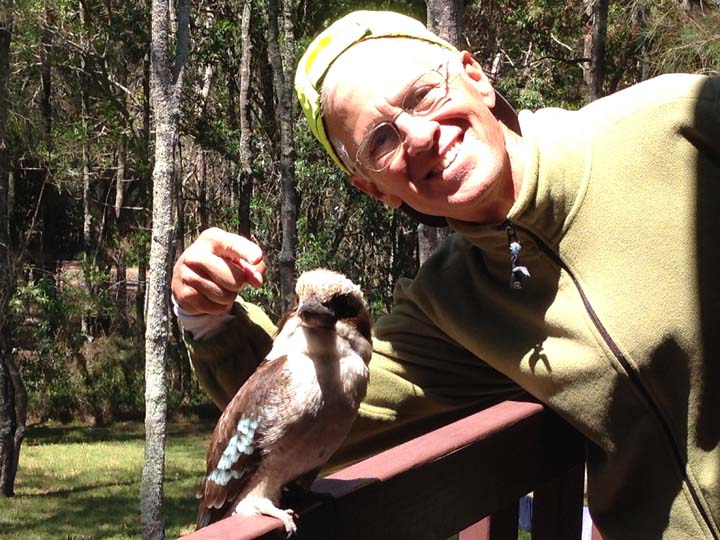
Kookaburra
The parrots and kookaburras came onto the veranda and we saw them within an arm’s distance.
King Parrot
This was an amazing trip that I won't forget. If you ever get the chance go to Broulee, Australia, you will find pristine uninhabited beaches and amazing nature and wildlife.
Tom and friendly Kookaburra

Monday, December 31, 2018

HAPPY NEW YEAR!

Every New Year’s Eve in Taiwan the tallest building in the country (and once the tallest in the world), Taipei 101, is the center of an impressive fireworks display visible for miles around. When we were in Taipei in October, we had our photo taken with a picture of the tower and fireworks in the background. We are with our gracious host for our visit to Taiwan, Liang-Yo, who watches the real fireworks every New Year's Eve with his family.
Tomorrow it is the beginning of a new year. Wherever you celebrate I wish you a very

                              HAPPY NEW YEAR 2019!