Showing posts with label fish. Show all posts

Monday, November 15, 2021

From EMPANADAS to PISCO SOURS: Enjoying Chile’s Favorite Foods

 52 Places to Go: Week 46

Individual bowls of Pastel de Choclo, a favorite Chilean dish, ready to bake in the clay oven.
On our recent trip to Chile it seemed that every meal was a feast–ranging from sumptuous hotel buffets to large family holiday parties to picnics in the country to meals in local restaurants–each time giving us tastes of delicious Chilean foods.
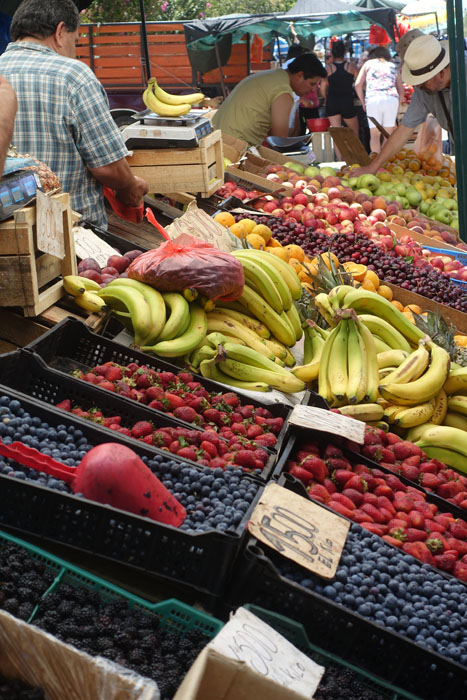
Blackberries, blueberries, strawberries and more fill the summertime farmer's markets.
It was December, the beginning of the southern summer, and the markets, or ferias, were full of juicy, locally grown, ripe fruits and vegetables. Many meals were eaten outdoors, often cooked on a barbecue or in a woodburning clay oven (horno.) And every meal included side dishes of tomatoes (tomates, always peeled), lettuce (lechuga), sliced cucumbers (pepinos) and avocados (palta.)
Typical side dishes. String beans, julienned and served as a cold salad, are a traditional Christmas dish.
A classic dish of Chile is pastel de choclo, a kind of casserole made of beef, chicken, onions, olives, raisins, and a wedge of hard boiled egg, which is then covered in a corn pudding topping and baked in a clay oven. We had pastel de choclo at a family party where guests formed an assembly line to prepare the ingredients. Each serving was cooked in the outdoor clay oven in its own ceramic bowl and then served steaming hot at a long picnic table.
Humitas. They can be made savory, sweet, or sweet and sour, served with added sugar, chile pepper, salt and paprika
The same corn mixture was used to make humitas, similar to tamales, but cooked in fresh rather than dried corn husks. I helped to make the humitas–my job was to secure the husks with a string made from a thin strip of a long leaf, making them look like fat bowties. The humitas were then steamed in a large pot on top of the stove.
Empanadas ready to bake.
Another classic dish of Chile, and elsewhere in South America, is the empanada, a kind of individual meat pie. They are fried or baked (empadanas del horno.)  Empanadas can be filled with meat, cheese, vegetables or other ingredients, but the typical filling in Chile is pino, a meat mixture made of beef, onions and herbs.
Clay oven with  empanadas inside.
During our trip, we spent three days in the country where our son-in-law’s father lives, enjoying fresh milk and vegetables every day from his neighbor’s farm and eating homemade empanadas.
Roadside stand for "The place where you can buy houseplants, beans, tomatoes, and lettuce."
The project of the visit was not only to make the empanadas (I helped roll the dough) but to build the clay oven!
At another family party during our trip, the main dish was cocimiento, a rich stew of vegetables, beef, chicken, fish and seafood (clams and mussels), flavored with wine and cooked slowly in a large pot over a barbecue. It is a bit like paella without the rice. Fish is delicious in Chile and we enjoyed it at several meals during our stay. With a coastline 2,653 miles long, a wide assortment of fish and seafood is always fresh and available.
"The King of Mote con Huesillo" offers drinks at his stand in the main plaza in Temuco. In the background are Chilean palm trees, whose flowers are used by bees to make honey.
Mote con Huesillo. The barley and peach sink to the bottom.
A typical summer drink in Chile is called mote con huesillo, made from dried peaches soaked in water to make a kind of tea, to which sugar and cooked barley is added. On a warm day it is very refreshing!
Enjoying a cafe helado.

On one of our restaurant visits my grandchildren ordered café helados another favorite Chilean treat. It sounds like it should be iced coffee, but café helado is actually an ice cream soda made with coffee, ice cream, and topped with whipped cream and wafer cookies–more like a dessert than a drink!
And, of course, on New Year’s Eve we drank the classic pisco sours, a lemon flavored drink similar to a whiskey sour, but flavored instead with pisco, a distilled alcohol made from grapes that is unique to Peru and Chile. (My only photos are of empty glasses so you'll have to imagine what our pisco sours looked like!)
And these are just a sample of Chile's delicious foods!  

This article first appeared 2/4/19

All text and photos copyright by Caroline Arnold.


Monday, May 31, 2021

PLACE OF REFUGE on the BIG ISLAND OF HAWAII by Caroline Arnold at The Intrepid Tourist

 52 Places to Go: Week 22

Place of Refuge, National Historical Park, Hawaii
When I am on the Big Island of Hawaii, one of my favorite places to visit is Pu’uhonua o Honaunau, the Place of Refuge, a 45 minute drive south of Kona. At the edge of the ocean, it is the perfect place for a picnic lunch, exploring tide pools, and learning about ancient Hawaiian culture. Once a sacred spot, it is now a National Historical Park.
Coconut palms line the shore in the Place of Refuge
On our recent visit to Hawaii we spent an afternoon there. After listening to an introductory talk from a park ranger, we explored the grounds on our own following the numbered posts that were explained in our brochure.
Carved figures guard the heiau (temple) where the bones of 23 chiefs are contained.
The first Polynesians arrived in Hawaii about a thousand years ago. People settled the islands and lived in family groups governed by chiefs or alii. Complex rules or kapu  governed every aspect of life. If kapu was broken the punishment was death. BUT if the person could make it to a designated place of refuge or Pu’uhonua, a priest could cleanse the sins and the person could return to village life. During times of war the Pu’uhonua was also a sanctuary for children, elders and noncombatants. Defeated warriors could also seek safety in the refuge. When the battle was over, they returned home.
This 12 foot high stone wall, built without mortar, divides the royal grounds from the Place of Refuge
There are two main parts to the park–the royal grounds, which is where the priests lived, and the Pu’uhonua or Place of Refuge.
Fish pond in the royal grounds
In the royal grounds there are several shallow ponds that were used to keep fish for the royal menu.  As we looked into the water we could see dozens of circular depressions in the bottom of the pond, each occupied by a pair of fish. These were their nests.
Each circular nest is guarded fiercely by its occupants
Before metal was introduced to Hawaii by Europeans, tools and building materials were made of stone, wood, shells and other natural materials.
Two shelters in the royal ground display examples of canoe making and other craft skills.
 
Small holes carved in the surface of this rock were used for playing a strategy game called konane. It is played with black and white pebbles.
Complex rules governed ancient Hawaiian society.  In the time of kapu, examples of infractions included a man eating with a woman, a fisherman catching a fish out of season, or a commoner casting his shadow on a chief. In 1819 the tradition of kapu ended and the places of refuge were no longer necessary. Elsewhere on the Hawaiian islands were other Places of Refuge. This is the only one that has been preserved.

All text and photos copyright Caroline Arnold at The Intrepid Tourist

Sunday, April 25, 2021

THE AFRICA TRIP, 50th ANNIVERSARY: Celebrating 10 Years of The Intrepid Tourist, by Caroline Arnold

 52 Places to Go: Week 17

Caroline and Jennifer (age 18 months), Uganda, 1971


Celebrating 10 Years of The Intrepid Tourist

Exactly fifty years ago today, on April 25, 1971, I arrived in Kampala, Uganda for a four month stay in East Africa, while my husband Art participated in a field course in animal behavior. The following blog post about my experiences was first published here ten years ago, on the 40th anniversary of the trip. Still my most memorable travel experience, a repost of that blog seems a fitting choice to celebrate ten years of The Intrepid Tourist. My plan when I first launched The Intrepid Tourist was to share some of my own travel experiences, but it has expanded over the years to include the photos and travel adventures of friends and family as well, for a total of more than 500 posts to date. I am deeply grateful to everyone who has contributed to the blog and for all my dedicated readers.

Trip of a Lifetime, East Africa, 1971
 In 1971, Art, along with four other graduate students at Rockefeller University in New York, embarked on a four month field course in western Uganda.  I didn’t want to miss out on a chance to go to Africa, even with a year-old baby (our daughter, Jennifer) to look after. One other student wife, Mary Sue, went along on the trip and we became traveling companions. During the first six weeks of the course, while our husbands were doing research in the Kibale forest near the town of Fort Portal, Mary Sue, Jennifer, and I traveled in Kenya and Tanzania.  Then, for the second half of the course, conducted in Queen Elizabeth National Park, we were able to join our husbands.

The Africa trip was a key life event for everyone who participated.  The following reminiscences are part of a collection of memories compiled to mark the anniversary and to honor of Peter Marler, who conceived of and organized the trip.  The Africa trip experience can never be repeated.  Africa, and we, have changed greatly in the last fifty years. This post is a trip down memory lane.  I hope you will enjoy reading it.

Impact on My Life
As a wife, I was not involved with the course itself, but without it I would never have had the opportunity to go to Africa. At the time, I had not yet begun to write books for children, but my experiences seeing wildlife, meeting people who lived and worked in Africa, and just being there has been important for many of the books I’ve written since then. In a larger sense, the trip also greatly impacted my world view. Before then, I had never traveled outside the United States and had no idea what it was like to live in a third world country or in a place so rich with wildlife. From the time I was a child, I had always dreamed of travel and adventure. The trip to Africa certainly fulfilled that dream. When I do school presentations and kids ask me what was the most exciting place I’ve ever been, the answer is always the same–Africa.

My memories of the three months in Africa are vivid, reinforced by the hundreds of photos we took (some appear in my books) and by letters and diary entries. My parents eagerly awaited my weekly letters, vicariously traveling Africa with me. My father typed all the letters, making them legible, and put them into a book. I have put a few excerpts below. I used my diary mostly to record animal sightings, brief reports of the events of the day, and our dinner menus. One entry says we ate stewed waterbuck, from meat given to us by a park ranger! The diary also documents the arrival of the Marler family at QE, a greatly anticipated event.

Thank You, Peter Marler

Dr. Peter Marler and Jameson's Wattle in the Kibale Forest near Fort Portal

Peter Marler accompanied us on the trip from New York to Uganda, herding us through the airport like a troupe of wayward Cub Scouts. He had made this trip before, and I was grateful for his expertise both in the larger organization and in the details. In the Amsterdam airport, he introduced us to smoked eel sandwiches. In Kampala he took us to an Indian restaurant to try the delicious East African style samosas. He also pointed out the “bat tree” along the main road, where hundreds of fruit bats hung like small black umbrellas during the day. After helping the students set up at Kanyawara, Peter went back to New York, returning a month later with his wife Judith and their kids. They camped out not far from us at QE and I remember being glad to have them nearby.

Only now do I realize the scope of the Field Course and how Peter’s vision for it made it happen. Now, on the fortieth anniversary of the Africa trip, I would like to thank Peter for creating the Field Course and for allowing me and Jennifer to tag along, providing us with the opportunity to have our own African experience and to share a bit of Art’s. Together with Art’s experiences during the course, and our travel together afterward in southern Uganda, this period still ranks as the most outstanding in our lives.

UPDATE July 14, 2014:  Sadly, Peter Marler passed away July 5, 2014.  Click HERE for his obituary in the Los Angeles Times.  Peter was a great friend, inspiring teacher, and intellectual giant.  He will be greatly missed.

The following entries are from my diary (in italics) and letters to my parents in California:

Queen Elizabeth National Park

The Students Camp:  Our accommodation at Queen Elizabeth (our room is the open door)

June 23, 1971
Arrived at Queen Elizabeth Park.

June 27, 1971

Mweya is an open, almost stark bluff above a large lake and channel which are filled with fish and hippos. At night the hippos come out of the water and up here to feed on the bushes, so one cannot step out of doors after dark. There are also elephants, bush pigs, and marabou storks, which wander in and out the camp area day and night. The windows of our room face the “Canteen”–the local native hotspot–and at night we hear loud music from that side, while from the other side we hear snorts of the hippos and elephants. I was under the impression that someone came in the night to empty our garbage can until I realized that the elephants and marabou storks were removing it all.

I am quickly reviving all my Girl Scout talents. We aren’t actually “camping” in that we have a room with three cots in it, but I am cooking all our food over a wood fire (which is tricky since we have a bare minimum of equipment.) The biggest problem besides obtaining food is water since it all must be boiled. At Mweya the only foods available are eggs, milk, and bread from the local Indian shop, tomatoes, bananas and matoke from the very small market, and you can buy fish from the Canteen.
Jennifer pointing to the eye of one of the tilapia (to be our evening's dinner)
July 4, 1971
Food supply here is very erratic. For the last three days there haven’t been any eggs and one day we had trouble getting fish. Tilapia–a tender, sweet fish–is the mainstay of our diet. It costs about 10 cents for two large fish. Pineapples, 10 cents each and bananas, 2 cents for four, are the main fruits. Vegetables vary but tomatoes and onions are always available.
Dad, it’s a good thing I used to watch you fillet fish when I was little, because that’s what I have to do every day. I’ve become quite an expert! We throw the remains to the marabou storks who hang around expectantly while we work. The dominant stork in group is apparent by the puffed pouch under its throat.

There are little lizards all over and the other day a four foot snake crawled into my shower as I left. I didn’t wait to see if it was poisonous. Apparently there are some really deadly snakes in the park and I don’t care to run into any of them!

July 5, 1971
Invasion of “dudus”–a small lake fly–in swarms of millions which clung to walls, food, people, and made the air thick.


July 7, 1971
Mary Sue found a baby bat.
Marlers arrived.
Euphorbia and Canteen, Mweya, Queen Elizabeth National Park
July 8, 1971
Showed Judith Marler local shopping spots–duka, market, and canteen–and got chased by a mad elephant twice and accosted by an incoherent drunk in canteen.
Had tea at Lodge.
Art out all night.

July 9, 1971
For excitement lately we have had an earthquake (a small one), an invasion of millions of lake flies (which just as suddenly vanished two days after they arrived), and I was charged by a mad elephant. We were walking to the market and making a wide path around an elephant when suddenly he trumpeted, started flapping his ears, and rushed toward us. Luckily it was only a bluff.

Last night Art and his study partner stayed out all night watching kob with an image intensifier. It is a telescope-like thing developed by the army which magnifies any available light so you can see things at night. What Art wanted to find out was whether the animals mate at night like they do in the day and he discovered they did.
Two male Uganda kob sparring on the lek (mating ground)

July 10, 1971
Trip to Katwe to get our lump of beef at 4/50 shillings per kilo.


July 16, 1971
Awakened in night by violent thunderstorm. Next morning discovered Waser’s tent had blown down and everything got drenched so they spent the night in the VW. Marler’s tent also blew down but they were gone.

July 17, 1971
The other day we had a hard rain, which apparently signals the male termites to come out of the ground. So, in the middle of the night we were awakened by a din, caused by the Africans going out to collect the termites around the lights. In the morning, we saw bowls of them and discarded wings all over the ground. They fry the termites and it is a great delicacy!

July 19, 1971
In evening, Art and Beverly’s seminar on ants.

July 21, 1971
Vast colonies of army ants have made trails across the ground. They are the same ones Art and Beverly studied in the Kibale forest. They go out in a column five to twenty ants wide and throw up dirt on either side forming a trench. On either side “guard”ants stand with their pincers raised, seemingly against potential predators. [One day, Jennifer dropped her teddy bear onto an ant column, and the ants hung on so tight, that I had to cut out patches of the bear’s “fur” to remove them.]

July 24, 1971
In morning, took car trip with Marlers and Mary Sue around Royal Circuit hoping to see lions, but saw only lots of waterbuck and kob, a group of elephants with two babies and hippos at hippo pool.


July 25, 1971
Spent most of afternoon at swimming pool and treated ourselves to ice cream.
Mary Sue's Python
July 30, 1971
Last week Mary Sue and I found a nine foot long baby python. It had been speared through the head and left dead on the side of the road. I didn’t really want to touch it, but Mary Sue wanted to bring it back and skin it, so she did. The skin is really beautiful and will be a great souvenir to hang on her wall. We created quite a sensation by bringing it in and there was a whole crowd of people watching the skinning procedure. Afterwards it was rubbed down with salt, scraped, and dried.
Caroline and Jennifer with baby hippo that was being hand reared by park staff

We are at the end of our stay here. This week Jennifer and I and Mary Sue went on two major sightseeing expeditions. Our first was hiring a Land Rover to take us to the craters, which turned out to be absolutely beautiful in the late afternoon sun. On the way we had two special treats. First, a group of elephants, which included a tiny baby nursing from its mother. The second was a pride of lions on a buffalo they had recently killed. This was the first time I’d seen lions doing anything but sleep (like house cats, they are basically rather lazy.) On Wednesday morning we took a boat trip up the channel. We saw all sorts of birds, lots of hippos, giant monitor lizards, plus elephant, buffalo, and bushbuck. It was a beautiful day and what made the trip most enjoyable was that Jennifer behaved well for the entire three hour ride.

July 30, 1971
Punch party at 6:00 in hostel with field course and NUTAE people.

(When the course was over, Art, Jennifer and I spent a week traveling in our rented VW through southwestern Uganda, up to but not across the borders to Burundi and Rwanda, and then back to Kampala.  In all, we spent nearly four months in East Africa.)

Note: In addition to Peter Marler, leaders of the field course in Africa were Tom Struhsaker, whose research site at Kanyawara was the location of the first half of the course, and Steve Green. Although I haven't mentioned them in the report of my activities, they also were key to the success of the course.

All text and photos copyright Caroline Arnold

Monday, September 30, 2019

GETTING TO KNOW GREENLAND – PART 3: ILULISSAT, Guest Post by Caroline Hatton


Midnight sunlight on icebergs, windows, and water
My friend and fellow children’s book author Caroline Hatton and her husband Bill visited Greenland in July 2019. She took all but one of the photos in this post.

Three whales as seen from the trail
While staying in the town of Ilulissat, almost half-way up the west coast of Greenland, we saw whales every single day: from the midnight-sun tour boat, from the hiking trails along the shore, and even from our breakfast table inside the hotel dining room. They were feeding, their backs and tails sporadically breaking the surface of the icy water among the icebergs.
On one hike, at one point a rocky hill blocked our view of the water, yet we heard a whale blow, loud as a locomotive releasing steam. When the water came into view, we discovered that the whale was some thousand yards (a kilometer) out in the water. Perhaps the far wall of icebergs the size of continents reflected the sound toward us.

Ilulissat as seen from a tour boat. When Greenland was a Danish colony, buildings were color-coded: hospitals were yellow, factories blue, radio communication sites green, and churches and shops red. The colors applied to the workers’ homes. Newer buildings can be any color.
It was on our midnight-sun boat tour that I took my favorite photos, compared to those I snapped while hiking, walking around town, visiting the museum, and eating.

This Zodiac got closer to these two humpback whales than our larger boat, but its passengers don’t appear to have cameras.
A dozen whales were at the rendezvous, the closest of all the whales we saw.

A mountain-size iceberg as seen from a tour boat
Admiring and photographing the mountain-size icebergs up close (but not too close, lest they flip and wash us off the face of the earth), pastel blue and yellow and peach in the soft golden light, made me feel like I had gone through a secret passage into an enchanted art gallery.

Left to right: Disko Island, Disko Bay, long white Ilulissat Icefjord, Greenland Ice Sheet. Courtesy of NASA.
The town of Ilulissat is well inside Disko Bay, a bay so big you can see it on a globe the size of a grapefruit. The icebergs in the bay come out of a nearby fjord 40 km (25 mi) long, the Ilulissat Icefjord (Ilulissat Kangerlua in Greenlandic). They are calved by the Sermeq Kujalleq glacier (or Jakobshavn Glacier, its Danish name, on some maps), on the edge of the Greenland Ice Sheet from which it flows.
As seen from a hiking trail: the icefjord, full of ice, all the way to the other shore, almost 5 miles (8 km) away.
This glacier is one of the most active in the world, fast-moving (40 m or over 130 ft/day) and producing the largest volume of icebergs outside of Antarctica. But the biggest ones don’t float out to sea. Instead, they get stuck on the shallow bottom at the mouth of the fjord, causing a giant pile-up and keeping the whole fjord choked with ice. It’s a natural wonder and a UNESCO World Heritage Area.
As seen from a hiking trail: apartment buildings and sled dogs on long chains at the inland edge of Ilulissat. There are more dogs than people and more mosquitoes than dogs.
Hiking without a guide was easy because we had a trail map provided by our tour operator.

Can you see the yellow trail marker?
The map’s yellow, red, or blue trails were clearly marked with rocks or wooden posts painted with the corresponding color.
For dinner at the Arctic Hotel, lavish buffets offered Greenlandic specialties, especially seafood. The Inuit, especially in the far north, have long survived on marine mammals because there was little else to eat. But of all the seafoods, I tried only baked Arctic char, which looked and tasted delicious like a supersized trout with pink or beige flesh, “depending on how much shrimp it ate,” said one chef.

Whale skin (and a mussel)
Like elsewhere in Greenland, the menu didn’t specify which species of whale was being served. Dark red whale meat was sliced paper-thin. Whale skin appeared by itself or in a stew.
I never saw seal meat. As for the whole silvery dried fish the size of my smallest finger, I tried but failed to saw it in half with a knife. So I chewed on its tail end a while without inflicting much damage to it. That’s why I don’t count it as a seafood I tried. Gnawing at it would be a good way to pass the time in winter, and not gain weight.

The chef also served Greenlandic musk ox, lamb, and farmed reindeer roasts. And I thanked him for the variety of vegetarian salads.

Breakfast, like elsewhere in Greenland, was a buffet of fresh fruits, cereals and milk, yogurts, cheeses, gorgeous yummy dark seeded breads, cold meats such as herbed ham, salami, and liverwurst, eggs, bacon, sausages, different cold fishes such as Greenlandic pickled halibut or smoked salmon, and more.  However, my breakfast favorite was… looking for whales from my table.

For lunch everywhere in Greenland, biting bug clouds chased me indoor where I enjoyed cheese (Danish) and Wasa (Swedish) or Tuc (French) crackers (from the local supermarket) in my hotel room, or freshly cooked, hot sandwiches at family-owned cafés.

When the time came to go home, we flew from Ilulissat to Reykjavik, Iceland, then to California. Flying over the Greenland Ice Sheet allowed me to see pale turquoise blue surface meltwater, as dashes on wrinkly ice like elephant skin, and squiggles like attempts to draw a river, but mostly in scattered rings like on a Nordic designer textile, each pattern another natural work of art but also an ominous reminder of global warming.

FOR MORE INFO


Read about a new, current map of Greenland and its back side about “Understanding the Arctic.”

Read“Greenland’s Dog”, another guest post by Caroline Hatton.