|
| From the plane: the Greenland Ice Sheet,
glaciers, and lakes with clear blue to milky beige waters. |
My friend and fellow children’s book author Caroline Hatton and
her husband Bill visited Greenland in July 2019. She took all the photos in this post.
Ever since I first saw Greenland from the air, as a
teen tourist flying with my parents from home in Paris to New York, I’ve
dreamed of visiting this world of snow and ice and mountains with unknown names.
Half a century later, I decided to go to Greenland before global warming makes
it “all melt away.” Considering the headlines about the June 2019 Greenland IceSheet record melting spike,
I hoped July 2019 wasn’t “two weeks too late…”
What should we see and do? We found no tour books.
Old Iceland tour books had only a paragraph about Greenland. With insufficient
info online, choosing destinations was too hard.
What does the landscape look like? Are there hiking
trails or maps? How many days should we spend in each place? In the end, my
husband picked a packaged tour,
a sampler combining a Viking archeological site, icebergs, the midnight sun, history,
culture, cuisine, and free time for hiking. The package included flights to
three towns, “one with a name that starts with an N,” Bill said, “the capital,
and one that starts with an I,” my first clue that Greenlandic is a challenge.
 |
| Flying from Reykjavik, Iceland, to
Narsarsuaq, Greenland. Image courtesy of NASA, with red added. |
We flew 2 h 20 min from Reykjavik, Iceland, to Narsarsuaq in
South Greenland.
 |
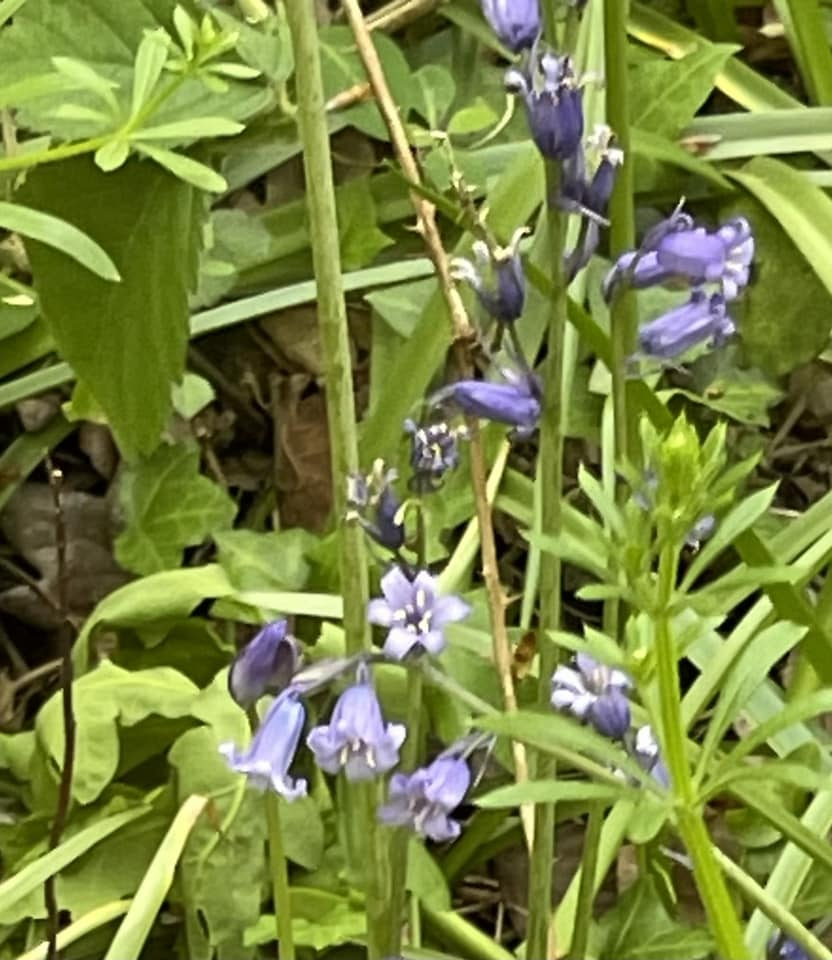
| Greenlandic Bluebells (Campanula gieseckiana
ssp. groenlandica) |
I found Greenland phenomenal because of the enormous
size and fluorescent blooms of its Greenlandic Bluebells (Campanula
gieseckiana ssp. groenlandica), the myriad shapes and shades of blue of its waters in fjords and
glacial lagoons and icecap meltwater lakes, and… the ferocity of its
mosquitoes.
 |
| Former World War II movie theater. Marlene
Dietrich sang there in person. |
Narsarsuaq is a former World War II U.S. military airbase. It was needed as a refueling stop for planes headed for battle in
Europe. American soldiers wounded in Europe received care at the base hospital
on their way home. The Narsarsuaq Museum tells the story with roomfuls of photographs,
news articles, documents, correspondence, military and medical paraphernalia,
and every-day objects. The runway and some original buildings still exist.
 |
| This is Narsarsuaq: a runway, a hotel, a supermarket,
a museum, a one-room school, four places to eat, and a tiny harbor (not in
photo)... Across the fjord, the current sheep farming settlement, Qassiarsuq,
and Erik the Red’s Viking ruins. |
A 15-minute boat ride across the fjord is the Viking
archeological site of Erik the Red’s farm, Brattahlíð, which is
part of a UNESCO World Heritage Site.
 |
| The most substantial Viking ruins at this
site: the wall stones of a Christian church, inside a turf fence. Other stones are
still aligned where house and barns once stood. Nearby replicas of a long house
and of an earlier, minuscule church are open to visitors. |
Erik the Red came from Iceland in 982 and later
established a Norse colony in what he named Greenland to attract more settlers.
South Greenland truly was and still is heavenly green.
After more than 400 years in Greenland, the Vikings
abandoned their settlements, but not until after the Thule ancestors of modern
Inuits had arrived. Then the area became uninhabited again for roughly 300
years, before sheep farming restarted and continued until now. This history is summarized
by tour guides and at the Narsarsuaq Museum.
 |
| The only musk ox we saw was on an appetizer
at the Hotel Narsarsuaq restaurant—dark, dried, and shredded atop raw scallops.
Edible wildflowers were picked outside the hotel and kept fresh with crushed
ice: a purple Greenlandic Bluebell (Campanula gieseckiana ssp. groenlandica), pink
Dwarf Fireweed (Chamaenerion latifolium), and yellow Greenland Buttercups
(Ranunculus auricomus). |
Today, guides lead visitors on foot or by boat or
helicopter, to the Inland Ice (Greenland Ice Sheet), glaciers, icebergs, viewpoints,
nearby towns, villages, tiny settlements, or more Viking ruins. Seeing musk ox,
a wild and woolly beast of the Arctic looking bovine but related to sheep,
would have been cool. But we would have had to research where locals might have
seen some, then hire a guide and a boat for a day… at a phenomenal cost.
 |
| Permanent nylon ropes helped us climb a
rocky slope. |
Instead, we took a photo of the trail map hanging in
the hotel lobby and went hiking past the ruin of the World War II hospital,
through Flower Valley, and up to one of several small lakes.
 |
| Kiattuut Sermiat, an average backyard
glacier, as seen from the trail |
We loved the exercise, the scenery, and our
mosquito-net jackets and headwear. Taking each photo two or three times was
enough to get one without mosquitoes parked on the camera lens, creating big blurry
blotches.
 |
| At the Polar-Tut Café: imagine thumping
music. |
For dinner at the Polar-Tut Café, we ordered from the
menu board, handwritten in English and Danish, the second language taught in
school (because Greenland is a constituent country of the Kingdom of Denmark). Reje burger is Danish for shrimp burger,
shrimp and fish being the top Greenlandic exports. Local Qajaq beer on tap came
in three shades: Doppelbock, Pilsner, and Dunkel.
After three richly satisfying days in Narsarsuaq, we
flew up the west coast to the capital, Nuuk (pronounced nuke). There are no
roads between towns in Greenland, so people get around by boat or plane. Clear
skies made flightseeing a highlight of our trip.
For more info
Extreme melting in Greenland is not the only problem
due to climate change: huge Arctic wildfires burned there and in Siberia, Scandinavia, and Alaska.
A U.S. World War II veteran pilot’s dramatic personal account of flying through Narsarsuaq