Monday, March 25, 2013

DINOSAUR NATIONAL MONUMENT: A Jurassic Treasure Trove

Excavating Apatosaurus vertebrae, Dinosaur National Monument, Utah
In 1908, Earl Douglass, a paleontologist from the Carnegie Museum in Pittsburgh, Pennsylvania, began to search the cliff faces and mountain ridges of eastern Utah for traces of dinosaurs.  He knew that fossilized bones had been found in similar places nearby in Colorado and Wyoming in a layer of sandstone rock called the Morrison Formation, which is found throughout this region and is a rich source of Jurassic dinosaur fossils.

The Morrison Formation was created between 145 and 135 million years ago.
A year later, on August 17, 1909, Douglass climbed to the top of a rocky ridge where wind and rain had washed away much of the dirt, revealing layers of older rock underneath.  He looked down and saw below him a neatly arranged row of dinosaur tailbones belonging to the huge plant-eating dinosaur called Apatosaurus. This discovery marked the beginning of one of the most spectacular dinosaur finds of the century.  Further digging revealed these bones to be the most complete Apatosaurus skeleton ever discovered.


Stegosaurus model, top; fossil leg and foot bones, below
In addition, the fossil quarry contained thousands of other bones belonging to at least sixty other dinosaurs.  Ten different kinds of dinosaurs have been identified from the fossils found in the quarry including more than half of all the known types of dinosaurs that lived in North America during the late Jurassic period. The bones removed from the quarry by Douglass and his crew were taken to the Carnegie Museum.  Later, other fossils from the quarry went to the Smithsonian in Washington, D.C. and to the University of Utah in Salt Lake City. 

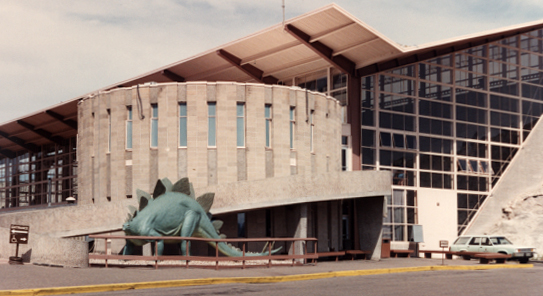
Quarry and Visitor Center, Dinosaur National Monument
The dinosaur quarry discovered by Earl Douglass is one of the most valuable sources of dinosaur fossils ever found.  In 1915, the United States government declared the quarry and eighty acres of the surrounding land to be a national monument.  In 1958, a visitor center was constructed at the quarry site.  It is now a museum and a place where visitors can view dinosaur bones and watch paleontologists at work. Nearly 1500 fossil dinosaur bones are visible in the cliff face enclosed by the museum! The park also includes camping and picnic areas and numerous hiking trails.


Hike in Hog Canyon, Dinosaur Nat. Mon.
In the summer of 1987, I visited Dinosaur National Monument to do research for my book Dinosaur Mountain (Clarion Books, 1989) and watched paleontologists scramble across the giant wall inside the museum where hundreds of dinosaur bones are still in the process of being excavated.  I also had a chance to visit an outdoor site and the laboratories where tiny microfossils are examined under microscopes. After I finished my research, my family joined me and we spent a week camping in the park.  While the Dinosaur Museum is the primary attraction, the hikes in the park are spectacular and the campgrounds are pleasant and not crowded.  We discovered petroglyphs on the canyon walls, watched deer and prairie dogs along the roadside, visited a fish hatchery, and watched people rafting down the Green River which flows through the park.  It was an ideal outdoor summer vacation spot with something for everyone.

Planning a Visit:  For more information and planning a visit to Dinosaur National Monument, go to the National Park Service website at http://www.nps.gov/dino/index.htm .

Monday, March 18, 2013

SAN FRANSICO BAY-DELTA MODEL, Sausalito, California

One of my favorite places in the San Francisco Bay area (and unknown to most people) is the Bay Model, a working demonstration of water flow in and out of San Francisco Bay and the Sacramento/San Joaquin Delta. Tucked along the waterfront in Sausalito, the Bay Model is located inside buildings that were part of a bustling shipyard during World War II.  (An exhibit on the main floor of the building displays photos and artifacts from the shipbuilding era.) 

Built in 1957 by the Army Corps of Engineers to test the impact of proposed changes in the Bay, the Bay Model spreads over 1.5 acres.  As you walk the ramps and platforms around the water, you can orient yourself by signs and the miniature bridges that connect the land around the bay–the Golden Gate connecting Marin County to San Francisco, the Bay Bridge crossing from San Francisco to Oakland on the east side and, to the south, the long San Mateo bridge over the shallow water of the tide flats.  Unlike in real life, in which the tide changes every twelve hours, the schedule of the model is speeded up so that the tide comes in and goes out every 14.9 minutes, whooshing through the Golden Gate and visibly creeping up the adjacent shores. It makes you realize the drama of this daily cycle and how important it is to people and wildlife along the shores.

Until about ten years ago, the Bay Model was used for scientific purposes, as a place where people made important calculations about water movement in San Francisco Bay.  Now, those calculations are done by computer and the model is no longer used in the same way for scientific research.  Instead, it has become an educational facility.  (I remember going to visit when it was a working model and watching scientists taking their measurements.)  The building has been recently remodeled (it was reopened in January 2012) and now has a handsome redwood entrance to the visitor center with a gift shop and art gallery.  In one corner is an amazing scale model of the Golden Gate Bridge made by a 14-year-old student as a 4-H project. Inside the main building along the walkways are photos, state-of-the-art videos, interactive displays, and explanatory panels telling about the history of the model, how it works, and the ecology of the Bay Area.  On the day I visited with a friend we did a self-guided tour, but ahead of us was a school group getting a tour with a docent.  Whether you go by yourself at your own pace, or with a group, it will definitely give you a new perspective on San Francisco Bay.

After our visit to the Bay Model we explored downtown Sausalito, had lunch at one of the many cafes in this popular tourist town, and then went to Fort Baker for a close-up of the real Golden Gate Bridge from below.

Visiting Information:
The Bay Model is at 2100 Bridgeway, Sausalito, CA 94965, telephone (415) 332-3870.  For directions, hours, and more information go to the website http://www.spn.usace.army.mil/bmvc/.

How do they make the tide in the model? To recreate the rising water level of a flood tide, more water is pumped into the Pacific Ocean area with less water allowed to flow out.  To model the falling waters of an ebb tide, less water is pumped in and more water is allowed to flow out.  A valve system controlled by a computer controls the flow of water.

Monday, March 11, 2013

LONDON IN WINTER: Museums and More, Part 2

Inner courtyard, Westminster Abbey, London
 (Continuation of previous post, my week in London, January 2013)

High tea at the Cranley
Tuesday– Went to Westminster Abbey.  At 16 pounds each (the senior or concession rate) it seemed expensive, but the self-guided audio tour, narrated by Jeremy Irons, is quite good.  And the cathedral is packed with history–it was consecrated in 1066 and has been going ever since as a center of the church and burial place for notables. We had lunch (pumpkin soup for me and a sandwich and ginger beer for Art )in the Cathedral café (which was nice and warm, compared to the church which felt nearly as chilly as the air outside.)  We then took the tube to Green Park to see Patrick Blanc’s vertical gardens on the Athenaeum Hotel, which are very impressive.  Our original plan was to take high tea there, but at 29 pounds per person, it seemed a bit steep, so we went back to our hotel where we ordered a delicious high tea for only 10 pounds per person.

Pinter Theater
That evening, we went to see Old Times with Kristen Scott Thomas at the Pinter Theater in the West End.  Afterward, we went back to our hotel, stopping at the Hereford Arms on Gloucester Road for a beer and crisps (potato chips).  Apparently the Hereford Arms is famous for its association with Sir Arthur Conan Doyle and for the American soldiers who turned the Hereford Square park across the street into a baseball diamond during World War II when they were stationed nearby.

Saatchi Gallery, once a military barracks
Wednesday– Walked to the Natural History Museum to see the dinosaurs.  Also saw an interesting exhibit of art from the first voyage to Australia (First Fleet) in a gallery devoted to art and science.  The museum was filled with school groups, some wearing green neon vests, others in suits and ties, and one group carrying note pads and wearing lab coats with “dinosaur scientist” printed on back. Then we met our friend Gretchen and went to the Bumpkin for lunch–I had a crispy duck salad (with pickled vegetables), Art had chicken pie again and Gretchen had a cheese tart.  We finished with sticky toffee pudding.  We then walked (about two miles) to the Saatchi Gallery in Chelsea where we saw two exhibits of Russian art and an amazing permanent installation on the ground floor that is a room covered with a layer of oil that perfectly reflects the posts and ceiling.  The effect is disconcerting.

Victoria and Albert Museum
Thursday– Walked to the Victoria and Albert Museum to see  Light from the Middle East, a photography show by Middle East and Asian photographers.  We made our way to a far corner of the museum to see the museum's permanent photography collection (a representative selection from the beginning of photography in 1846 to the 1970's) passing through countless halls of sculpture, ironwork, casts of famous artworks, including the huge pillars of Hadrian from Rome (prepared in the 1800s for students to copy), jewelry, and more.  According to a friend, the V and A is where they put everything that doesn’t fit into the other British museums. It has a random feel. We ate lunch in the café and spent another hour (I spent most of it in the Indian galleries looking at Hindu and Moghul miniatures and Art went back to the photography room.)

The next day was Art’s meeting and on Saturday we headed back to Heathrow for our flight to Los Angeles.  We had had a full and invigorating week in London.  And despite all the time we spent in museums, we only saw a fraction of the displays, so we always have a reason to go back.

Monday, March 4, 2013

LONDON IN WINTER: Museums and More, Part 1

British Museum of Natural History, London
Why go to London in January, when it is cold, wet, and dark?  As long as you dress warmly, carry an umbrella, and plan mostly inside activities, it is a terrific time to see this great city when it isn’t jam packed with summer tourists--and there are more exhibits, plays and concerts than you could possibly see in one visit.  We were in London for a week in mid-January, opting to stay in Kensington because of its central location.  Here are some highlights from my diary:

The Cranley Hotel, Kensington, London
Saturday-- We arrived at our hotel, the Cranley, at about 8:30 pm, after walking through light snow from the Gloucester Road tube station. Checked in.  Very genteel--living room with fire and drinks available.  The desk person made a reservation for us for 9:30 at the Bumpkin, a pub about five minutes down the Old Brompton Road.  The dinner was surprisingly good.  Fresh organic food.  Art had a chicken pie and I had squash with brown rice risotto.  We also ordered an onion tart as an appetizer–an artfully presented slab of pastry, red onions, topped with cheese.  We had no room for the sticky toffee pudding on the menu.  Maybe we’ll go back. (We did.)

Statue of Charles Darwin, Museum of Natural History
Sunday– We walked to the Natural History Museum, on Cromley Road, about 10 minutes away and got tickets for the wildlife photography show–100 stunning prize winning nature photos, including a number of penguins photographed underwater by Flip Nicklin (seen in the recent National Geographic.)  On the way to the show we passed the ichthyosaurs and plesiosaurs found by Mary Anning. [See my post for Feb 11.] After lunch in the museum cafeteria we went to see the statue of Darwin, who presides over the main hall.  At the other end is a giant sequoia slice, brought from CA in the late 1800's, and nearly 2000 years old. That evening we went to a piano concert at Wigmore Hall.

Easter Island Moai
Monday–Took the tube to Kings Cross, walked to a pub called The Driver to see the  Patrick Blanc vertical gardens, then stopped for a Cornish pasty and sausage roll at the station for a late lunch before going to the British Museum.  The entrance hall there is huge, and filled mainly with an enormous gift shop.  First we went to see the Easter Island moai, (made of basalt so the details of the carvings on the back were especially fine).  We then went upstairs to view the mummies, and spent most of our time in just two rooms–all the Egyptian rooms extend across the width of the museum.  Our last stop was to see the Elgin Marbles on the main level.

(Continued next week.)

Monday, February 25, 2013

MOUNTAIN VIEW CEMETERY: in Oakland, CA--Bankers, Chocolate Kings and Ordinary People

View of Mountain View Cemetery from the Fish Nichols plot
On a recent sunny afternoon, I visited Mountain View Cemetery in the Piedmont area of Oakland in search of the grave site of Juliet Fish Nichols, the lighthouse keeper on Angel Island from 1902 to 1914.  I had learned about her last summer on a trip to Angel Island and about her heroic efforts to keep the fog bell ringing on a very foggy night in the summer of 1906 after the devastating San Francisco earthquake. (See my post for July 30, 2012.)  After retiring, she returned to her home in Oakland where she lived until she died in 1947. She is buried in the cemetery alongside her husband, father, and mother.

Mausoleum of Charles Crocker (1822-1888) founder of Crocker Bank
I found Julia's tombstone in the family plot, high on a hill with a spectacular view and a host of impressive neighbors–Charles Crocker of Crocker Bank, Domingo Ghiradelli, the “chocolate king”, Julia Morgan, California’s first woman architect, James Folger, the coffee producer–and many more of the people who are integral to California’s history.  Luckily, we  had picked up a brochure at the park office near the entrance on our way in along with a guide to the cemetery and the graves of some of its notable residents--a kind of crib-sheet to local history.

Crocker's tomb, upper left; Samuel Merritt, right, with pyramid on top
The brochure also included a brief history of the building of the cemetery, which was designed by the well-known landscape architect Frederick Law Olmstead, the designer of Central Park in New York City. In 1863, Olmstead was in California writing a report on Yosemite in an effort to convince Congress to make it into a national park.  The city of Oakland, rapidly growing on the East Side of San Francisco Bay, had bought 220 acres of land for a cemetery in the Oakland hills and invited Olmstead to create a design for it, which he did.  His design, an elegant blending of art and nature with majestic avenues, winding roads, shaded paths and inspiring vistas, among beautiful plantings of trees and flowers, became one of the most prominent garden cemeteries in America.

Avenue leading to top of hill
On the day we visited we saw some families tending graves, but the cemetery is so large that as we drove up the hill to find Juliet Nichols grave, we encountered few people and were aware mainly of the quiet and peacefulness of the site.  When we got to the top, we had stunning views of San Francisco and the whole Bay Area.  We were there in December and the entrance of the cemetery was decorated with a large nutcracker figure for the holidays and inside they had a special display of holiday lights.

You can take free docent led tours of the cemetery at 10:00 a.m. on the second and fourth Saturdays of each month. For more information about visiting Mountain View Cemetery and learning about its historic residents go to  http://www.mountainviewcemetery.org/.

Sunday, February 24, 2013

25,000 Views of The Intrepid Tourist

As of today, the counter has ticked over to 25,000 views of The Intrepid Tourist since I launched the blog in April 2011! When I started, I wasn't sure that anyone out there would be interested in reading my posts.  Apparently there are!  My thanks to all of you who have been reading The Intrepid Tourist!  According to the Blogger stats, 10,000 of your views have come from the United States, 2000 from Russia, 1400 from United Kingdom, and significant others from Canada, Ukraine, Germany, France, Australia, India, Poland, Taiwan, Sweden, Japan, Italy, Denmark, Norway, New Zealand, Singapore and Turkey. (It varies from day to day, so I am sure there are more countries not currently listed.)  I am gratified to be reaching such a wide audience.  You can look forward to more weekly reports!

Monday, February 18, 2013

Eagles in Iowa and Other Birds of Prey, Guest Post by Barbara Siebenschuh

Bald Eagles, along the Iowa River near Iowa City, Iowa
My friend Barbara Siebenschuh, classmate (Grinnell College) and roommate (University of Iowa), who still lives in Iowa City, recently went out on a cold winter day with two friends to look for bald eagles.  In winter, bald eagles gather, often in large groups, along the rivers and lakes of Iowa, where they hunt for fish.  I think you will enjoy reading her report.
 
On Saturday, I went with two friends to look for bald eagles and other birds. We were going to watch from observation areas in Muscatine, Iowa, and from our car, because it was soooo cold out. Our day began with a bang when we stopped in Iowa City near the recycling area and could see a "cluster bomb" of bald eagles in the trees near the Iowa River. Some were flying but most were just hanging out. Al got out and took pictures because we were on the other side of the river from the birds--otherwise the birds can get spooked. We proceeded to an area near the Iowa River in Hills, Iowa, and were still seeing birds. 
 
Barn Owl
Then we took off for Muscatine to a place near the Mississippi River. When we arrived, there was an "Eagle Watch" event. Not only could people be inside or outside, but sheltered, to watch eagle activity on the river; there was also a lecture being given with actual birds of prey. We missed the horned owl talk, but we saw a barn owl, a peregrine falcon, and a bald eagle. These birds were rescued from injuries and most cannot fly. They were magnificent none the less.
Bald Eagle

The handler of the eagle, who was from Wildlife Prairie State Park in Illinois, said all these birds tolerated humans but were not tamed or trained. The eagle was huge. One of his wings was deformed. The handler could never touch him or the eagle would rip at him. His beak can snap chicken bones into three or four parts. It was "mutual trust" that the handler would not touch the bird and the bird had never bitten him. Owls and other birds had bitten the handler though. While the talk was being given, each bird was sitting on the handler's arm, which was covered with a big glove.
The eagles were from a sanctuary in Illinois. We learned that the bald eagles got fish in the a.m. and a rat at night. One day a week they were not fed, as this mimics their life in the wild.  The mostly eat prey four pounds or under; so small cats and dogs are potential prey if the animals are small sized. Eagles soar the highest and have wonderful sight.
Peregrine Falcon
We were mesmerized at this live demonstration. The peregrine falcon was a lot smaller but we learned interesting facts about his coloring, big eyebrows, and speed. (They can dive at speeds up to 200 mph!) After the show, we could get a bit closer. It was awesome.
We then went to Davenport, Iowa, and to Credit Island Park where we saw more birds as we drove out of the park. Staying in the car, we were about twelve feet from bald eagles, who stayed in their trees, probably because we did not get out of the car. In areas where there was a lot of open water we saw eagles swooping to catch fish; where there was more ice but holes in the ice, eagles sat there dragging fish out when they could. Along the way we also saw hawks, gulls and blackbirds - but no wild turkeys.
It was really a neat outing.

Eagles near the Iowa River in Iowa City, Iowa
 We thank Al Persson for the wonderful photos of eagles and the other birds.